








Trump waved his hand, stirring up a gaming hurricane in Venezuela
TechFlow Selected TechFlow Selected
Trump waved his hand, stirring up a gaming hurricane in Venezuela
Venezuelans, RuneScape, cryptocurrency—these three elements were once so intensely intertwined, forming a story about survival and escape.
 Navigating Web3 tides with focused insights
Text: Cookie, BlockBeats
You never know where a hurricane might land after a butterfly flaps its wings.
Nine days after the United States launched a raid on Venezuela and arrested its president, Maduro, a game called RuneScape made history once again. On that day, RuneScape's concurrent player count exceeded 258,000—the highest in the game’s 25-year history.
Two seemingly unrelated events were magically connected.
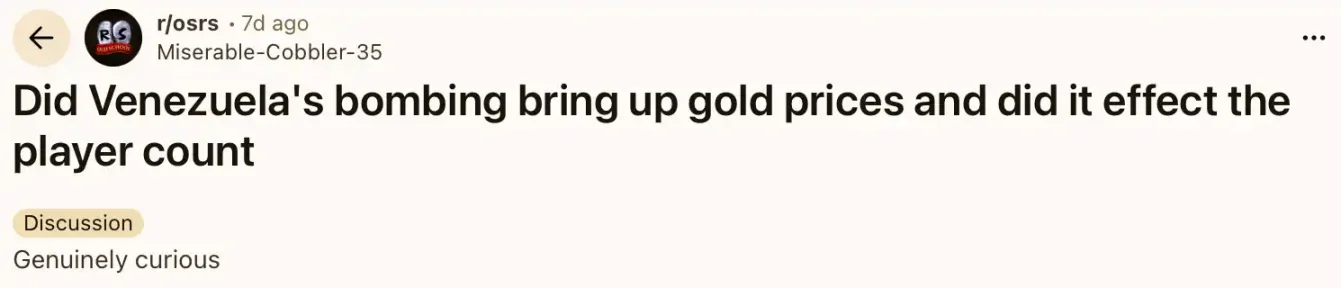
“Could the U.S. attack on Venezuela lead to rising gold prices and changes in player numbers in RuneScape?”
While the world watched international oil prices or Venezuela’s stock market amid political turmoil, RuneScape players were closely monitoring in-game currency values, commodity prices, and shifts in player counts.
If Maduro’s departure from Venezuela marked the end of an era, then the exodus of Venezuelan players from RuneScape also signaled an ending.
The end of an old era only means history moves forward—relentlessly and indifferently—but it doesn’t necessarily herald new hope. Venezuelans, RuneScape, and cryptocurrency—these three elements were once intensely intertwined, forming a story about survival and escape.
Survival
Thanks to oil, Venezuela was once one of South America’s wealthiest nations. But starting in 2013, its economy began to collapse.
The collapse snowballed like an avalanche rolling down a mountain—growing larger and faster over time. Between 2013 and 2021, Venezuela’s GDP declined by approximately 75%–80%, marking the worst non-war-related economic collapse globally in the past 45 years—surpassing even the Great Depression in the U.S. and the disintegration of the Soviet Union. By 2021, 95% of Venezuelans lived below the poverty line, with 77% in extreme poverty.
In August 2018, just before Venezuela revalued its currency, the bolívar, annual inflation had already exceeded 48,000%. Within just four months, the black-market exchange rate for bolívars against the dollar plummeted from 1 million to 1 to roughly 7 million to 1. Banknotes became worthless.
Amid this deteriorating reality, Venezuelans discovered RuneScape. At that time, the exchange rate for Old School RuneScape (hereafter OSRS) in-game gold was around 1–1.25 million gold per dollar—far more valuable and stable than the bolívar.
Although OSRS officially launched in 2013, it was actually a fork of the August 2007 version of RuneScape. The game’s developer, Jagex, attempted to revive dwindling player interest and counter backlash over updates by reintroducing the classic version.
This effort unexpectedly succeeded, fueling OSRS’s growth and ensuring the longevity of the RuneScape franchise. It also carried a fateful significance: as a legacy version playable directly through web browsers with minimal hardware requirements, it allowed masses of Venezuelan players to flood in, working within this virtual world to survive in the real one.
On YouTube, there’s a video from February 2018 showing someone playing OSRS on a Canaima laptop with only 2GB of RAM. In the 2010s, the Venezuelan government distributed millions of free Canaima computers to students to support education.
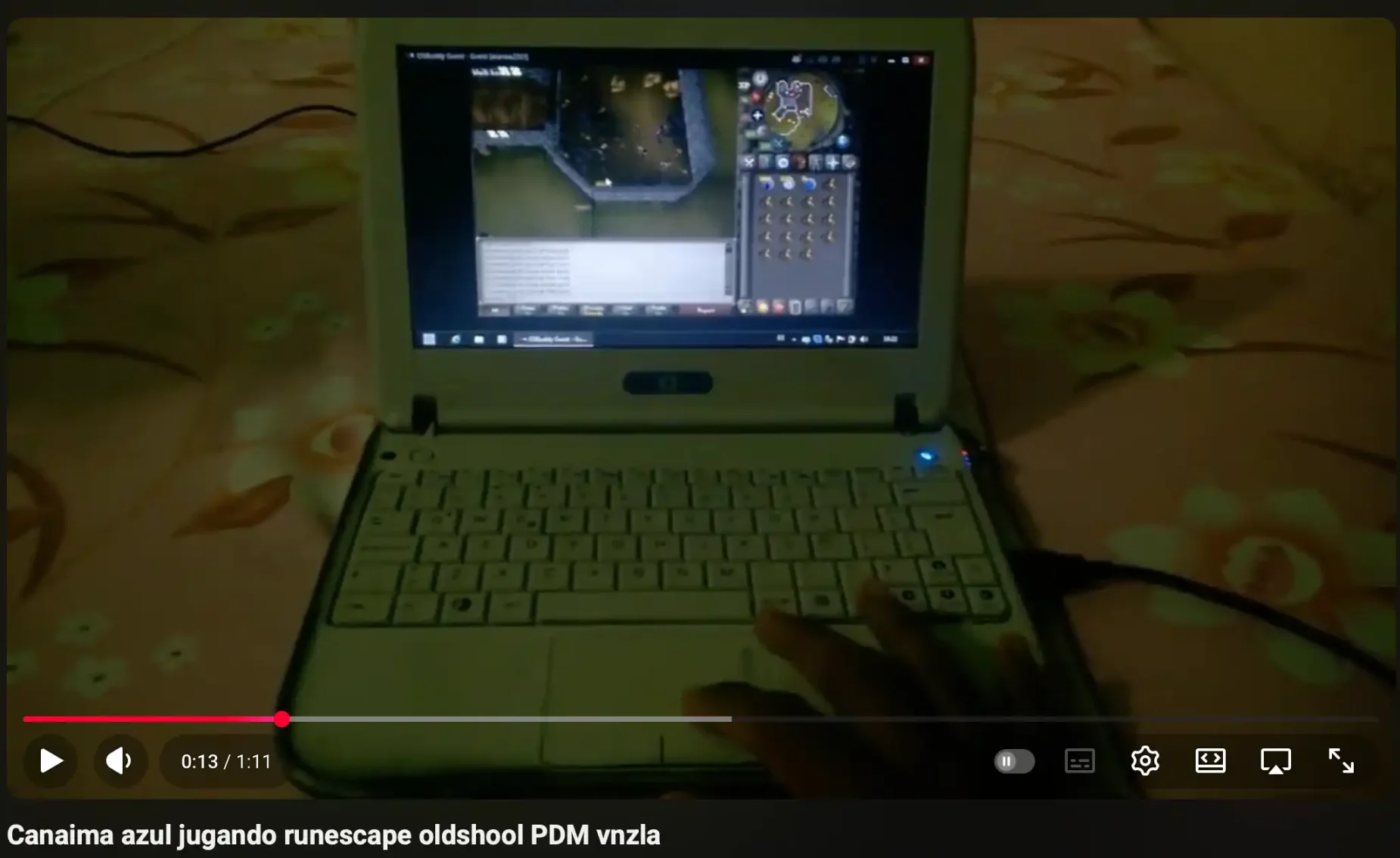
Who would have thought that while knowledge failed to help these children change their fate amid national decline, this underpowered machine gave them a breathing space when facing life-or-death struggles?
Venezuelan players had begun using OSRS to earn a living as early as 2017, if not earlier. That September, a Reddit post teaching other OSRS players how to hunt Venezuelans in the game’s “Eastern Dragon Zone” went viral—and later became a significant meme in OSRS history:
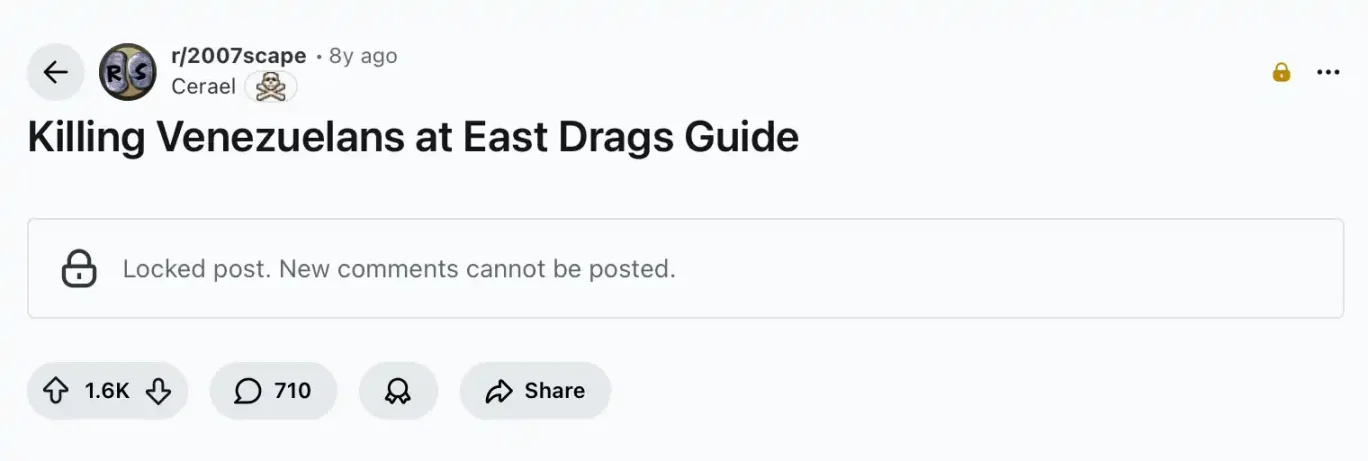
The “Eastern Dragon Zone” refers to the eastern part of the “Graveyard Hunter” area in OSRS, where green dragons spawn. Between 2017 and 2019, Venezuelan players crowded into this spot. They repeatedly slaughtered dragons, selling the dropped dragon bones and hides on RuneScape’s trading market to earn in-game gold, which they then converted into Bitcoin or other cryptocurrencies for real-world income.
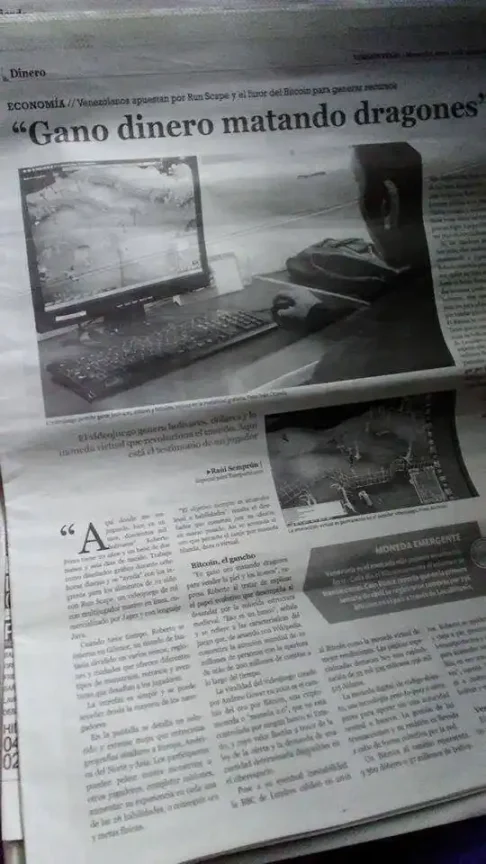
According to an article published in August 2017 by Steemit user “fisherman,” farming green dragons could yield 500,000 OSRS gold per hour—about $0.50. This method of earning money even made headlines in Venezuelan newspapers:
High-level players hunted a winged giant serpent boss named “Zulrah,” increasing hourly earnings to $2–$3. This wage already surpassed what most university-educated people earned in Venezuela.
A few years ago, during the peak of Venezuelan gold-farming activity in OSRS, several English-language media outlets interviewed them. Most interviewees reported monthly earnings of $100 or more from OSRS—while their parents earned only around $10 per month. To them, OSRS was highly recognized among Venezuelans and could be considered a mainstream way to make money—enough to support their entire families and shield their hard work from the devaluation of the bolívar.
Just as foreign domestic workers fill labor gaps in household tasks in Hong Kong, Venezuelan players in the OSRS world filled the need for tedious, repetitive monster grinding and resource gathering. Besides hunting dragons, serpents, and deer for materials, they also took on jobs such as skill leveling and crafting items for others. However, unlike domestic workers in Hong Kong who can casually gather for coffee on the streets, Venezuelan players couldn’t appear so openly. Due to Jagex’s crackdowns on real-money trading of in-game items, they operated much like cryptocurrency users employing burner addresses to avoid phishing risks—using multiple burner accounts to evade bans.
In March 2019, Venezuela suffered a nationwide blackout. For those days, the green dragons lost their most loyal hunters, causing a sharp drop in the supply of dragon bones on the market—and prices surged accordingly.
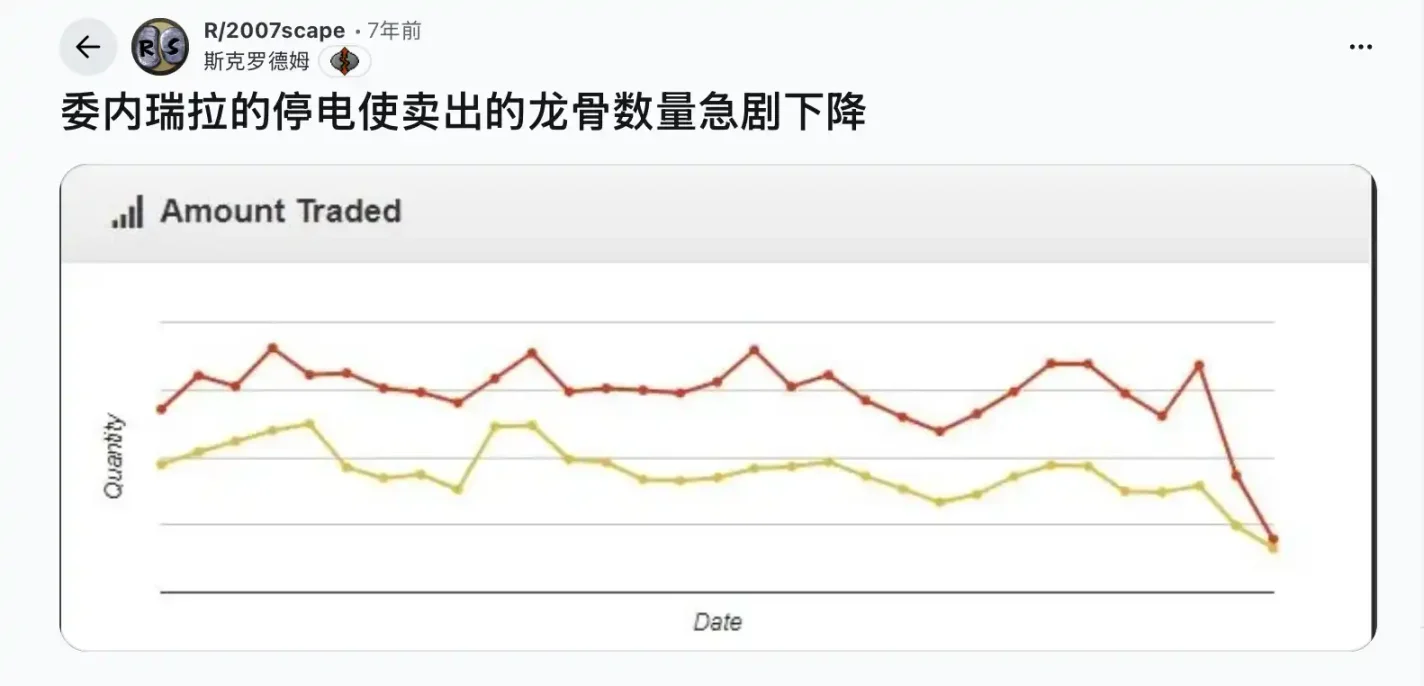
Player attitudes toward these Venezuelan gold farmers were deeply ambivalent. On one hand, most were genuine manual players—unlike players from other regions who could afford botting operations, they earned gold fairly through gameplay identical to others, solely for survival. Sometimes, casual players even felt that the presence of Venezuelans improved their gaming experience, allowing them to enjoy desired content without spending heavily.
On the other hand, profit-driven activities inevitably affected normal gameplay and the game’s economy. The actions Venezuelans took in OSRS for real-life survival ended up impacting the survival of the OSRS world itself. For years, debates raged on Reddit, filled with both anonymous hostility and unexpected compassion.
Until, the Venezuelan players left.
Escape
Today’s OSRS world speaks only of Venezuelan legends—no longer seeing the gold farmers of old.
Starting in 2023, Venezuelan players gradually departed from OSRS. While Venezuela’s economy remained broken, the price of OSRS gold also fell. Relentless, tireless bots entered the scene, competing directly with manual Venezuelan players. OSRS gold production surged, driving prices steadily downward. Currently, the exchange rate stands at approximately 1 million OSRS gold for $0.16–$0.20.
For Venezuelans, gold farming didn’t stop—it simply moved to more profitable grounds. They shifted to games like Tibia, Albion Online, and World of Warcraft, continuing to seek real-world livelihoods within virtual worlds.
Yet some inevitably ask, “Is this really the right way to live?” And so, some players decisively left not only these virtual worlds but also their home country.
According to recent data from early this year, around 7.9 million Venezuelans have fled the country—one of the largest refugee crises in Latin American and global history. In English-language media, we find interviews with Venezuelans who used OSRS earnings to escape their homeland.
José Ricardo, an OSRS gold middleman, made profits by buying and reselling in-game gold. A few years ago, he earned between $800 and $1,200 monthly. He invested those profits into cryptocurrency and used the funds to vacation in Brazil, Colombia, and Trinidad and Tobago. Though he still lives in Venezuela, it’s no longer his only option—he refuses to let his life remain stagnant in one place or one pursuit.
Victor Alexander Rodriguez decided in early 2017 to play OSRS for 14 hours daily with his sister to supplement their family income. From the start, they agreed: “One day, we’ll leave.” Through joint efforts, they saved $500 and moved to Peru in 2018. Later, he became a security guard, earning more than he ever did farming gold in OSRS. During downtime, he occasionally returns to OSRS via mobile—but now, he truly plays for enjoyment.
But not every escape story ends well. Bran Castillo once recounted a friend-of-a-friend’s experience—someone who earned enough through OSRS to reach Peru, continued farming gold there, but found the income sufficient in Venezuela yet inadequate in Peru. On Reddit, Venezuelan players once explained this: although public services in Venezuela were poor (the most absurd being first logging into OSRS via mobile data because broadband copper cables had been stolen), they were largely free. Their earnings mainly covered basic food and shelter.
There are even darker rumors—of Venezuelan female OSRS players who, after fleeing the country, found themselves unable to survive and turned to sex work…
OSRS players share a creed-like saying: “This game never ends. You don’t leave—you just take a break.”
And the most touching blessing I’ve seen is this: “I hope one day, none of us will have anything to worry about beyond the joy of the game—just enjoying it.”
Conclusion
The ties between Venezuela and the cryptocurrency industry are numerous and profound. Today, we eagerly discuss the potential scale of Maduro’s regime holding up to 600,000 Bitcoins, deeply analyze why Venezuela’s once-launched “Petro” coin failed, and study how USDT has become the de facto local currency shaping everyday economic life...
But this time, when we sought out human stories rather than macro-industry phenomena, we saw how cryptocurrency and a 25-year-old game helped Venezuelans survive. Entangled in virtual worlds, exchanging emotions and battling monsters—all for survival in reality, or to escape a cursed fate.
Without cryptocurrency overcoming geographical, linguistic, and cultural barriers—uniting vast value consensus worldwide and providing a globally trusted foundation for settlement—the story of OSRS and Venezuela might never have happened.
Whether barely sustaining crumbling lives in virtual worlds or escaping both virtual and real realms in search of new hope, these seemingly mundane personal choices have in fact driven industry progress.
Their stories fade into the distance within OSRS, and they pass quietly through the cryptocurrency world like outsiders—yet they embody the true hardship and struggle behind the industry’s advancement.
Join TechFlow official community to stay tuned
Telegram:https://t.me/TechFlowDaily
X (Twitter):https://x.com/TechFlowPost
X (Twitter) EN:https://x.com/BlockFlow_News
 BlockBeats











