








Giving Money Freedom: Information Flow from Binance to Twitter
TechFlow Selected TechFlow Selected
Giving Money Freedom: Information Flow from Binance to Twitter
Give money freedom, give information a price tag.
 Navigating Web3 tides with focused insights
Text by: Zuoye
The economy has consumed society, technology has distorted the economy, finance has become the target of technology, and Memes have极致虚无化 financial systems.
Every era’s great wave leaves behind either gold or sand. From .ETH domains to tutorials on rapidly gaining followers with "Yap," all are eventually washed away into oblivion by time—especially in the cryptocurrency industry, where content monetization cycles are exceptionally short.
Yet what I observe is only fragmentation—the separation of information flows from capital flows. Public chains divide along user bases, Memes isolate themselves from interconnectivity, and only entropy increases forever.
Revolutionary times unlike any before in the history of financial evolution have made the following conditions commonplace:
- In typical crypto contexts, information is fated to become a tradable commodity;
- Nation-states are reclaiming authority; no investment vehicle can transcend political boundaries;
- Preservation lies in lossless transmission—information flow severely undermines fundamental commercial value.
Binance Square’s frantic traffic acquisition masks an underlying anxiety about high-energy Meme mining. Twitter’s seizure of financial traffic is similarly short-sighted, perpetuating the entanglement between capital and information.
Separation Anxiety: The Break Between Information and Capital Flows
Unable to integrate into the global order, Binance can only continuously update and maintain its commercial value.
If one understands early crypto history, there should be no surprise at ICOs or Chinese Memes—they were indeed precise, almost predestined wealth-generation movements, as long as you moved faster than those who came after.
Back in 2017 it was reaction speed; in 2026 it's network speed.
This isn’t irony. Speculation and creation have always coexisted. Bitcoin evangelists reaped fame and fortune—even becoming sources of hype themselves. Stories of going all-in on EOS or selling ETH too early now surface as nostalgic tales among old friends late at night, sparking viral moments on Twitter.
Nostalgia reflects an implicit acknowledgment of information preservation. Celebrity narratives often strangely align with current tickers—from Kuaiwan’s Wang Xin to YZi Labs’ Happy Sci Meme. I believe they don’t need such profit-driven tactics, yet often feel powerless to avoid them.
Binance’s embrace of Memes is merely a timely shift in marketing strategy. Its “Binance Angels” are far more aggressive. What truly puzzles me is why Binance, already dominant atop the CEX ecosystem, insists on staying grassroots, manufacturing traffic and illusions of instant wealth.
Take Binance as an example: the entire exchange and industry face deep-seated anxiety over the separation of information and capital flows.
Since Kaito, per capita information intake has exploded, while quality plummets. By the end of Vibe Coding, the overseas-shifted content base built since 2021 had completely vanished. Shifting toward AI or general traffic is merely a survival tactic.
Four years after new entrants stopped joining the space, the battle for traffic and internal trading friction can no longer sustain growth. For KOLs, media, and exchange employees living abroad, accessing external networks is effortless. But for retail investors who actually bear losses, this gap might as well be a chasm.

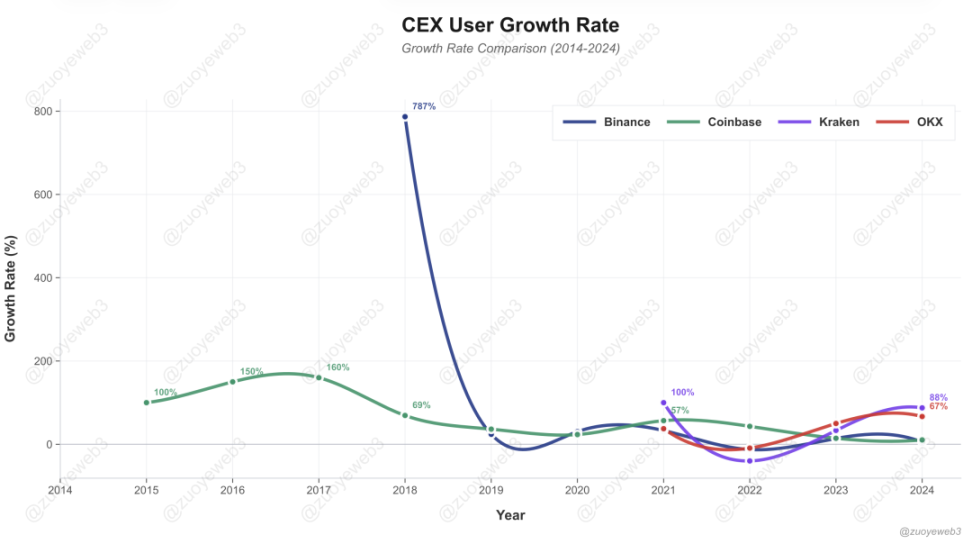
Image caption: The End of Growth
Data source: @_businessofapps
Long-term growth for exchanges has ended—and will not return. The industry’s core issue is traffic anxiety stemming from insufficient user acquisition. Everyone inside and outside knows about crypto, but trading enthusiasm continues to wane.
The more pronounced this trend becomes, the harder subsequent data growth becomes. This is precisely why Binance aggressively pushes BSC: on-chain users are now crypto’s final source of incremental customers. Next comes the challenge of mainstream adoption.

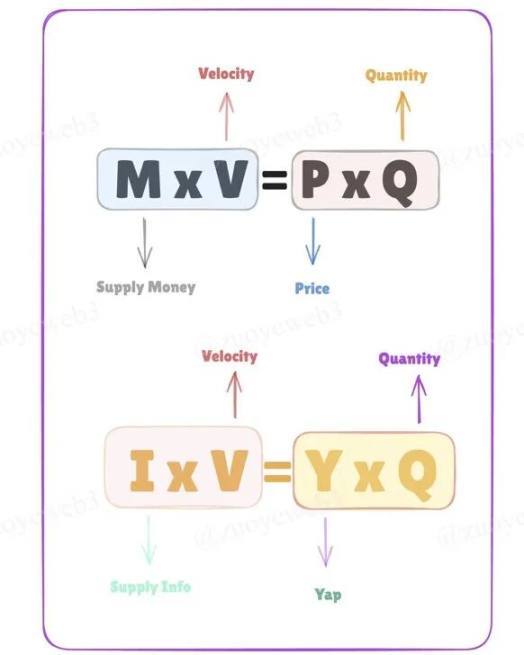
Image caption: Theory of Cryptographic Information Quantity
Image source: @zuoyeweb3
Drawing from Irving Fisher’s quantity theory of money, we can propose a quantity theory of cryptographic information: Information supply × velocity of opinion circulation = exposure per project × total number of projects within a given timeframe. Let’s use this to understand how the crypto information network actually functions.
During Irving Fisher’s time, U.S. dollar inflation remained unresolved—eventually leading people to embrace the gold standard, the Great Depression, and WWII. If you think Memes and Yap make crypto hopeless, here’s some good news: at least it’s better than another world war.
Within a certain period—for instance, when observing the launch of XX Foundation and its massive funding announcement—everyone, including retail investors, recognizes the pre-listing phase. At this point, research articles, hype posts, and interactive content around the Yap project surge explosively, increasing information liquidity. You could say the velocity of information circulation accelerates rapidly—but “effective” information becomes inversely proportional to V/Y/Q in the chart above.
Closed Information Loops, Free Flow of Capital
Under macro-financial inflation, spending money and spreading information are nearly indistinguishable.
If I dislike Binance, can I still use it? Can I still trade coins listed on Binance?
In fact, Binance doesn’t like the crypto community either. Musk doesn’t care about Binance’s feelings, and He Yi clearly dislikes Chinese content—but none of this prevents collaboration. Qualified investors are accountable for returns, not personal preferences.
Today’s crypto industry no longer debates its ultimate dreams—decentralization and privacy protection—instead focusing on which Meme Shandong School or a16z favors more. East doesn’t laugh at West; infrastructure doesn’t envy applications.
Moreover, with coordinated support from on/off-ramps, CEXs, and crypto banks, free movement of capital has become normal. Yet CT (Crypto Twitter) traffic declines daily. Information collapse appears everywhere. Crypto circles discuss AI, U.S. stocks, robotics, and commercial spaceflight—but almost no one cares about crypto’s future.
Interaction between information and capital is not rare—it’s increasingly common:
- Information races: Extreme bot accounts aren’t scripts, but endless human GMs and account-spinning guides;
- Exchanges: Aster’s human-bot competitions, Nof1’s LLM pump contests—all vying for crypto attention.
The real difficulty lies in converting information into capital flows. From every trading product to buyback mechanisms, the emphasis is on aligning capital with users’ information preferences. The extreme case is Hyperliquid’s Builder Code with transparent commission rebates.
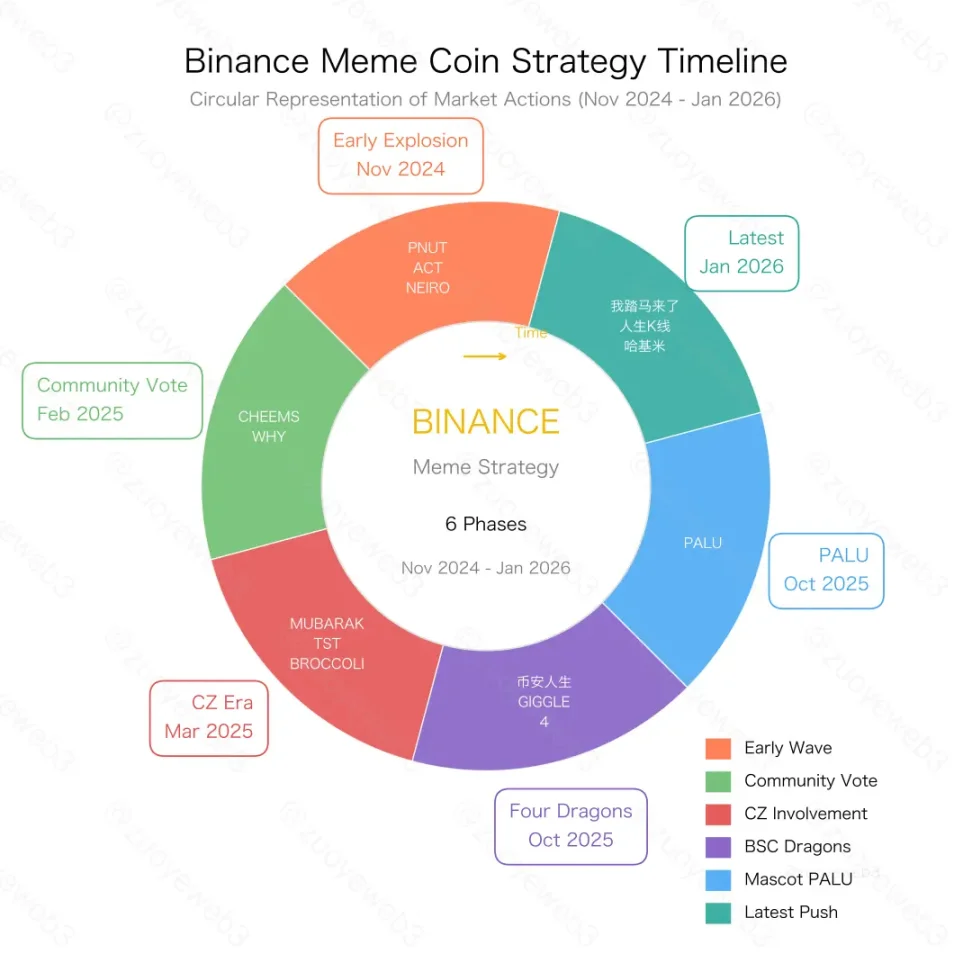
Image caption: Binance Meme Campaign Timeline
Image source: @zuoyeweb3
Most rebate schemes cannot be directly linked to information dissemination—not because exchanges can’t trace rebate sources (OKX banning user rebate accounts proves otherwise)—but because trades are genuinely tied to KOL content?
The medium is the message; rebates are the content.
Combined with the IV=YQ formula, we can roughly map information distribution chains and confirm that certain KOLs do possess strong order-pushing power—but we still can’t determine whether a KOL’s content preference drives transaction growth.
Understanding this reveals the intermediate stage of capital flow—but we cannot track every node of information flow. Official trending topics, recommendation algorithms, and regional language biases all contribute to virality. Memes thus become unpredictable “vibes.”
Hence, exchanges like Binance enter marketing directly—acquiring traditional crypto media and KOLs. Paid promotions aren’t for user acquisition, but to maintain comprehensive, systematized distribution channels. At its extreme, this model sees both Binance founders personally promoting Memes—consistently and repeatedly.
This resembles Irving Fisher’s equation: under traditional monetary frameworks, cash circulation velocity cannot be precisely calculated. Similarly, amid CT’s information noise, we cannot accurately measure effective information or its circulation speed. Statistical methods may extract insights from KOL agency data—but ultimately, these dissolve into CEX or DEX trading records.
Perhaps this is the root of Binance’s anxiety. Information originating outside Binance isn’t unusual—but losing control over information flow means Binance cannot precisely assess trading effectiveness. This framework also explains the fading impact of listing announcements.
Remember, traffic isn't just about entry points—it's where discourse forms, amplifies, and crisis management unfolds. The entanglement of information and capital constituted the essence of the CEX era. Now, this monopoly is being taken from them.
First is “re-nationalization” following globalization’s failure. Regional power centers are expanding again. Chen Zhi couldn’t protect himself with Cambodian citizenship or noble titles. The so-called “Crypto King” hiding in the Middle East will face even stronger sovereign crackdowns.
Second, public chains + exchanges once formed the strongest info + capital network. Whether RWA, stablecoins, or Memes sat atop didn’t matter—the key was a closed loop from information to capital, enabling fees to continuously feed the ecosystem.
But product evolution may bring a tectonic shift unseen in a decade: On one hand, we must prepare for billion-user-scale product transitions; on the other, the entire crypto industry risks being backend-ified and losing its brand identity.
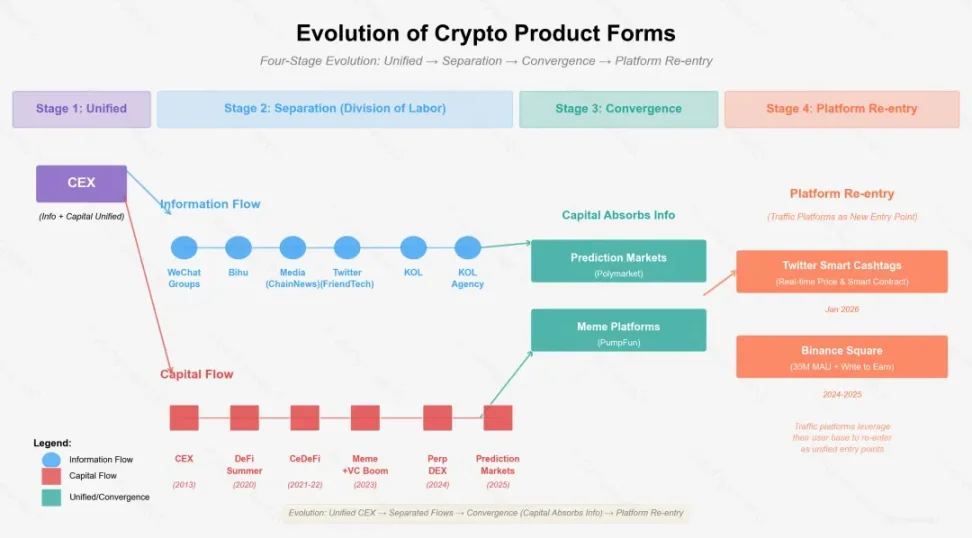
Image caption: Evolution of Crypto Products
Image source: @zuoyeweb3
Starting with CEXs as the origin of traffic and capital, we seem to be undergoing a classic four-stage cycle:
1. Unification: CEX
2. Separation (social specialization)
- Information flow
- Capital flow
3. Homogenization (capital leads information)
- Prediction markets
- PumpFun
4. Reconfiguration: X aims to become the gateway for financial products
When Musk acquired Twitter, he admired WeChat’s Super App model—a dream unfulfilled after losing X.COM to Peter Thiel’s PayPal. In reality, WeChat’s move into finance isn’t as smooth as public-platform logic suggests. Human relationships are mostly peer-to-peer. Looking at Western financial products, no integrated finance<>social giant exists yet.
I view Twitter’s integration with crypto and CEXs as a failed expectation—one where low expectations breed greater hope.
A more intriguing perspective is that Twitter is reverting to traffic-first-crypto rather than crypto-first-traffic—a step backward. We once believed DeFi, represented by DEXs, would eat the world like the internet. But in reality, stablecoins still need broader merchant adoption, and BTC has fully become a pale imitation of gold.
Conclusion
Speech is power; traffic is leverage.
A beginning usually only reveals the existence of another beginning.
From the initial consolidation of information dissemination and capital interaction by CEXs, we are now entering a classic phase of separation—where shouting trades and following orders constitute everything. High-quality content no longer needs to drive traffic, or rather, quality content is no longer the starting point of all things.
Finally, the reverse process—capital directing information—is even harder. Most projects cannot initiate from here. Only perhaps the U.S. stock market’s “Magnificent Seven” achieve this effect. If the crypto industry loses its ability to set agendas and is left with only internal capital games, crypto will become a dying island, fading into silence.
Even if confined within a nutshell, Binance remains king of an infinite universe—until Musk’s dark X arrives, ushering in truly world-class mainstream products.
Join TechFlow official community to stay tuned
Telegram:https://t.me/TechFlowDaily
X (Twitter):https://x.com/TechFlowPost
X (Twitter) EN:https://x.com/BlockFlow_News
 @zuoyeweb3










