








Crypto enthusiasts fortune-telling with K-line charts
TechFlow Selected TechFlow Selected
Crypto enthusiasts fortune-telling with K-line charts
Metaphysics is no longer a fringe culture, but a widespread psychological need.
 Navigating Web3 tides with focused insights
By: San, TechFlow
AI fortune-telling is nothing new—face reading, picking mahjong seats, you name it.
But crypto circles play differently—turning fate into K-line charts.
On December 13, a blogger focused on crypto mysticism, @0xSakura樱花, launched something new: an app called "Life K-Line."
Input your birth details, and AI generates a K-line chart from age 1 to 100 based on your Bazi (Four Pillars), with red and green candles mapping your life's fortunes.
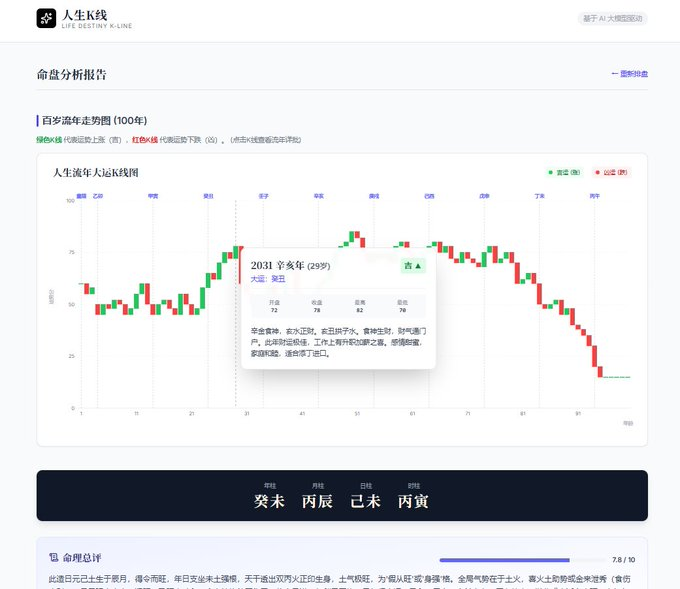
It blew up on Twitter. The debut tweet surpassed 3.3 million views, and within three days, website visits and API calls exceeded 300,000. People started sharing their charts wildly, many claiming the generated K-lines closely matched their real-life trajectories.
Even more surreal? A namesake meme coin for this tool, clearly labeled "for entertainment only," appeared within 24 hours of launch.
Why did such a playful fortune-telling tool strike such a deep chord in crypto?
Beneath lies the undercurrent of trading mysticism—and a collective release of anxiety unique to crypto culture.
The Mystics of Trading
Crypto traders believing in mysticism isn’t surprising. Wall Street’s no different.
W.D. Gann was one of the most famous market analysts of the 20th century and deeply integrated astrology into technical analysis, using horoscopes to predict markets.
Soros admitted in *The Alchemy of Finance* that he gauged market risk by the severity of his back pain—intense pain signaled an impending market reversal.
Yet these stories long remained “legends.” Few publicly admitted using mysticism to guide trades.
You could privately set feng shui layouts, wear lucky charms, or consult masters—but peers couldn’t know, or you’d be seen as unprofessional.
Crypto broke this taboo.
In an industry already steeped in mystery, mysticism feels natural. Some forecast BTC’s yearly trend via astrological charts; others decide whether to open positions based on daily horoscopes.
Mystical discussions in crypto have grown steadily in recent years. More people, whether out of belief or curiosity, are joining the ranks of mystical traders. Twitter now hosts countless crypto influencers who use mysticism as their signature angle.
The viral success of "Life K-Line" is just one manifestation.
Users across communities discuss their "life trends" seriously or jokingly—not seeing themselves as "superstitious," but simply using a fun way to share their feelings about uncertainty with peers.
Mysticism’s role among traders has shifted—from Wall Street’s secret to a public topic on crypto social media.
Why Mysticism Thrives in Crypto
Why do crypto traders need mysticism?
The answer falls into roughly three reasons.
Psychological Compensation for Uncertainty Anxiety
The crypto market is a perfect environment for generating anxiety.
Trading runs 24/7, year-round, with no circuit breakers—massive surges and crashes can happen instantly.
Here, a single tweet from an influencer can vaporize hundreds of millions or even billions in market cap overnight. Well-packaged projects may see their founders vanish without a trace.
Traders constantly face “unknown risks.” The scariest part isn’t the “risk” itself, but the “unknown.”
Economist Frank Knight pointed out in 1921: Risk is quantifiable probability (like dice rolls), while uncertainty is unquantifiable unknowns (like whether war will break out tomorrow).
Humans are naturally afraid of “uncertainty.” When we can’t quantify risk, we instinctively create “false certainty” to ease anxiety.
Mysticism is the ideal vessel for this false certainty.
When lost, opening a daily trading almanac at least gives you a clear directive.
Within crypto, @AstroCryptoGuru, a crypto astrologer with 51,000 followers, uses Bitcoin’s “birth chart” (timestamped to the genesis block on January 3, 2009) combined with planetary cycles for predictions:

Saturn signals bear markets; Jupiter signals bull market peaks. He claims to have accurately predicted the bull peak in December 2017, the 2022 bear market, and BTC’s 2024 price highs.
This method—tying specific dates to celestial events—gives traders clear "signals to watch" during uncertain times, even if those signals come from outer space.
"No trading during Mercury retrograde, full moons bring crashes, my chart says BTC bull run next year"—these directions require no complex technical analysis or dense whitepapers. Just believe in “destiny.”
A 2006 University of Michigan study found stock returns across 48 countries were 6.6% lower during full moons than new moons.
Not because the moon actually affects markets—but because collective superstition shapes trader behavior. When enough people believe "full moons cause crashes," they sell early, making the crash self-fulfilling.
In crypto, this collective anxiety intensifies, especially during bear markets, when "fundamental analysis" and "value investing" become jokes—making mystical analysis seem relatively more credible.
So traders turn to mysticism not because it’s accurate, but because it offers an explanation—even if false—that’s easier to accept than endless, directionless uncertainty.
Cognitive Bias Fuels Self-Reinforcement
Why does mysticism always “seem effective”?
Its staying power in crypto isn’t just about easing anxiety—it’s that it “appears genuinely useful.”
Not because mysticism is accurate, but because cognitive biases reinforce belief.
The most prominent is confirmation bias: If you believe "full moons cause crashes," you remember every crash after a full moon, but forget the ones followed by rallies or sideways movement. If your "Life K-Line" shows a bull year, you credit every small gain to "chart accuracy," and dismiss drops as "short-term corrections that don’t affect the big picture."
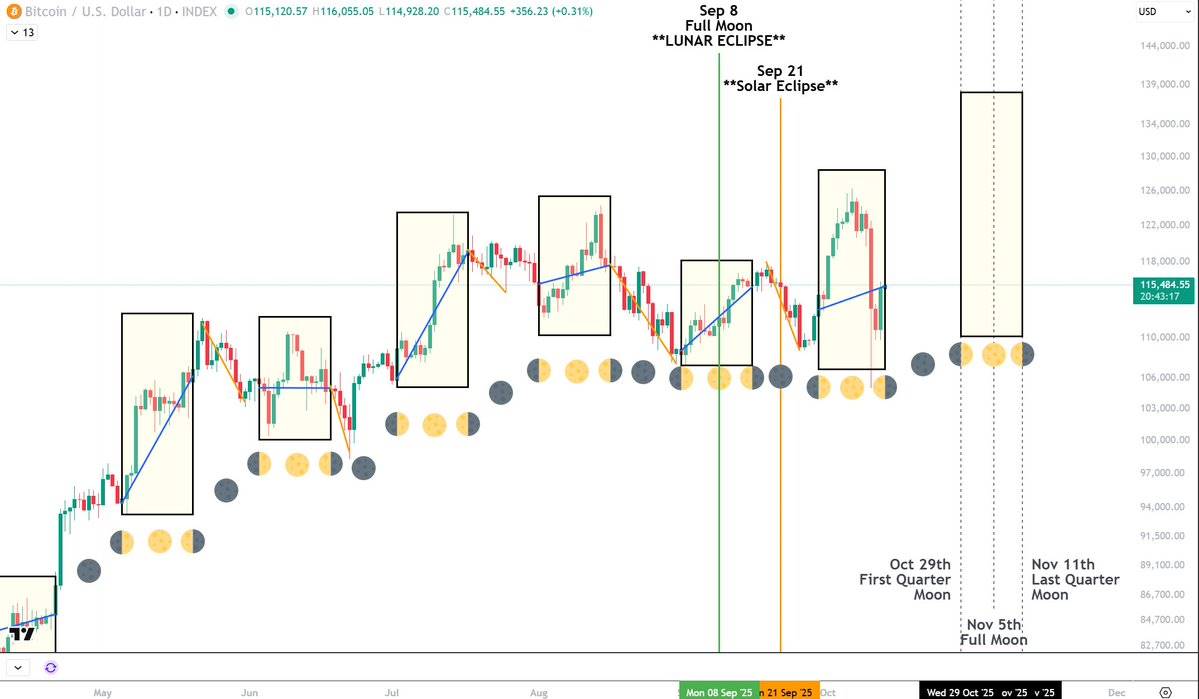
Image source @Drazzzzz
Crypto’s social media environment amplifies this bias exponentially.
Tweets like “I went long ETH per tarot guidance, made 20% in 3 days!” get widely shared, liked, and screenshotted.
But traders who lost money following tarot advice stay silent and invisible.
Thus, the community feed becomes flooded with “mysticism works” cases, while failures are filtered out.
Such examples are everywhere on Twitter. For instance, when @ChartingGuy's blood moon prediction window arrived this March, the outcome was interpretable regardless of price action: “topped early,” “delayed fulfillment,” or “needs alignment with other planetary angles.”
If BTC happened to dip around then, the tweet would be cited repeatedly as a “prophetic hit.”
When BTC crashes, traders desperately seek explanations. Scrolling social media, technical analysts say “broken support,” macro experts cite “Japan rate hikes”—but these explanations feel too complex, too uncertain.
Mysticism offers a clean, simple answer: “Saturn is in retrograde—crypto enters a bear cycle.”
No need to understand market dynamics, policy, or data—just believe celestial movements affect markets. Thus, it spreads fast and becomes consensus.
More crucially, mysticism’s vagueness makes it unfalsifiable.
A master says not to trade during Mercury retrograde. If you lose, it’s because you ignored the warning; if you profit, it’s because your chart is special and thrives during retrogrades. Tarot predicts major volatility—whether up or down counts as fulfillment.
This “always right no matter what” quality makes mysticism invincible in crypto.
So traders aren’t necessarily superstitious—they’re using the brain’s most energy-efficient way to process information: remember the hits, ignore the misses, replace complex analysis with simple narratives.
Mysticism isn’t popular because it’s accurate—it’s popular because it always appears accurate.
The Social Function of Mysticism
Another reason mysticism thrives in crypto is its role as social currency.
Talking technicals leads to disagreements; talking mysticism has no right or wrong—only resonance. “Is your Life K-Line accurate?” sparks widespread discussion not because people truly believe, but because it’s a universally accessible topic with zero expertise required.
Here’s an example proving the demand for mysticism exists.
Previously, our readers kept asking if we could add a fortune-checking feature. So many asked that we eventually built a “Daily Fortune” section into our site.
People may not actually make decisions based on it, but they want a shared topic—a daily mental comfort ritual.

Image sourceTechFlow official website
When you say in a group chat, “Mercury’s in retrograde today—I’m not opening any positions,” no one replies “That’s unscientific.” Instead, others chime in: “Same here, let’s both sit this one out.”
The real purpose? Validating each other’s anxiety as reasonable.
A 2025 Pew Research survey found 28% of American adults consult astrology, tarot, or fortune-tellers at least once a year.
Mysticism is no longer fringe—it’s a widespread psychological need. Crypto simply transformed it from “private use” to “public display.”
In a market with no authoritative answers, mysticism doesn’t offer solutions—it offers companionship.
So—how accurate is your Life K-Line?
The viral success of "Life K-Line" lies in expressing, in crypto’s language, what every trader feels but dares not admit: our sense of control over the market may be as fragile as our control over fate.
When your "Life K-Line" shows a bear year, you won’t actually liquidate everything and leave. But when you lose, you’ll feel less guilt; when you miss a rally, you’ll find comfort:
“It’s not my fault—my destiny cycle is off.”
In this 24/7, nonstop, uncertain market, what we really want to predict isn’t our life trajectory—but a psychological anchor that lets us stay seated at the table.
Join TechFlow official community to stay tuned
Telegram:https://t.me/TechFlowDaily
X (Twitter):https://x.com/TechFlowPost
X (Twitter) EN:https://x.com/BlockFlow_News
 深潮TechFlow


