








Crypto Morning News: Hashkey and other institutions donate to support Hong Kong, Upbit hacked
TechFlow Selected TechFlow Selected
Crypto Morning News: Hashkey and other institutions donate to support Hong Kong, Upbit hacked
Mantle network launches USDT0 cross-chain stablecoin service, enabling seamless flow across the EVM ecosystem.
 Navigating Web3 tides with focused insights
Author: TechFlow
Yesterday's Market Developments
Multple institutions donate to Hong Kong to support fire relief and reconstruction efforts
According to official announcements, HashKey Group has pledged an emergency donation of 10 million HKD to support emergency aid and resettlement for residents affected by the Tai Po fire in Hong Kong. HashKey Group stated: "We pay our highest respects to frontline rescue workers and will continue monitoring the situation, fully assisting our fellow citizens through this difficult time. Wishing everyone safety."
OKX announced a donation of 10 million HKD to Hong Kong to support local emergency rescue and post-disaster recovery efforts.
Binance announced it will donate 10 million HKD to Hong Kong to support disaster relief and subsequent reconstruction work. Binance said it will channel donations to the affected areas to assist Hong福苑 residents in rebuilding their homes. Binance also extended condolences to all those affected by the Tai Po disaster.
Avenir Group and its charitable foundation, Avenir Foundation, announced a donation of 10 million HKD to support emergency rescue, resident安置, and community recovery following the Tai Po fire. Avenir Group expressed deep concern over the incident and paid tribute to firefighters, medical personnel, and disciplined forces involved in the rescue. The donation will provide immediate assistance including essential supplies, temporary accommodation, and future community rebuilding support, aiming to offer tangible help to affected families and accelerate the restoration of normalcy.
Upbit discloses security breach; approximately 54 billion KRW worth of tokens transferred to unknown wallet
According to official disclosure, South Korean cryptocurrency exchange Upbit detected abnormal withdrawal activity at 4:42 AM on November 27, resulting in around 54 billion KRW (approximately $36 million) of Solana-network digital assets being moved to unknown external wallet addresses.
Upbit stated it will fully compensate users with its own funds to ensure no user losses. The exchange is currently conducting a security review, during which deposit and withdrawal services are temporarily suspended.
Uniswap's "UNIfication" proposal passes initial vote by overwhelming margin; $15.5M bug bounty launched
According to The Block, Uniswap's "UNIfication" governance proposal has received over 63 million UNI tokens in support during the preliminary Snapshot vote, facing almost no opposition. The proposal aims to unify Uniswap Labs and the Uniswap Foundation under a coordinated governance framework while activating a protocol-level fee mechanism. A $15.5 million Cantina bug bounty program is now live, covering the new fee-switch smart contract, preparing for the full on-chain vote expected next week.
Bitwise updates filing for spot Avalanche ETF, plans to add staking functionality
According to CoinDesk, Bitwise has updated its filing with the U.S. Securities and Exchange Commission (SEC) for its spot Avalanche ETF. The revision changes the ETF’s ticker to BAVA and sets the management fee at 0.34%, among the lowest in its category.
The updated S-1 filing shows the fund will allow staking of up to 70% of its AVAX holdings, earning additional tokens under Avalanche’s proof-of-stake mechanism. Bitwise plans to take a 12% cut from staking rewards, with the remainder distributed to shareholders.
Wormhole: Foundation purchases $5M in W tokens, recorded on balance sheet
Wormhole announced on social media that its foundation has purchased $5 million worth of W tokens, which have been recorded on its balance sheet.
Balancer DAO discusses distribution plan for $8M in recovered assets from hack
According to CoinDesk, Balancer DAO has begun discussing a plan to distribute approximately $8 million in recovered assets to affected liquidity providers.
The funds were swiftly recovered by white-hat hackers and internal teams after the attack. According to a draft proposal published by DAO contributor Xeonus, the plan includes structured payments to white-hat hackers and a compensation mechanism based on pool holdings snapshots taken at the time of the attack.
In addition to the $8 million to be redistributed via the DAO, another $19.7 million in osETH and osGNO was recovered by white-hat hacker StakeWise and will be handled separately. Furthermore, $4.1 million recovered jointly by internal teams and Certora does not qualify for bounty rewards due to prior agreements.
Earlier reports indicated the protocol suffered an attack on November 3, losing over $110 million.
Bubblemaps accuses Edel Finance of "sniping" 30% of token supply at launch; co-founder denies claims
According to blockchain analytics platform Bubblemaps, decentralized lending protocol Edel Finance "sniped" (front-ran) 30% of the EDEL token supply—worth about $11 million—during its token launch earlier this month.
Bubblemaps reported that approximately 160 wallets acquired these tokens through coordinated strategies, funded from centralized exchanges using automated trading methods consistent with sniping behavior. The platform noted that funds were structured across multiple new wallets, with half of the purchased tokens distributed to 100 secondary wallets.
In response, Edel Finance co-founder James Sherborne stated the team intended to secure around 60% of the token supply and lock it into a vesting contract, in line with project documentation. However, Bubblemaps questioned this explanation, arguing that if the team were genuine, they should have pre-allocated supply according to tokenomics.
Mantle Network launches USDT0 cross-chain stablecoin service, enabling seamless flow across EVM ecosystems
Mantle Network today announced the launch of USDT0 on its platform, enabling smooth cross-EVM ecosystem transfers through unified native USDT liquidity. The service eliminates the need for wrapped tokens, removes liquidity fragmentation, and reduces transaction friction.
Mantle, in partnership with Bybit, becomes the first exchange-driven network to establish a borderless, frictionless stablecoin standard. Users can enjoy seamless cross-chain USDT transfers and settlements, along with native support for building full-chain DeFi applications using stablecoins.
The network offers high-speed, low-cost, institutional-grade infrastructure, ready for large-scale DeFi and RWA use cases, further enhancing capital efficiency in on-chain economies and laying the foundation for the next phase of on-chain finance.
Lido proposes new development plan: shifting from single staking product to diversified DeFi platform
According to an official announcement, Lido has published a new forum proposal outlining a strategic shift from a single-product staking service to a broader portfolio of DeFi offerings.
The proposal includes four core strategies:
Expanding the staking ecosystem: With Lido V3, stVaults will transform staking into modular infrastructure for integrators, node operators, custodians, and large allocators;
Protocol resilience upgrade: Introducing ValMart validator marketplace to dynamically allocate stake based on performance, cost, and decentralization, increasing DAO revenue and strengthening risk management;
Expanding Lido Earn: Targeting advanced DeFi users, restakers, stablecoin depositors, passive yield seekers, and on-chain treasury managers;
Vertical expansion and real-world application in parallel: Small experiments + one major bet, bridging on-chain and off-chain economic activities.
The proposal sets a three-year vision: treating staking as a mature, profitable product line rather than the sole business, building vertically to capture more value, expanding horizontally into stablecoins and new asset classes, and positioning Lido as a leading DeFi platform. The entire transition will prioritize security, measurable impact, and iterative validation.
YZi Labs files preliminary consent statement with SEC, seeking to expand CEA Industries board and elect new directors
According to YZi Labs, the company has filed a preliminary consent statement with the U.S. Securities and Exchange Commission, seeking shareholder approval to increase the size of the board of directors of CEA Industries Inc. (Nasdaq: BNC) and elect additional directors.
As a BNC shareholder, YZi Labs stated that despite BNC completing a $500 million PIPE financing this summer and a significant rise in the price of its primary asset BNB, the company’s performance has still fallen short of expectations.
YZi Labs head Ella Zhang said BNC’s poor performance stems directly from weak strategic execution, inadequate investor communication, and lack of effective oversight. The firm also expressed concerns over BNC’s delays in key SEC filings, absence of investor updates regarding digital asset inventory and net asset value, and ongoing investor confusion about the company’s identity and strategy.
Naver and Dunamu plan $6.8B investment in AI and blockchain technology
According to The Block, South Korean internet giant Naver and Upbit parent company Dunamu plan to invest 10 trillion KRW (approximately $6.8 billion) over the next five years to build next-generation financial infrastructure powered by artificial intelligence and blockchain technology.
At a joint press conference on Thursday, Dunamu CEO Song Chi-hyung said they aim to establish a "completely new global framework" spanning payments, settlements, and the broader financial sector. Naver CEO Choi Soo-yeon stated the company sees new opportunities at the intersection of blockchain adoption and agent-based AI transformation.
Earlier reports confirmed that NAVER officially announced its plan to acquire 100% of Dunamu’s shares through a share exchange.
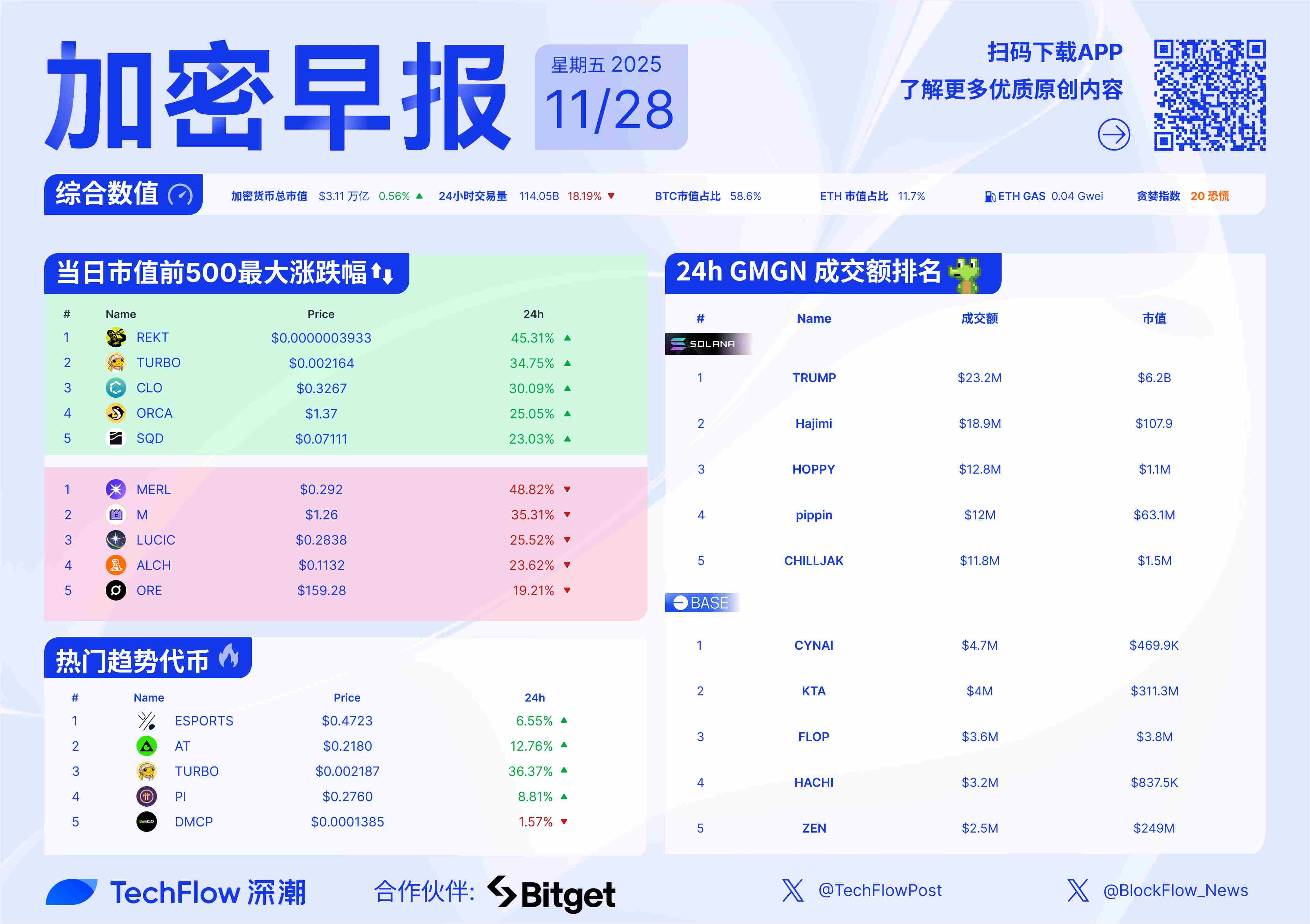
Market Data
Suggested Reading
Korean Premium vs. Nation-State Hackers: The Covert War Behind Upbit’s Repeated Breaches
This article provides an in-depth analysis of the South Korean cryptocurrency market, highlighting its dual role as the world’s most active retail market and a prime target for North Korean hackers. Focusing on multiple breaches at South Korea’s largest crypto exchange Upbit, the article details the long-running cyber warfare between North and South Korea, and how state-sponsored hacking groups like Lazarus use cryptocurrencies to fund North Korea’s nuclear and missile programs. It also examines security vulnerabilities, historical incidents, and geopolitical context within the Korean crypto market.
Former a16z Partner’s Major Tech Report: How Will AI Eat the World?
This article explores the profound impact of artificial intelligence (AI) on the tech industry and its potential to reshape future industries. Drawing from a report by former a16z partner Benedict Evans, it analyzes technological shifts driven by generative AI and examines massive investments by tech giants in AI infrastructure. The piece also covers AI commoditization, challenges in user engagement, slow enterprise adoption, and potential disruptive changes to advertising and recommendation systems.
Spotlight: Five Winning Projects from Solana’s Latest x402 Hackathon
This article showcases innovative projects from the Solana x402 hackathon, including AI-powered autonomous payments, AI model trading, and IoT economies—foreshadowing new directions in on-chain business models.
Why Is the Crypto Industry Losing Young Talent?
This article examines the current issue of young talent leaving the crypto industry, analyzing the reasons behind it and potential solutions. It argues that crypto has lost its compelling narrative for attracting youth, causing many to migrate to fields like artificial intelligence. The author calls for the industry to rebuild its narrative and offer a more inspiring vision for the next generation.
Revisiting Crypto’s Golden Era: The Wealth Craze Has Passed—No More Easy Money
This article回顾 the multiple "gold rush" cycles in the cryptocurrency industry since 2016, analyzing phenomena such as ICO booms, DeFi yield farming, NFT bubbles, and meme coin frenzies. It explores why today’s market lacks wealth creation driven by "dumb money" and looks ahead to emerging trends like RWA (real-world asset) tokenization and their potential investment opportunities.
Join TechFlow official community to stay tuned
Telegram:https://t.me/TechFlowDaily
X (Twitter):https://x.com/TechFlowPost
X (Twitter) EN:https://x.com/BlockFlow_News
 深潮TechFlow






