








The "Bankruptcy" of Metcalfe's Law: Why Cryptocurrencies Are Overvalued
TechFlow Selected TechFlow Selected
The "Bankruptcy" of Metcalfe's Law: Why Cryptocurrencies Are Overvalued
Value capture is undergoing a shift from the foundational layer to the application layer to the user aggregation layer, which benefits users, but they should not pay a premium for this in advance.
 Navigating Web3 tides with focused insights
Author: Santiago Roel Santos
Translation: AididiaoJP, Foresight News
The Network Effect Dilemma in Cryptocurrency
My previous argument that "cryptocurrency prices are far above fundamentals" sparked debate. The strongest opposition did not concern usage volume or fees, but stemmed from ideological differences:
-
"Cryptocurrency is not a business"
-
"Blockchains follow Metcalfe's Law"
-
"Core value lies in network effects"
As someone who witnessed the rise of Facebook, Twitter, and Instagram, I understand early internet products faced similar valuation challenges. But patterns emerged: as users' social circles joined, product value exploded. User retention improved, engagement deepened, and the flywheel effect became clearly visible in the experience.
This is what true network effects look like.
If the claim is that "cryptocurrencies should be valued as networks rather than businesses," then let's analyze it closely.
Upon deeper examination, an unavoidable issue emerges: Metcalfe's Law not only fails to justify current valuations—it actually exposes their fragility.
Misunderstood "Network Effects"
What passes for "network effects" in crypto is mostly negative:
-
User growth degrades user experience
-
Transaction fees skyrocket
-
Network congestion worsens
The deeper problem is:
-
Open-source nature leads to developer attrition
-
Liquidity is profit-driven
-
Users migrate across chains chasing incentives
-
Institutions switch platforms based on short-term gains
Successful networks never operate this way—Facebook’s experience never deteriorated when adding millions of new users.
But New Blockchains Have Solved Throughput Issues
This indeed alleviates congestion, but doesn't resolve the core issue of network effects. Increased throughput merely reduces friction; it doesn't generate compound value.
The fundamental contradiction remains:
-
Liquidity may drain away
-
Developers may move
-
Users may leave
-
Code can be forked
-
Poor value capture capability
Scaling improves usability, not inevitability.
The Truth Revealed by Fees
If L1 blockchains truly had network effects, they would capture most value like iOS, Android, Facebook, or Visa. The reality is:
-
L1s account for 90% of total market cap
-
Fees share plummeted from 60% to 12%
-
DeFi contributes 73% of fees
-
Yet valuation share is under 10%
The market still prices under the "fat protocol theory," but data points the opposite way: L1s are overvalued, applications undervalued, and ultimate value will converge at the user aggregation layer.
User Valuation Comparison
Using common metrics—market cap per user:
Meta (Facebook)
-
3.1 billion monthly active users
-
$1.5 trillion market cap
-
Per-user value: $400–$500
Cryptocurrency (excluding Bitcoin)
-
$1 trillion market cap
-
400 million general users → $2,500/user
-
100 million active users → $9,000/user
-
40 million on-chain users → $23,000/user
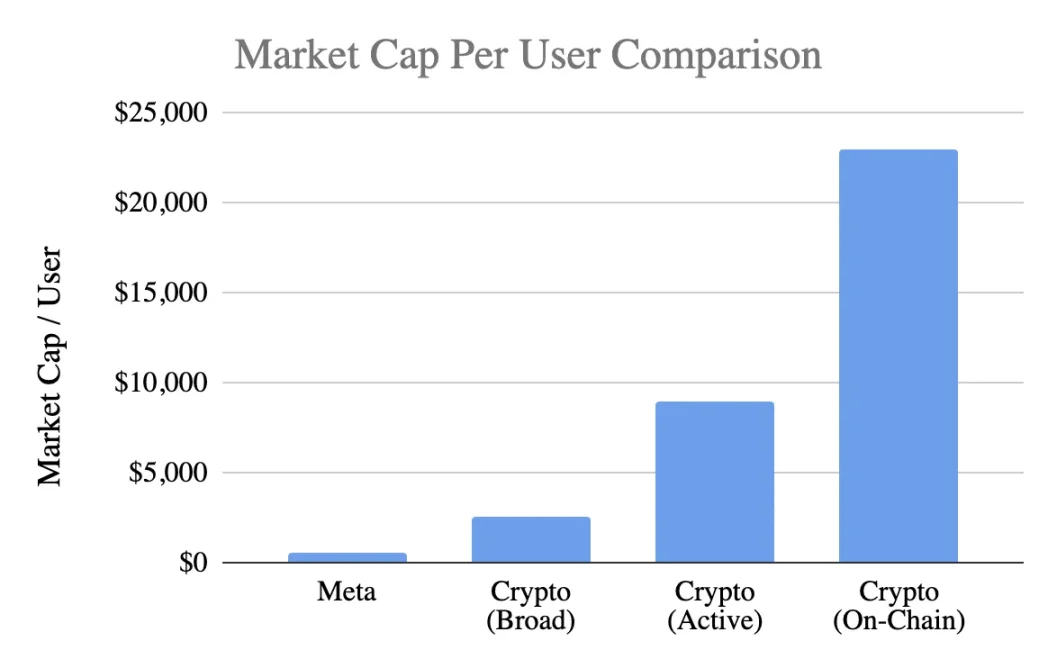
Valuation levels reach:
-
5x premium at most optimistic estimates
-
20x premium under strict standards
-
50x premium based on actual on-chain activity
And Meta is arguably the most efficient monetization engine in consumer tech.
Clarifying Development Stage Arguments
The argument that "Facebook was like this in its early days" is debatable. While Facebook initially lacked revenue, its product already established:
-
Daily usage habits
-
Social connections
-
Identity formation
-
Community belonging
-
Value increasing with user growth
In contrast, the core use case of cryptocurrency remains speculation, leading to:
-
Rapid user influx
-
Even faster churn
-
Lack of stickiness
-
No habit formation
-
No improvement with scale
Unless cryptocurrencies become "invisible infrastructure"—underlying services operating without user awareness—self-reinforcing network effects won't emerge.
This isn't a maturity issue; it's a product essence issue.
Misapplication of Metcalfe's Law
The law’s proposition that value ≈ n² is appealing, but its assumptions are flawed:
-
Deep interaction required among users (rare in practice)
-
Network should be sticky (currently missing)
-
Value should concentrate upward (actually fragmented)
-
Switching costs should exist (practically negligible)
-
Scale should create moats (not yet evident)
Most cryptocurrencies fail these prerequisites.
Insights from the Key Variable k
In the V = k·n² model, k represents:
-
Monetization efficiency
-
Level of trust
-
Depth of participation
-
Retention capability
-
Switching costs
-
Ecosystem maturity
Facebook and Tencent have k values between 10⁻⁹ and 10⁻⁷, small due to massive network size.
Estimated k values for cryptocurrency (at $1T market cap):
-
400M users → k ≈ 10⁻⁶
-
100M users → k ≈ 10⁻⁵
-
40M users → k ≈ 10⁻⁴
This implies the market assumes each crypto user is worth far more than a Facebook user, despite inferior retention, monetization, and stickiness. This isn't early optimism—it's excessive future discounting.
The Reality of Network Effects Today
Cryptocurrencies do possess:
-
Bilateral network effects (users ↔ developers ↔ liquidity)
-
Platform effects (standards, tools, composability)
These effects exist but are fragile: easily forked, slow compounding, and far from achieving Facebook-, WeChat-, or Visa-level n² flywheels.
A Rational View of Future Prospects
The vision that "the internet will be built on crypto networks" is indeed attractive, but we must clarify:
-
This future may come to pass
-
It has not arrived yet, and current economic models don’t reflect it
Current value distribution shows:
-
Fees flow to application layers, not L1s
-
Exchanges and wallets control users
-
MEV extracts value surplus
-
Forks weaken competitive barriers
-
L1s struggle to retain created value
Value capture is migrating from base layer → application layer → user aggregation layer. This benefits users, but shouldn’t justify paying a premium today.
Characteristics of Mature Network Effects
A healthy network should exhibit:
-
Stable liquidity
-
Concentrated developer ecosystem
-
Increased fee capture at base layer
-
Sustained institutional user retention
-
Growing cross-cycle retention rates
-
Composability defending against forks
Ethereum shows early signs, Solana is poised, but most public chains remain distant.
Conclusion: Valuation Based on Network Effect Logic
If crypto users:
-
Are less sticky
-
Harder to monetize
-
Have higher churn
Then their per-unit value should be lower than Facebook users—not 5 to 50 times higher. Current valuations are pricing in network effects that haven't formed. The market behaves as if powerful effects already exist, but they don’t—yet, at least not now.
Join TechFlow official community to stay tuned
Telegram:https://t.me/TechFlowDaily
X (Twitter):https://x.com/TechFlowPost
X (Twitter) EN:https://x.com/BlockFlow_News


