








Huobi Growth Academy | In-depth Research Report on Privacy Coin Sector: Reassessing Value from Anonymity Demand to the Era of Zero-Knowledge Proofs
TechFlow Selected TechFlow Selected
Huobi Growth Academy | In-depth Research Report on Privacy Coin Sector: Reassessing Value from Anonymity Demand to the Era of Zero-Knowledge Proofs
Privacy coins are not a short-term trend, but are gradually becoming a structural necessity in the financial system against the backdrop of deepening digitization, maturing regulatory technology, the advancement of CBDCs, and frequent data abuse incidents.
 Navigating Web3 tides with focused insights
Executive Summary
This report uses the surge in Zcash (ZEC) as a starting point to systematically analyze the technological evolution, valuation repricing, and medium- to long-term investment logic of the privacy coin sector. Privacy is not a fleeting theme but an increasingly essential financial infrastructure amid regulatory technology, CBDCs, on-chain surveillance, and data abuse: enterprises need to protect trade secrets, individuals must prevent their assets and behaviors from being fully profiled, and nations are engaged in strategic competition over data sovereignty. The recent price rally in ZEC stems from post-halving supply contraction, prolonged undervaluation, upgrades such as Halo 2 / NU5, and resonance with the "compliant privacy" narrative—yet this price amplification comes with high volatility and policy sensitivity. The future landscape will likely shift from “privacy coins” to “privacy infrastructure,” with privacy capabilities becoming embedded in L2s, DeFi, and TradFi. Privacy assets are better suited as functional allocations within portfolios—hedging risks from transparent public chains and CBDCs while capturing long-term beta from the adoption of zero-knowledge infrastructure—rather than serving as single, concentrated bets.
I. Overview of the Privacy Coin Sector
In the structural rotation of the crypto market during 2024–2025, one of the most dramatic narratives has been the “resurrection of privacy coins.” After years of suppression due to regulatory pressure, exchange delistings, and cooling sentiment, the privacy sector suddenly returned to the spotlight in the second half of 2025: total market capitalization for privacy coins broke into the $24–28 billion range, led by strong rallies in Zcash (ZEC) and Monero (XMR), significantly outperforming the broader market. Notably, ZEC rose from below $20 in July 2024—a period when it was largely ignored—to reach $600–700 by November 2025, achieving a gain exceeding 30x and emerging as one of the leading symbols of this privacy-driven market cycle. Under these conditions, privacy coins are no longer merely synonymous with “darknet assets” or “regulatory gray zones,” but are increasingly recognized as part of the medium- to long-term portfolio of “digital financial privacy infrastructure.”
Since Bitcoin’s inception, debates around “privacy” in the digital asset world have never ceased. From early pseudonymity to today's diverse privacy protocols, privacy has never been a peripheral issue but a fundamental variable spanning “financial freedom—regulatory博弈—data sovereignty.” Bitcoin is not truly anonymous; all transactions are publicly visible on-chain, and by combining KYC data with on-chain clustering analysis, participants’ transaction paths, asset holdings, and even identities can be highly reconstructed. As regulatory tech and on-chain forensics matured rapidly between 2020 and 2025, the privacy gaps in public ledgers like Bitcoin and Ethereum were fully exposed, fueling successive generations of privacy coins such as Dash, Monero, Zcash, Grin/Beam—an ongoing “arms race” in privacy technology. Early solutions relied mainly on coin mixing and on-chain obfuscation techniques: for example, Dash’s PrivateSend disrupts traceability by mixing inputs and outputs so that “who paid whom” becomes difficult to determine directly. Monero leverages ring signatures, stealth addresses, and RingCT to achieve tripartite privacy for sender, receiver, and amount, further enhancing anonymity through larger “ring sizes” and adopting Bulletproofs to reduce transaction size. Zcash brought zero-knowledge proofs into mainstream public blockchains, enabling for the first time “complete hiding of transaction content while only revealing validity proofs.” Its dual-track design of shielded and transparent addresses gives users choice between “privacy and auditability.” MimbleWimble elevated privacy to the block level by aggregating transactions and deleting intermediate data, creating a lightweight chain structure that is both private and highly scalable. These technologies were never intended solely as tools for illicit markets, but rather represent systematic responses to three universal needs: protection of commercial secrets and pricing confidentiality, personal asset security, and institutional resistance against state and platform “panopticon-style data monitoring.” The 2017 bull market pushed privacy narratives to their peak, with most privacy coins entering the top 20 by market cap, positioning “privacy” as a core competitive advantage for next-generation cryptocurrencies. However, starting in 2018, the sector gradually declined under regulatory pressure, flaws in early models, and high user barriers. Exchanges began delisting strong privacy coins, reducing liquidity; some projects suffered from early-stage high inflation and founder rewards that created sustained selling pressure; and the technical complexity of privacy tools meant actual demand lagged far behind speculative interest. By 2023–2024, the privacy sector had become marginalized, with its market share dropping below 1%. Yet development continued quietly: Zcash advanced with NU5/NU6 upgrades removing trusted setup, unifying address formats, and introducing Halo 2; Monero continuously refined ring signatures and privacy proofs; the MimbleWimble community explored lighter, more anonymous implementations. Technological accumulation did not halt despite price stagnation and negative sentiment, laying the groundwork for the sector’s resurgence in 2025. Entering 2024–2025, macroeconomic conditions, regulatory trends, and sector rotation collectively reshaped the landscape: privacy coin market cap rebounded to $24–28 billion, drawing renewed institutional attention and prompting specialized research coverage from multiple analyst firms.
At the same time, regulatory pressure and privacy demand have risen in tandem, creating a paradoxical dynamic. The EU’s AMLR imposes clear restrictions on “highly anonymous crypto assets,” meaning fully private-by-default assets like Monero and Grin may face outright bans or trading prohibitions in certain jurisdictions starting in 2027. Meanwhile, the U.S. Treasury, Department of Justice, and blockchain analytics firms use machine learning, large-scale address clustering, and behavioral modeling to repeatedly track and seize major Bitcoin holdings, turning “privacy gaps in transparent chains” into public events. Ironically, this reverse demonstration effect has prompted the market to reevaluate the value of privacy coins: in a world where surveillance capabilities grow ever stronger, the need for privacy is no longer a niche concern for technologists but a shared priority for ordinary users, institutions, and cross-border enterprises. Against this backdrop, privacy assets have clearly diverged: Monero represents the path of “strong privacy, non-auditable”—default-on privacy that also brings regulatory friction and shrinking liquidity; Zcash, Secret, and others pursue “compliant privacy,” supporting shielded transactions while allowing selective disclosure via view keys to achieve minimal transparency required for regulation, clearing, and auditing. This design is more readily accepted by institutions and regulators in policy-friendly regions. The market’s revaluation of ZEC stems largely from the belief that its technical architecture and compliance attributes make it more sustainable under evolving privacy regulations.
Looking beyond 2025, the privacy sector is undergoing a historic shift—from “privacy coins” to “privacy infrastructure.” Privacy is no longer just the narrative of a single token but a foundational module for Web3, DeFi, RWA, identity protocols, and financial systems. Future developments will likely follow at least three evolutionary paths. First, compliant privacy will become the dominant design philosophy. Selective disclosure mechanisms and view key models are increasingly seen as viable solutions, enabling institutions to strike new balances between privacy and oversight. Second, privacy will be deeply integrated into DeFi and Web3 in modular form. In decentralized lending, derivatives, NFTs, and on-chain identity, user demand for “position privacy, transaction privacy, asset privacy” is intense, and technologies like ZK, MPC, and ring signatures are already entering L2s, cross-chain bridges, and application layers. Privacy will evolve from L1 competition to become “a privacy layer for every application,” potentially serving as a differentiator for L2s. Third, privacy will engage in deep strategic interactions globally with CBDCs, digital identity frameworks, and data sovereignty policies. Central bank digital currencies face a common dilemma: how to preserve basic financial privacy under anti-money laundering and counter-terrorism financing mandates. Zero-knowledge proofs and selective disclosure mechanisms may be absorbed by central banks as part of their infrastructure. In other words, privacy technologies may not only be suppressed but also co-opted—and even become standard components of traditional finance. The 2025 reassessment of the privacy sector is not a product of short-term speculation but a structural comeback shaped by “technological maturity × regulatory pressure × market reflection × expansion of on-chain surveillance.” The long-term value of privacy assets lies not in price volatility but in addressing the most critical question of the digital age: when everything is computable, auditable, and archivable, do humans still have a “financial space” of their own? The future of privacy is neither darkness nor transparency, but a new paradigm that is controllable, authorizable, auditable—but not exploitable. ZEC’s emergence as a leader in innovation and compliance may well signal the early stages of this paradigm shift.
II. Investment Value Analysis of Privacy Coins
From an investor’s perspective, the key question in evaluating whether a sector warrants long-term allocation is never simply “how much has it risen,” but whether underlying demand is structural and enduring. The reason privacy coins merit serious consideration as an independent investment theme is that in an expanding on-chain financial world, “privacy” is shifting from optional to essential. If you have stable usage scenarios on public chains and your main addresses have ever been linked to real-world identities (e.g., depositing to KYC-compliant exchanges or leaving traces during OTC trades), your entire transaction history, holdings, and fund flows could be algorithmically profiled. For high-net-worth individuals, institutional capital, and professional traders, this implies higher risks of targeted attacks and strategy exposure: hackers or ransom actors can selectively target “whale addresses,” while counterparties can reverse-engineer your position structure and liquidation thresholds using on-chain intelligence. Privacy coins offer a technical pathway to “reclaim financial privacy” within open financial systems by anonymizing addresses, hiding amounts, and obfuscating transaction paths. In B2B and supply chain finance contexts, transaction terms are often extremely sensitive. If all settlement data is exposed on-chain, it not only risks triggering customer perceptions of “unfair pricing” but also allows competitors to reverse-engineer your cost structure and bargaining power. Thus, building a settlement network that is “auditable to regulators but opaque to the public” is itself a hard requirement for enterprises. On a broader social level, the growing number of data breaches and platform abuses has made the public increasingly aware that “data is an asset”—once leaked, it can be permanently copied, traded, and reassembled, often without users even knowing how their data is used. In this context, the sentiment that “I want my assets and transaction records protected from infinite exploitation by platforms and third parties” provides deep cultural and value-based support for the privacy sector. As on-chain monitoring matures, “tainted coins” and “blacklisted addresses” are becoming reality: once an address is associated with hackers or sanctions lists, its assets may be rejected or frozen regardless of subsequent transfers, undermining fungibility. Privacy coins combat “address discrimination” by weakening transaction traceability. At the philosophical level, in many societies with strong liberal traditions, privacy is considered a fundamental right—“what I choose to disclose and to whom should be my decision.” Privacy coins and zero-knowledge infrastructure can thus be understood as the financial expression of this principle. Therefore, as long as digitization and on-chain migration continue, the demand for privacy will not disappear but emerge in increasingly systemic ways—this alone justifies treating the privacy coin sector as worthy of long-term study and strategic allocation, rather than mere thematic speculation.
From a technical lineage perspective, the privacy sector can be broadly categorized into several schools and representative assets: Dash represents the CoinJoin/mixing approach, functioning more like an add-on obfuscation tool layered atop transparent ledgers, offering limited privacy strength; Monero exemplifies the ring signature + confidential transaction model, using ring signatures, stealth addresses, and amount hiding to enforce mandatory, default-on deep privacy—the technical haven for “pure anonymity advocates”; Zcash embodies the zk-SNARKs path, leveraging zero-knowledge proofs to fully hide transaction content while only publishing validity proofs, with potential extensions to smart contracts and broader ZK ecosystems; the MimbleWimble framework (e.g., Grin, Beam) favors minimalist protocols and lightweight ledgers, emphasizing block-level aggregation and data pruning to balance privacy and scalability. Within this landscape, Monero stands as the consensus leader on the strong privacy side, boasting the largest anonymity set and richest practical experience, making it a natural focus for regulatory scrutiny. DASH positions itself closer to “digital cash with light privacy features,” gaining traction in some emerging markets due to its payment experience. Next-generation ZK projects aim to bind privacy capabilities with L2 scaling and ecosystem narratives. Structurally, ZEC occupies a subtle yet highly flexible middle ground: technically superior to simple mixing schemes and more mature than many MimbleWimble projects, yet less privacy-intensive than Monero’s enforced ring signatures. However, through its dual-track model of transparent and shielded addresses and mechanisms like view keys, ZEC offers a more natural design space for balancing “privacy, auditability, and compliance.” Combined with a series of upgrades including Halo 2, Orchard, and NU5/NU6, ZEC leads in “removing trusted setup, unifying address structures, and lowering barriers to private transactions.” ZEC is no longer just a privacy coin—it is beginning to act as a “zero-knowledge technology provider,” with its R&D in ZKPs generating spillover effects across broader Web3 and ZK Rollup ecosystems. From an investor standpoint, ZEC can be viewed as a classic “high-beta leader”: capturing the sector-wide beta while earning additional alpha through technological moats and compliance-friendly appeal.
ZEC’s surge during 2024–2025 was not driven by a single catalyst but by the convergence of multiple medium- to long-term variables within the same timeframe. First, on the supply and valuation front, Zcash follows Bitcoin’s capped supply and halving schedule. After years of price decline and sentiment cooling, the 2024 halving reduced block rewards to 1.5625 ZEC, sharply lowering inflation and reducing sell-side pressure from miners. The quantity of ZEC received by the developer fund also decreased accordingly. For years prior, the “founders’ reward/developer fund” was widely seen as a persistent source of downward pressure. However, after multiple halvings, this negative factor’s marginal impact has begun to wane. Combined with historical lows near $15–20, the “spring” of supply and valuation had been compressed to its limit. When sentiment and capital returned to the sector, upward price elasticity was greatly amplified. Second, a sense of “qualitative transformation” emerged from technical and product upgrades: eliminating trusted setup, improving proof efficiency, unifying address formats, and enhancing light wallet and mobile experiences shifted external perception of ZEC from “legacy privacy coin” to “candidate privacy infrastructure adoptable by financial institutions and compliant products.” The technical narrative moved beyond whitepapers to tangible improvements at the network and user experience levels. Third, narrative momentum and capital flows interacted: as the total market cap of privacy coins rebounded above $20 billion, multiple research and media outlets labeled ZEC the “flagship of privacy revival.” Institutional holdings disclosed in product filings added a new “institutional recognition” label. In derivatives markets, perpetual and options trading volumes spiked during key breakouts, triggering repeated short squeezes and driving prices upward in near-waterfall fashion. Subsequently, capital rotated within the sector to XMR, DASH, and others, forming a full-fledged “privacy coin sector rally.” Finally, macro and regulatory events provided powerful narrative fuel: several high-profile BTC tracking and seizure cases on transparent chains vividly demonstrated that public ledgers offer almost no “right to be forgotten” under strong regulation and advanced analytics. This simultaneously reinforced regulatory confidence and heightened user fears about complete loss of financial privacy. In this contrast, assets that offer strong privacy while enabling selective disclosure naturally gained traction as tools to hedge risks from transparent chains and overly visible future CBDCs.
However, understanding ZEC’s rally logic does not mean ignoring its risk profile. The privacy sector overall exhibits high volatility, policy sensitivity, and narrative dependence—greater gains correlate with higher sensitivity to regulatory and liquidity shocks. Therefore, rather than “all-in” single-coin speculation, a more rational approach is to incorporate the privacy sector into portfolio construction as a structured allocation. It can serve as a functional sub-allocation within a digital asset portfolio: hedging tail risks from further erosion of privacy in macro and regulatory environments, while capturing long-term beta from the gradual integration of zero-knowledge proofs and privacy infrastructure into traditional finance and Web3. In practice, investors might adopt a “core + satellite + option” three-layer framework: using XMR and ZEC as core holdings—one favoring extreme privacy, the other compliant flexibility; employing payment-focused or regionally adopted privacy assets as satellites, judged by real-world use and network effects; and allocating small positions to emerging ZK/L2/privacy DeFi modules as option-like bets on technological inflection and narrative breakout. Regardless of structure, the prerequisite is clear-eyed awareness of the sector’s high volatility and policy uncertainty, managed through position sizing, stop-loss mechanisms, and regular rebalancing—integrating “long-term conviction in privacy” with “short-term respect for risk” within the investment framework. For investors willing to conduct deep research and understand the interplay between technology and regulation, the privacy coin sector—especially compliance-oriented architectures like ZEC—may represent a recurring theme across future crypto bull and bear cycles. But it is best approached rationally and systematically as part of a diversified portfolio, rather than driven by emotion and short-term price spikes.
III. Investment Outlook and Risks for the Privacy Coin Sector
The medium- to long-term outlook and risk structure of the privacy coin sector are rapidly transforming alongside deeper digitization, evolving regulations, and maturing cryptographic infrastructure. Whether viewed through macro trends, technical trajectories, or institutional adoption pathways, the value proposition of privacy assets is moving beyond the realm of “speculative niche tokens” toward a long-term thesis spanning business, finance, sovereignty, and internet architecture. In a world where assets, identities, and data are increasingly on-chain, privacy is no longer optional but an emerging foundational need. Hence, the cryptographic privacy infrastructure represented by privacy coins could become a structurally significant growth pillar over the next decade.
Real-world developments show rising privacy awareness and data sovereignty concerns among enterprises, individuals, and governments. For businesses, trade secrets, cost structures, supply chain pricing, and credit terms are highly sensitive. If settlements and clearing processes are fully transparent, competitors can easily reverse-engineer cost models and strategies via on-chain data, creating asymmetric advantages. For individuals, data leaks and misuse by social media, ticketing platforms, and big tech companies have become commonplace. The public now recognizes financial behavior, asset size, and transaction patterns as high-value “invisible assets,” whose exposure increases attack risks. With the rollout of CBDCs, digital ID systems, and unified credit reporting infrastructures, debates over data sovereignty between states and citizens are intensifying. Together, these forces are pushing privacy from “optional feature” to “infrastructure-layer necessity,” placing privacy coins and protocols at the intersection of this trend. Simultaneously, advances in cryptographic techniques—zero-knowledge proofs, ring signatures, multi-party computation—are accelerating the shift from “a feature of one chain” to “a full-stack Web3 infrastructure component.” For instance, ZKP research driven by ZEC, Aztec, and ZK Rollups is now applied across privacy payments, on-chain settlements, RWA data protection, ZK KYC, and ZK reputation systems. Even if individual privacy coins do not see further price appreciation, their underlying technologies may still be adopted in broader B2B and B2G contexts via enterprise solutions, sidechains, and permissioned networks. In other words, investors may benefit from the value of the privacy sector through technological spillovers—even without direct ownership of privacy tokens.
Moreover, under the push for institutionalized DeFi globally, privacy demand is evolving from “anonymous trading” to “selective transparency.” Institutions want to monitor systemic risk and overall leverage but do not wish to expose their positions, strategies, or liquidity to competitors. High-net-worth clients desire the benefits of on-chain settlement and 24/7 liquidity without having their wealth fully exposed by on-chain scanning tools. As on-chain Treasuries, money market funds, and institutional lending pools emerge, a financial network that is “auditable but not fully transparent” is taking shape. Privacy chains, privacy L2s, and privacy modules thus stand a chance of being adopted as infrastructure by financial institutions. In this sense, privacy is no longer confined to niche narratives but becoming an “optional transparency layer” for institutions. Viewed this way, the privacy sector possesses a long-term growth foundation that can persist across market cycles. However, it is not without risks—the most critical being systemic regulatory risk. Over recent years, privacy coins have occupied a “gray zone”: they are fundamentally privacy-enhancing tools, not exclusive conduits for illegal activity. Yet regulators often associate privacy tools with illicit fund flows. The EU’s AMLR explicitly targets highly anonymous crypto assets for enhanced supervision, and some jurisdictions are considering banning privacy coins from local exchanges. The U.S. and others may impose direct sanctions on mixers, anonymous wallets, or specific privacy protocols. In this environment, “compliant privacy” remains a dynamic negotiation: whether regulators accept ZEC-style view key mechanisms, and whether institutions embrace “selective disclosure,” remains to be proven over time. Should major jurisdictions enact stricter restrictions, the entire privacy sector could face sharp valuation corrections in the short term.
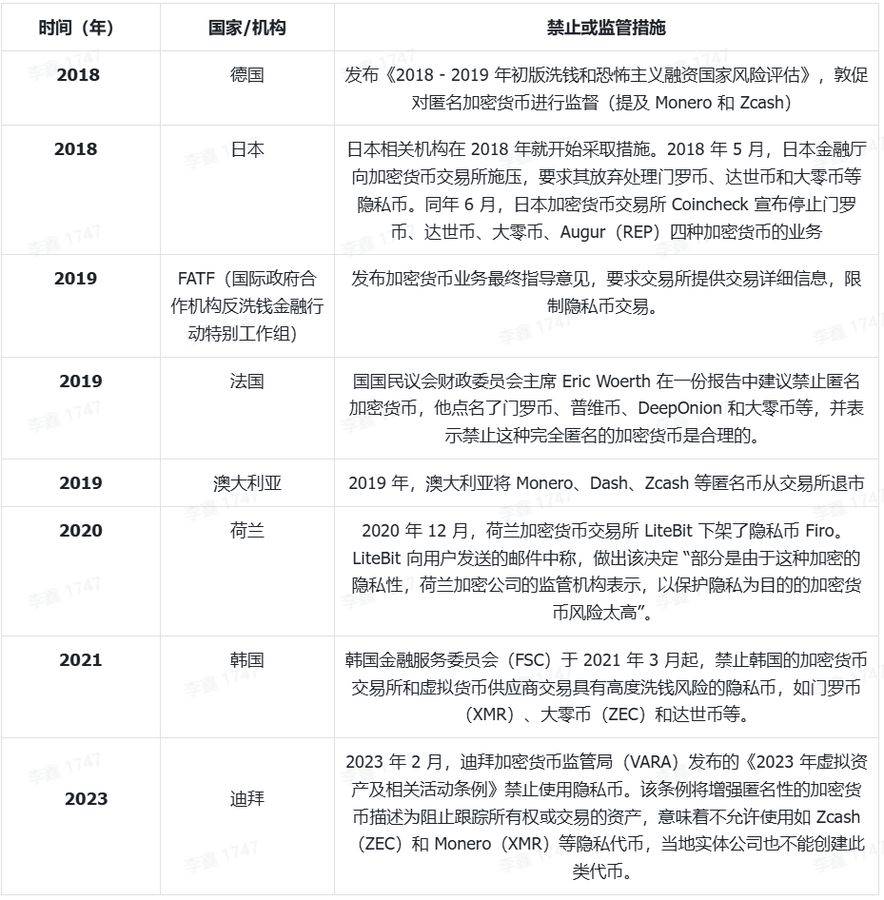
Technical risks are equally significant. Privacy protocols rely critically on correct cryptographic implementation. Any bug in underlying algorithms, risks in zero-knowledge proof parameter generation, incorrect wallet defaults, or user misconfiguration of privacy settings could weaken or even break anonymity. Additionally, the attack surface of privacy protocols is more complex than standard blockchains, and many users fail to understand that “privacy is not absolute,” increasing security uncertainties at both usage and implementation levels. Therefore, the security of privacy assets should not be taken for granted but requires continuous monitoring of audits, upgrade cadence, and community transparency.
The sector also faces internal and external competitive pressures. As Ethereum and its L2s (e.g., zkSync, Stark family), Bitcoin sidechains, and high-performance public chains integrate zero-knowledge proofs, privacy capabilities are gradually being “democratized” across mainstream blockchains. This means privacy may become a “universal feature” rather than the exclusive advantage of standalone “privacy coins.” The final landscape may split into two: dedicated privacy coins like XMR and ZEC serving purists, and privacy modules on mainstream chains providing sufficient protection for 90% of use cases. From a valuation standpoint, this implies that privacy coins’ ability to sustain high market caps will depend on ecosystem depth, real-world adoption, and institutional uptake—not merely on possessing privacy technology as a moat.
Finally, liquidity and market structure remain the most immediate risks for privacy coins. Compared to BTC and ETH, privacy coins generally have smaller market caps, higher concentration, and shallower order books, making prices more volatile during large inflows or outflows. Shallow derivatives markets can amplify long/short squeezes; exchange delistings or temporary risk controls may cause severe price shocks. In short, even if the long-term thesis holds, privacy coins are not suitable for high-leverage or heavily concentrated bets. In summary, the privacy sector has clear medium- to long-term growth drivers: certainty of privacy demand, spillover effects of zero-knowledge technology, and deep integration potential with institutional finance. At the same time, it faces systemic risks from regulation, technical execution, competitive dynamics, and market structure. The future of privacy coins should not be oversold nor dismissed due to short-term price moves. The key is recognizing their strategic value as the “privacy foundation layer of the future on-chain world,” and allocating to them through portfolio thinking, risk budgeting, and long-term monitoring. In an era of ever-increasing on-chain transparency, privacy will paradoxically become scarcer and more valuable—making the investment case for privacy coins ultimately hinge on whether investors can assess them through an infrastructure lens, not a short-term volatility lens.
IV. Conclusion
Privacy coins are not short-lived themes but are evolving into structural necessities for the financial system amid deepening digitization, maturing regulatory technology, CBDC rollouts, and frequent data abuses. Privacy will inevitably move from the margins to the mainstream, with its forms evolving across privacy coins like XMR and ZEC, ZK Rollups, privacy L2s, and compliant privacy modules. Yet the long-term trend of “expanding privacy infrastructure” is already clear. ZEC’s current price surge stems from supply contraction, prolonged undervaluation, and technical upgrades like Halo 2 / NU5, amplified by high leverage and sentiment in the crypto market—such price growth cannot extend linearly. What matters is whether ZEC continues to increase the share and real usage of shielded transactions during pullbacks, and maintains its strategic position in “compliant privacy” amid regulatory negotiations. For investors, the privacy sector is better suited as a functional allocation within portfolios—hedging risks from transparent public chains and CBDCs while sharing in the long-term beta of widespread privacy adoption—rather than a single, heavily weighted bet. Core holdings should focus on leading assets, supplemented by small allocations to innovative projects, with continuous monitoring of regulation, development progress, and on-chain metrics. This report aims to provide a cognitive framework, not a buy/sell signal. Over the next decade, the privacy sector will likely undergo multiple cycles of hype and suppression. What truly matters is maintaining judgment amid volatility and narratives, assessing the inevitable value of “privacy” as infrastructure through a long-term lens.
Join TechFlow official community to stay tuned
Telegram:https://t.me/TechFlowDaily
X (Twitter):https://x.com/TechFlowPost
X (Twitter) EN:https://x.com/BlockFlow_News
 @HTXAcademy






