How to Understand TRON's Energy Mechanism and Save on Gas Fees: How to Skillfully Use JustLend DAO's "Energy Leasing and GasFree" Dual Strategies to Reduce Gas Costs?
TechFlow Selected TechFlow Selected
How to Understand TRON's Energy Mechanism and Save on Gas Fees: How to Skillfully Use JustLend DAO's "Energy Leasing and GasFree" Dual Strategies to Reduce Gas Costs?
Now, on the TRON network, users can easily achieve an optimal Gas fee experience by leveraging JustLend DAO's two key features: "Energy Leasing + GasFree"
 Navigating Web3 tides with focused insights
As the world's largest stablecoin network, TRON handles approximately 60% of global stablecoin transaction volume. According to a CoinDesk research report from August, among the 50 countries surveyed, 35 have directly listed TRON as their preferred blockchain for stablecoin payments. This level of global adoption means that every change in its on-chain Gas fees draws attention from users worldwide.
At the end of August, TRON underwent its most significant fee optimization since mainnet launch: "Energy," a core component of TRON’s Gas system, saw its unit price drop from 0.00021 TRX to 0.0001 TRX—a nearly 60% reduction—alongside the introduction of a quarterly dynamic adjustment mechanism to ensure fees flexibly adapt to ecosystem demand. This major update quickly ignited the crypto community, making “How to achieve optimal Gas fees on TRON?” a hotly discussed topic.
As the official lending platform within the TRON ecosystem, JustLend DAO has consistently focused on “reducing users’ on-chain costs” and has launched two key solutions to lower fees: Energy Rental service allows users to rent Energy on-demand without long-term staking of TRX, directly reducing Gas expenses per transaction; the GasFree smart wallet feature completely breaks the traditional requirement of paying Gas fees with native assets, enabling users to deduct transaction fees directly from transferred tokens (such as USDT), greatly simplifying the on-chain transfer process.
Today, by leveraging JustLend DAO’s dual “Energy Rental + GasFree” features, users on the TRON network can easily achieve an optimal Gas fee experience—without worrying about holding native tokens or bearing high transaction fees—truly enjoying convenient and cost-effective on-chain interactions.
TRON Energy Mechanism and the “Energy Rental Economy”: The Resource Allocation Logic Behind Low-Cost Interactions
In terms of Gas fee management, the TRON network employs a unique "Bandwidth + Energy" dual-resource model. By allocating different resources for various on-chain operations, it enables developers to precisely control costs while forming a core advantage distinct from other public blockchains—especially suitable for high-frequency, small-value, and complex interaction scenarios like DeFi and GameFi.
These two resources serve different operational needs: Bandwidth acts as the basic resource of the TRON network, primarily measuring the consumption of storage and network resources, required for all on-chain actions and sufficient alone for simple transactions. Energy, by contrast, functions as an advanced resource specifically supporting smart contract operations—complex DApp interactions such as DeFi calculations, NFT minting, TRC20 token creation, and meme coin transfers rely heavily on Energy.
In short, basic on-chain operations like TRX transfers, voting, or staking do not require smart contract calls and only consume Bandwidth. However, using DApps (e.g., depositing or borrowing TRX on JustLend DAO) triggers contracts and requires combined payment of both “Bandwidth + Energy.”
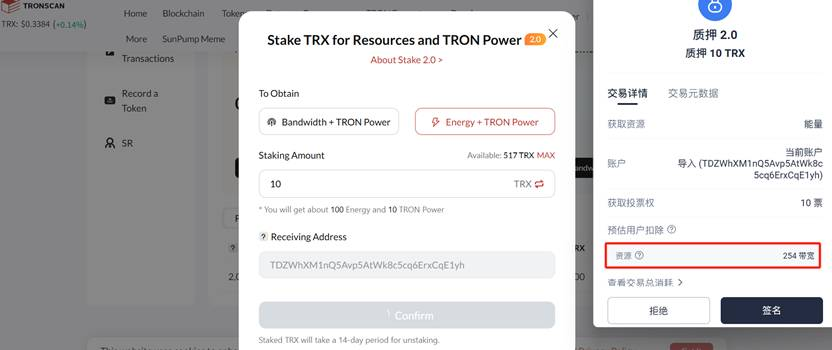
【Staking TRX consumes only Bandwidth】
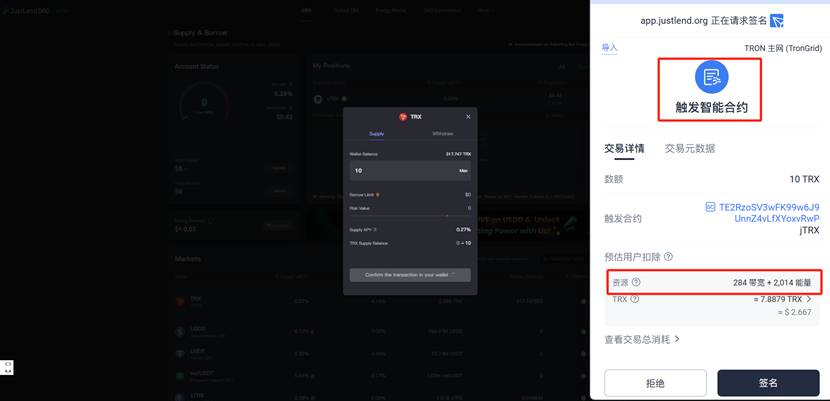
【Using JustLendDAO to deposit TRX triggers a smart contract, requiring both Energy and Bandwidth.】
This “Bandwidth + Energy” dual-resource design is what fundamentally distinguishes TRON from EVM networks like Ethereum, BNB Chain, and Base. On EVM chains, all operations are priced uniformly under Gas fees—whether it's a simple transfer or a complex smart contract call. Miners prioritize transactions with higher Gas fees, causing even small transfers to become extremely expensive during peak network congestion, with fee volatility far exceeding expectations. TRON’s separation of Bandwidth and Energy elegantly avoids these issues: simple transactions use Bandwidth, while complex contract operations are priced based on Energy usage. This ensures fairness in contract execution, enhances cost transparency and predictability, prevents ordinary users from being priced out, and avoids unnecessary resource waste during complex operations.
In terms of acquisition, Bandwidth and Energy share some similarities but also differ significantly: both can be obtained by staking TRX, but users receive 600 free Bandwidth units daily—enough to cover regular transfer needs. Once this free quota is exhausted, users may either stake TRX to obtain more Bandwidth or burn TRX directly at a fixed rate of 0.001 TRX per unit. Energy has no free allowance—every contract-related interaction requires Energy consumption, which scales with contract complexity. Thus, the unit price of Energy directly determines DApp usage costs. Each transaction first uses available Energy from the wallet address, and if insufficient, TRX must be burned to acquire more.
With growing TRON ecosystem activity—including increased USDT circulation and more DApp interactions—Energy consumption has risen year after year, and rising TRX prices have further driven up Energy costs. To reduce network Gas fees, TRON has slashed Energy prices twice since last September, each time by over 50%: first from 0.00042 TRX to 0.00021 TRX in September last year, then most recently on August 29 this year from 0.00021 TRX down to 0.0001 TRX—cutting Energy costs for smart contract operations by 60%. A quarterly dynamic adjustment mechanism was also introduced, where Super Representatives will review metrics like TRX price and network activity every quarter to optimize pricing and align costs with ecosystem demands.
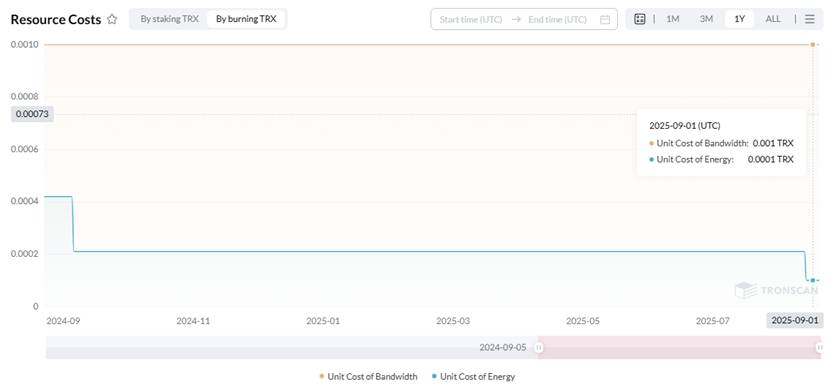
Currently, users can obtain Energy through three primary methods:
First, by staking TRX, which allocates daily Energy proportional to one’s share of total network staked TRX—for example, on September 5, each staked 1 TRX yielded 10 units of Energy;
Second, by burning TRX at the current rate of 0.0001 TRX per unit;
Third, via rental—temporarily using idle Energy staked by others. For instance, on JustLend DAO, 2.6 TRX can rent 100,000 units of Energy, sufficient for two transactions.
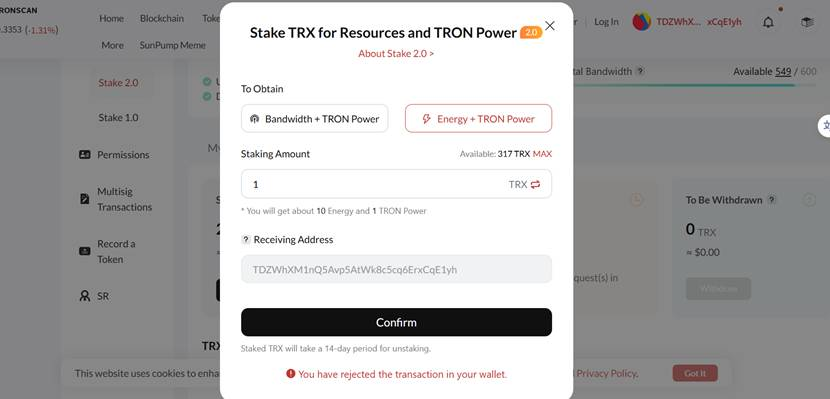
【Method 1: Acquire Energy by Staking TRX】
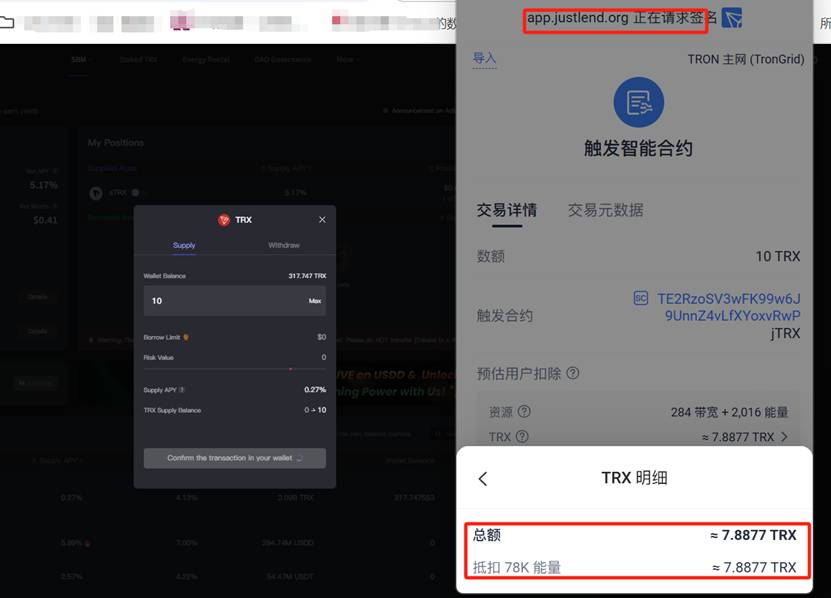
【Method 2: Directly Burn TRX to Obtain Energy】
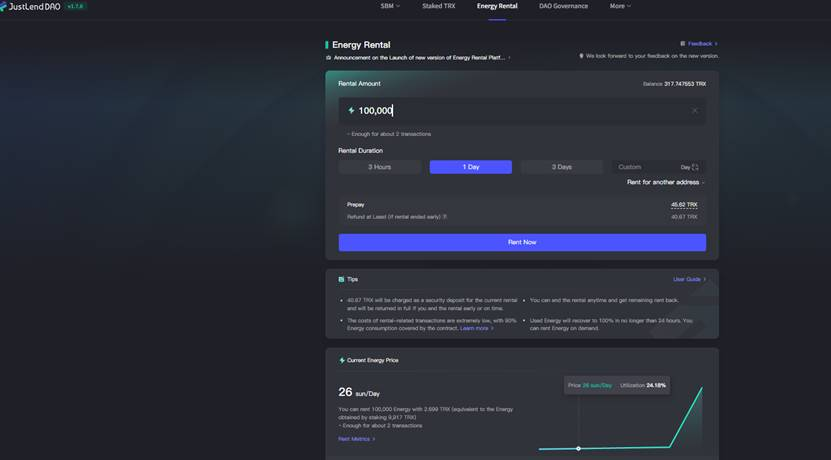
【Method 3: Rent Energy】
Among these, “Energy rental” stands out as a unique economic model within the TRON ecosystem, built upon the core feature of Energy sharing on TRON: users who stake TRX can share their allocated Energy with other addresses, granting any user permission to temporarily use idle Energy from others. Under the rental model, users don’t need to lock large amounts of TRX long-term—they pay a small fee to access needed Energy on-demand, meeting short-term on-chain operation needs.
Whether for individual USDT transfers, team-based contract development, or frequent project-level API calls, users can “rent as needed” with full flexibility. This rental model creates a win-win: users save costs while stakers earn passive income. For on-chain users, renting eliminates the need to permanently lock up TRX—by accessing platforms like JustLend DAO, they can rent Energy per use or per session to complete short-term tasks (e.g., participating in DeFi mining or minting NFTs), avoiding capital opportunity costs and significantly lowering the barrier to entry for complex DApp usage. For TRX stakers, renting out otherwise idle Energy generates additional rental income, transforming “staking TRX” from pure “ecosystem contribution” into a dual-value activity of “contribution + profit,” greatly improving capital efficiency.
A growing number of specialized Energy rental platforms have emerged in the market, including JustLend DAO’s official Energy Rental service and third-party platforms like Catfee and TRONEnergy. These platforms efficiently match supply and demand, offering diverse service models such as “per-use rental” and “customized plans,” allowing idle Energy to transcend the limitation of “personal-only ownership” and circulate efficiently across the ecosystem, unlocking greater resource value.
Today, the Energy rental economy has become a distinctive and vibrant financial use case within the TRON ecosystem. It reduces participation costs for everyday users, activates idle assets for stakers, and improves overall TRX staking efficiency through optimized resource allocation—strengthening TRON’s core competitive advantages of “low cost and high vitality” across user experience, asset value, and ecosystem circulation.
JustLend DAO’s Official Energy Rental Service: The Core Tool to Save Over 70% on Single TRON Gas Costs
Currently, on the TRON network, whether for occasional users or projects, developers, and traders requiring frequent contract calls, obtaining Energy via rental is the optimal choice. Compared to directly burning TRX for Energy, the rental model helps users save approximately 70%-80% on each smart contract operation (e.g., transfers, minting, lending).
JustLend DAO, a lending platform within the TRON ecosystem, pioneered its Energy Rental service back in 2023. Thanks to its advantages of “no staking required, secure, flexible, and cost-controllable,” it has become a core tool for reducing on-chain costs and currently serves as the largest Energy rental channel by user base on TRON.
The Energy rental market remains in its early stages, and many users remain concerned about “uncertain security of third-party platforms” and “opaque pricing.” As an official lending application in the TRON ecosystem, JustLend DAO manages over $8 billion in locked value (TVL), giving its Energy Rental service a strong foundation of trust. With fully transparent fees and no hidden costs, and direct integration with the TRON mainnet, it stands as the “go-to secure platform” for acquiring Energy.
According to official data, JustLend DAO’s Energy Rental service supplies over 50 billion units of Energy daily, sees over 10 billion units rented per day, and has attracted 68,300 cumulative users.
The operational logic of JustLend DAO’s Energy Rental service is straightforward—users can complete the entire rental process in just a few clicks, with no complex steps. Specifically, the process consists of three main stages:
1. Enter rental details: amount, duration, and recipient address.
Rental Amount refers to the quantity of Energy needed, with a minimum unit of 100,000 (note: a single USDT transfer typically requires around 120,000 units, so users should adjust accordingly);
Rental Duration supports hourly or daily rentals, with a maximum single period of 30 days. Users can choose based on their activity frequency—for example, selecting “1 day” for high-daily usage or “30 days” for long-term project development;
Recipient Address is the target address where Energy will be allocated. If renting for oneself, this field can be left blank; if renting for someone else, the correct address must be entered.
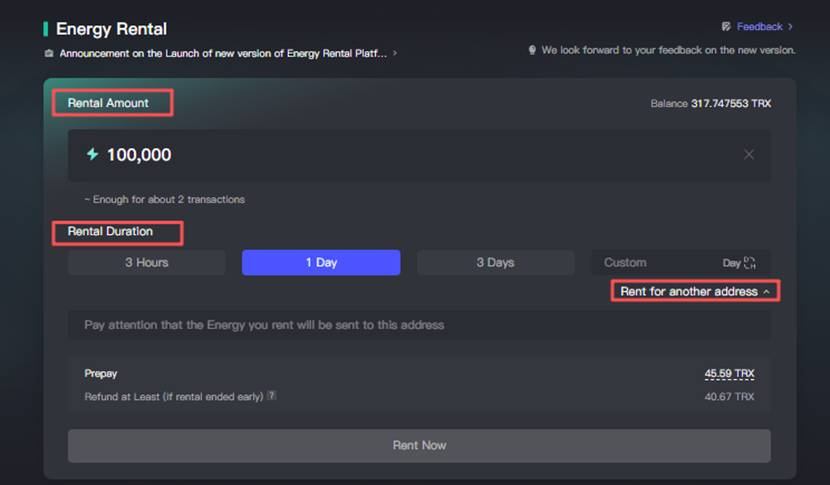
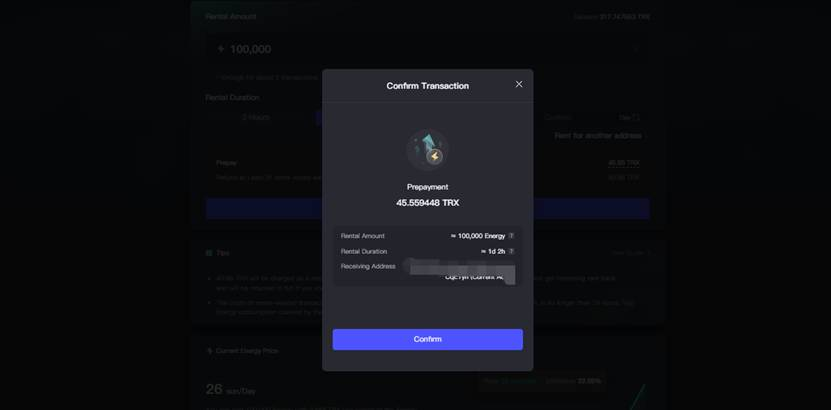
2. Submit the rental order and pay the prepayment: The rental uses a “prepayment model,” requiring three components: rental fee (core cost), deposit (refundable after rental ends), and penalty fee (a safeguard against misuse). All fee details are displayed in real-time with full transparency and no hidden charges.
For example, renting 100,000 units of Energy for 1 day requires a total prepayment of 45.5 TRX.
3. End rental and reclaim deposit: After completion, users can manage orders in real-time via the “Energy Rental interface,” including options to return Energy early (terminate rental), extend the rental period (with additional fees), or check remaining Energy and time.
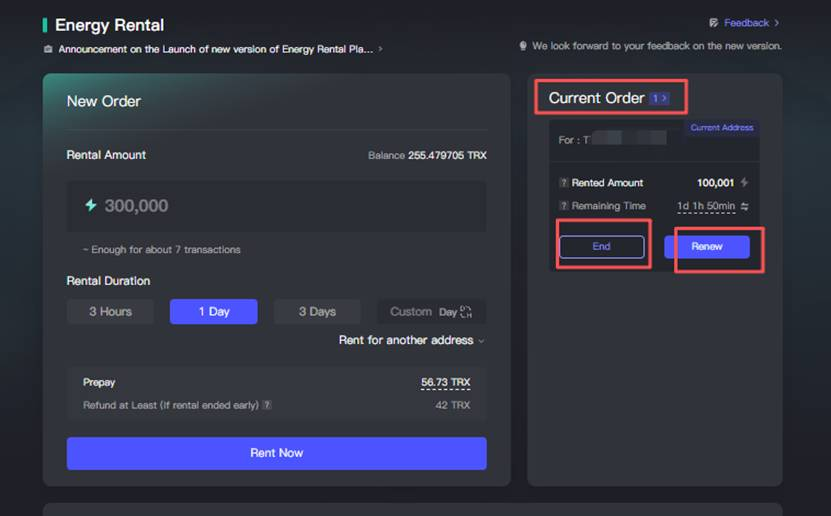
Tip: If only completing a single transaction, it’s recommended to return the Energy immediately afterward to avoid extra fees from idling. For users with frequent daily transactions (e.g., multiple DeFi actions per day), a 30-day long-term rental is advised.
In practical cost terms, JustLend DAO’s rental service offers clear advantages: taking a common USDT transfer on TRON as an example, burning TRX directly incurs an Energy cost of about $4.30, whereas renting via JustLend DAO costs only $1.17—saving over $3 per transaction, a reduction exceeding 70%.
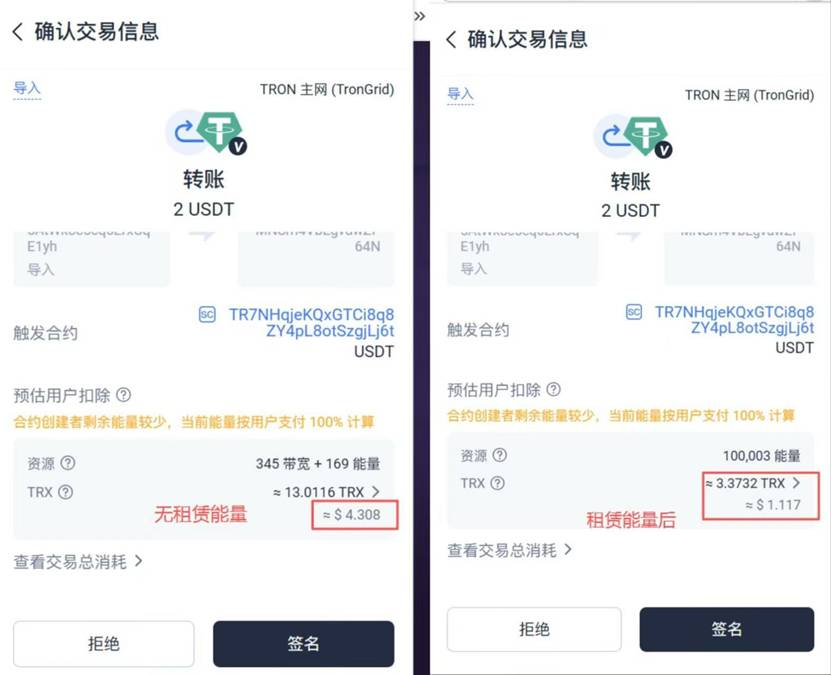
【Cost comparison: USDT transfer without vs. with Energy rental】
From the above workflow, three core advantages of JustLend DAO’s Energy Rental become evident:
First, no locked funds, maximum capital flexibility. Users don’t need to stake large amounts of TRX long-term to obtain Energy. Instead, they can “rent as needed,” matching Energy to actual requirements and avoiding the opportunity cost of long-term capital lockup—ideal for temporary needs like one-time NFT mints or short-term DeFi interactions.
Second, simple operation, supports diverse use cases. The service is open to all TRON users and supports “one-to-many” rentals—users can rent Energy for their own address or on behalf of others, meeting the needs of individuals, teams, and projects alike.
Third, controllable costs, ideal for high-frequency use. Having Energy directly offsets Gas fees for smart contract operations. For high-frequency traders such as GameFi players or DeFi arbitrageurs, long-term rentals help continuously suppress costs and prevent the issue of “accumulating excessive TRX burn fees.”
More importantly, following TRON’s 60% Energy price cut on August 29, JustLend DAO responded on September 1 by reducing its Energy Rental “base rate from 15% to 8%.” Users now enjoy a double benefit: reduced base Energy price plus lower rental rates.
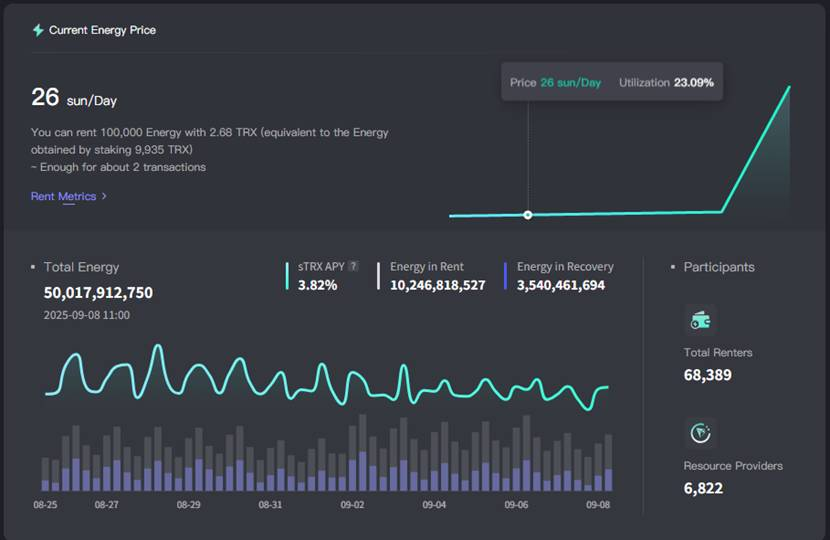
Currently, the Energy price on JustLend DAO is around 26 SUN per day—just 2.62 TRX to rent 100,000 units (equivalent to the Energy from staking 9,935 TRX), enough for two contract transactions, further amplifying its cost advantage.
JustLend DAO Launches GasFree Smart Wallet: Pay Gas Fees Directly with Transfer Tokens, Making Crypto Transfers as Simple as Sending a Message
To enhance user on-chain experience, JustLend DAO doesn’t just offer Energy Rental to reduce Gas costs. In March this year, it launched the innovative GasFree smart wallet feature, addressing a core pain point in crypto transfers: users no longer need to hold the network’s native token (e.g., TRX) to pay Gas fees. Whether transferring TRC20 or ERC20 tokens, transaction fees can be deducted directly from the transferred token itself. This mechanism breaks the traditional rule of “paying network fees with native tokens,” providing a frictionless Gas payment solution that brings crypto transfers closer to everyday usability.
But GasFree’s vision goes further: it aims to let users seamlessly transfer assets across different blockchains—including TRON, Ethereum, and others—all within a single interface, without needing to understand underlying technical details or prepare various native tokens in advance. Ultimately, GasFree seeks to make “crypto transfers as simple as sending an email,” while maintaining the security of decentralized environments and the interoperability required for global payments—bringing blockchain transfers truly into daily life.
This innovative “pay with what you send” design simplifies the previously cumbersome process of “swap for native token → initiate transfer → pay Gas” into just two steps: “initiate transfer → deduct corresponding token as fee.” This dramatically improves operational efficiency and significantly lowers the learning curve for new users, making crypto transfers more intuitive and user-friendly. Both beginners and experienced users can enjoy seamless asset sending and receiving, no longer burdened by the hassle of “gathering native coins for Gas.”
In April, TRON founder Justin Sun stated at the “BUIDL 2025” crypto conference in Hong Kong that for individual users, GasFree eliminates the need to worry about Gas fee calculation and payment; for institutional users, it represents a highly significant solution. Many institutions want to adopt blockchain for efficient settlement but prefer not to hold volatile cryptocurrencies. GasFree allows them to send and receive funds via address alone, without touching native crypto assets—greatly lowering the barrier to entry, driving broader ecosystem adoption, and promoting large-scale implementation of blockchain technology.
In the month following its launch, TronLink, a leading wallet in the TRON ecosystem, was the first to integrate the feature. Users simply need to open the TronLink app or browser extension, click GasFree, and immediately experience this new transfer method. Currently, the feature supports TRC20-USDT transfers, with plans to expand to more asset types. Additionally, to improve user experience, JustLend DAO introduced a 90% fee subsidy program. Under this policy, users pay only about 1 USDT per USDT transfer. Note: First-time users of GasFree in TronLink must pay a one-time activation fee, currently set at just 1 USDT.
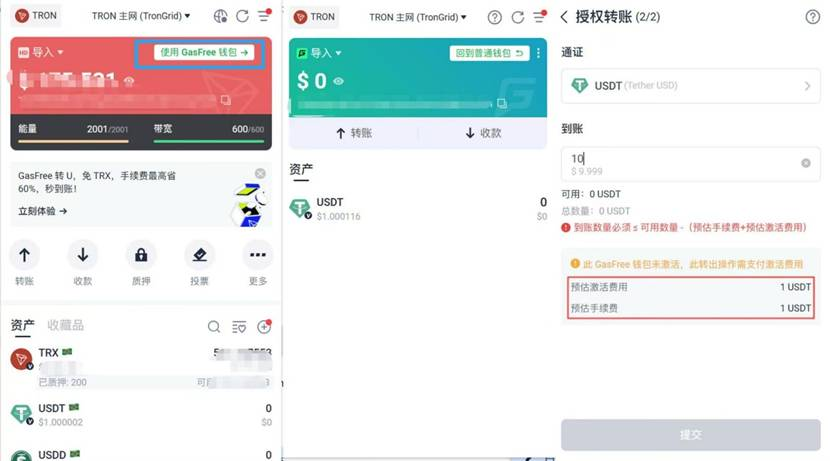
【Using GasFree to transfer USDT costs only 1 USDT】
To date, mainstream wallets including Guarda and Klever have integrated GasFree, with more platforms expected to follow, further expanding its reach.
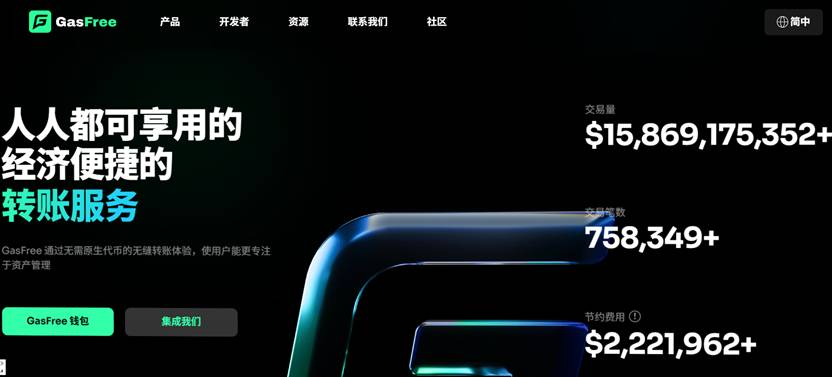
In practical impact, GasFree has already demonstrated strong ecosystem value: as of September 8, the feature has facilitated over $1.58 billion in transaction volume across more than 750,000 transactions, saving users nearly $2.2 million in Gas fees—clear evidence of its effectiveness in cost reduction and efficiency gains.
Beyond payment experience, GasFree excels in technical adaptability: it supports any TRC20 or ERC20 token without relying on specific token implementations, and provides standardized APIs and smart contract templates. Projects can “deploy instantly” with Gas-free transaction systems, drastically lowering the barrier for new tokens to join the ecosystem and expanding GasFree’s applicability and coverage.
To comprehensively reduce costs for users and developers, GasFree recently launched its Developer Center, offering an all-in-one suite of energy management tools including “Energy cost forecasting, automatic Energy rental, and optimization recommendations.” This helps developers control Energy consumption when integrating GasFree, streamlining DApp development and deployment so they can focus on product innovation without excessive concern over underlying network costs—achieving dual optimization of “user-side convenience + developer-side efficiency.”
The launch of GasFree marks another solid step forward in TRON’s continuous innovation and enhancement of user experience. As more wallets and platforms adopt the feature, users will enjoy lower transfer costs and simpler processes—not only improving interaction within the TRON ecosystem but also offering a practical blueprint for blockchain inclusivity through its pioneering model of “breaking dependency on native tokens.”
Join TechFlow official community to stay tuned
Telegram:https://t.me/TechFlowDaily
X (Twitter):https://x.com/TechFlowPost
X (Twitter) EN:https://x.com/BlockFlow_News