
The wind of crypto treasuries has finally reached Solana
TechFlow Selected TechFlow Selected
The wind of crypto treasuries has finally reached Solana
Solana's story is itself a testament to the incredible allure of the crypto world.
 Navigating Web3 tides with focused insights
By angelilu, Foresight News
Within just two days, Solana has attracted massive bets exceeding $2 billion from institutional investors managing tens of billions of dollars in assets.
SOL, which previously shined during the meme coin rally, is now following in the footsteps of BTC and ETH—will it succeed this time?
An increasing number of public companies are adding SOL to their balance sheets. With Solana's current market cap at $101.4 billion, according to The Block Dashboard data, publicly listed firms collectively hold 3.44 million SOL. At the article’s publishing price of approximately $190 per SOL, this amounts to roughly $650 million in value. Among them, Upexi alone holds over 1.82 million SOL, worth about $350 million.
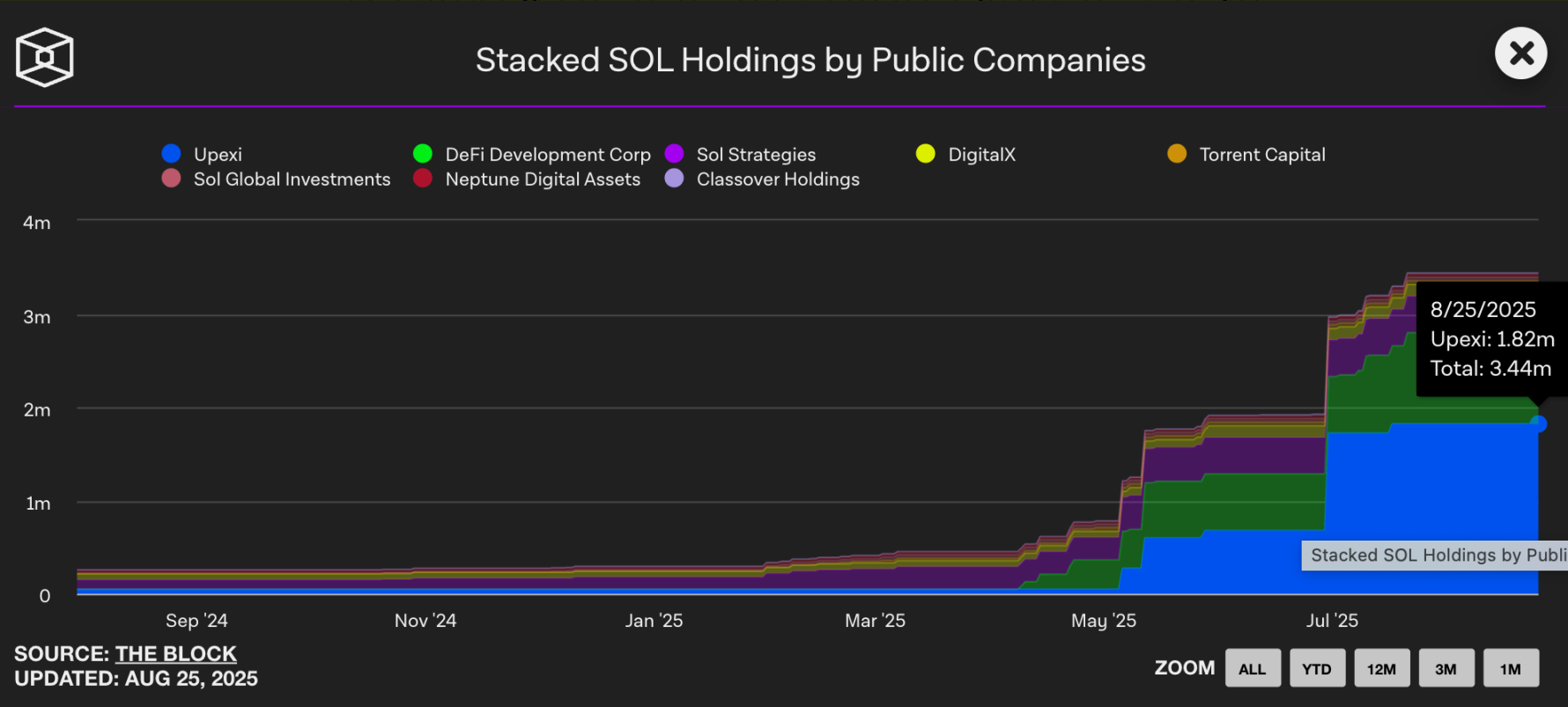
But a new wave of capital deployment is reshaping the landscape. Currently, public company holdings account for only 0.69% of Solana’s circulating supply. Meanwhile, Pantera Capital’s recent commitment of $1.25 billion, combined with Galaxy, Multicoin, and Jump’s joint pledge of $1 billion, will amount to 3.5 times the current total held by public companies.
Whales enter: A silent battle of capital
On August 25, Galaxy Digital, Multicoin Capital, and Jump Crypto officially announced a joint initiative. These three crypto investment giants are negotiating with potential backers to raise around $1 billion specifically for accumulating Solana tokens.
This is not a simple investment—it’s a carefully orchestrated market move. The trio has hired Wall Street veteran Cantor Fitzgerald LP as lead banker, planning to acquire an unnamed public company and transform it into a digital asset treasury firm focused on Solana.
Notably, the Solana Foundation has expressed support, and the deal is expected to close by early September.
This move isn’t isolated but part of a long-term strategy. Multicoin and Jump have previously made significant investments in Solana ecosystem projects. Galaxy Trading had earlier raised approximately $620 million specifically to buy SOL at a discount from FTX’s bankruptcy estate. Now, they’re joining forces to double down.
One day later (August 26), Pantera, led by former Tiger Management executive Dan Morehead, revealed its ambitious plan in a report by The Information—to raise up to $1.25 billion, acquire a Nasdaq-listed company, and restructure it into a Solana-focused investment vehicle named "Solana Co."
This isn’t a spontaneous decision. As early as April 2024, Pantera began raising over $1 billion for a new fund. Now, the true ambition behind this seemingly ordinary fund has surfaced—targeting the Solana ecosystem.
Most notably, Pantera isn’t acting alone. It has partnered with ParaFi Capital to back Sharps Technology, a company developing financial tools for Solana that is currently raising over $400 million. This series of moves reflects Pantera’s strong confidence in Solana’s future.
But Pantera’s strategy goes further. It is reported to have quietly invested around $300 million in digital asset treasury (DAT) companies across “various tokens and regions.” This approach not only generates returns but also increases net asset value, demonstrating the mature strategies of established investment firms in the crypto space.
Why Solana? The strategic logic of institutional capital
Smart investors excel at spotting opportunities amid crises. A comparison reveals that before Bitcoin and Ethereum treasury companies became popular, Pantera and Galaxy had already bought deeply discounted SOL tokens from FTX’s bankruptcy assets. Simply put, they’ve already made substantial profits from SOL.
The first batch of SOL tokens sold from FTX’s bankruptcy estate—between 25 million and 30 million tokens—was priced at $64 each, more than 60% below the market price at the time. The second batch was sold between $95 and $110 per token (15%–26% below market). Public records don’t disclose how much Pantera and Galaxy profited from FTX’s restructuring, but their aggressive new strategies clearly signal successful prior gains.
The rise of the digital asset treasury (DAT) model offers these institutional investors a novel way to capture value. Through this model, they can not only hold SOL for potential appreciation but also earn steady yields via various DeFi protocols, enabling multi-layered asset growth.
The large-scale entry of institutional capital will undoubtedly provide strong price support for SOL. Historically, when institutional investors begin systematically accumulating a crypto asset, it often triggers a relatively stable upward trend.
Ethereum has already demonstrated this. With the launch of ETFs and growing institutional participation, ETH has not only risen in price but also seen reduced volatility and a more mature market structure. Currently, 69 Ethereum treasury entities hold a combined 4.1 million ETH—about 3.39% of Ethereum’s circulating supply—valued at approximately $20 billion. Ethereum’s recent surge to a nearly four-year high was partly driven by purchases from these entities.
Now, Solana appears to be replicating this path, though still far behind BTC and ETH in scale. As more institutional holders join, SOL’s liquidity structure could undergo a qualitative shift, potentially leading to a more stable yet more concentrated ownership pattern. Moreover, after spot ETH ETFs were approved over a year ago for BTC and ETH, analysts have predicted that a spot SOL ETF could be approved this year.
Traditional financial institutions are eyeing Solana not out of impulse, but due to its unparalleled technical advantages. In balancing blockchain’s trilemma—decentralization, security, and scalability—Solana stands out with its remarkable transaction throughput and low gas fees.
While Ethereum still grapples with high transaction costs, Solana can process thousands of transactions per second at negligible cost. For institutional investors accustomed to traditional finance efficiency, this performance aligns better with their expectations.
More importantly, Solana’s expanding ecosystem of decentralized applications (dApps), NFTs, and DeFi protocols provides rich use cases and growth potential. This comprehensive ecosystem vitality is one of the key factors attracting institutional investors.
For developers and projects on Solana, this is undoubtedly good news. More capital means more experimentation, innovation, and real-world applications, potentially propelling the ecosystem into an accelerated development phase.
Specifically, the success of the digital asset treasury model may inspire more similar investment vehicles. This model not only offers institutions a convenient entry point but also presents a viable path for integrating traditional finance with the crypto world.
In the coming years, we may see a proliferation of investment firms focused on specific blockchain ecosystems, forming an entirely new institutional investment landscape.
Potential risks of power redistribution
When Solana was first created, few could have foreseen it would attract so much institutional attention within just a few years. From nearly collapsing due to FTX’s downfall to becoming a favored asset among institutional giants, Solana’s journey embodies the incredible allure of the crypto world.
This current wave of institutional investment may only be the beginning. As pioneers like Pantera and Galaxy set precedents, more traditional financial institutions may follow, incorporating Solana into their diversified portfolios.
However, the influx of institutional capital also brings new concerns. When a small group of institutions accumulates large amounts of SOL, it could re-centralize what was meant to be a decentralized asset, potentially undermining Solana’s network decentralization. SOL treasury company DeFi Dev Corp., while actively stockpiling tokens, has also indicated on Twitter that it will vote in favor of Alpenglow, a proposal aimed at making Solana “faster.” When ordinary users face complex technical proposals like this, will they simply follow the votes of major players, turning Solana into a chain optimized for big institutions?
Additionally, the risk of price manipulation may increase. If these large holders decide to adjust their positions, the market could experience severe volatility.
Join TechFlow official community to stay tuned
Telegram:https://t.me/TechFlowDaily
X (Twitter):https://x.com/TechFlowPost
X (Twitter) EN:https://x.com/BlockFlow_News
 Foresight News