Euro, gold, RMB: When will the "second half" of stablecoins arrive?
TechFlow Selected TechFlow Selected
Euro, gold, RMB: When will the "second half" of stablecoins arrive?
The story of stablecoins is gradually moving toward "multipolarity," with dollar-denominated stablecoins remaining the backbone of crypto finance.
 Navigating Web3 tides with focused insights
Author: Bulu Shuo
If someone asked you, "Have you ever used a stablecoin?"
Your mind would most likely immediately jump to USDT and USDC—the dollar-pegged stablecoins that have almost become synonymous with the term "stablecoin."
But what if they were referring to euro stablecoins, gold-backed stablecoins, or even the recently rumored yuan-denominated stablecoin? This actually reflects the true state of today’s stablecoin market: while the U.S. dollar dominates, the world of stablecoins is far more diverse than it appears.
These non-dollar stablecoins aren't trying to challenge the dollar's dominance—they serve differentiated needs. Some users adopt euro stablecoins to avoid currency volatility, others prefer gold-backed stablecoins as a safe-haven asset, and some see yuan stablecoins as a potential bridge for cross-border payments.
In other words, stablecoins are evolving from a single narrative centered on the U.S. dollar into a more complex, global, and pluralistic narrative.
Why pay attention to non-dollar stablecoins?
If stablecoins are the "lifeblood" of the crypto world, then dollar-pegged stablecoins are the dominant blood type. Over the past five years, USDT and USDC have consistently ranked first and second in the market, nearly monopolizing trading, clearing, and payment functions.
According to CoinGecko data, together they account for over 90% of the total stablecoin market capitalization—a dominance even greater than the dollar’s share in the global trade system—placing them in an undisputed leading position.
Source: CoinGecko
However, demand for stablecoins extends well beyond dollarization.
In Europe, daily payments, savings, and accounting systems are denominated in euros. Holding dollar-pegged stablecoins often exposes users to exchange rate fluctuations. In markets like the Middle East or Southeast Asia, while the dollar remains dominant for international settlements, local populations still have demand to anchor their funds in local currencies or other safe-haven assets. On a macro level, trends such as de-dollarization, regional monetary alliances, and the financialization of energy and resources have further amplified interest in stablecoins pegged to non-dollar assets.
In short, the current discussion around non-dollar stablecoins isn’t driven by any failure of dollar-pegged stablecoins, but by the fact that real-world and crypto-financial demands are becoming increasingly diversified. These varied needs form the foundational market for non-dollar stablecoins.
Recognizing that "stablecoins are no longer tools defined by a single narrative, but vary by user and use case," imToken has categorized stablecoins into multiple exploratory subgroups (see further reading: *Stablecoin Worldview: How to Build a Stablecoin Classification Framework from the User Perspective?*).
Under imToken’s classification framework, existing non-dollar stablecoin practices—based primarily on actual issuance and circulation—mainly include euro stablecoins and gold-backed stablecoins.
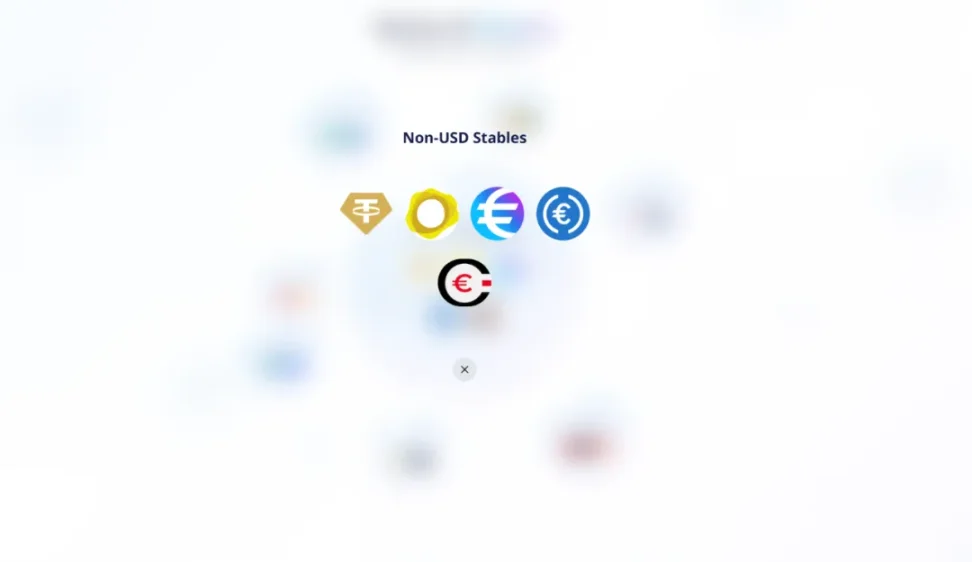
Source: imToken Web (web.token.im), Non-Dollar Stablecoins
Main Types of Non-Dollar Stablecoins
Among non-dollar stablecoins, the most practically significant are euro-pegged stablecoins.
The currently more mainstream offerings include EURC launched by Circle and EURS by Stasis. Both are pegged 1:1 to the euro and backed by reserves held by regulated financial institutions. Their target audience is not global crypto traders, but rather local European users.
For example, a German investor using USDT as a trading medium would face EUR/USD exchange rate risk every time they convert between fiat and the dollar-pegged stablecoin. By contrast, using a euro stablecoin allows on-chain transactions and settlements without incurring any currency conversion loss.
With the gradual implementation of EU regulatory frameworks like MiCA, the compliance and use cases for euro stablecoins are becoming clearer. This suggests that euro stablecoins could become the primary digital representation of local currency within European crypto finance. While their market cap is still far smaller than that of dollar stablecoins, their growth trajectory is clearly driven by policy tailwinds, indicating strong long-term penetration potential.
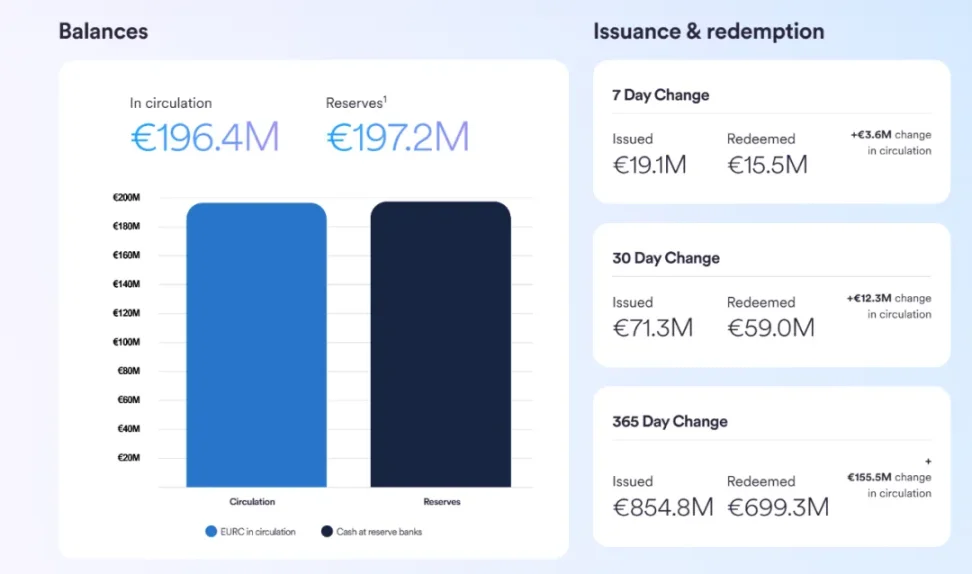
Source: Circle
Unlike euro stablecoins, which focus on local settlement convenience, another representative category is gold-backed stablecoins.
Gold has historically served as the "value anchor" of the global financial system. Even though the dollar abandoned the gold standard over half a century ago, central banks worldwide still regard gold as a core foreign reserve asset. In the crypto space, this traditional safe-haven asset has been tokenized and brought on-chain, with prominent examples including PAX Gold (PAXG) and Tether Gold (XAU₮).
Their mechanism is straightforward: each token represents one troy ounce of physical gold, stored by custodians (such as vaults in London or Switzerland). Users can freely transfer these tokens between wallets just like USDT, use them as collateral in DeFi protocols for lending or yield farming, or redeem them for physical gold. This combines gold’s traditional safe-haven properties with blockchain’s high liquidity.
Compared to physical gold bars or gold ETFs, the key innovation of gold-backed stablecoins lies in their divisibility and liquidity. Physical gold is typically measured in grams or ounces and difficult to divide into small amounts. While gold ETFs are easier to trade, they rely on traditional financial market clearing systems. Gold stablecoins overcome these limitations—representing real hard assets while enabling fast on-chain transfers and fractional ownership, significantly lowering the barrier to entry.
Of course, they’re not without drawbacks. Gold prices fluctuate due to global economic conditions, interest rates, and geopolitical risks, so gold-backed stablecoins don’t offer the near-perfect price stability of dollar-pegged ones. However, for those seeking diversified value storage on-chain, they provide a closer link to tangible assets.
Overall, euro and gold-backed stablecoins represent two distinct logics within the non-dollar stablecoin landscape: the former emphasizes regional currency convenience and regulatory compliance; the latter focuses on digitizing traditional safe-haven assets and enhancing liquidity. Together, they are shifting the stablecoin narrative away from a singular "dollar hegemony" toward a diversified global monetary ecosystem.
Where are non-dollar stablecoins headed?
From a macro perspective, the rise of non-dollar stablecoins will not diminish the dominance of dollar-pegged stablecoins in the short term. The dollar remains deeply entrenched in global crypto settlements and cross-border liquidity infrastructure.
Yet this doesn’t render non-dollar stablecoins meaningless. Instead, they serve as complements and expansions to the current system—offering new options for anchoring value beyond the dollar-dominated financial order.
Taking euro stablecoins as an example, their value lies in reducing currency friction for European users. Combined with regulations like MiCA, they have the potential to become foundational elements of regional digital finance. Gold-backed stablecoins, by merging traditional safe-haven attributes with blockchain liquidity, offer investors a new tool that balances value preservation with flexibility.
Beyond these, rumors of a yuan-denominated stablecoin have recently entered the crypto conversation. While it hasn’t yet achieved large-scale circulation, it benefits from both policy support and real-world demand in cross-border and regional trade settlements. Once integrated with compliant on-chain financial infrastructure, a yuan stablecoin could become a significant player in the broader de-dollarization discourse.
Nevertheless, non-dollar stablecoins face limitations:
First, limited liquidity. Compared to USDT and USDC, which operate at multi-billion dollar scales, non-dollar stablecoins generally have modest market caps, resulting in shallow secondary markets and lower adoption.
Second, narrow use cases. Euro stablecoins are largely confined to Europe, gold-backed versions are primarily used for value storage, and yuan stablecoins face constraints from policy windows and regulatory environments—making it difficult for them to achieve the global utility of dollar-pegged stablecoins.
Yet from a long-term view, the stablecoin narrative is gradually moving toward multipolarity. Dollar-pegged stablecoins will remain the backbone of crypto finance, while assets pegged to the euro, yuan, gold, and others will fill specific market needs across different dimensions.
They may not replace the dollar, but they are continuously expanding the boundaries of stablecoins and reshaping the structure and layers of the entire ecosystem. The future of stablecoins may not be about one currency winning, but about a coexisting, complementary system of multiple anchored assets.
Dollar-pegged stablecoins are just the beginning—not the end.
Join TechFlow official community to stay tuned
Telegram:https://t.me/TechFlowDaily
X (Twitter):https://x.com/TechFlowPost
X (Twitter) EN:https://x.com/BlockFlow_News
 @imTokenOfficial