"Staking, ETF, Treasury": Three Arrows Fired Simultaneously: Is Ethereum's Value Logic Being Rewritten?
TechFlow Selected TechFlow Selected
"Staking, ETF, Treasury": Three Arrows Fired Simultaneously: Is Ethereum's Value Logic Being Rewritten?
Ethereum is standing at an unprecedented node of "multi-narrative resonance."
 Navigating Web3 tides with focused insights
Author: imToken
Ethereum stands at an unprecedented node of "multi-narrative resonance."
On-chain, ETH staking continues to rise, gradually establishing itself as a "risk-free interest rate anchor"; in traditional finance, spot ETFs have been operating for over a year, with trading volume and net inflows rapidly increasing, signaling sustained accumulation by compliant capital; at the corporate level, more and more U.S.-listed companies are strategically adding ETH to their treasury reserves.
Staking, ETFs, and corporate treasuries—these three seemingly independent trends are now reinforcing each other, collectively driving ETH from a single cryptocurrency into a comprehensive financial asset with yield attributes, regulatory-compliant channels, and enterprise reserve value.
If Bitcoin's narrative is "digital gold," then Ethereum's story is quietly shifting toward "global ledger," reaching a pivotal "resonance moment" in 2025.
01 Staking steadily rises, ETH "benchmark rate" emerges
Since the Shanghai upgrade in April 2023 enabled withdrawals from staking, Ethereum completely resolved its long-standing exit bottleneck, unleashing growth potential within the staking ecosystem. Since then, LSD-based derivative markets have rapidly expanded, pushing ETH staking rates higher.
At the time of writing, staked ETH has surpassed 33.8 million, worth approximately $140 billion at current prices, accounting for over 25% of total supply—significantly up from around 10% just a few years ago. This not only strengthens network security but also enhances ETH's scarcity from a supply-demand perspective.
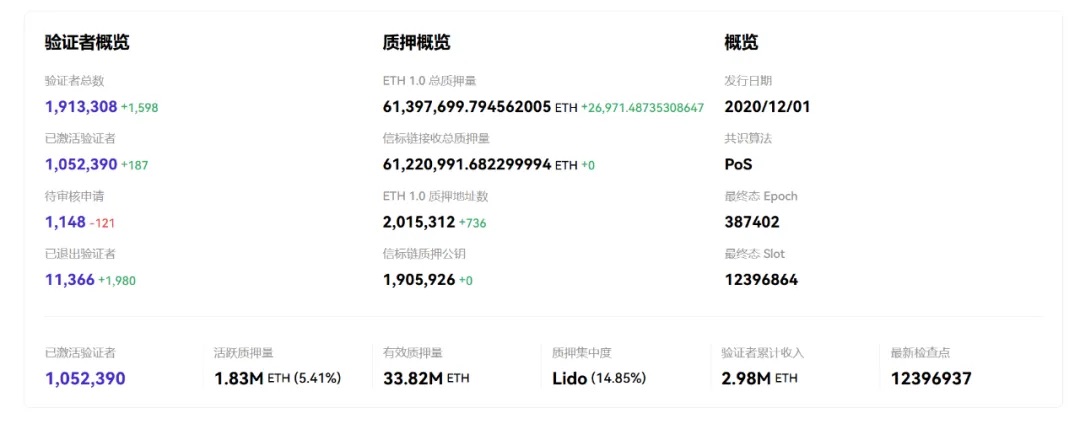
More importantly, ETH staking is gradually becoming the "interest rate anchor" of on-chain finance.
Over the past year, an annual staking return of 3%-5% has been widely accepted by the market, even regarded by some institutional research reports as the "on-chain equivalent of Treasury yields," forming an implicit parallel with U.S. Treasury yield curves. This characteristic transforms ETH from merely a tradable asset into one with the foundational logic of fixed-income products.
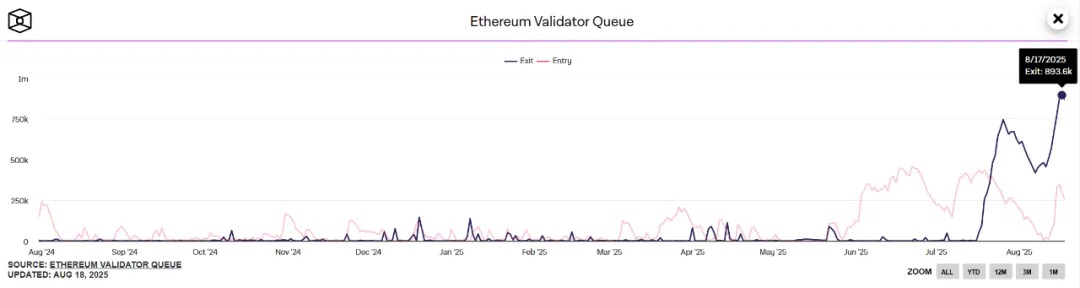
However, a notable reverse trend has recently emerged—since July 16, unstaking requests have surged dramatically. Validator exit requests jumped from under 2,000 to 475,000 by July 22, and wait times stretched from less than an hour to over eight days.
According to The Block, there are currently about 670,000 ETH (approximately $3.1 billion) in the exit queue, far exceeding new staking demand, with estimated processing time nearing 12 days. Rising prices leading to unwinding of leveraged staking positions, LST de-pegging risks, and arbitrage opportunities are the main drivers behind this large-scale unstaking, primarily originating from Lido, EthFi, and Coinbase.
Source: The Block
Despite short-term volatility caused by this unstaking wave, from a long-term perspective, ETH staking has increasingly become the "risk-free interest rate anchor" on-chain, forming one of ETH’s core financial logics.
Notably, U.S. Treasury yields remained in the 4%-5% range throughout 2024, making ETH staking yields relatively unattractive at the time. However, with the Federal Reserve opening a rate-cutting cycle in 2025, ETH's 3%-5% staking returns have regained competitiveness—even viewed as "excess returns" in certain risk models.
This implies a deeper implicit connection is forming between ETH's on-chain yield and global liquidity conditions. Protocols like EigenLayer, which enable re-staking, have already attracted over tens of billions of dollars worth of ETH, creating a chain reaction: "staking yield → re-staking premium → protocol security."
In other words, ETH is evolving beyond being just an asset—it is increasingly becoming foundational collateral for the Web3 financial system.
02 ETFs become primary channel for traditional capital
In May 2024, the U.S. SEC approved 19b-4 filings for eight Ethereum spot ETFs, which officially began trading on July 23, marking the formal opening of a compliant gateway between ETH and Wall Street. To date, Ethereum spot ETFs have operated for over a year.
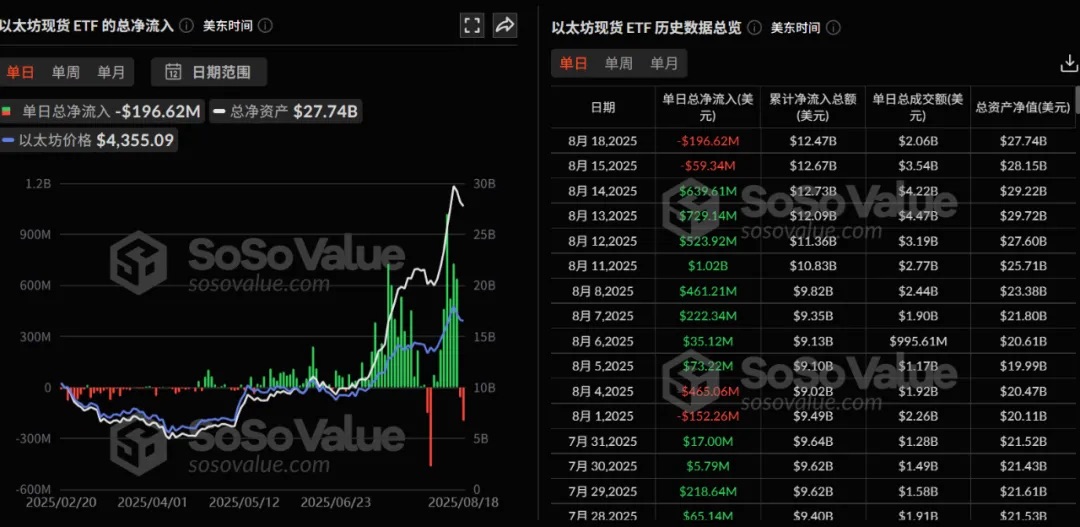
Objectively speaking, ETFs serve as a "compliance entry point," providing traditional institutions with direct access to ETH while reducing compliance friction in financial reporting and audits. According to SoSoValue data, the total net assets of U.S. Ethereum spot ETFs have exceeded $27 billion, roughly 5.34% of Ethereum’s market cap, with cumulative net inflows reaching $12.4 billion since launch.
Markets often overestimate the short-term impact of new developments while underestimating their long-term influence. The development of ETH spot ETFs exemplifies this pattern—the true breakout did not occur immediately. Before May of this year, daily trading volumes for ETH ETFs remained low, reflecting limited market interest.
Source: SoSoValue
The turning point came on August 11, 2025, when Ethereum ETFs recorded over $1 billion in single-day net inflows for the first time. BlackRock’s ETHA attracted $640 million, and Fidelity’s FETH drew in $277 million, highlighting the capital-siphoning power of these two giants. The institutional shift toward Ethereum ETFs is now evident.
The significance of ETFs lies not only in being a capital "channel," but also in providing a "legally recognized status" on compliance audits and financial statements, greatly reducing institutional barriers to holding ETH. Another profound implication is that it opens cross-border financial institutions' paths for arbitrage and portfolio allocation.
More importantly, concentration in ETF holdings is beginning to emerge. BlackRock and Fidelity together control two-thirds of the U.S. ETH ETF market. This consolidation not only creates a capital magnet effect but may also mean that ETH's "institutional pricing" characteristics will become increasingly pronounced in the future.
03 ETH accelerates onto U.S. public company balance sheets
If MicroStrategy represents a milestone case of public companies adding crypto assets to their balance sheets for BTC, then starting in 2025, ETH is entering a similar turning point.
An increasing number of U.S.-listed companies are now choosing to add ETH to their treasuries—not symbolically, but through large-scale, strategic allocations.
Take BitMine as an example. According to official disclosures, its crypto holdings now exceed $6.612 billion, up about $1.7 billion from $4.9 billion the previous week. BitMine holds 1.523 million ETH (valued at $4,326 per ETH), along with 192 BTC.
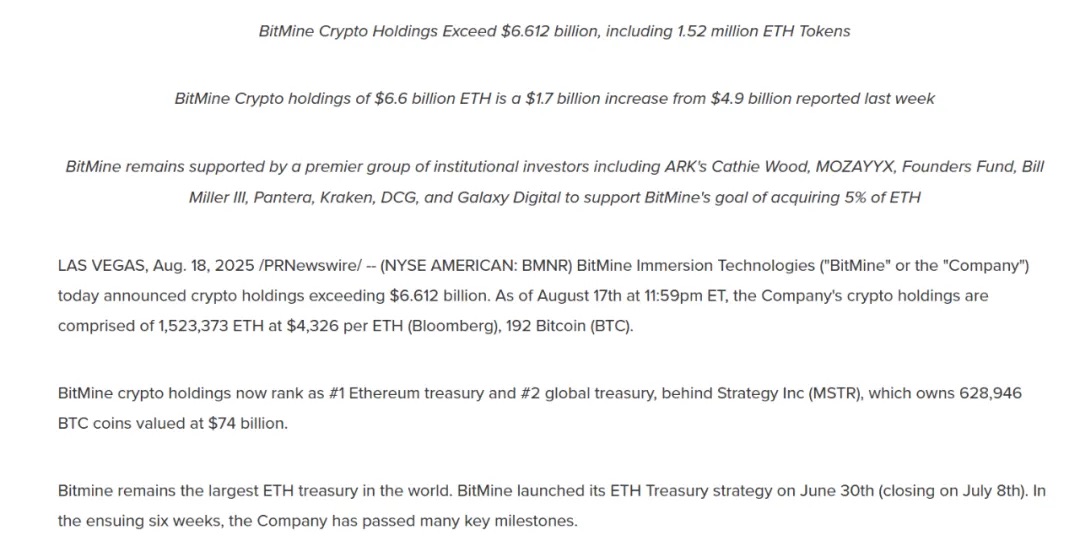
Source: BitMine
Meanwhile, Nasdaq-listed Cosmos Health announced a securities purchase agreement with a U.S. institutional investor for up to $300 million to initiate its ETH treasury strategy, leveraging BitGo Trust for custody and staking infrastructure.
This proactive treasury adoption differs from passive ETF allocations: ETFs mostly reflect product-level exposure demands, whereas direct corporate purchases and treasury inclusion indicate ETH is becoming a genuine settlement medium and reserve asset. Whether for financial diversification, cross-border payments, or employee and R&D incentives, ETH is beginning to demonstrate practical utility as a "liquid asset."
Overall, after enduring widespread skepticism in the last cycle, Ethereum's multiple narratives are now converging:
-
Staking yields provide ETH with a Treasury-like interest rate anchor;
-
ETFs open compliant capital allocation channels;
-
Corporate treasuries further endow ETH with real-world reserve and payment value;
These three forces intertwine, collectively propelling ETH from a "cryptocurrency" toward a "financial infrastructure asset."
If Bitcoin in corporate treasuries represents "digital gold," then Ethereum’s value narrative is progressively pointing toward being the "liquidity core of the global ledger."
Join TechFlow official community to stay tuned
Telegram:https://t.me/TechFlowDaily
X (Twitter):https://x.com/TechFlowPost
X (Twitter) EN:https://x.com/BlockFlow_News
 @imTokenOfficial