Hong Kong Stablecoins: Exploring the Balance Between Crypto Winter and the Rise of Digital Yuan
TechFlow Selected TechFlow Selected
Hong Kong Stablecoins: Exploring the Balance Between Crypto Winter and the Rise of Digital Yuan
Hong Kong's stablecoin strategy seeks a balance between innovation and stability in the post-crypto era of digital financial order.
 Navigating Web3 tides with focused insights
Author: Jeffrey Sze
Translated by: TechFlow

Hong Kong is becoming Asia's stablecoin hub. Image credit: Jeffrey Sze.
On August 1, Hong Kong’s Stablecoin Ordinance officially took effect, marking the city as the first jurisdiction in Asia to implement a comprehensive regulatory and licensing regime for stablecoins.
The Hong Kong Monetary Authority (HKMA) announced it expects to issue the first batch of stablecoin licenses by early 2027, and has already begun reviewing applicants and establishing operational frameworks.
This swift yet cautious advancement reflects Hong Kong’s deliberate attempt in digital finance—striving to balance innovation with stability to build a new financial order grounded in trust.
A Purpose-Built Regulatory Experiment
Unlike the U.S. model—where markets often outpace regulation—Hong Kong has embedded risk controls into its system from the outset.
The framework mandates 100% fiat currency reserves, strict audits, a minimum capital requirement of HK$25 million (approximately $3.2 million), and smart contract security verification. It aligns more closely with Singapore’s Payment Services Act or the EU’s Markets in Crypto-Assets Regulation (MiCA), but with a bolder vision: to become a clearing hub based on stablecoin settlements.
Currently, only applicants meeting stringent conditions are eligible to apply for a stablecoin license. Among numerous interested institutions, only three to four are expected to ultimately receive approval. This is understandable: ensuring stability and security means this game is reserved for giants.
Hong Kong Monetary Authority Chief Executive Eddie Yue previously emphasized, “Stablecoins are not investment or speculative tools, but rather a form of blockchain-based payment application that does not inherently possess capital appreciation potential.”
Stablecoins and Cryptocurrencies: From Power Coupling to Conscious Decoupling
Initially, stablecoins were indispensable partners within the cryptocurrency ecosystem.
They mitigated volatility, enabling exchanges and decentralized finance (DeFi) protocols to operate on a price-stable foundation. However, this relationship is changing. As regulation intervenes and financial sovereignty takes center stage, stablecoins are being redefined as independent financial instruments.
The role of stablecoins is shifting—from supporting tools for cryptocurrencies to fiat-pegged financial instruments gradually integrating into regulated monetary systems and cross-border settlements. Examples like HKDG (a Hong Kong dollar-pegged stablecoin) and CNHC (an offshore RMB stablecoin) highlight this evolution at the intersection of policy intent and financial engineering.
The logic is simple: only by operating under sovereign oversight and serving real-world economic use cases can stablecoins transcend their crypto origins and become legitimate new forms of money.

Digital payment terminal supporting Octopus cards and mobile stablecoin applications. Image credit: Jeffrey Sze, copyright 2025.
The Battlefield for Stablecoins: Competing Beyond Technology in Use Cases
Today, U.S. dollar stablecoins dominate over 90% of the global market share—not due to superior technology, but because of their entrenched position in global trade, on-chain finance, and pricing benchmarks. For Hong Kong dollar or offshore RMB stablecoins to gain traction, the key lies not in elegant design but in strategic deployment, such as:
-
HKDG could integrate with Octopus (public transit), e-commerce checkout systems, ticket refunds, and B2B reconciliation.
-
Offshore RMB stablecoins could support Belt and Road trade flows, energy payments, or remittances to Southeast Asia.
-
Real-world asset (RWA) platforms could pair with HKD/RMB stablecoins to offer custody services and liquidity pools.
Notably, JD.com’s fintech arm, JD Technology, has registered two stablecoin brands—JCOIN and JOYCOIN—in Hong Kong, signaling Chinese enterprises’ clear intent to actively enter the HKD and RMB stablecoin arena.
Global Strategy: The On-Chain Battlefield
According to data from CoinGecko, SlickCharts, and the Financial Times, as of August 2025, the global cryptocurrency market cap has surpassed $4 trillion—roughly equivalent to Japan’s GDP—with Bitcoin accounting for over 60%. This is a fast-moving, highly liquid, high-frequency trading ecosystem.
If HKD and RMB stablecoins can successfully penetrate this space, they will no longer be seen merely as wrappers for fiat currencies, but as full participants in on-chain finance. Leveraging Asia’s time zone advantage, Hong Kong’s real-world asset (RWA) issuance platforms, and compliant Web3 exchanges, Hong Kong could establish a liquidity node independent of dollar dominance.
In July 2025, the Shanghai State-owned Assets Supervision and Administration Commission began studying stablecoin and digital currency policies. Major tech firms such as JD and Ant Group have started actively lobbying Beijing to explore offshore RMB stablecoin models—indicating growing regulatory interest.
Against this backdrop, Hong Kong can serve both as a laboratory and a launchpad.
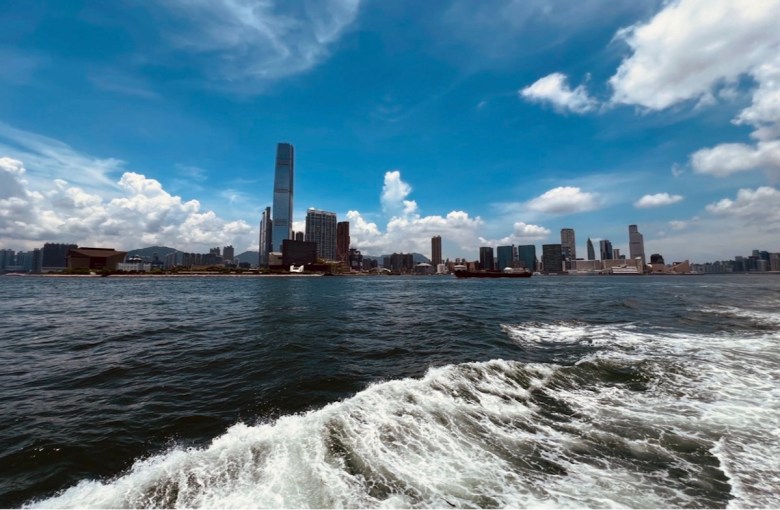
Hong Kong Central Business District, a critical node in Asia’s financial infrastructure. Image credit: Jeffrey Sze, copyright 2025.
Hong Kong’s Dual Role: Designer and Clearing Hub
Dollar stablecoins enjoy global influence backed by U.S. financial hegemony, but cracks in their system are emerging—from regulatory fragmentation to insufficient reserve transparency. Hong Kong is betting on an alternative model: a sovereign-backed, rules-driven, market-oriented digital currency system.
The goal is to bypass the centralization of central bank digital currencies (CBDCs) while avoiding the opacity seen in Tether. If successful, Hong Kong could evolve into a global stablecoin registry, digital asset issuer, and politically neutral hub for cross-border payments.
Until recently, banks viewed anything blockchain-related as “high-risk junk.” Yet under the new regulatory framework, traditional bank participation will be essential for the stablecoin ecosystem to scale.
Hong Kong must mobilize its local banks—to drive account opening, clearing participation, custody services, and lending—and embed the stablecoin architecture into the traditional financial system.

Cross-border container trade along the Belt and Road—potential application for RMB stablecoins. Image credit: Jeffrey Sze, copyright 2025.
A Bridge, Not a Destination
Today, stablecoins sit at the intersection of national regulation and Web3 innovation. They differ from the full state control of CBDCs and the complete decentralization of cryptocurrencies, forming instead an institutionalized middleware—operating commercially through technology under policy guidance.
Looking ahead, as e-HKD and e-CNY roll out features like smart contracts, cross-chain interoperability, and programmable taxation, they may inherit the most practical characteristics of the crypto world. We may soon witness the emergence of the first generation of sovereign-approved, natively on-chain currencies.
From this perspective, stablecoins are not the endgame, but transitional scaffolding. As sovereign nations progressively embrace fully digital fiat currency systems, stablecoins may eventually be superseded by e-HKD, e-CNY, or even a digital dollar.
But for now, they are bridges. Whether these bridges stand firm—and whether they lead us somewhere worth going—depends on Hong Kong’s ability to turn its regulatory ambitions into concrete action.
Jeffrey Sze is Chairman of Habsburg Asia (partially owned by the Habsburg family) and General Partner of Archduke United LPF and Asia Empower LPF. He focuses on high-end art trading and real-world asset tokenization (RWA-T). In 2017, he obtained a cryptocurrency exchange license in Switzerland.
Join TechFlow official community to stay tuned
Telegram:https://t.me/TechFlowDaily
X (Twitter):https://x.com/TechFlowPost
X (Twitter) EN:https://x.com/BlockFlow_News