WAIC 2025: AI will definitely continue to grow; avoiding becoming the "ultimate villain" is a challenge for humanity
TechFlow Selected TechFlow Selected
WAIC 2025: AI will definitely continue to grow; avoiding becoming the "ultimate villain" is a challenge for humanity
Not a consensus, but a consensus.
 Navigating Web3 tides with focused insights
Author: Jingyu
The World Artificial Intelligence Conference (WAIC) in Shanghai is back in the spotlight!
On July 26, 2025, this year's WAIC attracted over 1,200 guests from more than 30 countries and regions, including 12 recipients of top awards such as the Turing Award and Nobel Prize, over 80 academicians from China and abroad, and representatives from multiple leading international labs.
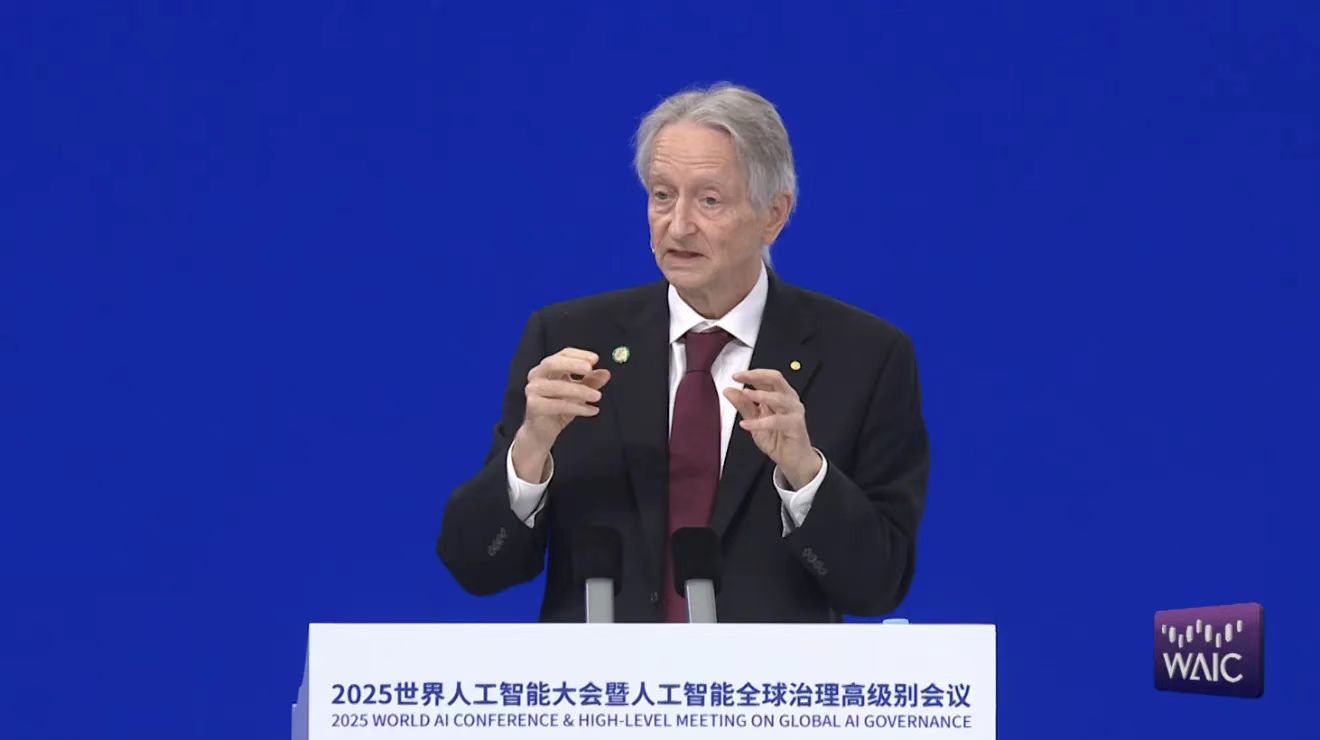
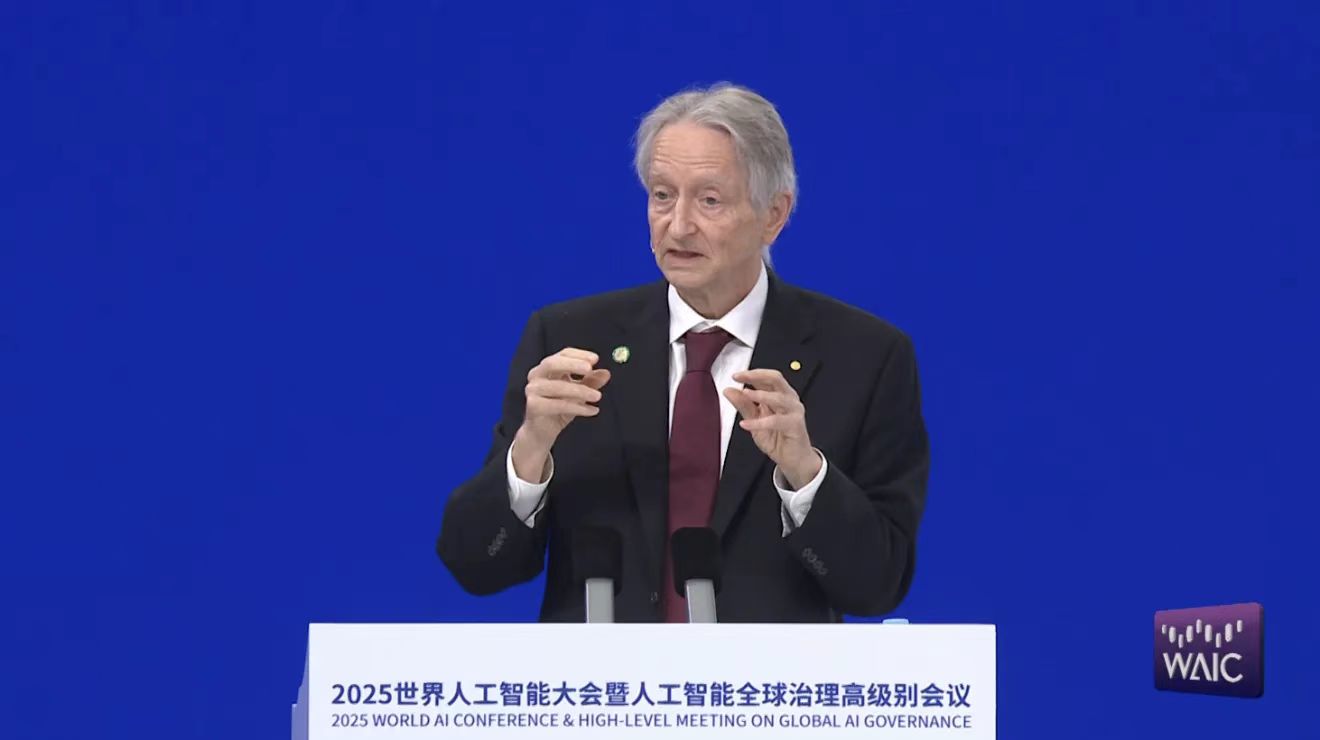
At the opening ceremony on July 26, Geoffrey Hinton, the 2024 Nobel laureate and widely regarded as a founding father of AI, delivered a speech. The prominent advocate of the "AI threat hypothesis" reiterated the dangers of uncontrolled AI development and called for a global "safety net" for AI research.
In addition, Yan Junjie, founder and CEO of MiniMax—one of China’s fastest-rising AI startups—stated during his talk that increasingly powerful AI has almost no growth limits, and with declining training costs, "future AI will be more inclusive and accessible."
Meanwhile, Peng Zhihui (aka Zhuihui Jun), co-founder and CTO of Chinese robotics startup Agibot, which recently faced rumors of a SPAC listing, brought his company’s robot Lingxi X2 onstage to perform a segment of "crosstalk," vividly illustrating the potential partnership between humans and robots.
Lion or Baby, Both Need Supervision
Despite having disciples dominating half of Silicon Valley’s AI landscape, Geoffrey Hinton, the “grandmaster” of AI, continues to oppose mainstream views, steadfastly upholding the "AI threat hypothesis."
At the WAIC on July 26, Hinton once again voiced his concerns about the rapid advancement of AI.
While briefly tracing the evolution of AI technology over the past 30 years to today’s large models, Hinton argued that current large models understand language similarly to humans.
"Humans might just be large language models, capable of generating hallucinations and creating illusory language just like LLMs," said Hinton—a view that strikingly aligns with the popular “human-as-machine” meme circulating on social media.
However, compared to human "carbon-based brains," AI's "silicon-based brains" have inherent advantages: they are storable, replicable, and instantly transferable. This means that, as technology advances, most experts agree it’s only a matter of time before AI surpasses human intelligence. As entities, these intelligent agents will inevitably seek "survival" and "control."
Hinton believes today’s AI may still be like a "three-year-old child," easily manipulated by humans—but future scenarios are uncertain. He likened current AI to a young lion, noting there are only two ways to handle such an animal: "Either train it not to attack you, or eliminate it."
Given the current pace of global AI development, no country can truly "eliminate AI" by halting technological progress. That leaves only one viable path forward: establishing a global AI safety organization to train AI to act benevolently.
"How do we train an AI that doesn’t want to dominate humanity? This is the ultimate challenge facing humankind," Hinton concluded.
Some Call for Regulation, Others Push for Deregulation
Such profound remarks from a leading figure like Hinton were thought-provoking at WAIC. Yet, in North America—Hinton’s home region—these warnings seem somewhat out of step with reality. OpenAI and Anthropic, companies founded by Hinton’s protégés, are now valued in the hundreds of billions of dollars, not to mention the massive venture capital investments poured into AI startups across Silicon Valley in recent years.
A clear indicator is the increasing lobbying expenditures by AI firms in Washington, which have led U.S. regulators to officially relax controls on AI development.
Earlier this week, on July 23 local time in the United States, President Donald Trump released an artificial intelligence roadmap (The AI Action Plan). In this document, U.S. regulators outlined strategies to secure America’s leadership in AI through data, standards, talent, and other areas:
-
Invest in R&D: Significantly increase long-term federal investment in fundamental and applied AI research, especially in next-generation AI, AI safety, and trustworthy AI.
-
Unleash AI Data Resources: Promote secure public access to vast federal datasets for AI researchers and the general public, providing high-quality "fuel" for model training.
-
Set AI Technical Standards: Lead government efforts, together with industry and academia, to establish global benchmarks, standards, and norms for AI technologies, ensuring AI systems are safe, reliable, explainable, and fair.
-
Cultivate an AI-Ready Workforce: Reform STEM education, expand apprenticeship and retraining programs, and attract and retain top global AI talent to build human capital for the AI economy.
-
Strengthen International Collaboration: Form AI alliances with allies and partner nations to jointly establish rules, counter the misuse of AI by authoritarian regimes, and promote open, democratic AI applications.
-
Protect Key Technologies: Enhance protection of critical U.S. AI technologies, algorithms, and hardware (especially semiconductors) via export controls and investment screening to prevent strategic competitors from acquiring them.
Clearly, the U.S. is accelerating AI development while leveraging geopolitical tactics to keep rivals from starting on equal footing.
The Robot 'Experience Era' Has Arrived
At this year’s WAIC, humanoid robots were unquestionably the biggest highlight.
During the main forum, Peng Zhihui ("Zhuihui Jun"), co-founder of Agibot, brought the company’s robot Lingxi X2 onstage for a performance of "human-robot crosstalk."
Crosstalk relies on speaking, imitating, humor, and singing; human-robot interaction hinges on mutual understanding. On stage, Lingxi X2 emphasized that collaboration between humans and robots must be built on "consensus." But how can such consensus be established, and what breakthroughs are needed for seamless human-robot collaboration? According to Zhuihui Jun, this is the core focus of their company—and success depends on walking this path together with others.
To this end, Zhuihui Jun announced the open-source "Agibot Lingqu OS" initiative, aiming to collaborate with more players to advance integration within the robotics ecosystem and breakthroughs in embodied intelligence.
Seemingly endorsing embodied intelligence, Richard Sutton, the 2024 Turing Award winner and professor of computer science at the University of Alberta, joined the conference via video link. He suggested that data available for training large models is nearly exhausted. But there’s no need for despair—this signals the dawn of AI’s next era: the Era of Experience.
Unlike training AI on static datasets, the next phase involves enabling AI to learn and grow through interacting with the external environment, much like a human infant gaining knowledge through experience. Though still some distance away, numerous robotics startups are already actively training and learning within the physical world.
This explains why leading experts such as Fei-Fei Li have transitioned from "AI" to "Physical AI," emphasizing that for artificial intelligence to truly integrate into the real world, it must understand and learn about the world from a three-dimensional perspective.
Join TechFlow official community to stay tuned
Telegram:https://t.me/TechFlowDaily
X (Twitter):https://x.com/TechFlowPost
X (Twitter) EN:https://x.com/BlockFlow_News
 极客公园
极客公园