
Long-read Analysis: Institutional Reserve Race Propels Ethereum Toward Becoming a Trillion-dollar Network
TechFlow Selected TechFlow Selected
Long-read Analysis: Institutional Reserve Race Propels Ethereum Toward Becoming a Trillion-dollar Network
As the second decade begins, Ethereum is entering its institutional era.
 Navigating Web3 tides with focused insights
Author: Obol Collective
Translation: Felix, PANews
Key Points:
-
Ethereum is entering a new decade and a new era. As the world's most secure and decentralized programmable blockchain, it has become the platform of choice for institutions. Just as Bitcoin earned the title of "digital gold," Ethereum's native asset is now gaining recognition as "scarce digital oil."
-
Institutions are racing to accumulate ETH as part of their long-term strategic reserves, with over 1.7 million ETH added to strategic ETH reserves in 2025. As these institutions increase their ETH holdings, it has become the first income-generating digital commodity.
-
ETH can be viewed as an internet bond, and staking offers institutions a risk-free way to earn yield. As Ethereum adoption grows, ETH becomes increasingly scarce, prompting institutions to focus on staking and distributed validators due to their security advantages.
-
Institutions recognize that Ethereum will drive the development of the global on-chain economy. This is one of the main catalysts for Ethereum’s future as a trillion-dollar network.
The Institutional Era of Ethereum Has Arrived
Institutions are embracing Ethereum. As major Wall Street players discover the potential of innovations like stablecoins, DeFi, and RWA, Ethereum is becoming their preferred decentralized platform. Institutions such as BlackRock, JPMorgan, and UBS are building on Ethereum because it dominates these verticals while offering significant decentralization and security advantages.
ETH is also emerging as a reserve asset. Over the past few years, several large corporations have added BTC to their balance sheets. Recently, however, a wave of public companies, DAOs, and crypto-native foundations have begun accumulating ETH as a long-term holding. Today, more than 1.7 million ETH (worth $5.9 billion) is locked in reserve holdings, doubling year-on-year in total reserve value.
Ethereum is the next global financial layer. Institutional investors are reserving ETH because they recognize ETH as the monetary foundation of this layer. ETH is the first digital asset to combine reliable neutrality, scarcity, utility, and yield. While BTC is recognized as the first reserve asset in cryptocurrency, ETH is the first income-generating reserve asset.
This report focuses on the first institutions adopting ETH as a strategic reserve asset. It also looks ahead to explain how these institutions will next stake ETH, the role distributed validators will play in establishing institutional staking standards, and why the race to adopt ETH as a reserve asset will become a trillion-dollar catalyst for Ethereum.
1. Why Institutions Prefer "Digital Oil" Over "Digital Gold"
Bitcoin rightfully earned its status as the world's first digital gold. Bitcoin is a non-sovereign store of value with unique properties that appeal to institutions. But Ethereum is a more dynamic asset because it powers the global on-chain economy. As the world moves on-chain, Ethereum’s utility and scarcity will rise together. If Bitcoin is digital gold, then Ethereum is digital oil.
The trend of institutions favoring digital oil over digital gold is expected to continue over the next decade. There are three reasons:
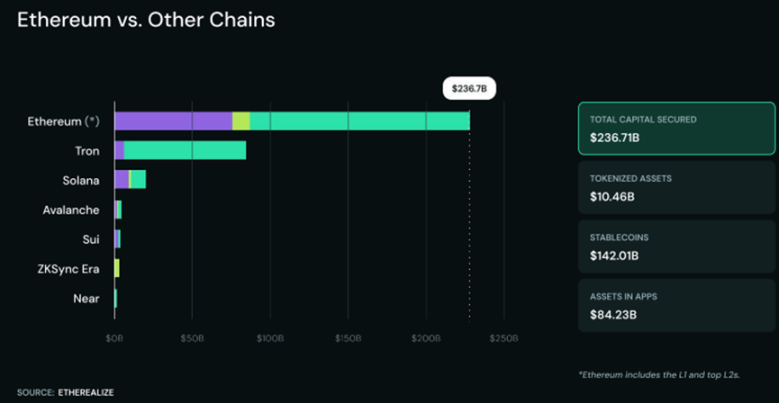
1. BTC sits idle; ETH builds. Bitcoin succeeded by serving as a passive store of value. In contrast, Ethereum succeeds by remaining highly productive. Ethereum is the essential fuel for the world’s most decentralized and secure smart contract blockchain. Every transaction in Ethereum’s vast DeFi ecosystem, every NFT mint, and every Layer 2 settlement requires ETH as gas fees. Since the launch of EIP-1559 in August 2021, approximately 4.6 million ETH (worth about $15.6 billion at current prices) has been burned, demonstrating the asset’s role as digital oil in the on-chain economy. Today, Ethereum secures around $237 billion in value across L1 and top L2 networks. As more of the global economy shifts on-chain, demand for ETH will continue to grow. Ethereum holds 57% of the RWA market and 54.2% of total stablecoin supply. In short, Ethereum leads across multiple metrics, and ETH powers its ecosystem.
2. BTC leans inflationary; ETH turns deflationary. BTC has a fixed supply schedule with a current issuance rate of about 0.85%, programmed to decrease over time. As block rewards halve every four years, miners will increasingly rely on transaction fees for revenue. Some argue BTC’s security budget poses a potential threat. Ethereum uses a different monetary policy tied directly to economic activity. ETH issuance is capped at 1.51% to incentivize network security, but since about 80% of transaction fees are burned via EIP-1559, net ETH issuance has averaged only 0.1% annually since The Merge. ETH frequently experiences net deflation, and as demand for Ethereum block space grows, the total supply (currently slightly under 120 million ETH) is expected to decline. In other words, as Ethereum grows, ETH becomes increasingly scarce.
3. BTC generates no yield; ETH is a yield-bearing asset. Bitcoin itself does not generate yield. But ETH is a productive digital commodity. ETH stakers can lock up Ether as validators and currently earn around 2.1% real yield (nominal yield minus new issuance). Stakers receive ETH issuance and a portion of transaction fees (the portion not burned), with no counterparty risk, incentivizing long-term holding and active network participation. What sets ETH apart from all other major crypto assets is that validator yields increase as Ethereum’s economic throughput expands.
ETH as the Leading Global Reserve Asset
ETH has become the leading global reserve asset due to its unique combination of properties. ETH uniquely satisfies three core requirements in ways no other asset can:
Pure settlement collateral. As new economies build on tokenized assets exposed to issuer and jurisdictional risks, the financial system needs a trust-minimized, non-sovereign collateral asset. That asset is ETH. Alongside BTC, ETH is the only “pure” collateral in the on-chain economy fully insulated from external counterparty risks. With $237 billion in secured value, ETH forms the censorship-resistant foundation of the next-generation financial system.
Liquidity. ETH is the most liquid and dominant asset in DeFi trading pairs. ETH plays a role in the on-chain economy similar to the US dollar in traditional foreign exchange markets. ETH’s deep liquidity and broad utility drive DAOs, foundations, and public companies to hoard ETH as a strategic asset. “Strategic ETH reserves” are rapidly expanding, and holders benefit from its programmability. While BTC sits idle in treasuries, ETH can be deployed through use cases like staking and collateralized lending.
Protocol-native yield. Corporate treasurers seek yield, but earning it without taking on significant credit or counterparty risk is difficult. ETH staking offers 2–4% risk-free yield, directly sourced from L1 staking rewards. This gives treasurers an efficient, cash-flow-generating tool to hold in reserves, aligning their balance sheets directly with the growth and security of the new economy’s base layer.
"Internet Bonds"
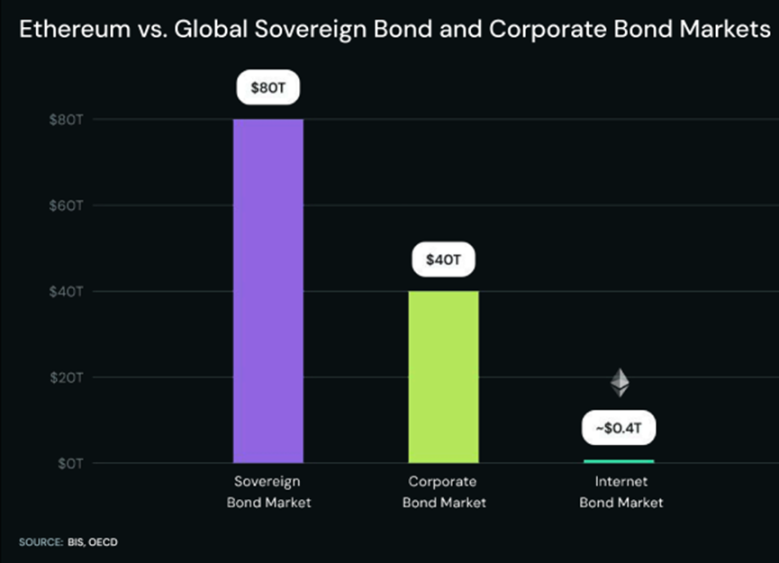
With staking generating protocol-native yield, ETH has become the world’s first “internet bond.” Historically, corporate treasurers allocate capital to sovereign bonds (worth ~$80 trillion) and corporate bonds (worth ~$40 trillion). ETH staking creates a new bond category with well-understood issuance, risk, and yield profiles. Today, this market is orders of magnitude smaller than sovereign and corporate bond markets. But unlike corporate and sovereign bonds, ETH has no maturity date—its yield is perpetual. Because yield is protocol-generated, ETH staking eliminates counterparty risk; there is no issuer default risk.
ETH is a global, censorship-resistant commodity whose yield is independent of traditional interest rate cycles. Currently, the Fed funds rate ranges between 4.25% and 4.5%. Meanwhile, ETH stakers earn a real yield of about 2.1%. As borrowing costs fall, capital allocators tend to favor risk assets over short-term Treasuries. Institutional interest in Ethereum staking even when Treasury yields are higher indicates strong conviction. If rates fall, these institutions could benefit from higher-yielding underlying assets, which may also appreciate as market risk appetite rises.
2. Institutions Racing to Accumulate ETH
Cryptocurrencies have firmly established themselves as a legitimate asset class, with Bitcoin as the gateway for institutional entry. But Ethereum represents its natural evolution. Ethereum combines Bitcoin’s store-of-value appeal with native yield and secures the growing on-chain economy of stablecoins, RWA, and DeFi. Strategic Ethereum reserves highlight this shift: institutions are hoarding ETH as a long-term strategic reserve asset.
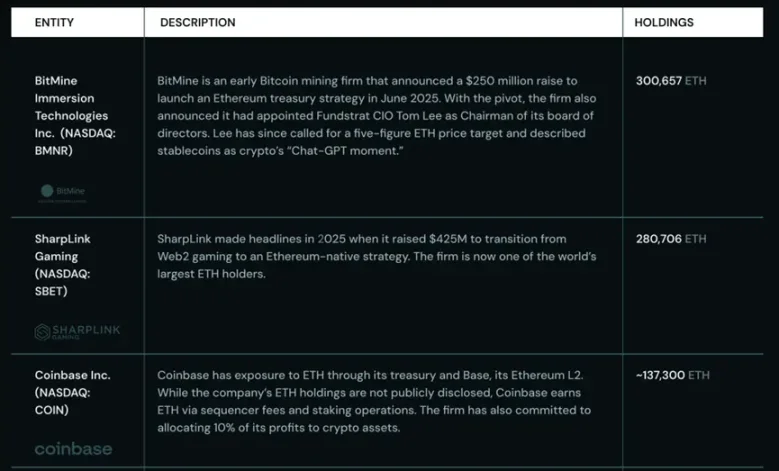
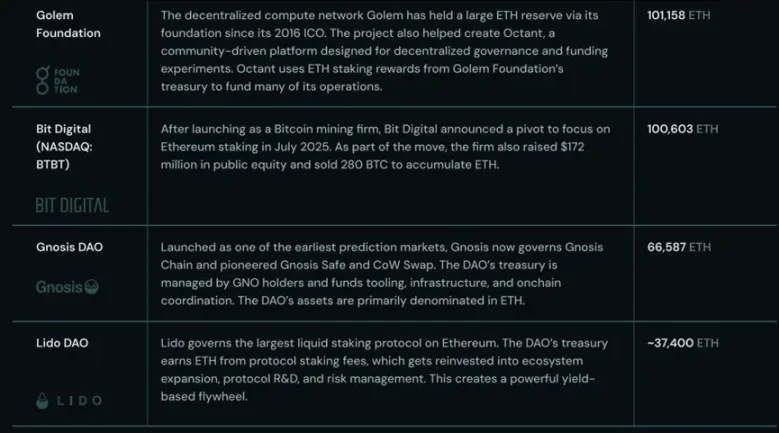
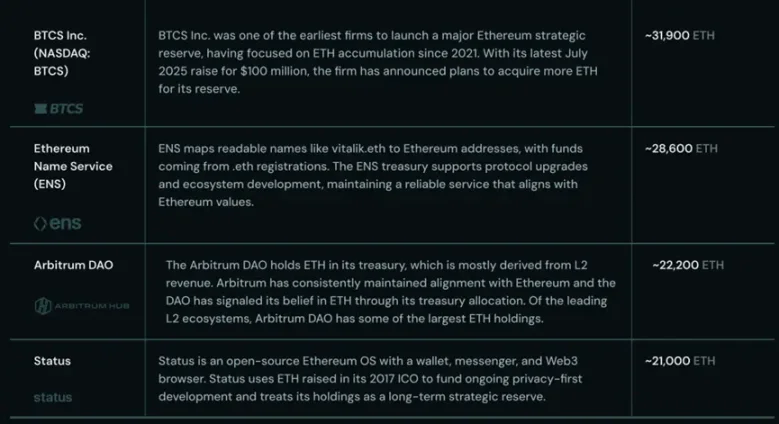
Many public companies and Ethereum-native organizations have implemented ETH treasury strategies. Most aim to generate yield, while others view ETH as the foundational currency for long-term operations. Many organizations do both.
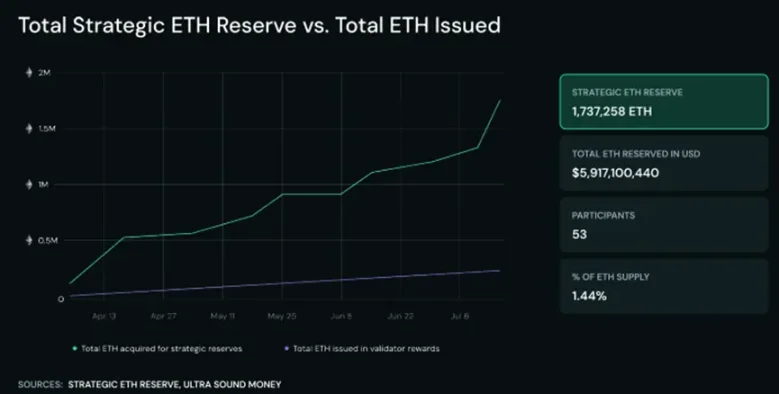
Data shows that approximately 1.7 million ETH (worth about $5.9 billion, or 1.44% of supply) is now held in strategic reserves.
Since the strategic reserve race intensified in early Q2, the amount of ETH accumulated by institutions has far exceeded ETH issued to validators. As this race intensifies, ETH faces increasing deflationary pressure.
3. ETH as a Yield-Bearing Asset
Clearly, institutions are adopting the Ethereum network, and ETH has become their preferred companion asset. Signs suggest that as Treasury yields decline, institutional demand for ETH staking will surge, as institutions seek real returns on capital—and staking provides that return at minimal risk. Distributed validators play a key role here, as institutions prioritize security and reduced counterparty risk in their capital allocation strategies.
Why staking wins (and how distributed validators fit in)?
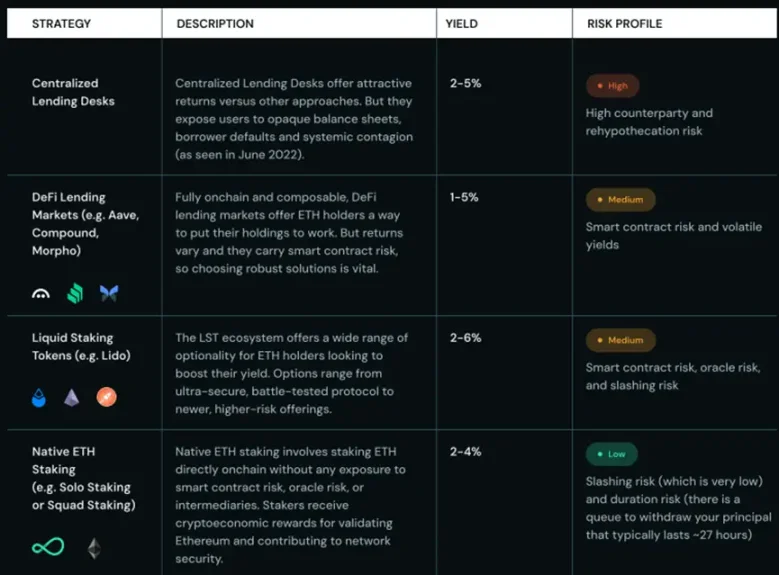
ETH staking is structurally different from all other ETH yield options because it offers predictable, protocol-level yield tied to security incentives and network adoption.
Among all possible yield strategies available to Ethereum holders, staking is the only one that introduces no borrower, counterparty, or credit risk.
Institutions like Bit Digital that are aligned with Ethereum have recognized staking as the optimal way to earn yield on their holdings. As more institutions adopt strategic ETH reserve strategies, staking in turn attracts more institutions by offering a low-risk way to earn yield from the “internet bond.”
For yield-seeking institutions, ETH staking is the best path forward, offering near-risk-free yields compared to other strategies.
However, while treasurers recognize native staking is clearly the strategic choice, they must consider other factors. For these institutions, the question is not just whether to stake, but how to stake in a way that ensures institutional-grade security and resilience. While traditional validators work, they create single points of failure. Distributed validators (DVs) solve this problem. Distributed validators feature:
-
A single Ethereum validator (staking 32+ ETH) spread across multiple nodes.
-
Use of distributed key generation (DKG) to eliminate single private key risk.
-
Remain functional even if up to half the nodes go offline.
-
Deliver performance equal to or better than traditional validators.
Although the distributed validator (DV) space is still nascent, many institutions building strategic Ethereum reserves are already using DVs. They benefit from:
-
Institutional-grade key security: DV keys are never stored in a single location and cannot be accessed by any single operator, providing users with a higher level of security.
-
Fault tolerance: Users avoid risks associated with individual operators, such as penalties or missed rewards.
-
Middleware design: Top global staking operators trust middleware infrastructure like Obol’s Charon, giving them a way to decentralize operations without major modifications.
-
No need to hold long-tail assets: Treasuries don’t need to acquire long-tail assets to stake Ether. No need to worry about collateral, margin, or liquidation mechanisms.
4. Why ETH Holds Trillion-Dollar Potential?
ETH is no longer a misunderstood speculative asset. Following Bitcoin, Ethereum is becoming an institutional asset held by major corporations, DAOs, and other institutions. But ETH has advantages BTC lacks: it is the foundation of the Ethereum network, which is the cornerstone of the next-generation financial system. As the first “productive” reserve asset, ETH combines trust-minimized value storage, settlement collateral, and yield-bearing reserve functions.
Ethereum lays the foundation for the next-generation financial system. Institutions now recognize this.
As adoption increases, ETH’s unique position makes it poised to become even scarcer. As Ethereum’s base currency, ETH features deflationary mechanics that reduce its supply as the network grows. No other asset combines these traits with credible neutrality.
In Ethereum’s first decade, it established the foundational layer for transformative innovations like DeFi, stablecoins, NFTs, and ICOs.
With the start of its second decade, Ethereum is entering its institutional era. Companies are viewing ETH as the premier “productive” asset, and the accumulation race is accelerating. In this new era, Ethereum’s path toward becoming a trillion-dollar network has never been clearer.
Join TechFlow official community to stay tuned
Telegram:https://t.me/TechFlowDaily
X (Twitter):https://x.com/TechFlowPost
X (Twitter) EN:https://x.com/BlockFlow_News
 @Obol_Collective