U.S. House Passes Procedural Vote to Advance 3 Crypto Bills, Genius Bill Expected to Be Signed This Week
TechFlow Selected TechFlow Selected
U.S. House Passes Procedural Vote to Advance 3 Crypto Bills, Genius Bill Expected to Be Signed This Week
The U.S. House of Representatives' latest vote on three cryptocurrency-related bills lasted over nine hours, setting a record for the longest procedural vote in House history.
 Navigating Web3 tides with focused insights
By: Weilin, PANews
On July 17 (Wednesday local time), the U.S. House of Representatives passed a procedural vote on three major cryptocurrency bills, paving the way for upcoming votes on the GENIUS Act, the Clarity Act, and the Anti-CBDC Act, expected to take place on Thursday local time.
Although July 14 was announced as "Crypto Week" in the House, the actual voting process faced significant setbacks. On Tuesday afternoon local time, the House voted 196–223 to block advancement of the three proposals, with 12 Republicans opposing due to concerns over ambiguity in the GENIUS Act regarding CBDCs.
9-Hour Vote Sets Record! Three Bills Finally Advance, GENIUS Act Moves Fastest
The latest procedural vote on July 17 (Wednesday local time) lasted over nine hours, setting a record for the longest procedural vote in House history. Ultimately, around 11 p.m., House Resolution 580 passed, allowing consideration of multiple bills by a vote of 217–212. Just one day earlier, this resolution had unexpectedly failed to clear the House procedurally.
The deadlock was resolved when House Majority Leader Steve Scalise announced that Republicans would attach the CBDC ban to the National Defense Authorization Act (NDAA), ensuring the CBDC prohibition would pass alongside the must-pass NDAA. This shift convinced eight conservative Republicans who had previously blocked the bill to change their votes.
According to PunchBowl News, after the vote succeeded, House Majority Leader Steve Scalise stated that the next round of House votes on these cryptocurrency bills would take place on Thursday.
Of the three crypto-related bills, the GENIUS Act is currently seen as making the fastest progress. The bill aims to establish a regulatory framework for stablecoins and already passed the Senate last month. The GENIUS Act could be sent to President Trump for signature before the end of this week.
The other two proposals include the Clarity Act (Clarifying Law Around Digital Assets), which takes a broader approach to establishing a regulatory framework for digital assets and clarifies the roles of the Securities and Exchange Commission (SEC) and the Commodity Futures Trading Commission (CFTC).
Lawmakers also voted to consider the Anti-CBDC Act, designed to prevent the Federal Reserve from issuing central bank digital currencies directly to individuals. However, even if passed by the House, both the Clarity Act and the Anti-CBDC Act still need to go through Senate voting.
President Trump Personally Meets With Lawmakers, Calls to Push Legislative Process Forward
According to Politico, the breakthrough in Wednesday’s deadlock came at the final moment of negotiations when President Trump called into Speaker of the House Mike Johnson’s office and expressed satisfaction with the agreement reached.
As early as the morning of July 15 local time, Trump posted on Truth Social: “Happy Crypto Week! The House will soon vote on a major bill aimed at making America the undisputed global leader in digital assets,” urging House members to support the procedural vote.
However, on Tuesday, the House rejected the rule advancement proposal by 196–223, with 12 Republicans opposed, citing concerns over ambiguity in the GENIUS Act regarding CBDCs—despite the fact that the GENIUS Act actually contains provisions explicitly prohibiting the Federal Reserve from creating a CBDC.
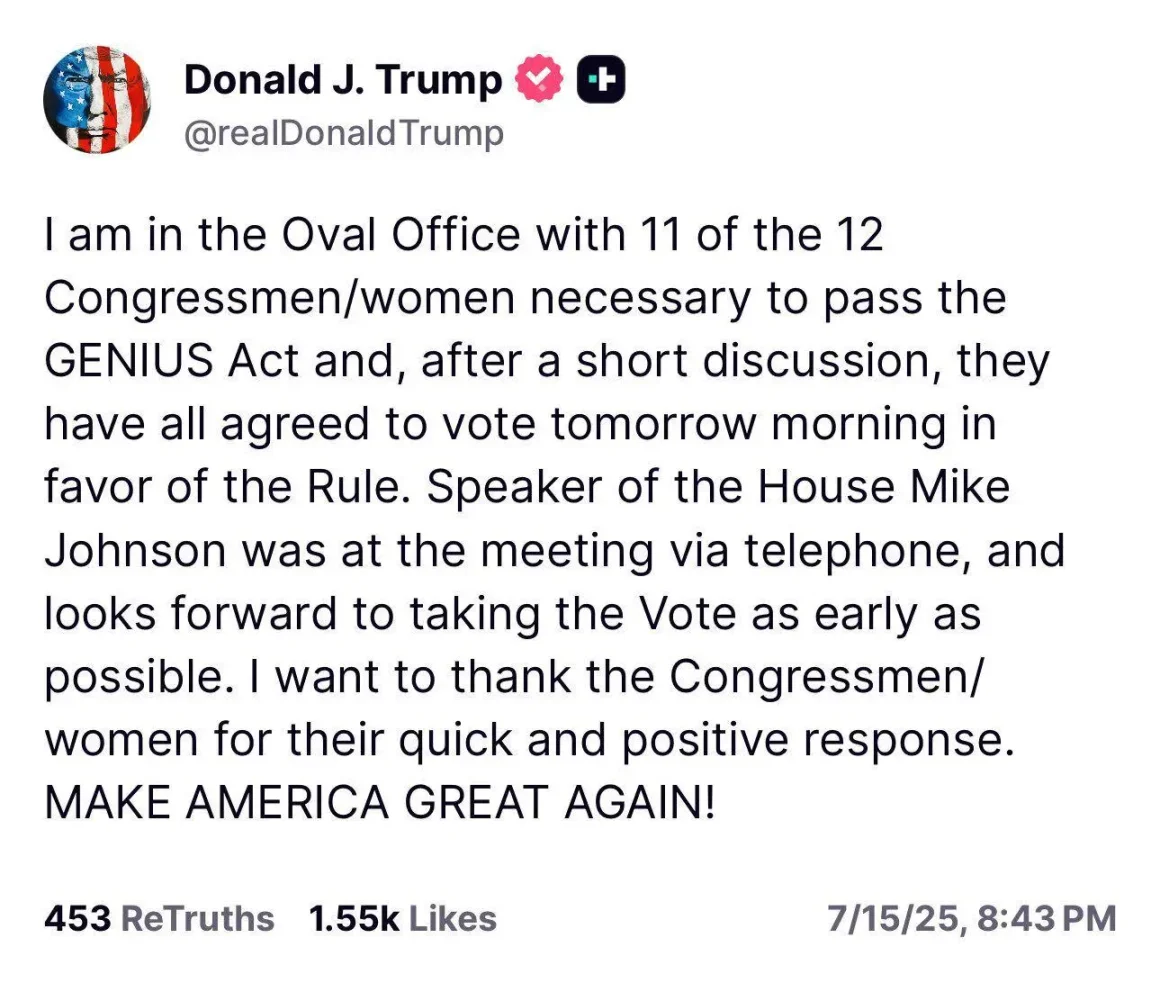
After the vote failed, on the evening of July 15, Trump quickly summoned the dissenting lawmakers to the White House and announced he had persuaded all of them to back the measure. On July 16, President Trump posted that he had met with 11 House representatives in the Oval Office on July 15 to discuss passage of the “GENIUS Act” rule, and they unanimously agreed to support it the following morning.
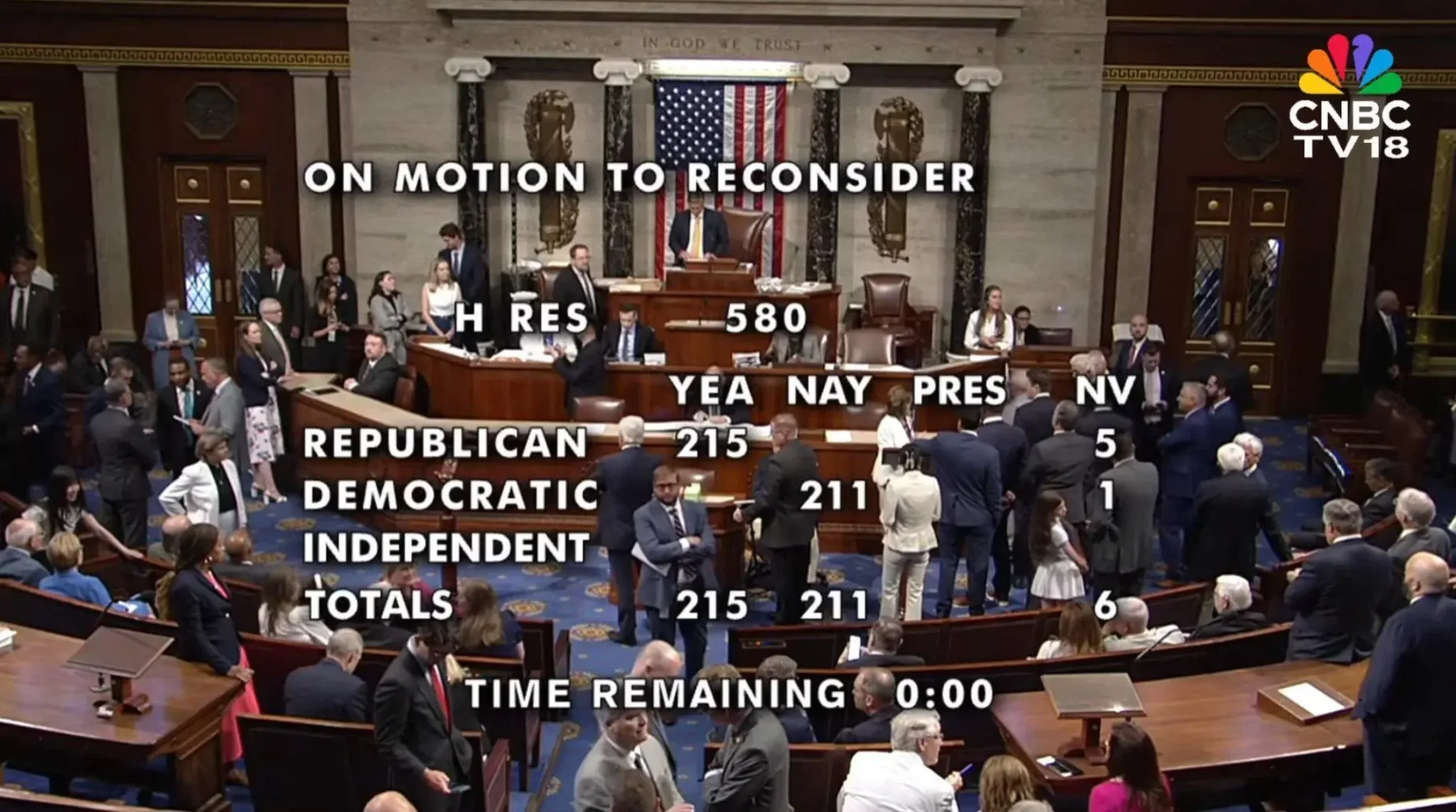
On Wednesday, the initial vote ended dramatically at 215–211. The outcome remained uncertain until the final moments, with a small group of Republicans opposing the rule until intense exchanges with party leaders on the House floor led them to switch their votes to “yes” at the last minute.
Yet, these staunchly opposed Republicans subsequently withdrew their support during a second “recorded vote,” leaving the House chamber to negotiate with party leadership over a potential deal to advance legislation—conditioned on clearer language revising the ban on central bank digital currencies (CBDCs).
Hardline Republican opponents pushing to block the procedural vote advocated merging the market structure bill—the Clarity Act—with partisan legislation banning central bank digital currencies. Republican Representatives French Hill, Chair of the House Financial Services Committee, and G.T. Thompson of Pennsylvania opposed this plan, fearing it would undermine Democratic support for the market structure bill.
The Republican rebels dropped their opposition after party leaders agreed to attach the CBDC ban—which conservatives argue government-issued digital dollars would open the door to privacy violations—to the must-pass National Defense Authorization Act. The agreement was reached during a late-night meeting in Speaker Mike Johnson’s office.
According to two attendees who spoke anonymously, Trump called in at the final moment and was briefed on the agreement. “He was very happy with it,” one person said.
In the early hours of July 17, two informed sources revealed that the Senate Banking Committee was delaying the release of its draft discussion paper on market structure, originally scheduled for the next day. The idea was to wait and see how events unfolded in the House, then reconsider introducing the bill once the situation became clearer.
According to Politico, the vote on the Clarity Act may be delayed until next week.
The GENIUS Act is expected to be sent to President Trump for signature within this week and could become the first major cryptocurrency bill passed by Congress—a significant lobbying victory for the crypto industry.
Overall, the House's “Crypto Week” carries profound implications for the digital asset sector. These bills could not only reshape the landscape of the U.S. crypto industry but also set crucial foundational precedents for future digital asset regulation. As the bills advance and with direct intervention from President Trump, can the regulatory framework continue moving forward smoothly? Can the U.S. government fulfill its promise to become the “crypto capital”?
Join TechFlow official community to stay tuned
Telegram:https://t.me/TechFlowDaily
X (Twitter):https://x.com/TechFlowPost
X (Twitter) EN:https://x.com/BlockFlow_News
 PANews