








Decoding BTC's "Unconventional Surge": When Rising Interest Rates, a Weakening Dollar, and a Trillion-Dollar Deficit Collide
TechFlow Selected TechFlow Selected
Decoding BTC's "Unconventional Surge": When Rising Interest Rates, a Weakening Dollar, and a Trillion-Dollar Deficit Collide
Is a massive short squeeze in the crypto market about to begin?
 Navigating Web3 tides with focused insights
Author: The Kobeissi Letter (@KobeissiLetter)
Translated by: Ethan (@ethanzhang_web3)
Editor's note: This is not another replication of a bull market, but a Bitcoin "crisis rally" erupting amid floods of deficits, dollar depreciation, and financial order restructuring. When gold prices and BTC surge simultaneously, Wall Street ETFs pour in massive capital, and even "conservative" funds no longer hesitate, we must admit: the market is entering an unprecedented new cycle. Why has Bitcoin become the winner under these "unconventional" macro conditions? Is this rally a bubble, a safe haven play, or a repricing of power? Odaily Planet Daily reveals where capital is truly placing its bets.
Original text below
The current market condition is anything but "normal." Bitcoin's uptrend is nothing short of狂疯 (frenzied), skyrocketing along a steep linear trajectory. Interest rates continue to climb, the dollar has depreciated 11% within six months, and the total crypto market cap has surged by one trillion dollars in just three months.
What exactly is happening? The answer is clear: Bitcoin has entered "crisis mode."
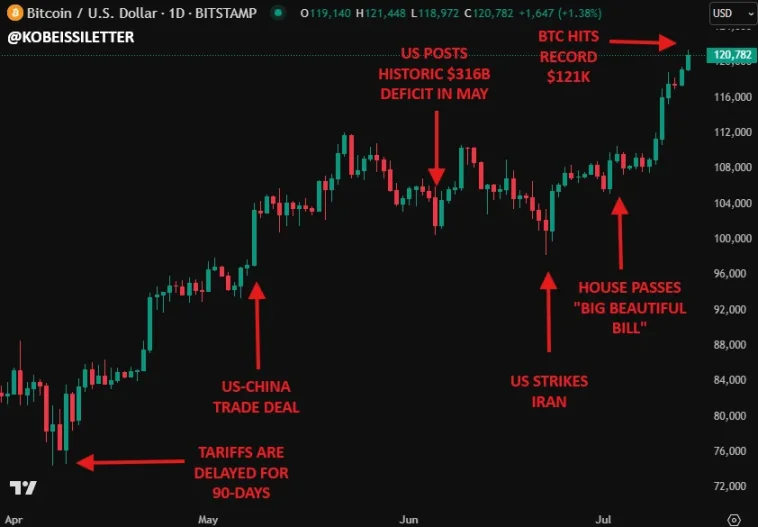
Bitcoin’s momentum today is so powerful that it breaks its all-time high (ATH) multiple times in a single day. Since the U.S. House passed President Trump’s "Big Beautiful Act" on July 3, Bitcoin has surged by $15,000. If gold failed to raise alarm, Bitcoin’s rally should be loud enough to sound the warning bell.
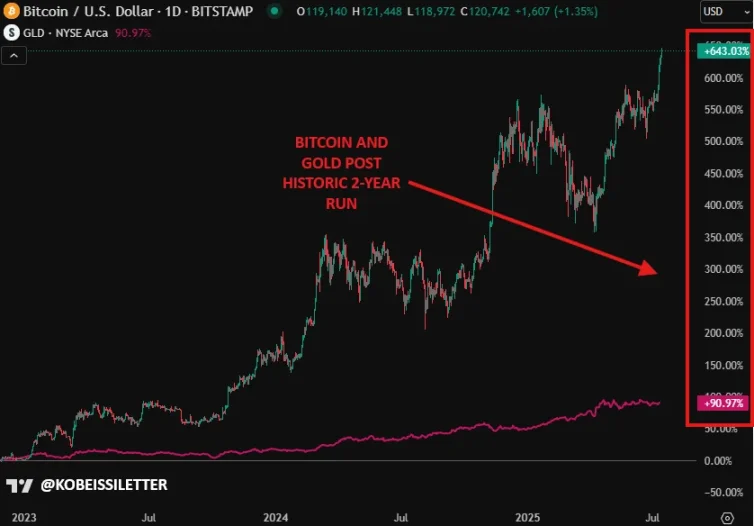
Is there a clearer signal? Consider the year-to-date comparison between Bitcoin and the U.S. Dollar Index ($DXY), revealing two distinct divergence points:
-
April 9 (after the 90-day tariff pause ended)
-
July 1 (when the Big Beautiful Act passed)
The message is self-evident.
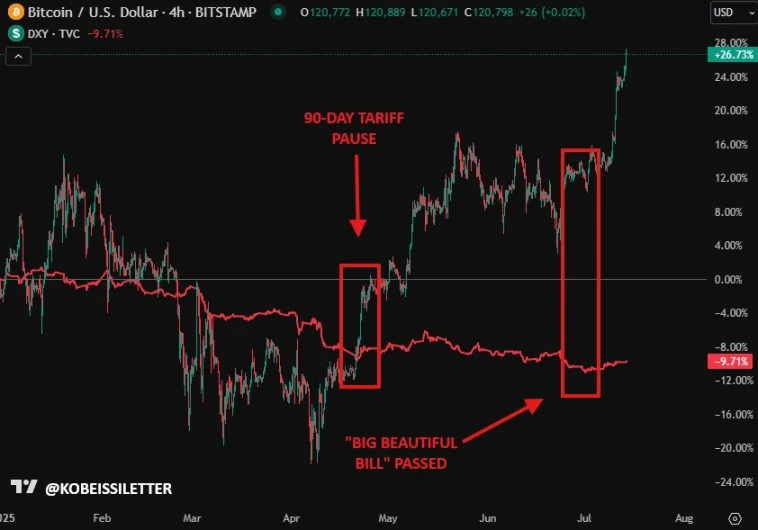
In early July, data revealed that the U.S. recorded a fiscal deficit of $316 billion in May 2025 alone—the third-highest monthly deficit in history. Initially, markets held hope due to Musk’s opposition to the spending bill.
Yet, that hope quickly vanished by early July.
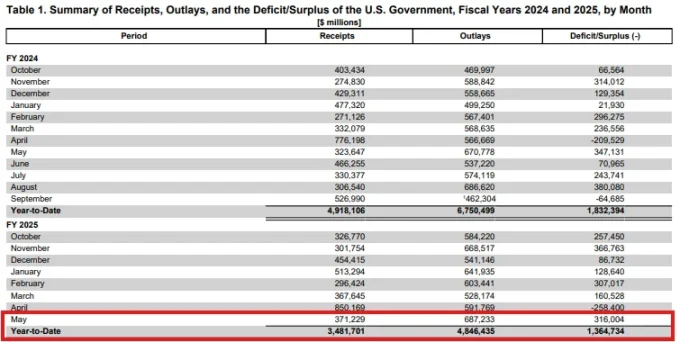
At the time, Bitcoin’s rise seemed driven by market expectations for a trade deal. But reality proved otherwise: regardless of whether a trade agreement was announced, the outcome remained strikingly consistent—bond yields rose, Bitcoin surged, the dollar fell, and gold climbed.
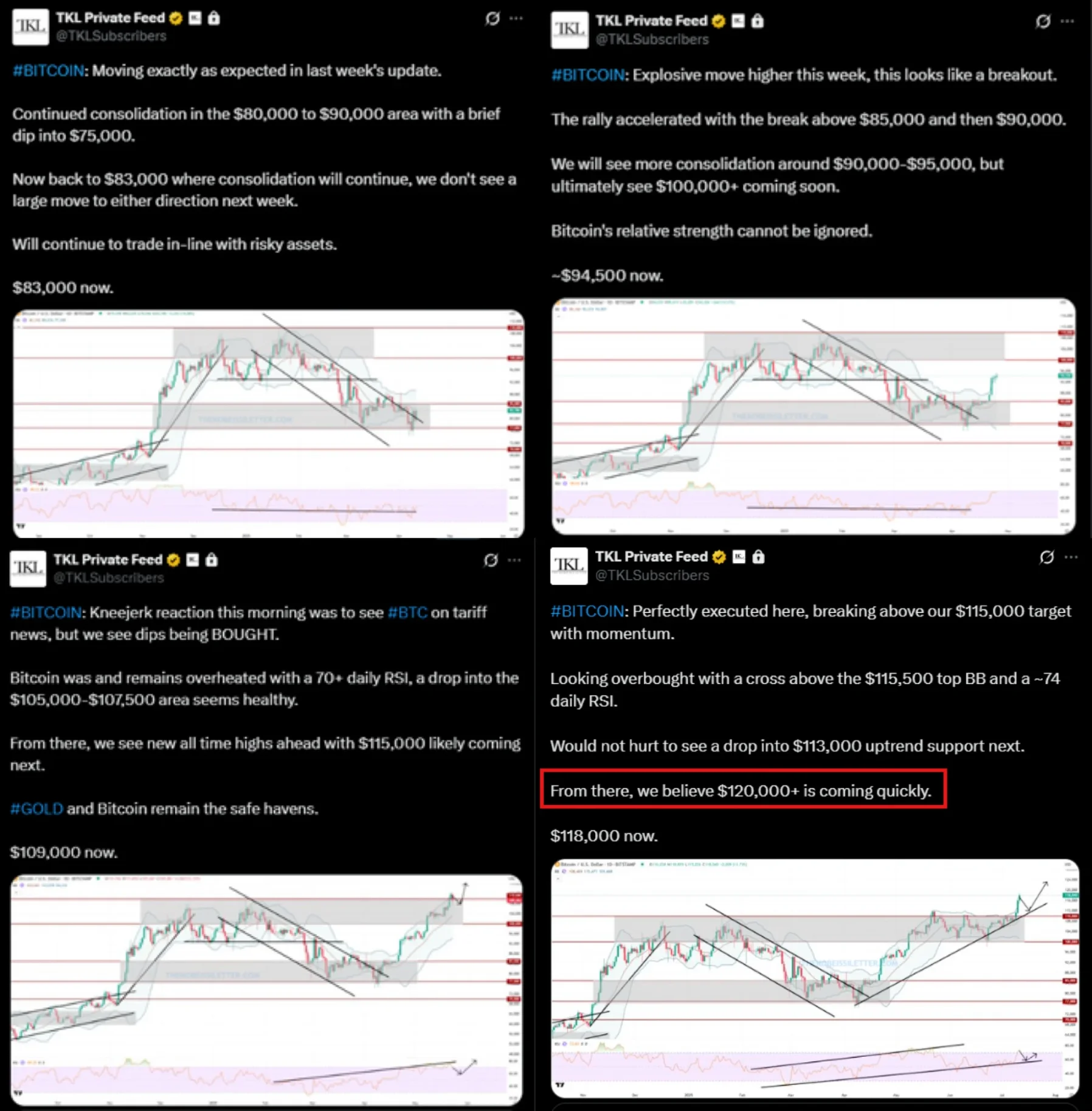
This is far from a "normal" market environment. We anticipated and capitalized on this trend early: buying decisively during pullbacks at $80,000, $90,000, and $100,000, and accurately forecasting a target of $115,000.
Last Friday, we raised our target further to over $120,000—a level that has just been reached.
This is undoubtedly a double tailwind (double positive) for both gold and Bitcoin.
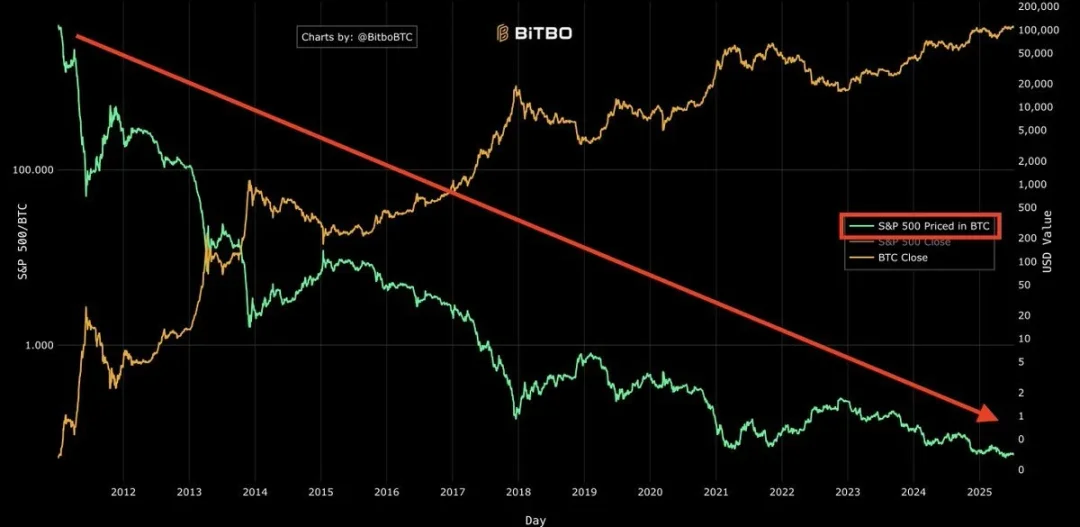
Year-to-date, the S&P 500 has fallen 15% when priced in Bitcoin. Tracing back to 2012, the S&P 500 priced in Bitcoin has plummeted a staggering 99.98%. The reality is clear: Bitcoin’s value soars while the dollar’s erodes.
Again, closely watch U.S. fiscal deficits.
More importantly, institutional capital appears to be rushing in, chasing this Bitcoin rally.
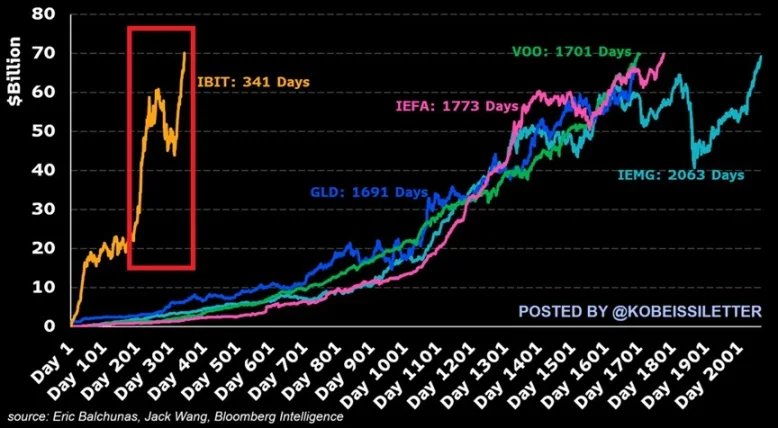
The AUM (assets under management) of Bitcoin ETF IBIT has rapidly climbed to a record $76 billion in less than 350 days. By comparison, the world’s largest gold ETF, GLD, took over 15 years to reach the same scale.
In deep conversations with institutional investors, we’ve noticed a recurring consensus: broadly speaking, family offices, hedge funds, and other institutional capital can no longer ignore Bitcoin. Even "conservative" funds are now considering allocating about 1% of their AUM to Bitcoin.
To clarify, calling Bitcoin’s state a "crisis mode" does not imply bearishness toward other assets. In fact, the short-term "stimulative" effect of higher deficit spending is "positive," and risk assets may continue rising in the near term.
Naturally, its long-term negative impacts cannot be overlooked.
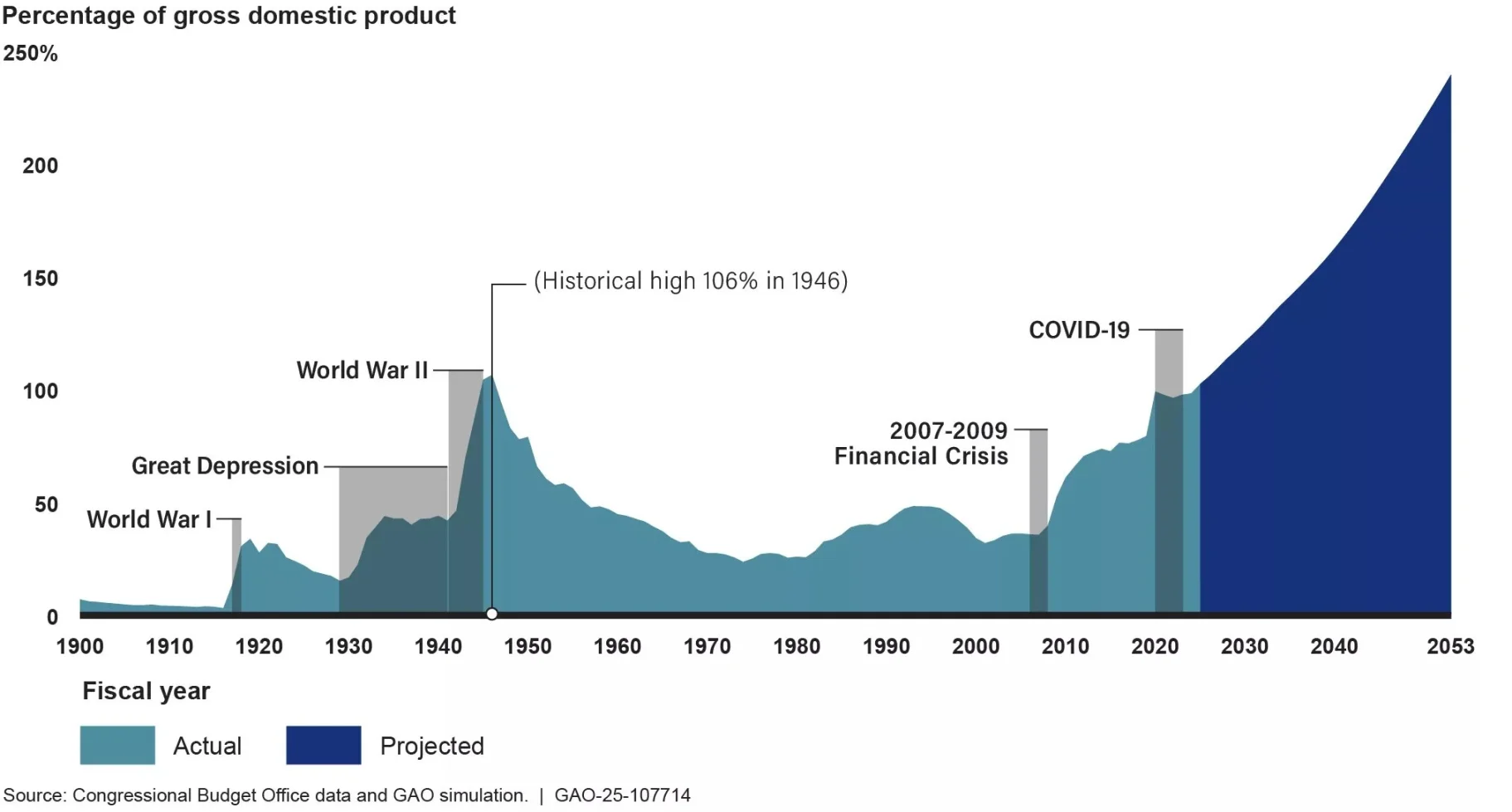
Ironically, solving the deficit issue would resolve many of America’s challenges—it could lower interest rates, curb inflation, and strengthen the dollar. But Bitcoin "knows" full well this is nearly impossible—just observe how its rally accelerated after the spending bill passed.
Shifts in the economic landscape are precisely where investor opportunities lie. As markets gradually digest this ongoing deficit crisis, capital is rotating massively, causing sharp asset price fluctuations.
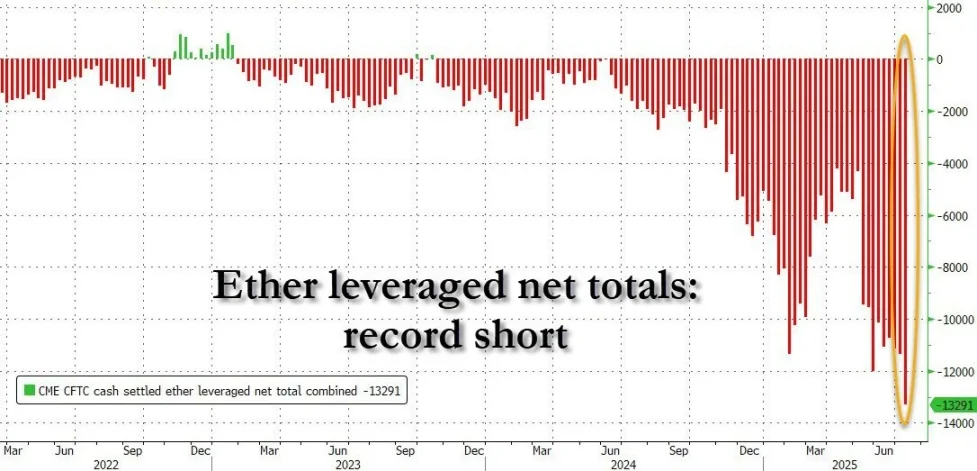
Finally, interestingly, according to ZeroHedge, Ethereum’s leveraged short positions are currently at an all-time high. This mirrors exactly what we observed ahead of the market bottom in April 2025.
Is a massive short squeeze across the crypto market about to begin? Something may indeed be brewing...
Join TechFlow official community to stay tuned
Telegram:https://t.me/TechFlowDaily
X (Twitter):https://x.com/TechFlowPost
X (Twitter) EN:https://x.com/BlockFlow_News
 @KobeissiLetter


