From "Bitcoin Jesus" to Prisoner: A Digital Prison Forged with 400,000 BTC
TechFlow Selected TechFlow Selected
From "Bitcoin Jesus" to Prisoner: A Digital Prison Forged with 400,000 BTC
The financial freedom promised by Bitcoin has ultimately become entangled with the very system it sought to replace.
 Navigating Web3 tides with focused insights
Text: THEJASWINI M A
Translation: Saoirse, Foresight News
Roger Ver is broke.
But not in the way most people understand bankruptcy. The Bitcoin he holds could still buy a small country. Yet as he sits in a Spanish prison, facing a potential 109-year sentence from the United States and mounting legal bills with no clear way out, this kind of "bankruptcy" is deadly.
On July 4, 2025, someone moved 80,000 bitcoins—worth $8.72 billion—from eight wallets that had been dormant since 2011. The transactions were orderly, methodical, as if following a checklist. Within hours, crypto Twitter users concluded that Roger Ver was liquidating his long-held Bitcoin stash to buy his freedom.
The logic seemed sound: Roger Ver had motive, capability, and the technical knowledge to access early Bitcoin wallets. His legal troubles were escalating, extradition hearings loomed, and his public plea for presidential pardon painted the image of a desperate man.
Yet no one can confirm these wallets belong to him. They’ve never been linked to any known addresses tied to Roger Ver. The funds could belong to any early Bitcoin holder who simply decided it was time to cash out now that Bitcoin has reached six-digit prices.

Roger Ver’s legal predicament is real. Once hailed as “Bitcoin Jesus,” he has fallen far from his preacher’s pedestal. In an instant, he went from being a passionate advocate of cryptocurrency to a cautionary tale about taxes and hubris. His arrest in Spain forced the crypto community to confront a harsh truth: their digital revolution could be dismantled so easily by traditional legal systems.
As a Silicon Valley entrepreneur, crypto evangelist, and federal fugitive, his journey reveals a contradiction: the financial freedom promised by Bitcoin ultimately remains entangled with the very system it sought to replace.
Silicon Valley Origins
In hindsight, one might say Roger Ver was born at just the right time and place.
Born on January 27, 1979, in San Jose, California, his father repaired computers for a living—meaning Roger grew up surrounded by the machines that connected the world, learning how networks functioned.
Roger Ver veered off the conventional life path early. From 1997 to 1999, he attended De Anza College, majoring in economics, mathematics, and astronomy, while taking physics courses at Stanford University. During this time, he founded MemoryDealers.com, reselling Cisco networking equipment, memory, and accessories during the dot-com boom when demand for such hardware was sky-high.
At the height of the internet bubble, everyone was scrambling for servers, routers, memory chips—anything that could speed up data transfer. Roger not only secured wholesale pricing but also cultivated a customer base willing to pay retail for immediate delivery. Two years later, he dropped out of school to focus entirely on running his company. Over the next decade as CEO, he expanded his client base from Bay Area startups to Fortune 500 companies.
In 2004, he launched Agilestar.com, specializing in fiber-optic transceivers—critical components for high-speed internet. The business operated in nearly every country worldwide, shaping Roger into a figure with both technical insight and global commercial experience.
Through this journey, Roger Ver developed a distinct worldview. He embraced libertarian philosophy, believing individuals should control their own wealth, data, and lives. In 2000, he ran for the California State Assembly as a Libertarian Party candidate. Though he received few votes, he used the platform to champion his conviction that technology would render government obsolete.
The Explosives Incident
In 2002, federal agents arrested Roger Ver for selling explosives on eBay.
Between January 1999 and August 2000, Roger purchased 49 pounds of a substance called “Pest Control Report 2000” from a South Carolina supplier—an explosive device—and sold at least 14 pounds to online bidders. However, he lacked the required license to handle or sell such materials. Multiple violations piled up: storing explosives in an apartment building, shipping them via the U.S. Postal Service, and doing so without proper authorization.
On May 2, 2002, Roger Ver was sentenced to 10 months in federal prison, fined $2,000, and placed under three years of supervised release. This experience transformed him. Sitting in his cell, he felt firsthand the power of federal enforcement and developed a new perspective on governmental authority.
Bitcoin Revelation
In 2011, Roger Ver discovered Bitcoin.
After reading the whitepaper, he saw a monetary system free from central banks and government oversight. For someone who had served 10 months in federal prison, the appeal was obvious.
When Bitcoin traded below $1, Roger began accepting it as payment at MemoryDealers, making his company one of the first to treat Bitcoin as real money rather than a novelty.
Bitcoin was brilliant technology, but to move beyond cryptography enthusiasts, it needed exchanges, wallets, payment processors, and educational resources.
Roger Ver began investing in Bitcoin startups. He provided early funding to BitInstant—one of the first Bitcoin exchanges—and invested in Kraken, Blockchain.com, Ripple, BitPay, and Purse.io—companies that built the infrastructure enabling Bitcoin’s practical use.
In 2012, Roger launched Bitcoinstore.com, selling electronics for Bitcoin, and founded Bitcoin.com, which later became a prominent crypto education platform.
Roger Ver understood: whoever controls the infrastructure controls adoption. He positioned himself at the core of the Bitcoin ecosystem—not just as an investor, but as a pivotal figure other entrepreneurs needed to collaborate with.
He systematically accumulated Bitcoin. By 2014, he and his companies held around 131,000 BTC (58,000 personally, 73,000 through MemoryDealers and Agilestar), with total holdings estimated to exceed 400,000 BTC. At Bitcoin’s 2014 price of ~$871, his net worth already surpassed $100 million.
Beyond hoarding Bitcoin, Roger relentlessly promoted it—speaking at conferences, giving media interviews, funding educational initiatives, and using his growing platform to advocate widespread adoption. The community began calling him “Bitcoin Jesus.”
The nickname fit perfectly. His fervor mirrored a belief that he was offering financial salvation to a world enslaved by government-controlled currencies. To him, Bitcoin transcended technology—it became ideology made tangible.

A Fatal Decision
On February 4, 2014, Roger Ver acquired citizenship in Saint Kitts and Nevis for $150,000 and renounced his U.S. citizenship. The move made financial sense: as a Caribbean citizen, he could avoid U.S. taxation on global income and gain visa-free access to over 130 countries. For someone who viewed government as a “predator,” the decision aligned perfectly with his beliefs.
However, renouncing U.S. citizenship triggered expatriation tax obligations. American citizens must report capital gains on global assets when relinquishing citizenship and pay taxes accordingly. Roger was required to disclose his Bitcoin holdings and pay taxes on their appreciation—but he failed to properly fulfill this duty, a misstep that would ultimately reshape his life.
Factional Split
In 2017, Bitcoin faced a critical challenge: surging user numbers overwhelmed its network, causing transaction delays and soaring fees due to limited block capacity.
The community split over solutions. One side advocated increasing block size to process more transactions; the other favored off-chain approaches like the Lightning Network. The technical trade-offs were significant: larger blocks improved throughput but raised hardware requirements for miners, potentially excluding smaller participants and undermining decentralization. Off-chain solutions preserved decentralization but added complexity and required additional infrastructure.
Roger Ver supported increasing block size, insisting it aligned with Satoshi Nakamoto’s vision of Bitcoin as “digital cash.”
In August 2017, the debate culminated in a hard fork, creating a new cryptocurrency—Bitcoin Cash—with larger blocks. Roger became its leading advocate, pouring all his resources into promotion. He shifted Bitcoin.com’s content to favor Bitcoin Cash and downplay Bitcoin, drawing criticism for allegedly misleading newcomers into buying the “wrong” cryptocurrency.
This proved a costly miscalculation. While Bitcoin’s market cap and adoption continued rising, Bitcoin Cash gradually lost relevance. At a pivotal moment in crypto history, Roger Ver chose the wrong side.
The Reckoning
On February 15, 2024, a federal grand jury indicted Roger Ver on eight counts: three for mail fraud, two for tax evasion, and three for filing false tax returns.
The charges centered on his 2014 decision to renounce U.S. citizenship. According to the Department of Justice, Roger provided false information to law firms and appraisers, concealing the true amount of Bitcoin held by himself and his companies, resulting in severely understated tax filings and unreported personal Bitcoin assets.
The indictment further alleged that in November 2017, Roger sold tens of thousands of Bitcoin for approximately $240 million but deliberately concealed these transactions from his accountants and failed to report capital gains. The government claims this cost the IRS at least $48 million. In April 2024, Roger was arrested in Spain. After posting $160,000 bail, he remains under house arrest awaiting Spain’s decision on extradition to the U.S. If convicted on all counts, he faces up to 109 years in prison.
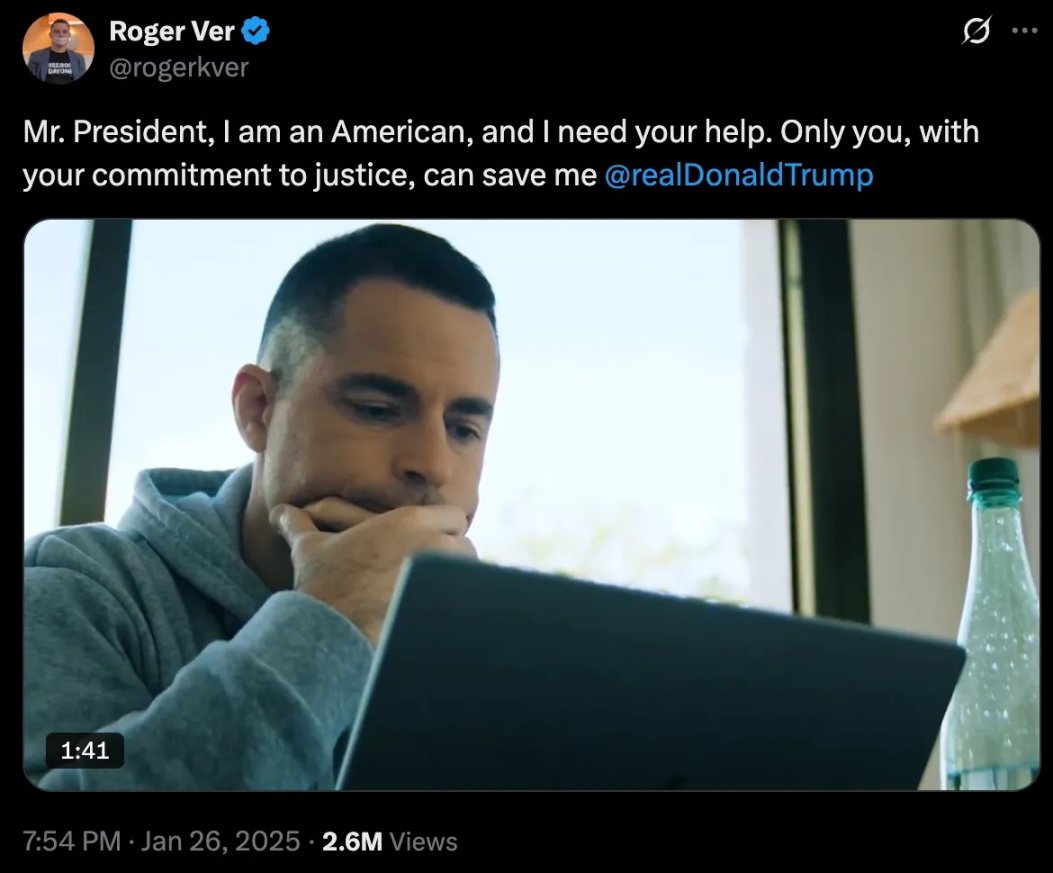
Imprisoned and desperate, Roger publicly appealed to President Trump: “Mr. President, I am an American. I need your help. Only you, standing for justice, can save me.”
Even the broader industry rallied behind him:
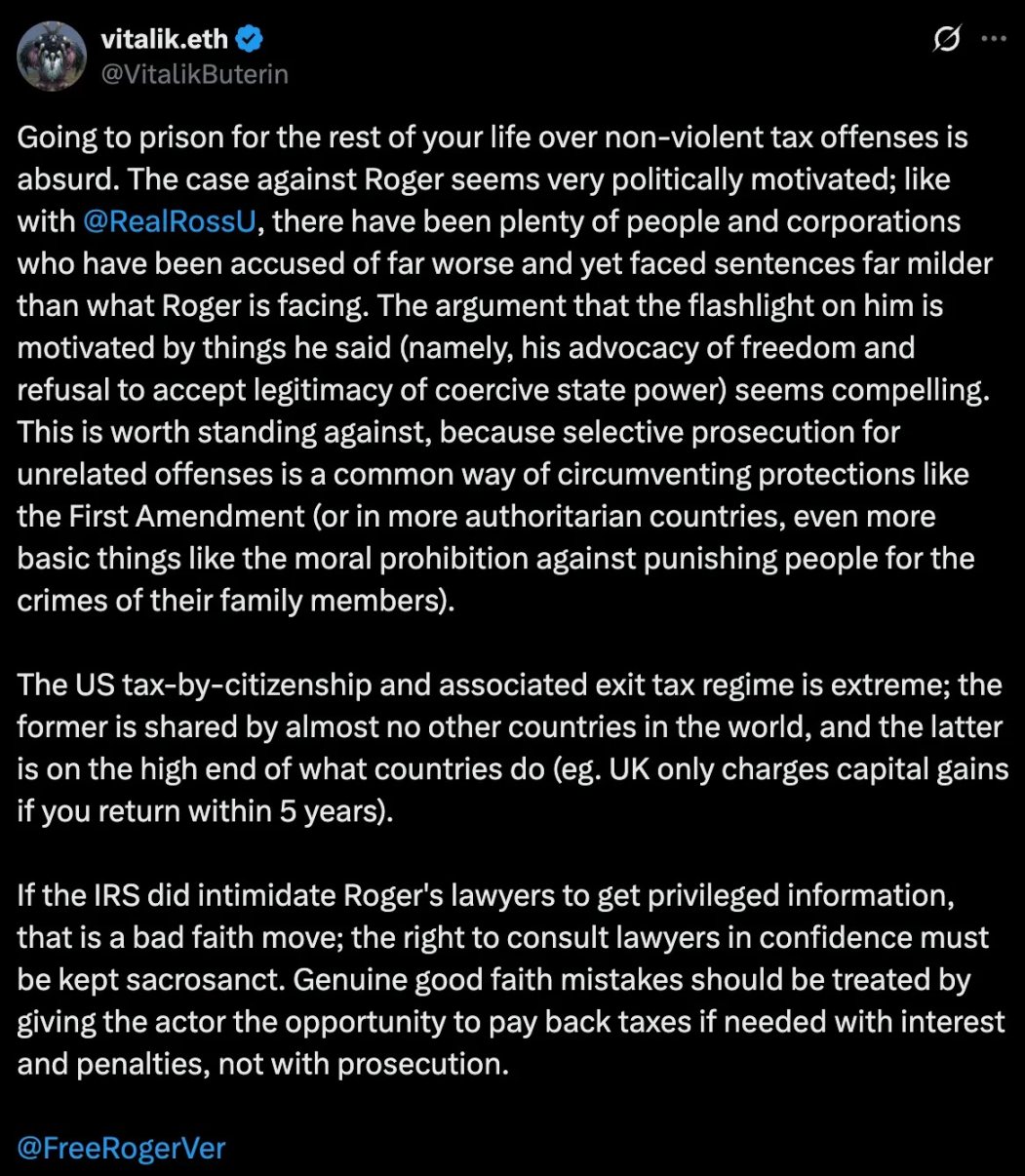
Vitalik: Imposing a life sentence for non-violent tax violations is absurd. The case against Roger Ver clearly carries strong political motivations—just like the Ross Ulbricht case. So many individuals and corporations have committed far more serious crimes yet received much lighter sentences. It's persuasive to argue that he's being targeted because of his speech—that is, his advocacy for liberty and refusal to recognize the legitimacy of coercive state power. This is something worth opposing, because selective prosecution on unrelated charges to circumvent protections like the First Amendment—or in more authoritarian regimes, even bypassing basic moral principles like not punishing individuals for their family's actions—is a common tactic. The U.S. practice of taxing based on citizenship is extremely harsh: almost no other country does this, and its exit tax rates are among the highest globally (for example, the UK only imposes capital gains tax on funds repatriated within five years). If the IRS indeed intimidated Roger Ver’s lawyers to obtain confidential information, that would be outright betrayal. The right to confidential attorney-client communication must be absolutely protected. For genuine unintentional errors, the appropriate response should be allowing the individual to rectify the situation by paying back taxes (if applicable), plus interest and penalties—not criminal prosecution.
Yet Roger Ver’s 2014 decision to renounce U.S. citizenship planted the seeds of his downfall. When asked whether he supports pardoning Roger Ver, Elon Musk replied on social media: “Roger Ver voluntarily gave up U.S. citizenship. He shouldn’t get a pardon. Citizenship comes with responsibilities.”
The man who abandoned nationality to escape government control now finds that only U.S. citizenship could grant him protection from the very government he rejected—a classic Catch-22 paradox. (Note: “Catch-22” originates from Joseph Heller’s 1961 novel of the same name, describing a self-defeating, no-win situation where contradictory rules create an inescapable loop.)
This brings us back to July 4, 2025—the day eight mysterious wallets suddenly moved $8.72 billion worth of Bitcoin. Crypto analysts immediately linked the transaction to Roger Ver’s legal crisis. Some Twitter users speculated he might be liquidating assets to cover massive legal fees or settle with the IRS.
For a cornered Roger Ver, selling early Bitcoin holdings to fund his defense—or even negotiating a plea deal with prosecutors—might seem like the only rational option. But the crypto community’s speculation rests solely on circumstantial evidence and timing. The truth remains shrouded in mystery.
The Fallen Prophet
Today, Roger Ver’s net worth stands at around $700 million, primarily from early Bitcoin investments and stakes in crypto companies. Yet wealth cannot resolve his immediate crisis: as a stateless individual, he faces extradition to the country whose citizenship he once willingly abandoned.
His story encapsulates both the early glory of cryptocurrency—leveraging foresight into Bitcoin’s potential and strategic infrastructure investment to lay the foundation for the digital asset ecosystem; introducing millions to crypto through evangelism and education—and the peril of idealism clashing with real-world rules.
The man who foresaw Bitcoin’s future failed to anticipate the consequences of his choices: selling explosives without a license, renouncing citizenship to evade taxes, backing Bitcoin Cash against the mainstream tide… Ultimately, he engineered his own downfall.
Whether he orchestrated the July 4 Bitcoin movement remains unknown. But one thing is certain: those transactions mirrored Roger Ver’s former essence—the power to shift billions with a keystroke, the freedom outside traditional finance, the ultimate liberation promised by crypto to its earliest believers.
For Roger Ver, that freedom has long since become a prison of his own making.
Join TechFlow official community to stay tuned
Telegram:https://t.me/TechFlowDaily
X (Twitter):https://x.com/TechFlowPost
X (Twitter) EN:https://x.com/BlockFlow_News