When fortune favors, Binance unites all; when luck fades, even OK brings no freedom
TechFlow Selected TechFlow Selected
When fortune favors, Binance unites all; when luck fades, even OK brings no freedom
In our era, everyone must be driven mad—no exceptions.
 Navigating Web3 tides with focused insights
Author: Zuo Ye
CEXs are simultaneously building on-chain trading tools, wallets, and Perp DEXs, yet they actually enforce censorship on their own users to achieve compliance—this is inherently contradictory.
In our era, everyone is inevitably driven to the brink of madness.
Manufacturing Crises: Romoss of Crypto
Compared to Romoss, which was ruined by 3C and forced into production halts and wage suspensions, OKX's problem lies in a lack of internal checks and balances, with the founder acting entirely on personal impulse.
Artificially creating public relations crises does not accelerate the compliance process.
OKX’s Star Xu issued a commanding statement, excluding “loan farming” users, shocking the entire crypto industry. This is not the responsible Xu we once knew.
In public memory, early OK was notably accountable:
-
In 2020, when OK faced regulatory scrutiny, the concept of "private key custodian" significantly raised public awareness about encryption: Not your Keys, Not your Money;
-
In 2025, facing MiCA compliance requirements, OK voluntarily suspended the DEX aggregator within the OKX wallet, allowing Binance to seize market share.
Of course, there can be alternative interpretations. If services are paused for regulation, the profits OK forgoes could still be captured by other providers. But this time, OKX has initiated a special regulatory action directly against its users—this is utterly baffling.
Pursuing上市 (listing) doesn't justify this. From Didi rushing through an IPO only to be immediately ordered to rectify, to Binance paying the price with CZ’s imprisonment, massive fines, CZ stepping down, platform overhaul, and even discontinuing BUSD issuance—all were reactive measures taken after being caught.
But OK is different. It proactively announces to the world, "I’m coming after you." The core issue isn’t compliance—it’s the inappropriate attitude toward users.
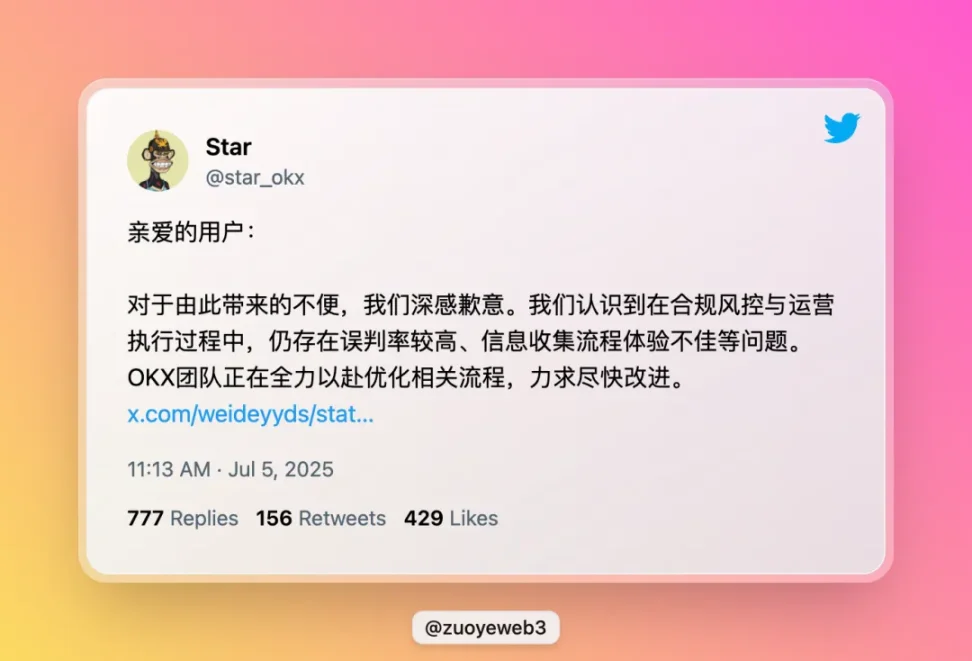
Caption: OK admits misjudgment in compliance. Source: @star_okx
Ultimately, this crisis escalated in public discourse and must be addressed there. OK’s global team of 600 compliance staff should dynamically adapt to market conditions. If OK ceases to exist, perfect compliance becomes meaningless.
In essence, it's not a compliance issue, nor is it really about whether loan farming and coin speculation should be tolerated. Debating the latter traps us in a trolley problem. The best response is no response at all.
This is an exceptionally clear-cut PR crisis—and hardest of all, self-inflicted by the founder.
Unlike Binance’s dual-core leadership, OKX is solely controlled by Star Xu. Amid widespread rumors as companies grow, no one is truly clean—this isn’t the decisive factor in business competition.
Xu’s will is OKX’s will; OKX has no independent will. In a founder-dominated culture, no executive dares voice dissent, let alone opposition.
-
Jingdong’s Richard Liu can make executives line up for汇报 (reporting), directly disband the branding department, and merge it into a more market-facing marketing unit;
-
After CZ’s release from prison, he cannot directly manage Binance but can still "influence" it, while Binance adjusts based on market forces, with legal counsel ensuring compliance.
The superior model is obvious. OK’s current problem is that the founder, clearly unsuited for frontline PR, insists on direct market engagement, repeatedly triggering public backlash.
Here’s a prediction: unless OK isolates its founder from public operations, such storms will recur. It would be far better to hand control to professional managers.
Professional managers aim to avoid mistakes; founders seeking glory are far more dangerous.
Binance Keeps Winning: The Liu Xiu of Crypto
Liu Xiu differs from Liu Bang—he was lucky. Liu Xiu differs from Liu Bei—he was lucky.
If luck defines a person, it’s because their rivals contributed their own misfortune.
Exchanges today aren’t doing well: Bybit struggles after a hack, Bitget faces retail backlash, Gate/Mexc occupy the kiddie table, Huobi belongs to Brother Sun, Coinbase and Kraken are rooted in the U.S.
Deribit has already sold to Coinbase. A new round of exchange consolidation has begun. With trading enthusiasm already low, the race is about minimizing errors and retaining users—not embarking on bold new ventures.
The only ones with real potential to challenge Binance were centralized OKX and "decentralized" Hyperliquid—but now only the latter remains.
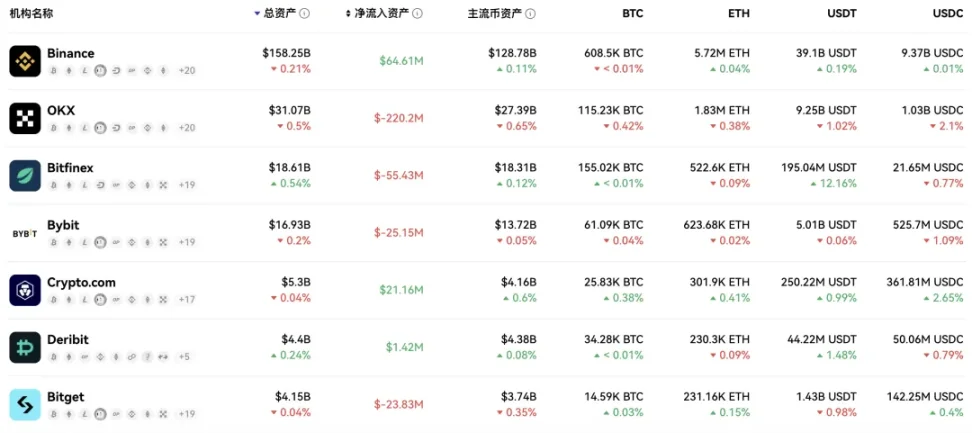
Caption: Exchange 24H fund flows. Source: @OKLink_CN
Even without using DeFiLlama data, OKLink’s own figures show assets flowing out of OKX. While mass withdrawals have only toppled FTX before, remember—FTX was legendary.
Despite frequent criticism, Binance continues to thrive, while competitors strive hard—Bybit actively engages with the Solana ecosystem, building its Perp DEX Byreal on Solana’s tech stack and launching xStocks stock-token trading first.
All exchanges now face the same question: how to operate under compliance. It’s no easy task.
Since 2022, compliance issues have centered on BitMEX, FTX, and Binance—their high leverage was a moral issue, money laundering a legal one, offshore operations an operational one.
Today, only Binance retains the composure of a veteran artist. FTX has vanished, BitMEX barely exists. If you think compliance is just lip service, you’re dangerously naive.
Binance withdrew its Hong Kong exchange license application because it couldn’t include mainland customers. Hong Kong is serious about compliance. Many offshore exchanges chose “preserve market, abandon license”—OKX HK did the same.
Exchanges today are anxious: they must go compliant and get licensed, while also confronting real disruption from DEXs.
The pain of the latter is something regulators simply don’t understand. We can even predict: licensed CEXs will soon launch attacks against unlicensed DEXs. Trust me, Coinbase—the same entity behind Stand With Crypto—will target both Congress members and Hyperliquid.
Binance is building Alpha, consolidating the wallet market it snatched from OK, expanding BSC, and occasionally raiding Hyperliquid—just enough to stay ahead of the pack.
OK’s tactical wins in wallets and products ultimately enable Binance’s strategic victory. Who will judge this irony?
Conclusion
To survive in crypto, avoiding fate, mysticism, and politics becomes progressively easier. With scientific rationality, we can explain cosmic movements and tidal shifts—but we struggle to explain why a certain token surges, or why OKX turns against its users.
We can only sigh: it’s not that the opponent is too strong, but that peers are too foolish.
Join TechFlow official community to stay tuned
Telegram:https://t.me/TechFlowDaily
X (Twitter):https://x.com/TechFlowPost
X (Twitter) EN:https://x.com/BlockFlow_News
 @zuoyeweb3