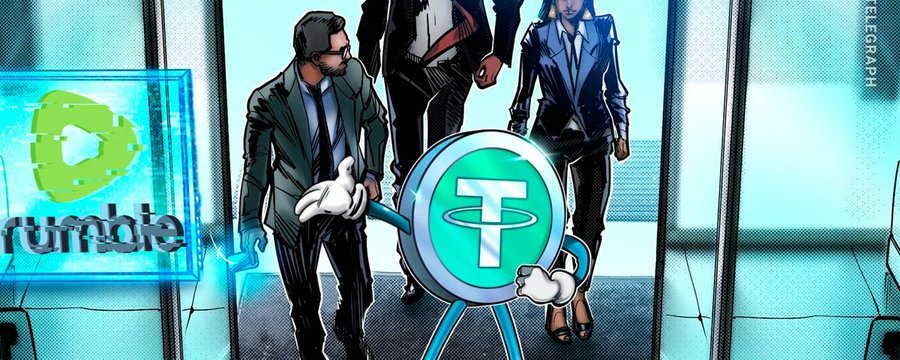
From Tether's Strategy to the Future Stablecoin Traffic Gateway: The Collaboration Between TechFlow and Rumble
TechFlow Selected TechFlow Selected
From Tether's Strategy to the Future Stablecoin Traffic Gateway: The Collaboration Between TechFlow and Rumble
Rumble and Tether's collaboration is a bold experiment in the decentralized wave merging social media with crypto finance.
 Navigating Web3 tides with focused insights
Author: Beta Bro, US Stocks
Tether's Global Strategy and Strategic Priorities
Tether is the world’s leading stablecoin issuer, with its parent company belonging to the iFinex Group, which also operates the prominent cryptocurrency exchange Bitfinex. Its flagship product, USDT, has long dominated the stablecoin market—by mid-2025, USDT accounts for over half of the total global stablecoin market capitalization. As a digital alternative to the U.S. dollar, USDT's circulation (approximately 156 billion tokens in 2025) far exceeds that of the second-largest stablecoin, USDC (around 60 billion), firmly securing its top position in the industry. This dominant market position makes Tether one of the key pillars of liquidity in the global crypto market.
In response to an increasingly clear regulatory landscape, Tether has gradually shifted its strategic focus toward emerging markets and cross-border payments. On one hand, financial institutions and tech giants in developed countries are actively planning to launch compliant stablecoins (for instance, after the U.S. Senate advanced the GENIUS stablecoin bill, banks and payment platforms almost universally want to "issue their own stablecoins"). However, Tether CEO Paolo Ardoino points out that large banks and technology firms primarily serve affluent and institutional users in the "Western world," while approximately 2.5 billion people globally still lack adequate access to financial services. Tether has therefore turned its attention to these underbanked populations concentrated in emerging economies, positioning USDT as a digital dollar tool for savings and cross-border remittances. According to World Bank data, about 1.4 billion adults worldwide remain unbanked, primarily in Sub-Saharan Africa and parts of Asia. Ardoino emphasizes the strong demand in these regions for a stable digital dollar: “For many people excluded from traditional finance, they need something stable in life—and the digital form of the U.S. dollar, such as USDT, provides exactly that.” Currently, around 37% of USDT users employ it for savings and value preservation, and the number of users in developing countries exceeds 420 million. In nations where local currencies are unstable or banking systems are weak, stablecoins have begun functioning as de facto digital dollars, helping citizens cope with currency depreciation and inadequate payment infrastructure. As infrastructure improves, this **most widely used digital dollar system could be built outside traditional banking systems**—presenting a significant opportunity for Tether in developing markets.
On regulation, Tether demonstrates a pragmatic and flexible approach. In anticipation of upcoming U.S. stablecoin legislation—the Senate’s "Guidance and Establishment of National Innovation in Stablecoins Act", or GENIUS Act—Ardoino stated that Tether is “gradually adapting and willing to comply” with the new requirements. Since the bill mandates that foreign issuers serving U.S. customers must meet equivalent U.S. standards—including 1:1 reserves held in short-term U.S. Treasuries or insured deposits, and oversight by the OCC—Tether is considering maintaining USDT’s primary focus on overseas markets while potentially launching a new, locally compliant stablecoin tailored for the U.S. market. In other words, USDT will continue to deepen its presence in emerging economies—the “markets Tether needs most”—while introducing a separate coin for domestic U.S. payments, differing in functionality and compliance from USDT. Tether effectively supports the development of stablecoin regulations, hoping for legal clarity between domestic and foreign issuers to guide its strategy. Meanwhile, Tether approaches foreign regulations like Europe’s MiCA cautiously (for example, MiCA requires dollar-backed stablecoins in the Eurozone to hold 60% of reserves in cash—a policy Ardoino criticized as a “terrible idea”). Overall, Tether is balancing compliance and innovation globally: complying with regulations in highly supervised markets like the U.S., while focusing growth efforts on high-demand, less-regulated emerging markets through use cases such as cross-border payments and trade settlements.
Notably, fueled by massive recent profits—primarily from interest income on reserve assets—Tether possesses substantial financial resources to support diversified expansion. Reports indicate that using record-breaking profits and a large treasury, Tether is actively investing in infrastructure, artificial intelligence, energy, and communications. For example, Tether is advancing Bitcoin mining and renewable energy projects in El Salvador and deploying peer-to-peer communication platforms globally to support censorship-resistant, decentralized internet infrastructure. These initiatives reflect Tether’s broader strategy of building a resilient, cross-sector digital ecosystem: leveraging broad investments to drive innovation, financial inclusion, and decentralization, creating synergy with its core stablecoin business. Within this context, the strategic investment in content platforms represents a critical step in expanding Tether’s ecosystem boundaries.
Background and Long-Term Motivations Behind the Rumble Investment
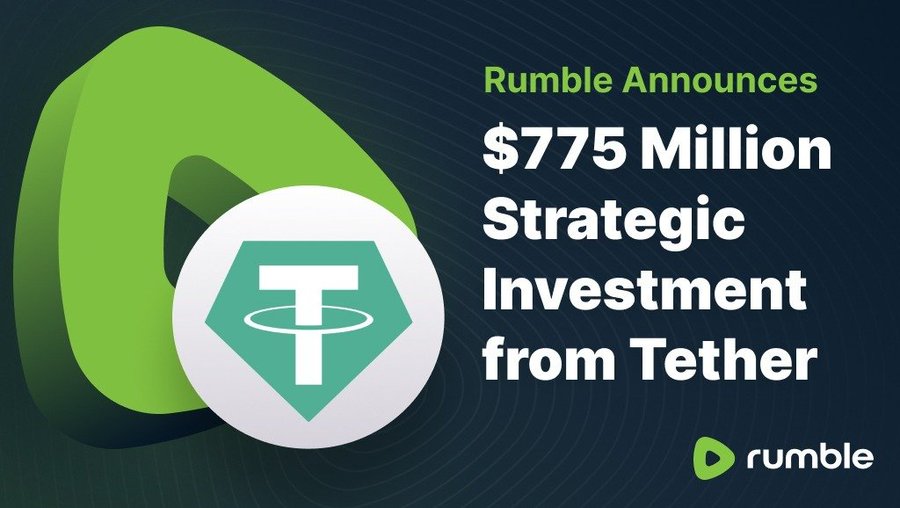
In late 2024, Tether announced a $775 million strategic investment in video platform Rumble (Nasdaq: RUM), sending shockwaves through the industry. Under the agreement, Tether will purchase 103.3 million shares of Rumble Class A common stock at $7.50 per share, with $250 million allocated directly to support Rumble’s operations and expansion, and the remainder used to acquire existing shares (via a tender offer for up to 70 million shares). The announcement triggered a surge in Rumble’s stock, rising over 40% in after-hours trading. While Tether becomes a major shareholder (holding approximately 17%), Rumble founder and CEO Chris Pavlovski retains super-voting rights, and Tether did not request board representation—highlighting the purely strategic nature of the partnership.
Tether’s investment in Rumble goes far beyond a typical financial move—it is a pivotal piece of its global stablecoin strategy. Tether CEO Paolo Ardoino explicitly stated the deal reflects shared values between both parties “in decentralization, independence, transparency, and freedom of speech.” He noted that declining trust in mainstream media has created opportunities for platforms like Rumble as a “credible, censorship-free alternative.” Through this collaboration, Tether aims to integrate its strengths in crypto finance into Rumble, enabling deep cooperation in advertising, cloud services, and crypto payments. In essence, Tether views Rumble as a traffic gateway and application expansion platform for the stablecoin ecosystem: future integrations will include Tether’s ad systems, cloud infrastructure, and USDT-based payment solutions within Rumble. For Tether, this means its stablecoins can embed into a rapidly growing content platform, directly reaching vast end-users and content creators, thereby establishing a closed-loop ecosystem from stablecoin issuance to consumption and payment.
From Rumble’s perspective, partnering with Tether is equally strategic. Rumble CEO Pavlovski likened the investment to installing a “rocket booster,” propelling the platform into its next phase of growth. He emphasized that the significant overlap between crypto communities and free-speech advocates makes the partnership “natural.” Indeed, many cryptocurrency supporters and free-speech advocates share a passion for freedom, transparency, and decentralization. Thus, Tether’s investment brings not only substantial capital but also ideological allies and technological ecosystem extension. Pavlovski noted the transaction immediately adds $250 million in cash to Rumble’s balance sheet, greatly supporting the company’s goal of achieving EBITDA profitability in 2025. Additionally, Tether’s tender offer provides existing shareholders with an exit opportunity, improving the company’s equity structure. He stated: “I truly believe Tether is the perfect partner to put a rocket booster under Rumble.” It is foreseeable that, with Tether’s backing, Rumble will accelerate its expansion—into global markets and Web3 features—further solidifying its status as a “censorship-free content platform.”
In summary, Tether’s investment in Rumble is a forward-looking move centered on the “content platform + payment gateway” model. It enables Tether to bridge the last mile of stablecoin adoption—reaching end-users and content scenarios—while advancing its mission of “empowering decentralized ecosystems” by supporting independent media challenging centralized platforms. This aligns seamlessly with Tether’s broader investment strategy: leveraging its vast capital to back like-minded projects in key strategic sectors—energy, AI, communications, media—to build a cross-domain, censorship-resistant application ecosystem for USDT. Rumble stands as a cornerstone in the content segment of this strategy, with significance extending well beyond financial returns, particularly in terms of ecosystem synergy and monetization potential.
Non-Custodial Wallet Partnership: Significance Amid Stablecoin Regulation
Following the investment, Tether and Rumble quickly moved into tangible product collaboration. The most notable initiative is the planned launch in Q3 2025 of the Rumble Crypto Wallet (provisional name), a non-custodial crypto wallet designed for content creators. Announced to be developed with Tether’s technical and financial support, the “Rumble Wallet” will support multiple crypto assets, including Bitcoin, USDT (Tether), and potentially Tether Gold (XAUT). Unlike custodial wallets offered by centralized exchanges, the Rumble Wallet will allow users full control over their private keys, offering decentralized asset storage and payment functions directly integrated into the Rumble ecosystem. This move is seen as a direct challenge to mainstream wallets like Coinbase Wallet, aiming to deliver tailored DeFi solutions for creators.
The Rumble-Tether non-custodial wallet collaboration holds multiple strategic implications, especially timely amid evolving U.S. stablecoin regulation. First, from the creator economy perspective, the wallet opens new monetization channels for Rumble’s content creators—enabling them to directly receive crypto tips or paid content fees without relying solely on ad revenue or traditional payment gateways. Many creators on platforms like YouTube earn limited income due to low ad rates, but with the Rumble Wallet, creators can receive USDT donations from a global audience, effectively dollarizing their earnings. This is particularly crucial for content producers in regions with weak ad markets. The Rumble Wallet aims to empower international creators, filling gaps left by traditional advertising models. Second, the non-custodial design ensures users truly own their assets, eliminating counterparty risk from centralized platforms—aligning with Rumble and Tether’s shared principles of decentralization and self-sovereignty. Introducing a self-controlled payment method on a free-speech platform ensures creators cannot be financially cut off due to political bias or payment censorship. In effect, it creates an anti-censorship economic lifeline for creators: even if mainstream financial services block controversial figures, stablecoin tipping and payments can continue smoothly via Rumble.

From a macro perspective, U.S. stablecoin regulation is rapidly taking shape. In June 2025, the Senate passed the landmark GENIUS Act by a wide margin. The bill mandates that payment-focused stablecoins maintain 100% reserves (in short-term Treasuries or insured deposits), prohibits issuers from paying interest, and establishes a clear licensing framework. Although the bill awaits final passage in the House, its symbolic significance is profound: stablecoins are gaining formal recognition and legitimacy from mainstream legislative bodies, potentially becoming legally sanctioned tools for payment and settlement. Against this backdrop, Rumble and Tether’s early move into wallet services appears to be seizing regulatory tailwinds in advance. First, compliant stablecoins backed by full reserves and audits will gain greater public trust, reducing psychological barriers for users adopting USDT for payments on Rumble. Second, the regulatory momentum is prompting tech giants like Meta to reevaluate stablecoin applications. Reports suggest Meta is discussing using stablecoins for micro-payments to creators across its platforms, with some crypto firms proposing stablecoins to streamline payouts to Instagram creators. Meta may even consider partnering with existing issuers like Circle or reviving its private digital currency project via acquisition or investment. However, given Facebook’s Libra project was derailed by intense regulatory opposition, Meta’s renewed exploration faces significant political headwinds—multiple U.S. senators have already sent inquiry letters warning of monopolistic and financial risks from big tech issuing money. In contrast, the Tether+Rumble alliance operates almost like a “guerrilla force” beneath the radar: completing the “content platform + stablecoin payment” loop before the regulatory curtain fully rises. By the time the stablecoin law passes and mainstream players enter, Rumble will already have secured first-mover advantage and operational maturity thanks to Tether’s support.
More importantly, this wallet collaboration aligns with the emerging trend of integrating decentralized payments with the creator economy. Once launched, users will be able to tip creators, buy premium content, or fund creator crowdfunding directly via their digital wallets on browser or mobile apps. This model avoids the high 30% “tax” imposed by Apple and Google on in-app purchases and bypasses traditional banking networks, enabling low-cost, intermediary-free value transfer globally. Notably, Rumble plans to integrate Bitcoin’s Lightning Network to speed up micropayments, making instant rewards or pay-per-view video feasible and vastly enriching monetization possibilities. A new ecosystem combining decentralized payments and free content creation is beginning to emerge: creators retain sovereignty over their content, users control their payments, and stablecoins act as the bridge. In this ecosystem, Tether’s USDT will play a central monetary role. Given that former U.S. President Trump and other conservative leaders have publicly urged swift passage of stablecoin legislation to ensure American leadership in digital assets, stablecoins are likely to gain broader political backing. Rumble and Tether’s early positioning positions them to capture the high ground of this emerging ecosystem.
Contrast with Circle/Meta: Building a Payment + Content Loop Ahead of the Curve
Tether’s alliance with Rumble inevitably invites comparisons with potential partnerships involving its rival, Circle. Circle, the issuer of the USDC stablecoin, has in recent years embraced regulation and mainstream finance: it went public via SPAC in 2023 and saw its market cap rise in 2024, becoming the first publicly traded stablecoin issuer. Circle CEO Jeremy Allaire has repeatedly expressed enthusiasm for collaborating with enterprises to bring stablecoins into broader applications. As U.S. regulatory sentiment warms, Circle is widely seen as the preferred “legitimate” stablecoin partner for traditional finance and Big Tech. Notably, Meta (Facebook’s parent), after its Libra project failed years ago, has recently signaled renewed interest in stablecoins—reports indicate Meta is in talks with crypto firms including Circle to explore deploying stablecoins for payments and creator rewards on social platforms. Sources suggest Meta has hired senior fintech executives to lead the initiative, possibly opting to partner with or invest in existing stablecoin issuers. One plausible scenario: Meta partners with Circle to integrate USDC into platforms like Instagram or WhatsApp for micro-transfers, creator tipping, or e-commerce settlements.
However, compared to the already-implemented Tether+Rumble loop, Circle/Meta remains in the conceptual stage and faces greater constraints. First, every financial innovation by Big Tech attracts intense regulatory scrutiny. As Senators Warren and Blumenthal wrote questioning Meta’s stablecoin ambitions, warning that “Big Tech issuing private money threatens competition and erodes financial privacy.” This political resistance ensures Meta will proceed with extreme caution, possibly delaying or abandoning the project altogether. In contrast, Rumble is a relatively “small and niche” platform whose user base and identity are inherently decentralized, allowing seamless integration with Tether with minimal regulatory or public backlash. Second, the target audiences differ: Meta/Instagram serves mainstream liberal-leaning audiences and creators, operating under strict content moderation and profit-driven strategies closely tied to governments and advertisers. Circle caters precisely to this high-compliance, reputation-sensitive market, so USDC focuses on integration with banks, Visa, and mainstream e-commerce. Conversely, Rumble’s user base leans conservative and pro-free speech, more receptive to decentralized and alternative solutions. Tether, as a maverick stablecoin giant, naturally aligns with non-mainstream platforms like Rumble, carving out a differentiated edge within its niche.
Crucially, the Tether+Rumble duo has already completed the “social content platform + stablecoin payment” closed loop, securing a strategic high ground. In this loop, content consumption and monetary flow merge: users can watch Rumble videos and instantly tip with USDT; creators receive stablecoin income directly; and Tether’s USDT becomes embedded in everyday social behavior. In contrast, Circle/Meta would face not only high corporate coordination barriers (complex negotiations and profit-sharing among large entities) but also lengthy waits for regulatory approval or legislative change. Industry analysts note that once the GENIUS Act passes, nearly every major financial institution and payment platform might launch its own stablecoin—sparking fierce competition. Yet Tether, having preemptively captured a niche segment (free-speech community content payments) via Rumble, will enter this race with a significant head start.
Moreover, from the lens of ideological divides in social media ecosystems, the Tether-Rumble alliance highlights a distinct positioning compared to Circle/Meta. Rumble brands itself as a “censorship alternative” to mainstream platforms, attracting right-wing and libertarian users skeptical or hostile toward “Big Tech” and legacy media. Tether, historically controversial over transparency and regulation, has operated largely outside the U.S. regulatory framework, with little connection to Wall Street or Silicon Valley elites. This makes Tether more palatable to this demographic, fostering resonance around anti-establishment narratives. In contrast, Circle and Meta represent the establishment: Circle emphasizes compliance and transparency, actively courting regulators and Wall Street; Meta, as a social media empire, has been at the center of past censorship controversies, accused by the right of suppressing conservative voices. Even if Meta successfully integrates USDC, its payment + content system will serve a more mainstream, moderate creator base—distinct from the audience cultivated by Rumble/Tether. In effect, Tether has firmly anchored itself within the conservative social ecosystem through Rumble, securing the role of payment provider in that space; while Circle/Meta may become the stablecoin backbone for liberal or mainstream social platforms. They thrive in different “parallel information universes,” each playing a digital currency role. This asymmetric competition allows Tether to avoid direct confrontation with Circle over the same user base, instead building moats in another camp and completing its product loop first.
In sum, in the race to merge stablecoins with social content, Tether and Rumble clearly lead in timing and real-world implementation. If Circle or other tech giants attempt to replicate this model later, they will face entrenched user loyalty and first-mover advantages already established by Tether/Rumble. In the mainstream, regulated arena, Circle may hold the upper hand; but amid America’s increasingly polarized political landscape, Tether’s bet on the conservative content ecosystem represents an underestimated yet high-traffic goldmine overlooked by mainstream rivals. This underscores Tether’s strategic sophistication: avoiding head-on battles for mainstream market share, instead forging a path in a fast-growing, niche ecosystem to build unique competitive moats.
Rumble’s Political Identity and Traffic Moat
As the content platform in this partnership, Rumble’s political identity and unique moat warrant deeper analysis. Rumble’s rise is steeped in right-libertarian ideology: it gained prominence around 2020 by hosting right-wing and conspiracy-oriented content banned from mainstream platforms. At the time, numerous creators banned from YouTube for spreading misinformation about COVID-19, disputing the 2020 U.S. election results, or promoting QAnon theories flocked to Rumble, turning it into a safe haven for right-wing internet users. Rumble consciously embraced the image of the “canceled”, attracting traffic by prominently signing or sponsoring controversial influencers. For example, Rumble actively promoted and sponsored conspiracy theorist Russell Brand, who faces repeated sexual harassment allegations, and Andrew Tate, the influencer arrested on human trafficking charges, as well as antisemitic broadcaster Stew Peters. These figures are either banned or restricted from monetization on mainstream platforms, yet command large followings on Rumble (Tate reportedly drew peak live audiences of 433,000 on Rumble). By welcoming such figures, Rumble solidified its differentiated content library, secured exclusive traffic unavailable to mainstream platforms, and built strong user credibility within right-wing/libertarian circles.
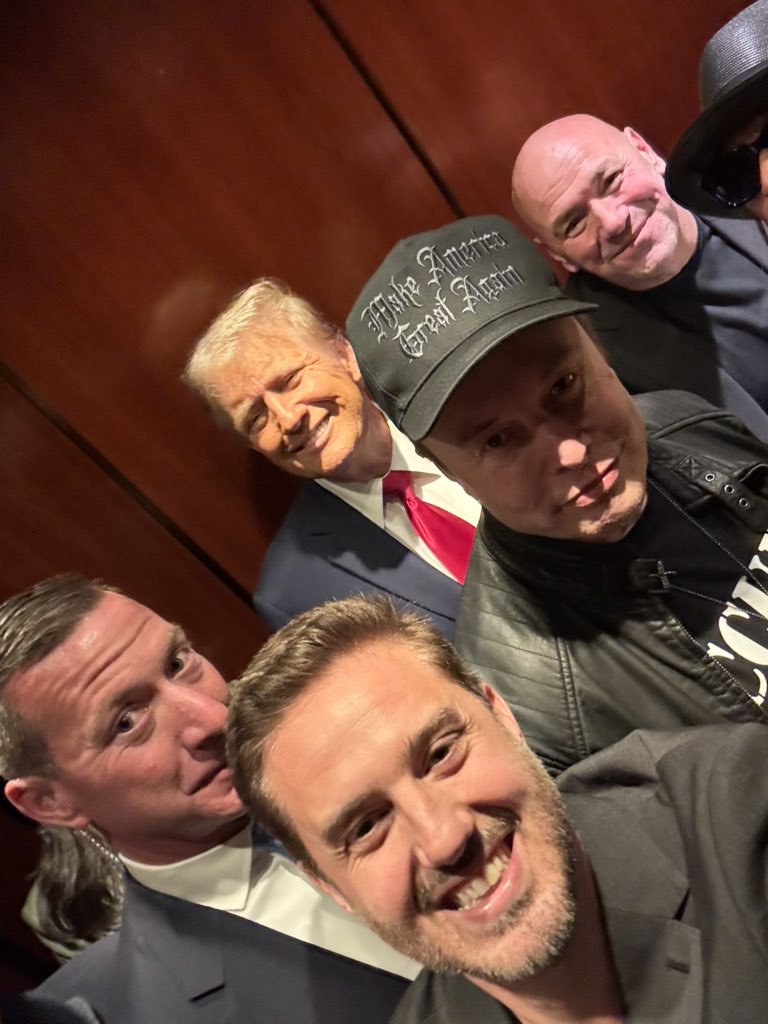
Rumble’s investor base further reflects its political leanings: major backers come from conservative circles. Silicon Valley billionaire Peter Thiel invested in Rumble during its early stages. More significantly, current Republican U.S. Senator J.D. Vance is also a financial backer of Rumble. Before entering the Senate, Vance ran Narya Capital, a venture fund disclosed as one of Rumble’s top ten investors. Narya purchased 7 million Rumble shares in 2022, earning a board seat. Vance himself disclosed holding hundreds of thousands of dollars’ worth of Rumble stock in financial filings. Clearly, Rumble enjoys financial and network support from a new generation of right-wing political leaders. This investor profile brings not just capital but also potential political protection: when the platform faces regulatory scrutiny or public pressure, influential allies can provide advocacy and defense. In essence, Rumble is backed by a coalition of “value-aligned allies” ideologically and financially committed to its success.
The most pivotal alliance is Rumble’s close relationship with the Trump camp. From inception, Trump’s social media platform Truth Social has maintained a deep partnership with Rumble: in 2022, Truth Social announced it would use Rumble’s video hosting and streaming technology as its backend; simultaneously, Rumble invited Truth Social to be a launch publisher on its new ad platform, helping Truth Social generate ad revenue. This two-way collaboration effectively makes Rumble part of Trump’s media empire: Truth Social’s video content is powered by Rumble Cloud, and its ad monetization relies on Rumble Ads. Moreover, Trump frequently chooses Rumble to livestream campaign rallies and public speeches, delivering steady, high-engagement traffic. For example, each of Trump’s major speeches draws hundreds of thousands of live viewers on Rumble, amplified further by conservative media, boosting Rumble’s visibility among right-wing audiences. Following Trump’s re-election and victory in the 2024 presidential race (within this hypothetical context), his favor toward this “insider” platform is expected to grow even stronger. This implies Rumble will enjoy exclusive access to one of the most influential political figures in America over the coming years, significantly elevating its traffic volume and user stickiness.
On the topic of value alliances, mention must be made of Elon Musk, who shares a kindred spirit with Rumble. Though Musk hasn’t directly invested in Rumble, his post-2022 acquisition of Twitter (renamed X) and push for “absolute free speech” mirror Rumble’s ethos. Musk has repeatedly criticized mainstream media and social platforms’ censorship policies, advocating for maximal user expression. This stance forms an ideological alliance with platforms like Rumble. For instance, when YouTube restricts content monetization under “ad-friendly” policies, Musk suggested on X that creators consider alternatives—prompting Rumble’s CEO to immediately extend an invitation; Musk has also liked and supported Rumble’s posts defending free speech on social media (under assumed interaction scenarios). While X and Rumble occupy different niches in the social media landscape, collaboration remains possible—such as integrating video sharing or jointly resisting advertiser boycotts. Broadly, Musk, Trump, Vance, and others constitute a contemporary U.S. conservative/libertarian digital ecosystem: mutually supporting each other’s platforms and values against the dominance of legacy media and Big Tech. Rumble is the fortress of this alliance in the video content domain. This value alignment grants Rumble a soft moat—users identify with the platform emotionally and ideologically, not merely functionally.
In summary, Rumble’s moat consists of several key elements:
-
Unique content supply: Rumble hosts a wealth of content absent or prohibited on mainstream platforms—from conservative political commentary and conspiracy programs to exclusive live streams by controversial figures—forming a differentiated content library. These offerings attract loyal audiences with no alternative viewing options, locking in this traffic segment.
-
Highly engaged user community: Rumble users often hold strong ideological convictions, treating platform usage as a value statement. Hence, user loyalty far exceeds that of typical entertainment products. Some far-right users even regard Rumble as a “digital sanctuary,” spending hours daily consuming content. Data shows Rumble users globally watched 47.6 billion minutes of content monthly in 2023. Though its monthly active users number in the tens of millions, average session duration is exceptionally high—indicating strong retention. Once immersed in Rumble’s ecosystem, users are unlikely to migrate elsewhere.
-
Autonomous technical infrastructure: Rumble recognizes that owning its cloud services is vital to resisting Big Tech suppression. To this end, it developed Rumble Cloud, offering independent video hosting, live streaming, and distribution, reducing reliance on giants like AWS. The 2022 Parler incident proved this: conservative social media platforms hosted on AWS were taken down, while Truth Social operated uninterrupted on Rumble Cloud. Recently, Rumble announced a collaboration with Tron DAO to explore using decentralized blockchain technology to enhance its infrastructure’s censorship resistance. Tron is known for high performance and low cost, handling over 63% of global USDT transactions, making it a key network for stablecoin applications. By partnering with Tron, Rumble aims to achieve a decentralized backend architecture, reducing dependency on traditional cloud providers and strengthening resistance to content takedowns. This technical independence forms Rumble’s “hard moat,” making it difficult to shut down.
-
Political and capital allies: As discussed, Rumble enjoys financial and political backing from conservative figures (Thiel, Vance, Trump, etc.). This brings not only user validation but also potential protection in regulatory battles. When lawmakers question mainstream platforms’ biases, Rumble is often cited as a positive example, gaining favorable exposure. This political endorsement is a rare advantage most commercial platforms cannot match.
These moats enable Rumble to establish a formidable stronghold within the right-wing/libertarian content community, making it extremely difficult for new entrants to displace. For Tether, this represents a high-engagement, high-loyalty user gateway. Given that Rumble users often distrust traditional finance and Big Tech, they are more receptive—even enthusiastic—about decentralized crypto tools. Pavlovski openly states that crypto and free-speech communities are ideologically aligned, both passionate about freedom and transparency. Many Rumble users may already hold Bitcoin or USDT, or at least be familiar with dollar-pegged stablecoins. Integrating USDT into Rumble’s content and payment systems can thus gain organic user acceptance. Converting these loyal users into regular USDT adopters would significantly strengthen Tether’s market position—they are not just traffic, but potential “Tether ecosystem allies” who help promote stablecoin adoption. In this sense, Rumble is a “traffic enclave” for Tether—a loyal, vibrant user base growing outside mainstream view, offering Tether a market fortress unreachable by other stablecoin issuers.
“Wallet economics” could become Rumble’s third growth engine. As previously mentioned, Rumble and Tether’s non-custodial wallet is scheduled to launch in late 2025. Once operational, Rumble stands to benefit in multiple ways: first, wallet usage generates transaction fees (though on-chain costs are low, frequent micro-tips can accumulate), from which Rumble may take a share. Second, the wallet will attract more crypto users to register on Rumble, raising the ceiling for user growth. Especially in USDT-prevalent regions like Latin America and Africa, the Rumble+wallet combo could draw incremental users seeking both free content and stablecoin-based transactions. Third, wallet features themselves can become new product differentiators—offering creators “one-click USDT withdrawals,” fan tipping leaderboards, or NFT content sales as premium services, generating revenue via commissions or fees. On a broader scale, Rumble is entering an underserved market: decentralized financial services for creator monetization. If creators previously relied on platform splits and ad sponsorships, direct user payments via stablecoins could reduce platform dependence on advertising, fostering a healthier, diversified revenue model. If successful, Rumble could even license its wallet technology to other platforms, opening new B2B revenue streams.
In terms of creator ecosystem development, Rumble’s recent investments are already yielding results. The platform now hosts both high-profile YouTubers who migrated and homegrown talent. In 2023 alone, Rumble saw 54,410 video uploads—a 59% increase from 2022—reflecting growing creator engagement. Rumble also signs exclusive deals with top-tier creators, such as a major contract with conservative commentator Steven Crowder (reportedly worth hundreds of millions over several years), securing his exclusive live presence. This aggressive talent poaching strategy increases short-term costs but has clearly driven significant follower migration and user growth. Looking ahead, as Rumble integrates stablecoin payments, its appeal to creators will rise further—no mainstream platform offers such diverse and unrestricted monetization: ad revenue, subscriptions, and global crypto tipping. Consequently, more niche creators are expected to choose Rumble, fueling a virtuous cycle of content creation.
Finally, from the broader perspective of “decentralizing platform traffic,” Rumble’s rise and Tether’s involvement carry symbolic significance. For years, giants like YouTube and Facebook have monopolized online content traffic and monetization, creating issues of censorship and centralization, leaving creators and users subject to platform rules. The Rumble+Tether model offers a viable alternative paradigm: content platforms building their own infrastructure and integrating crypto payments, achieving dual decentralization of content and capital flows. Users can access information and express opinions in an environment free from Silicon Valley control, while using currencies outside the Wall Street banking system for value exchange. This architectural divergence is driving a more multipolar distribution of internet traffic, no longer concentrated on a few corporate servers. For instance, Rumble’s decentralized cloud in partnership with Tron could allow future websites to rent censorship-resistant infrastructure, diverting traffic away from AWS and Google Cloud. Similarly, stablecoin wallets let users make payments without going through Visa/Mastercard, weakening traditional finance’s monopoly on micro-payment flows. In essence, the Rumble-Tether partnership is a bold experiment in the convergence of social media and crypto finance within the decentralization wave. If successful, it will prove that decentralized technology and free-market ideals are not utopian—they can spawn new mainstream platforms capable of competing with, and even rivaling, today’s tech giants.
Join TechFlow official community to stay tuned
Telegram:https://t.me/TechFlowDaily
X (Twitter):https://x.com/TechFlowPost
X (Twitter) EN:https://x.com/BlockFlow_News
 @ChainTrust0103