From "Ten-Thousand-Yuan Consultations" to Quark's Free AI: The Battle for Information Equality in College Admission Counseling
TechFlow Selected TechFlow Selected
From "Ten-Thousand-Yuan Consultations" to Quark's Free AI: The Battle for Information Equality in College Admission Counseling
In the face of the top-tier demand where each person has unique needs, large models are in their prime element.
 Navigating Web3 tides with focused insights
Author: Zhang Yongyi
On June 10, the final exam of the 2025 college entrance examination concluded. But for millions of考生 families across China, the upcoming college application process represents another kind of gaokao.
Faced with admission information from over 3,000 universities and aspirations for future life, candidates and their parents are making increasingly concrete real-world considerations. The market has responded by mass-producing various types of college application products and services to meet the personalized needs of post-2005s.
From Zhang Xuefeng-style planning services costing thousands or even tens of thousands of yuan, to "budget versions" sold for several thousand yuan on social platforms, down to AI software priced at just a few hundred yuan, the commercial wave around college applications is reaching its peak.
Many AI products are now tearing down the information barriers standing before students by leveraging data and large models. With large models entering the college application scene, more students and parents are gaining access to information equity.
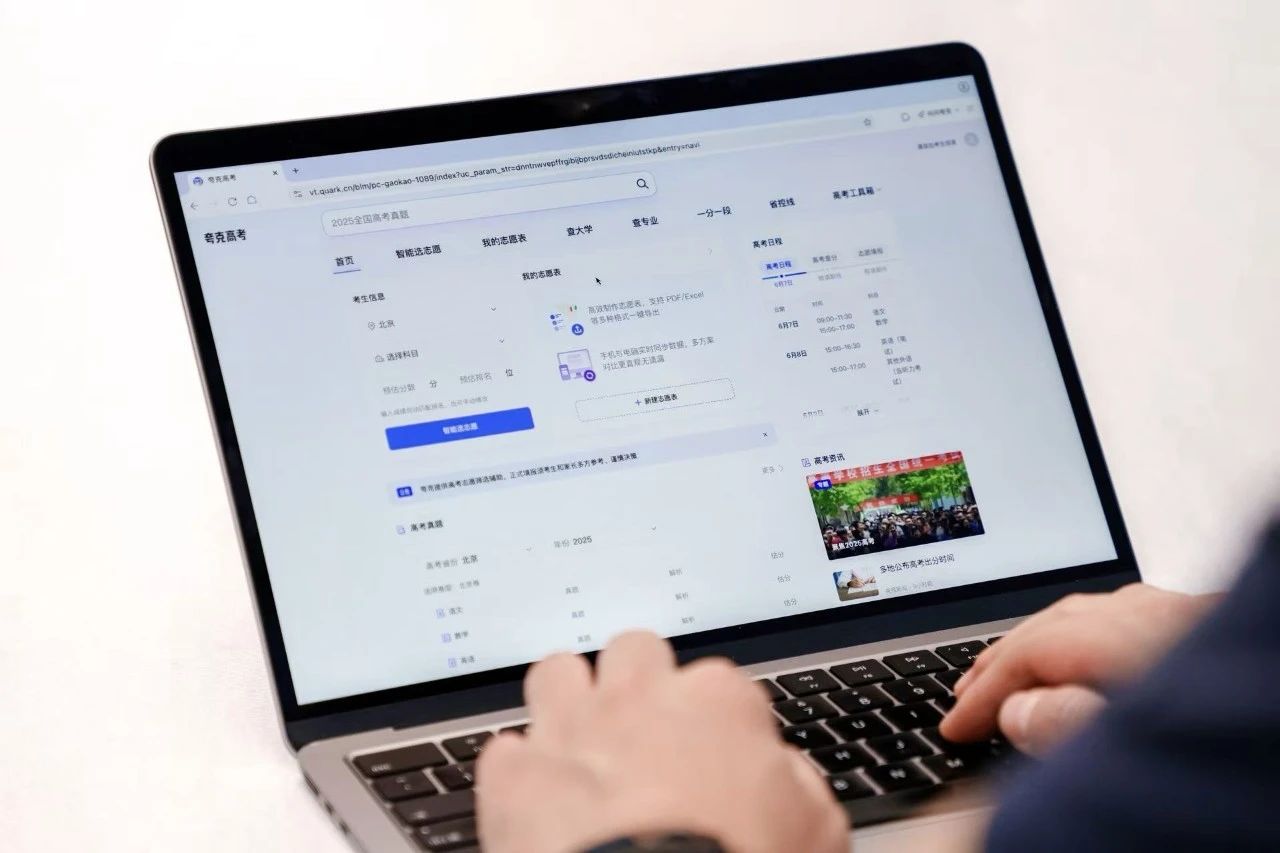
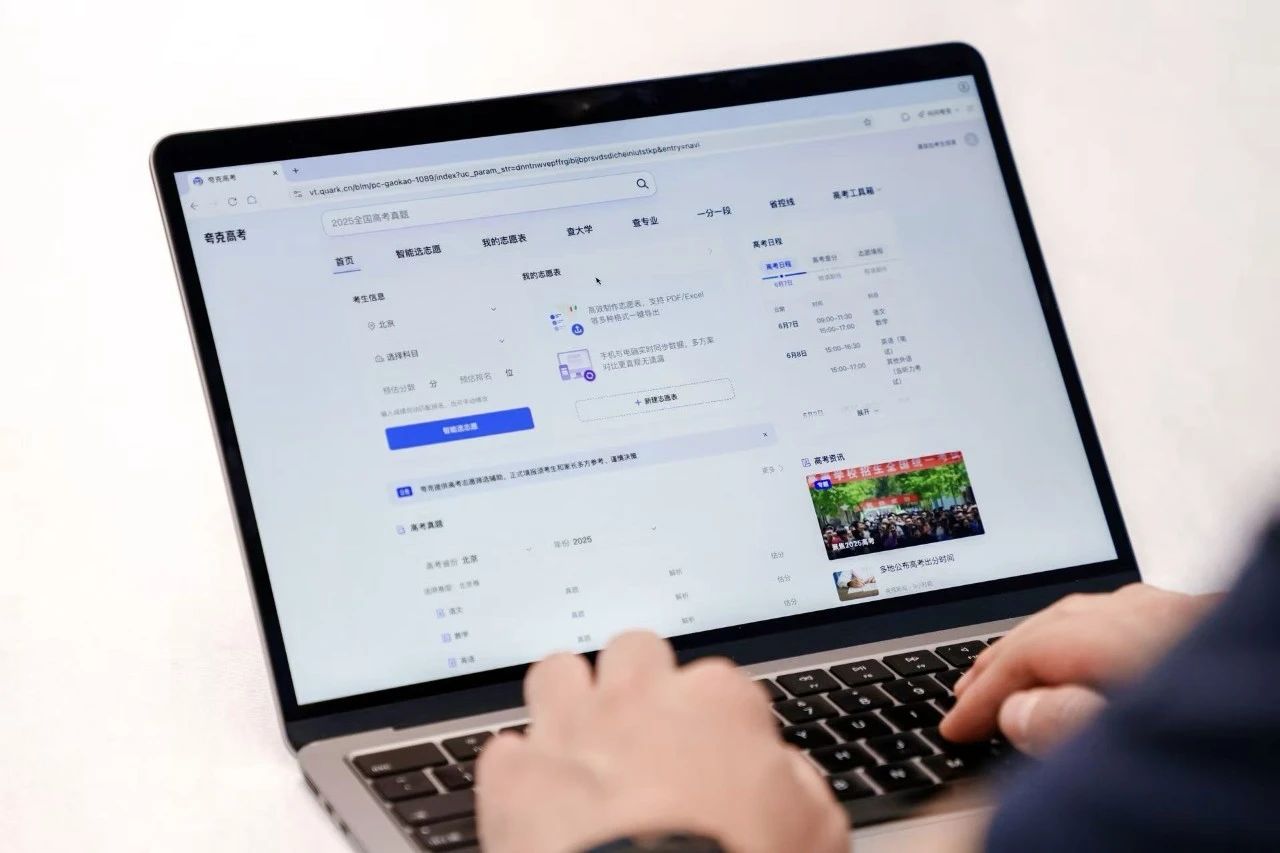
As a platform that has specialized in college entrance exam information services for seven consecutive years, Quark has once again positioned itself behind this year’s candidates—launching not only the industry's first college application large model and knowledge base, but also introducing AI-powered features such as “Volunteer Report” and “Gaokao Deep Search.”
Quark’s goal is clear: through product innovation and AI technology, answer every open-ended question related to college applications, while ensuring every candidate receives a professional volunteer report to assist in life-changing decisions.
01 How to Create a Good “Personalized” Volunteer Report?
In human-led college application services like those offered by figures such as Zhang Xuefeng, advisors must first master vast amounts of data and exclusive insights, building their own moat of expertise. They then conduct one-on-one interviews to deeply understand each student’s background, interests, and family circumstances before analyzing and offering recommendations. After revisions and comparisons, they deliver a final “volunteer report” to the user.
Given that the volunteer report is an extremely information-dense and long decision-making scenario, what would an AI-generated version look like?
After Quark launched its “Volunteer Report” feature, I personally tested it. Taking a Beijing-based student scoring 630 points in physics, chemistry, and biology who enjoys law and wants to become a lawyer, I filled in personal details and interest preferences through 12 questions to complete the profile setup.
Upon confirmation, Quark begins generating the report, which takes about 5–10 minutes and results in a 15–20 page document.
During this process, Quark leverages its college application large model via agent-based invocation to provide personalized planning advice. Ultimately, it outputs three distinct reports emphasizing different priorities—major-first, university-first, and location-first—with content covering strategy design, detailed lists of recommended schools and majors, and interpretations of the application form. Users can directly add suggestions into their application forms or export them as PDFs.
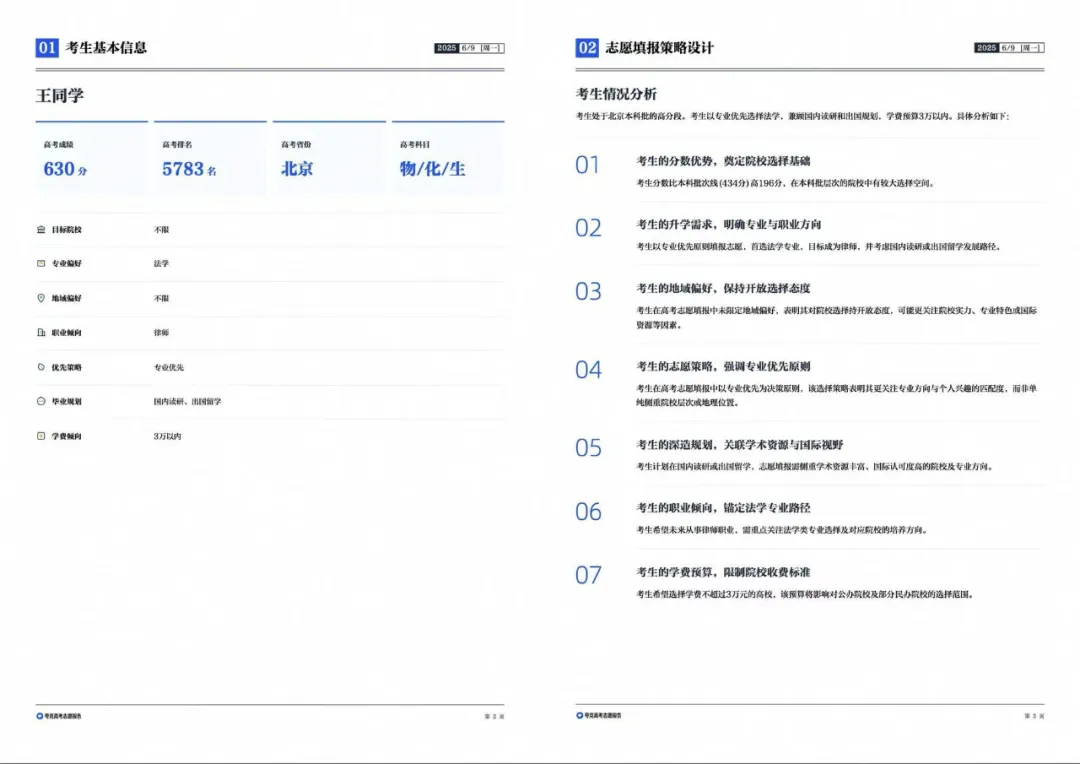
The resulting report clearly understands my preference for law and creates a tiered plan incorporating 985 and 211 universities along with distinctive disciplines.
It also analyzes factors such as city, tuition, and employment prospects, integrating these into school and major recommendations so students gain a comprehensive understanding—not just raw data about institutions and programs.
Data shows only 2% of students opt for offline consultations annually. For the remaining 98%, Quark helps reduce disparities caused by geography and cost, narrowing the information gap in college applications.
Beyond this, powered by its Gaokao Deep Search function, even open-ended, highly conversational queries receive practical, reality-grounded suggestions.
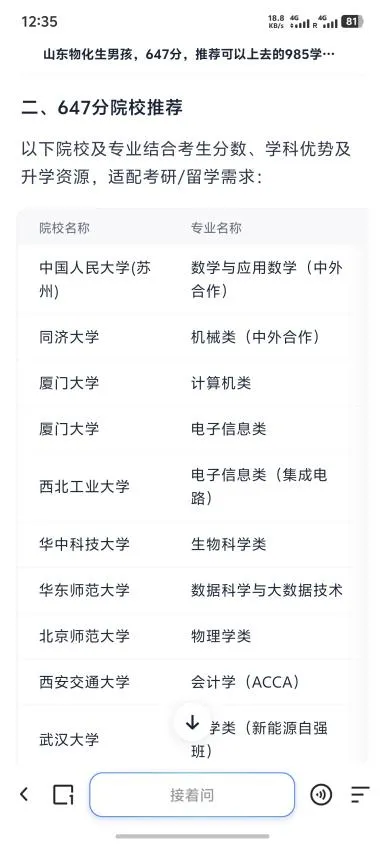
For example, I used the prompt: “A boy from Shandong with physics, chemistry, and biology subjects scored 647. Recommend reachable 985 universities, including Sino-foreign cooperative programs. He plans to pursue postgraduate studies or study abroad. Help with college application,” to test Quark’s deep search capability.
Under this prompt, Quark first parses the student’s core needs—score, subject combination, interests, regional preferences—then performs multidimensional matching and reasoning within its extensive college entrance knowledge base. This database includes structured data such as historical enrollment statistics, major information, employment rates, and further-study rates, as well as unstructured knowledge on industry trends and connections between majors and careers.


02 How Is the “Expert Brain” Forged?
To make front-end user experiences more accurate, Quark significantly increased its investment in AI model capabilities this year, boosting computing power by 100x.
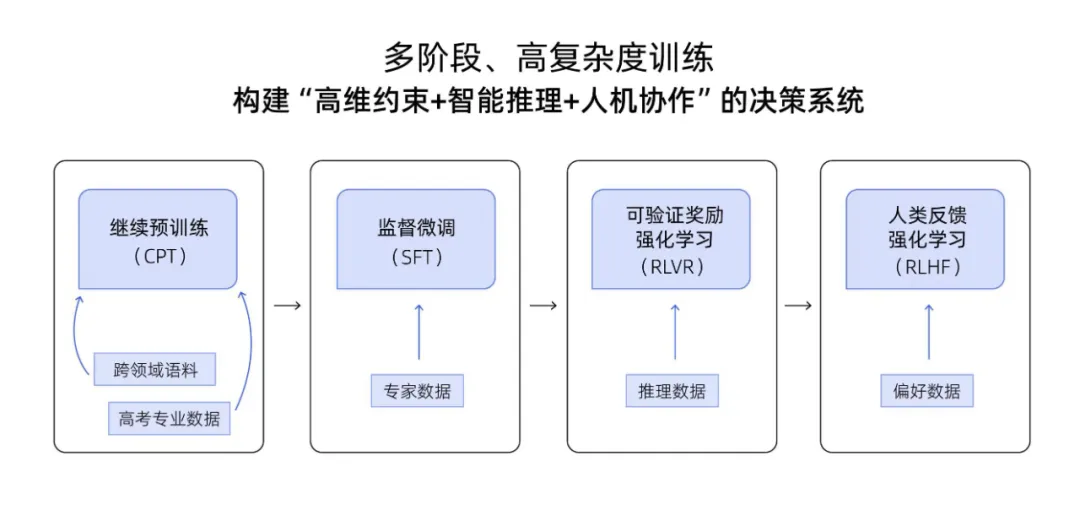
Although built upon Qwen (Tongyi Qianwen), Quark’s college application large model isn’t merely a fine-tuned general-purpose model. Instead, it uses a strategy refinement mechanism guided and evaluated by real-life college application experts, enabling the model to truly “think like an expert advisor.”
To achieve this, Quark first trains the AI to mimic the “chain of thought” of human experts. During instruction tuning, the R&D team structurally processed hundreds of real multi-round dialogues between experienced college planning counselors and students or parents, extracting complete analytical pathways and communication styles. These high-quality supervised datasets—containing tens of thousands of authentic expert “reasoning chains”—serve as textbooks for the large model to learn human expert analysis processes.
This highlights Quark’s core advantage. “Quark’s data comes from authoritative sources released by official education examination authorities—the so-called ‘thick books’ recognized in the industry,” emphasized Teacher Ren, an expert involved in training Quark’s AI college application model. This stands in stark contrast to many other large models relying on web-scraped, unverified outdated data, fundamentally eliminating absurd AI hallucinations like recommending 985 universities to students with 500-point scores, ensuring recommendation accuracy and authority.
03 The Pulse of the Era
From understanding how the AI college application large model was developed, you’ve likely realized that producing accurate results in such a specific application context cannot happen without the help of real human college application experts.
Each gaokao season, we see renowned experts like Zhang Xuefeng. Yet in reality, anxious students and parents still face numerous “college application mentors” whose service quality is hard to guarantee.
The reason these services continue to thrive annually is because college application has evolved beyond simply “choosing a school or major.” It has become a “first career planning session” involving the entire family—and arguably, a shared “pulse of the era” affecting tens of millions of students each year.
However, Zhang Xuefeng represents the expensive pinnacle solution. No matter how capable, his capacity is limited; his services remain a “luxury” accessible only to a few. Behind him lies a much larger, uneven market where countless individuals and organizations brand themselves as “experts,” exploiting equally anxious ordinary families who cannot afford top-tier resources with subpar services.
If Zhang Xuefeng’s core advantage lies in personal experience and information accumulation, Quark’s approach is to internalize the decision-making logic and experience of hundreds of senior planners through its college application large model, combined with China’s largest and real-time updated college entrance knowledge base. Its aim is to transform what was once a personal-dependent, costly, and non-standardized “expert service” into a standardized, high-quality “AI advisor” freely available to everyone.
Some say Quark’s newly launched AI college application tool is trying to “overturn the table,” but that’s not quite accurate. It’s not overturning the table—it’s replacing it with a bigger one, allowing more people to sit down. This new table requires no appointments and charges no consultation fees. As long as you can open your phone and fill out a profile, it delivers a logically sound, data-backed volunteer report.
At this table, a student from Liangshan sees the same report structure, the same major dimensions, and the same recommendation logic as a student from Hangzhou. AI brings their starting points closer together. The gaokao is an opportunity to change one’s fate, and the role of technology is to make that opportunity fairer. Such opportunities should never be reserved solely for those holding VIP gold cards.
User data revealed by Quark at its June 12 launch event perfectly illustrates this point—its college application services have cumulatively helped 120 million users, with over 50% coming from third-tier cities and below.
Join TechFlow official community to stay tuned
Telegram:https://t.me/TechFlowDaily
X (Twitter):https://x.com/TechFlowPost
X (Twitter) EN:https://x.com/BlockFlow_News
 极客公园
极客公园