
Yupp raises $33 million in seed funding, Twitter's former tech leads rebuild AI model evaluation framework
TechFlow Selected TechFlow Selected
Yupp raises $33 million in seed funding, Twitter's former tech leads rebuild AI model evaluation framework
How does Yupp use a crowdsourcing model to break through the bottleneck of AI accessibility and evaluation?
 Navigating Web3 tides with focused insights
By KarenZ, Foresight News
With the rapid advancement of AI technology, the proliferation and diversification of AI models have left users overwhelmed. How to choose the right AI model, how to go beyond traditional benchmarks to precisely capture real-world needs, and how to provide tangible incentives for feedback contributors have become critical challenges in the AI industry.
Yupp emerged against this backdrop as an open platform aiming to build an open, transparent, and community-driven AI model evaluation ecosystem. As Yupp puts it, "Compared to any other technological innovation in history, AI depends more on everyone's participation and contribution to drive its evolution."
Last week (June 13), Yupp.ai announced a $33 million seed round led by a16z crypto, drawing community attention not only for its funding but also for its impressive investor lineup, including Google Chief Scientist Jeff Dean and X co-founder Biz Stone. At the same time, Yupp launched its product, offering users not just a window into exploring AI, but redefining how AI models are evaluated and optimized through community participation and blockchain technology.
Yupp Team and Funding Background
The company behind Yupp is Ber Sarai Labs Inc., co-founded in June 2024 by Pankaj Gupta and Gilad Mishne, who have been conducting secret testing over the past six months. The two co-founders and the chief scientist first met on Twitter in 2010 and all possess deep expertise in the AI industry, having previously worked at companies such as Coinbase, Google, and X.
-
Pankaj Gupta: Co-founder and CEO of Yupp, holds a Bachelor’s degree in Computer Science and Engineering from IIT Delhi and a Ph.D. in Computer Science from Stanford University. He served as Tech Lead, Senior Manager of Personalization & Recommendations, and Senior ML Staff at Twitter (March 2009 – May 2014). At Google, he held roles as Engineering Director and Senior Engineering Director (July 2017 – March 2021). He was the first employee and site lead for Coinbase India, later serving as Vice President of Engineering and Advisor at Coinbase (April 2021 – May 2024).
-
Gilad Mishne: Co-founder and Head of AI at Yupp, formerly Software Engineer at Intel (1998–2000), Senior Scientist at Yahoo (2007–2010), Senior Engineer and Search Director at Twitter (2010–2015), and Senior Engineering Manager and Machine Learning Lead at Google’s Moonshot Factory (2019–2023).
-
Jimmy Lin: Chief Scientist at Yupp, completed his Ph.D. in Computer Science at MIT focusing on question-answering systems and conversational interfaces. He currently serves as Professor and David R. Cheriton Chair at the David R. Cheriton School of Computer Science, University of Waterloo. From 2010 to 2012, Jimmy Lin contributed to data analysis and data science infrastructure at Twitter.
The $33 million seed funding announced this month was actually completed last year. Yupp's capital network spans technology, investment, and academia. In addition to lead investor a16z crypto, participants include Google Chief Scientist Jeff Dean, X co-founder Biz Stone, Pinterest co-founder Evan Sharp, Perplexity CEO Aravind Srinivas, Cred CEO Kunal Shah, four Stanford University professors (Dan Boneh, Chris Re, Nick McKeown, Balaji Prabhakar), Othman Laraki, Paul Grewal, Gokul Rajaram, and Coinbase Ventures.
What is Yupp? How Does It Work?
Positioned as an AI model exploration and evaluation platform, Yupp allows users to freely experience and compare various AI models. Its core idea is crowd-sourced model evaluation: users submit prompts, compare responses generated by different AI models, select the better answer, provide feedback, and receive redeemable point rewards. These choices and feedback are recorded and used as data for subsequent AI model training and evaluation.
Yupp will also leverage open-access and permissionless technologies like blockchain, cryptographic primitives and protocols such as zero-knowledge proofs and challenge/response mechanisms, and privacy-preserving technologies like confidential computing to build a system with provably trustworthy neutrality, fairness, and robustness.
Yupp's operating mechanism can be summarized as follows:
1. Model Exploration and Comparison: Yupp aggregates over 500 AI models, including ChatGPT, Claude, Gemini, DeepSeek, Grok, Llama, and others. Users can access these models via the platform’s chat interface to test prompts and directly compare their performance side-by-side.
Currently, Yupp features two main pages: a chat page and a leaderboard. The chat interface is simple, featuring a message box, file upload, optional model selection, image upload, and a toggle between private and public chat modes (defaulting to private).

As shown below, after a query, Yupp presents two AI-generated responses, prompting the user to select the better one.

Notably, models are selected automatically by default, and sometimes model names are hidden to collect more objective feedback. Of course, users can also ask random questions. Additionally, Yupp’s QuickTake AI feature offers concise summary responses.
2. User Feedback: After selecting the preferred response, users can further indicate quality preferences via tag clicks or provide free-form text feedback. This feedback helps personalize future AI responses on Yupp and enables Yupp to offer models for free.
3. Feedback Rewards: After submitting feedback, users receive a scratch card for points. Points can be used for asking questions or redeemed.

4. Evaluation: By selecting the best responses and providing feedback, users actively participate in model evaluation. Yupp aims to establish a transparent evaluation system where AI developers gain valuable training data, users receive rewards, and together they advance AI technology. The platform features a public leaderboard called the “Yupp VIBE Score” (VIBE: Vibe Intelligence BEnchmark), which leverages user feedback to improve model performance while ensuring prompt privacy unless users opt to share.
The leaderboard ranks AI models based on user feedback, response speed, and other factors. Users can filter and sort integrated models by metrics including VIBE score, confidence interval of probabilistic samples, voting statistics, speed, latency, and input/output cost.
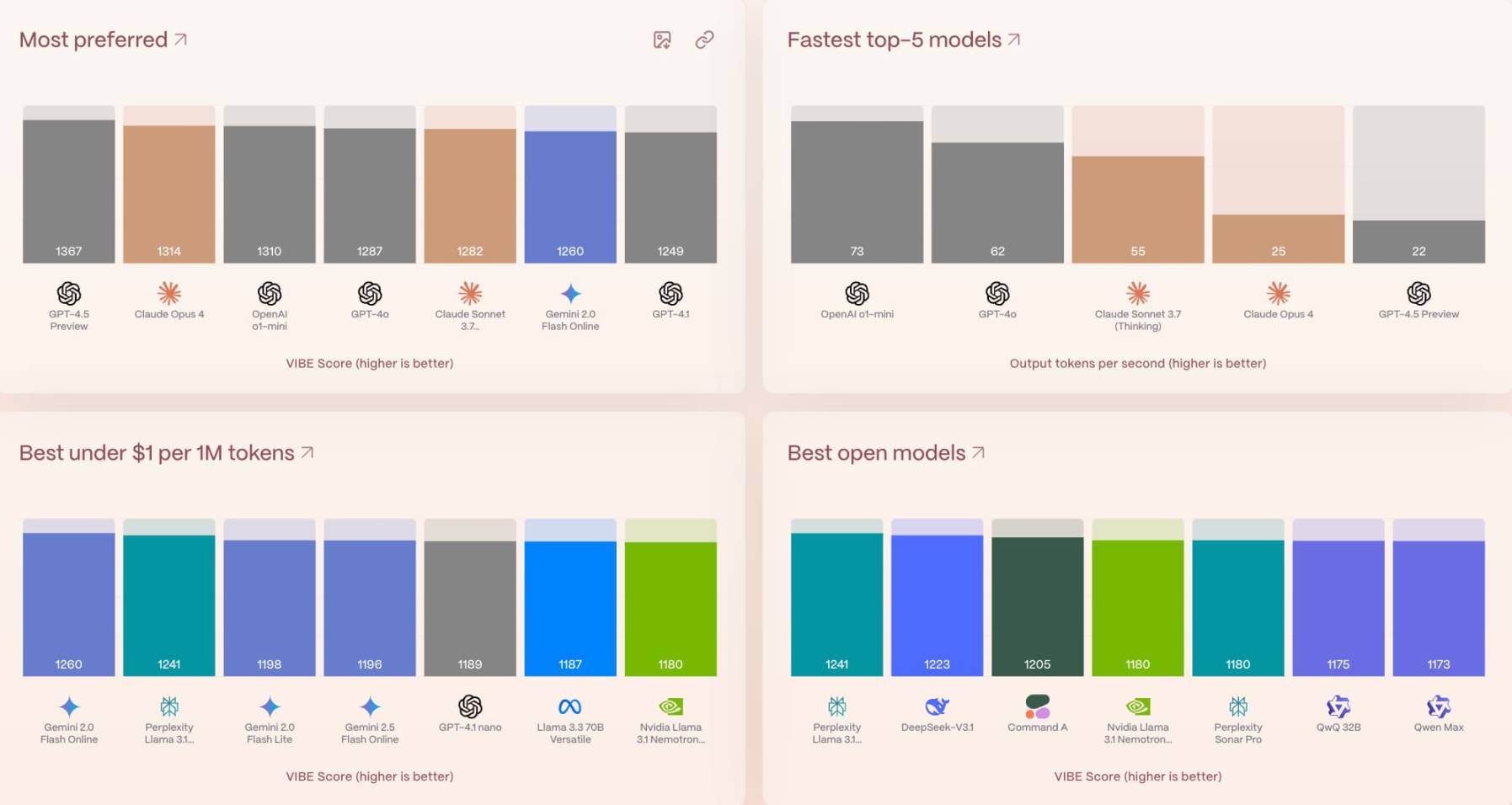
Yupp combines user preference data to segment users and evaluation data at a finer granularity, providing valuable samples for AI developers. According to Yupp, leveraging the founders’ experience combating spam and bots at Twitter, the team has developed sophisticated algorithms to filter out low-quality data and ensure ranking integrity. Yupp has also established a dedicated Trust & Safety team and plans continued heavy investment in this area.

Yupp Point System: Rules for Spending and Redemption
Yupp points are spent when asking questions and earned through feedback, with partial redemption available. Yupp states that if users responsibly engage with the platform, they will always have enough points to ask questions and may redeem some points as a token of appreciation for improving the ecosystem.
Asking questions costs points; new users receive 5,000 free points upon registration. Total cost equals the sum of base fee, PRO model fee, attachment submission fee, and pre-selected image model fee.
-
Base Fee: Each prompt costs 50 points by default. Generating images costs 100 Yupp points.
-
PRO Models: These advanced models are typically available only via paid subscriptions elsewhere. Pre-selecting a PRO model adds 50 Yupp points per query.
-
MAX Models: These use the most expensive models. Pre-selecting a MAX model adds 300 Yupp points per model per prompt (totaling 350 points including base fee).
-
Attachment Submission Fee: Each attachment costs 25 Yupp points.
-
Selected Image Model: Each pre-selected image model incurs an additional 100 Yupp points.
In addition, Yupp conversations are private by default. If users choose to make a conversation public, they pay only half the standard fees listed above.
As mentioned earlier, providing feedback earns users scratch cards. The author received several scratch cards ranging from 200 to 500 points.
Yupp says users can cash out points into USD, EUR, INR, and over 20 other fiat currencies, or exchange them for stablecoins (on Base and Solana). Yupp has partnered with payment providers including Stripe, PayPal, and Coinbase to meet diverse user needs. Every 1,000 points can be redeemed for $1. However, the redemption feature is currently unavailable. To prevent Sybil attacks or abuse, Yupp has set the following redemption rules:
-
Maximum 1 withdrawal per day, capped at $10 (10,000 points);
-
Maximum 3 withdrawals per week, totaling up to $20 (20,000 points);
-
Maximum 6 withdrawals per month, totaling up to $50 (50,000 points).
Additionally, Yupp stipulates that any purchase, sale, transfer, or trading of Yupp points violates the Terms of Service, will be deemed invalid, and may result in immediate account suspension. Abuse may lead to feature disablement or even account suspension.
How to Participate?
The process to join Yupp is as follows:
-
Sign up using a Google account (registration grants 5,000 points; official code “yupp-launch” gives an extra 2,500 points if used before June 20);
-
Ask questions to AI models and choose the better answer between two;
-
Select feedback tags or provide written feedback;
-
Scratch the digital scratch card with your mouse to claim points;
-
Decide whether to withdraw (currently disabled by the platform).
Summary
As Chris Dixon, Founding Partner and Managing Partner at a16z crypto, stated: “Yupp’s design transforms human judgment into a sustainable economic resource. As new interactions replace old data—and data ‘expires’—a natural virtuous cycle emerges: more usage brings fresher evaluations; fresher evaluations produce better models; better models attract more usage. All participants—from users to AI builders—can take part, seeing the same transparent rules apply to everyone, ensuring a credibly neutral market. No one can hide the leaderboard, and no one can manipulate rewards or outcomes.”
Yupp’s slogan, “Every AI for everyone,” could be more aptly translated as “AI for All.” Yupp seeks to build the “evaluation infrastructure” for the AI era by combining blockchain technology with crowdsourcing—empowering users with incentives for feedback, enabling developers to access real-world data, and ultimately driving AI toward greater inclusivity and trustworthiness.
Join TechFlow official community to stay tuned
Telegram:https://t.me/TechFlowDaily
X (Twitter):https://x.com/TechFlowPost
X (Twitter) EN:https://x.com/BlockFlow_News
 Foresight News