The Ethereum Revival Battle: Lubin Leads the Strategic Deployment of a $425 Million War Chest
TechFlow Selected TechFlow Selected
The Ethereum Revival Battle: Lubin Leads the Strategic Deployment of a $425 Million War Chest
Lubin's move with SharpLink not only brings direct financial implications but also marks Ethereum's evolution from a speculative technology to a significant financial infrastructure.
 Navigating Web3 tides with focused insights
Author: Prathik Desai
Translation: Block unicorn

Introduction
Two weeks ago, Joe Lubin, co-founder of Ethereum and founder & CEO of ConsenSys, announced he would become chairman of the board at SharpLink Gaming and lead its $425 million Ethereum treasury strategy.
This move adds a new chapter to the resurgence of Ethereum—the world’s second-largest cryptocurrency—which had been stuck below $3,000 for over four months.
The initiative mirrors the playbook popularized by Michael Saylor, whose Bitcoin-focused financial strategy inspired a wave of public companies to adopt Bitcoin into their treasuries.
In this article, we analyze whether this could be one of Ethereum’s best opportunities for revival.
Ethereum Treasury
When SharpLink Gaming announced it would raise funds to build an Ethereum treasury, market reaction was swift and clear.
Its stock surged more than 450% in a single day, jumping from $6.63 to over $35 per share. Within five trading days, the price had risen over 17-fold from $6.63. Even after pullbacks, it continued trading at more than triple its pre-surge level.
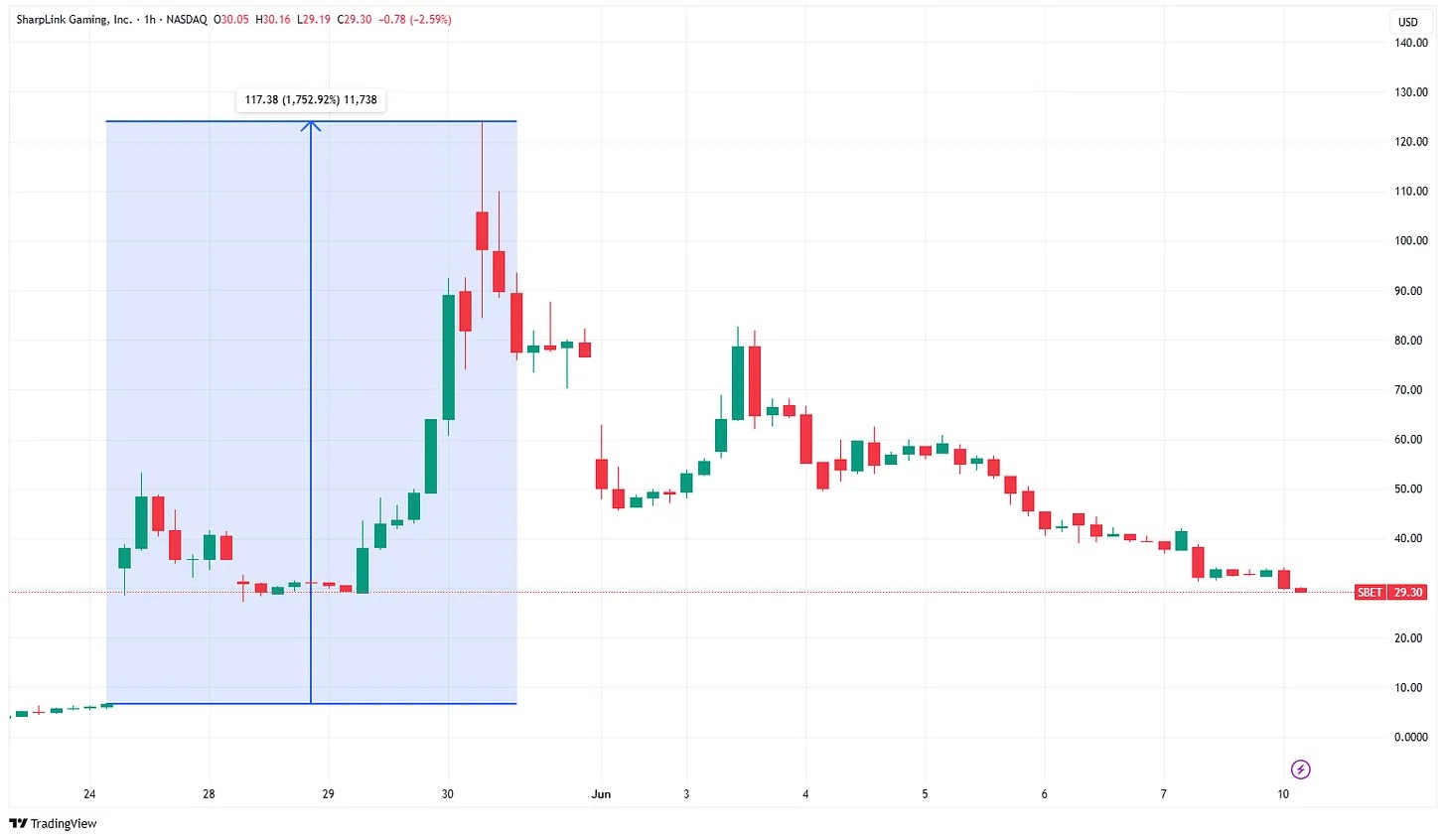
What drove this surge?
The belief that Lubin could help SharpLink replicate the success Saylor achieved with Strategy (formerly MicroStrategy).
Ethereum gives Lubin an advantage over Bitcoin treasuries in at least one key aspect: building an active ETH treasury that doesn’t just store value like Bitcoin, but actively generates more value.
How?
Active Treasury Theory
The difference between Bitcoin and Ethereum treasury strategies is stark. The Bitcoin treasury logic is simple: buy Bitcoin, hold Bitcoin, enjoy price appreciation. Elegant and straightforward—but inherently passive.
Ethereum’s treasury strategy diverges: the majority of ETH tokens will be staked, creating what Ethereum core developer Eric Conner describes as “high-beta, yield-generating leveraged ETH.”
This staking strategy transforms corporate treasuries from passive vaults into active contributors to network security.
Strategy’s Bitcoin holdings generate no native yield, but SharpLink’s staked ETH will earn at least 2% annual yield while strengthening Ethereum’s consensus mechanism.
Conner also highlights the “flywheel effect” as a key advantage of an ETH treasury.
Companies can raise cash at valuations below net asset value, use it to buy and stake ETH, then—if shares trade above the per-share ETH value—raise more capital and repeat the cycle. This is the classic Strategy loop, but with enhanced yield potential unreplicable in Bitcoin treasuries.
The advantages go beyond basic staking.
Decentralized finance (DeFi) protocols offer additional yield strategies through lending, liquidity provision, and sophisticated financial instruments absent in the Bitcoin ecosystem. SharpLink’s backing by DeFi-savvy firms like ParaFi Capital and Galaxy Digital suggests they understand this potential.
ETH vs BTC Treasuries

Ethereum’s initial coin offering (ICO) in 2014 raised $18 million when ETH traded between $0.30 and $0.40, laying the foundation for today’s ecosystem now worth over $320 billion.
SharpLink’s pledged $425 million is more than 20 times the ICO amount—enough to acquire over 150,000 ETH at current prices. Yet this still represents only 0.25% of the 60 million ETH sold during the ICO.
The 2014 ICO laid Ethereum’s foundation. Today’s treasury strategy may validate its maturity as an institutional asset and help shape financial infrastructure for the next decade.
Institutional Momentum
Beyond treasury strategies, Ethereum ETFs have seen sustained inflows across institutional channels over the past two weeks.
As of June 9, Ethereum ETFs recorded net inflows for 16 consecutive trading days—the second-longest streak since their approval in July 2024.

The past two weeks saw inflows of $281 million and $285 million respectively—the strongest two-week performance for Ethereum ETFs in four months.
BlackRock, the world’s largest asset manager, accumulated over $500 million worth of ETH across 11 trading days. Its ETHA ETF now manages nearly $4 billion in assets.
Bernstein analysts noted in a recent report: “Over the past 20 days, ETH ETF inflows reached $815 million, turning year-to-date net flows positive at $658 million.”
CoinShares said 15 consecutive weeks of ETF inflows totaling $1.5 billion signaled a “significant recovery in investor sentiment.”
Products based on Ethereum now account for 10.5% of total assets under management in crypto ETPs.
“The narrative around value accrual in public blockchain networks is at a critical inflection point,” Bernstein stated, “and this is beginning to reflect in investor interest via ETH ETF inflows.”
Our Take
Lubin’s move with SharpLink brings not just immediate financial impact, but signals Ethereum’s evolution from speculative technology to critical financial infrastructure.
When payment giants like Visa and Mastercard develop stablecoin strategies, when Coinbase builds merchant payment systems, when Robinhood plans to launch tokenized assets—they are all, in essence, betting on Ethereum’s trajectory.
This may be the “critical inflection point” Bernstein refers to—a moment of transformation for blockchain networks.
The timing appears deliberate.
With stablecoin legislation advancing in Congress and regulatory clarity emerging, institutional investors finally have the framework they need to deploy capital with confidence. Circle’s successful IPO this week, closing 160% above its listing price, reflects Wall Street’s enthusiasm for crypto infrastructure investments.
For Ethereum, the convergence of corporate treasury adoption, institutional ETF inflows, and regulatory clarity creates conditions unseen in previous cycles.
If SharpLink’s experiment succeeds, it could trigger a domino effect of corporate adoption similar to what Saylor’s Strategy sparked for Bitcoin. Given that Bitcoin’s analogous risk model has proven manageable, Ethereum adoption could come faster and at greater scale.
Beyond corporate adoption, if BlackRock continues accumulating and regulatory clarity solidifies as expected, Lubin’s move may be remembered as the first step in Ethereum’s institutional era.
Join TechFlow official community to stay tuned
Telegram:https://t.me/TechFlowDaily
X (Twitter):https://x.com/TechFlowPost
X (Twitter) EN:https://x.com/BlockFlow_News