DeFi Day shows its magic, is the ETH ecosystem set to rise?
TechFlow Selected TechFlow Selected
DeFi Day shows its magic, is the ETH ecosystem set to rise?
Are we really going to have to chase Ethereum back to 3,000 again?
 Navigating Web3 tides with focused insights
Author: Bright, Foresight News
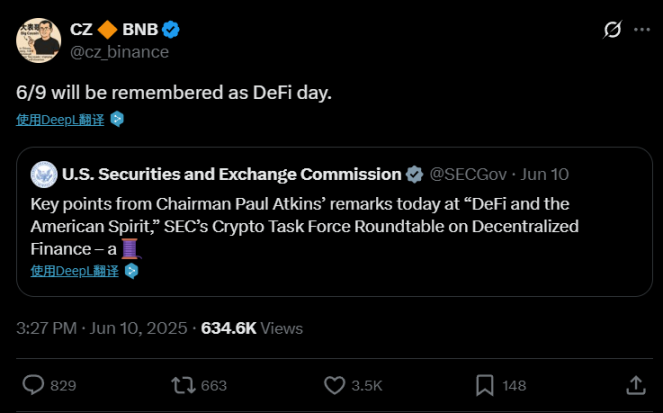
CZ publicly stated on social media: "June 9 will be remembered as DeFi Day." Following the repeal of the 'DeFi Broker Rule,' U.S. crypto regulation has once again broken another chain. Subsequently, established DeFi tokens such as AAVE and UNI entered a vigorous upward trend.
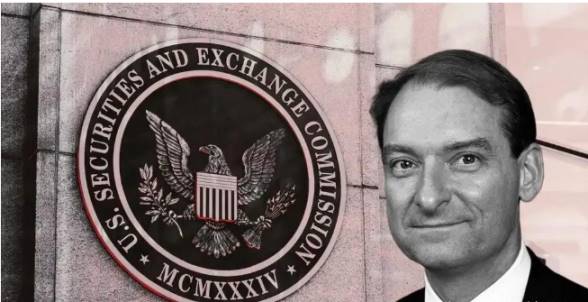
On June 9, U.S. time, the speech by SEC's new chair Paul Atkins titled “DeFi and the American Spirit” marked a fundamental shift in U.S. crypto regulatory logic. Combined with strategic adjustments from the Ethereum Foundation (EF) and market capital resonance, DeFi on the ETH chain is entering an unprecedented structural opportunity. Three core drivers—regulatory paradigm innovation, institutional capital inflows, and technological breakthroughs—are collectively forming the foundational logic behind the爆发 of DeFi Summer 2.0.
1. Regulatory Easing: The Policy Catalyst for DeFi Summer 2.0
In his June 9 speech, Atkins released three major regulatory signals, completely shifting away from Gensler-era "enforcement-first" tone.
First, the U.S. SEC finally acknowledged the code neutrality principle. Using the analogy that "developers of self-driving cars should not be held responsible for third-party misuse," Atkins clearly shifted liability from tool developers to end users, removing legal barriers for "permissionless innovation" in DeFi protocols. This directly addressed cases like Tornado Cash under the previous Democratic administration, freeing developers from compliance constraints. Within 24 hours after the speech, blue-chip DeFi tokens including AAVE and UNI surged over 13%, while privacy-focused tokens like AZTEC rose 9%, demonstrating the market’s tangible revaluation driven by regulatory easing.
Second was property rights restoration and Staking legalization. Atkins emphasized that "the right to autonomously manage private property" is a core American value, explicitly supporting users’ direct participation in on-chain financial activities via personal wallets. This statement effectively ended Gensler-era allegations that liquid staking derivatives (LSD) protocols like Lido and Rocket Pool were securities. The leading LSD token LDO jumped 11% that day, with re-staking projects like EigenLayer also rising, reflecting renewed institutional confidence in the staking ecosystem.
Third, the launch of an innovation sandbox mechanism. Similar to Dubai's DFSA, the SEC announced an "innovation exemption" framework allowing both registered and unregistered entities to rapidly launch on-chain products under compliant conditions. This provides an officially sanctioned testing ground for RWA (real-world asset tokenization), accelerating the onboarding of trillions of dollars in off-chain assets.
2. Core Momentum: Ethereum Foundation Pushes “Defipunk”
The Ethereum Foundation’s 2030 plan clearly states it will promote the establishment of a “Defipunk” evaluation mechanism and support related transformations for DeFi projects.
Within this plan, the Ethereum Foundation views DeFi as the core vehicle for achieving Ethereum’s vision of “permissionless, censorship-resistant” finance, and commits to advancing DeFi as the “open financial infrastructure of the digital age” through treasury allocation, technical support, and standard-setting. A key goal is that by 2026, over 30% of its treasury (excluding core ETH holdings) will be allocated to on-chain DeFi, with priority given to privacy-preserving and highly composable protocols.
Basing on cypherpunk principles, the Ethereum Foundation (EF) is developing a “Defipunk” assessment framework focusing on core attributes such as security, open-source nature, financial sovereignty, technical prioritization, and privacy protection. The aim is to foster a censorship-resistant DeFi ecosystem through research, advocacy, and funding, addressing current challenges like high privacy-related gas fees and user experience friction, while resolving systemic vulnerabilities in existing DeFi—such as widespread reliance on centralized backdoors and multi-signature mechanisms.
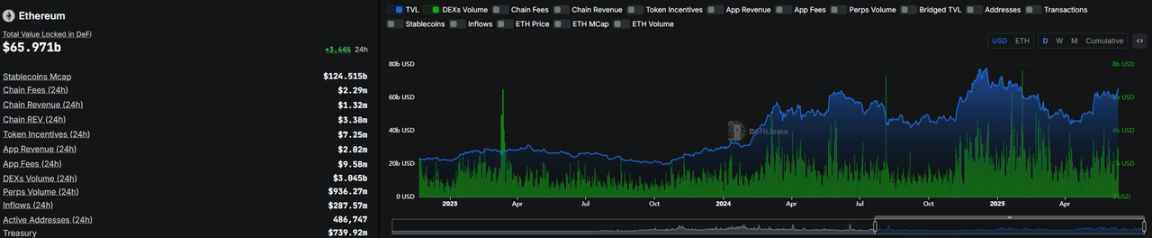
Currently, ETH’s on-chain TVL has rebounded from the lows seen in February and March to $66 billion, showing strong expansion momentum and poised to surpass the peak reached in December 2024.
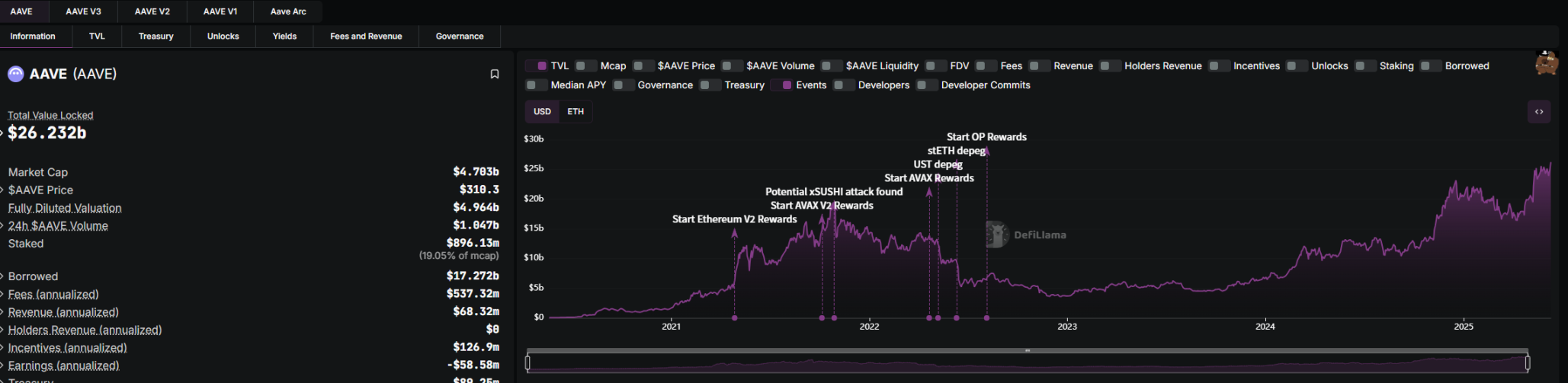
AAVE, which has recently performed exceptionally well, continues to reach new highs—its TVL now exceeds $26 billion, with more than 9.3 million ETH staked.
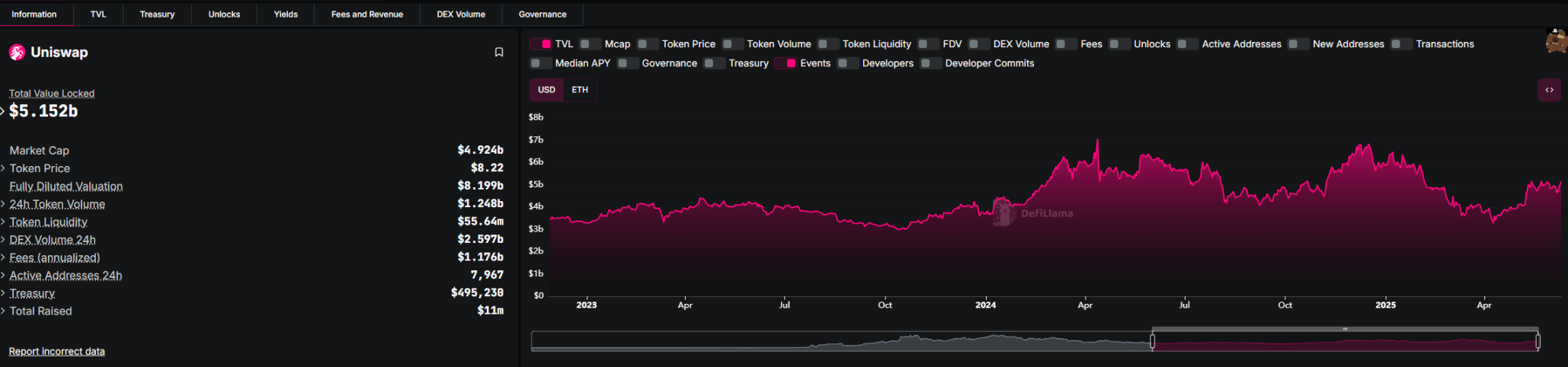
UNI, which surged 30% in one day, also shows strong recent data performance. Its TVL has recovered to $5.152 billion, approaching its 2024 high.
3. Institutional Bullishness: ETH Remains the Top Choice Under Crypto Compliance Framework
On June 11, according to Farside monitoring, FETH saw a net inflow of $26.3 million yesterday, Grayscale’s ETH product had a net inflow of $9.7 million, and ETHW recorded a net inflow of $8.4 million. Meanwhile, Ethereum staking volume hit a record high of 34.8 million ETH, accounting for approximately 28.15% of circulating supply.
The market expects the U.S. SEC to soon approve staking-enabled Ethereum ETFs, with REX Shares already having filed an application. BlackRock’s iShares Ethereum Trust has gone 23 consecutive trading days without any outflows.
Recently, JackYi, founder of LD Capital, reiterated his strong bullish stance on Ethereum and its ecosystem tokens. He disclosed holding long positions in 100,000 ETH options, citing reasons such as undervaluation of the ETH token itself and expectations for ETH/BTC ratio recovery during the bull market; projects with real revenue, users, and products being the first beneficiaries of traditional capital inflows following regulatory easing; and Wall Street capital currently building positions in Ethereum. LD Capital’s Trend Research fund has openly taken a long position in ETH, currently holding 142,000 ETH with unrealized gains of $42.35 million.

QCP’s research report suggests rising implied volatility for Ethereum, with at-the-money front-month option volatility climbing to around 70%. The options skew has also noticeably turned bullish, increasing by 5 to 6 percentage points. High funding rates in perpetual contracts further reinforce the bullish market sentiment. ETF inflows indicate a return of institutional interest. This round of capital rotation may signal a shift in market narrative—from “Bitcoin as digital gold” to “Ethereum as the infrastructure layer for real-world assets (RWA).”
Looking ahead, macro-level tailwinds are indeed gathering momentum for Ethereum. From the wild, regulation-free DeFi Summer of 2020 to today’s fully compliance-oriented environment, the crypto industry has fully transitioned into a regulated era. With the GENIUS Act advancing in the U.S. Senate, Circle launching its IPO, and stablecoins making gradual regulatory progress, Ethereum’s central role in tokenization and settlement infrastructure may unlock structurally unexpected upside potential. Correspondingly, ETH-based DeFi is poised to soar once again.
Join TechFlow official community to stay tuned
Telegram:https://t.me/TechFlowDaily
X (Twitter):https://x.com/TechFlowPost
X (Twitter) EN:https://x.com/BlockFlow_News
 Foresight News