2025 Global Crypto Anti-Fraud Trends Report
TechFlow Selected TechFlow Selected
2025 Global Crypto Anti-Fraud Trends Report
Modern fraud is shifting from technical vulnerabilities to a dual attack on trust and psychological vulnerabilities.
 Navigating Web3 tides with focused insights
Bitget Anti-Scam Month Research Report (2025) Summary
Cryptocurrency fraud has entered a new era driven by AI deepfakes, social engineering, and fraudulent project packaging. This report, jointly authored by Bitget, SlowMist, and Elliptic, analyzes prevalent fraud tactics from 2024 to early 2025 and proposes collaborative defense strategies for users and platforms.
Top three high-risk fraud types:
1. Deepfake impersonation—using synthetic videos to promote fake investments;
2. Social engineering fraud—including job-hunting trojans, phishing bots, and fake staking schemes;
3. Modern Ponzi schemes—disguised as DeFi, NFT, or GameFi projects.
Modern fraud is shifting from technical vulnerabilities to dual attacks exploiting trust and psychological weaknesses. From wallet hijacking to multi-million dollar scams, attacks are becoming increasingly personalized, deceptive, and stealthy.
To combat this, Bitget has launched an "Anti-Scam Hub," upgraded its platform protection system, and partnered with SlowMist and Elliptic to trace illicit on-chain funds, dismantle phishing networks, and flag cross-chain fraudulent activities.
The report includes real case analyses, a red-flag checklist for fraud detection, and security guidelines for individuals and institutions.
Core conclusion: When AI can perfectly replicate anyone, security defenses must start with skepticism and end with collective resistance.
Table of Contents
1. Executive Summary
Overview of AI-enhanced crypto fraud threats and the joint countermeasures implemented by Bitget, SlowMist, and Elliptic.
2. Introduction: The Evolution of Threats
How DeFi growth, AI proliferation, and borderless transactions have created fertile ground for new forms of fraud—and the risks involved.
3. Anatomy of Modern Crypto Fraud
Analysis of today’s most dangerous scams:
3.1 Deepfake Impersonation
3.2 Social Engineering Tactics
■ AI Arbitrage Bots
■ Trojan Job Scams
■ Social Media Phishing
■ Address Poisoning Attacks
■ "Pump-and-Dump" Token Schemes
■ Fake Staking Reward Platforms
■ Airdrop Traps
3.3 Ponzi Schemes in the Web3 Era
4. Strengthening Digital Defenses: Bitget’s Multi-Layer Security Architecture
Detailed overview of Bitget’s real-time threat detection, token due diligence, dual audit mechanisms, and $300 million protection fund.
5. On-Chain Fraud Tracking and Fund Forensics (by Elliptic)
How transaction monitoring, cross-chain bridge tracking, and behavioral analysis help identify and block illicit fund flows.
6. Protection Recommendations and Best Practices (by SlowMist)
Practical guidance for users and enterprises—from phishing identification to anti-scam habits and enterprise-level response frameworks.
7. Conclusion: Future Roadmap
How crypto security must evolve from isolated defense to network-wide immunity, and how Bitget stays ahead amid escalating threats.
Frontline Insights: Unveiling New Trends in Cryptocurrency Fraud
1. Executive Summary
In January 2025, Hong Kong police dismantled a deepfake scam syndicate and arrested 31 individuals who stole $34 million by impersonating cryptocurrency executives—one of 87 similar cases cracked in Asia during Q1 alone (SlowMist, “2025 Cryptocurrency Crime Report”). These are undeniable facts. From AI-generated videos of Singapore’s Prime Minister to Elon Musk’s “false endorsements,” deepfake-based trust attacks have become everyday threats.
This tripartite report reveals how crypto fraud has evolved from crude phishing attempts into AI-powered psychological manipulation: nearly 40% of major fraud cases in 2024 involved deepfake technology. Whether through trojan job traps or Ponzi-style “staking platforms,” these schemes exploit human psychology—specifically trust, fear, and greed—with surgical precision.
Crypto fraud isn’t just about stealing money—it’s eroding the foundational trust of the entire industry.
Bitget’s security systems intercept massive volumes of trust-abuse behaviors daily: abnormal logins, phishing attempts, malware downloads. In response, we’ve launched an Anti-Scam Center, developed proactive protection tools, and collaborated with global leaders like SlowMist and Elliptic to dismantle scam networks and trace stolen funds.
This report maps the evolution of threats, exposes current high-risk tactics, and offers practical defensive strategies for users and institutions. When AI can replicate any face or voice, our security mechanisms must be built on inherent skepticism.
2. Introduction: The Evolution of Threats
The borderless nature of cryptocurrency is both its greatest strength and its biggest vulnerability. As total value locked in decentralized protocols exceeds $98 billion and institutional participation grows, the same technologies driving innovation are also fueling a new wave of cryptocurrency fraud.
This is no longer your average phishing attack. From 2023 to 2025, the scale and sophistication of fraud have surged dramatically: global users lost over $4.6 billion to scams in 2024, a 24% increase year-on-year (Chainalysis, “2025 Cryptocurrency Crime Report”). From deepfake impersonations to Ponzi schemes disguised as “yield-generating staking platforms,” scammers are leveraging AI, psychological manipulation, and social media to deceive even seasoned users.
Three dominant attack vectors:
● Deepfakes: Falsely portraying public figures endorsing fake platforms.
● Social Engineering Scams: Including trojan job tests and phishing tweets.
● Variants of Ponzi Schemes: Disguised under DeFi/GameFi/NFT branding.
Most alarming is the advancement in psychological manipulation: victims aren’t simply tricked—they’re systematically convinced. Attackers don’t just steal passwords; they design traps targeting cognitive blind spots.
Fortunately, defense systems are evolving in parallel: ecosystem-wide collaboration is accelerating.
Bitget’s behavioral analysis system flags suspicious patterns in real time; Elliptic traces multi-chain assets across chains; SlowMist intelligence helps dismantle Asian phishing gangs.
Based on real-world cases, field research, and operational data from all three parties, this report analyzes the root causes of asset losses and provides counter-strategies for users, regulators, and platforms.
Fraud techniques continue to evolve—but so do defenses. This report details specific solutions.
3. Anatomy of Modern Crypto Fraud: Top 10 Scams of 2024–2025
As blockchain technology spreads and crypto assets appreciate, scams have grown more complex, concealed, and sophisticated—exhibiting a new pattern of “high-tech disguise + psychological manipulation + on-chain诱导.” Over the past two years, scammers have fused AI, social engineering, and traditional fraud models to build more deceptive and destructive ecosystems. Among them, deepfakes, social engineering, and Ponzi variants are the most rampant.
3.1 Deepfakes: The Collapse of Trust Systems
From 2024 to 2025, generative AI has spawned a new form of trust-based fraud using deepfake technology. Attackers use AI synthesis tools to forge audio and video of well-known project founders, exchange executives, or community KOLs to mislead users. These forged materials are often indistinguishable from reality—mimicking facial expressions, voice tones, and even generating backgrounds with “official logos”—making it difficult for ordinary users to detect fakes. Typical scenarios include:
(1) Celebrity Deepfakes Promoting Investments
Scammers easily “recruit celebrities” using deepfake tech. Example: Singapore’s Prime Minister Lee Hsien Loong and Deputy Prime Minister Lawrence Wong were featured in deepfake videos promoting a “government-backed crypto platform.”

https://www.zaobao.com.sg/realtime/singapore/story20231229-1458809
Tesla CEO Elon Musk frequently appears in fake investment reward scams.

https://www.rmit.edu.au/news/factlab-meta/elon-musk-used-in-fake-ai-videos-to-promote-financial-scam
These videos spread widely via social platforms like X/Facebook/Telegram. Scammers often disable comments to create an illusion of “official authority,” luring users to click malicious links or invest in specific tokens. This tactic exploits users’ inherent trust in “authorities” or “official channels,” making it highly deceptive.
(2) Bypassing Identity Verification
Attackers use AI to generate dynamic facial videos (responsive to voice commands) combined with victim photos to bypass identity verification systems at exchanges/wallets, hijack accounts, and steal assets.
(3) Virtual Identity Investment Scams
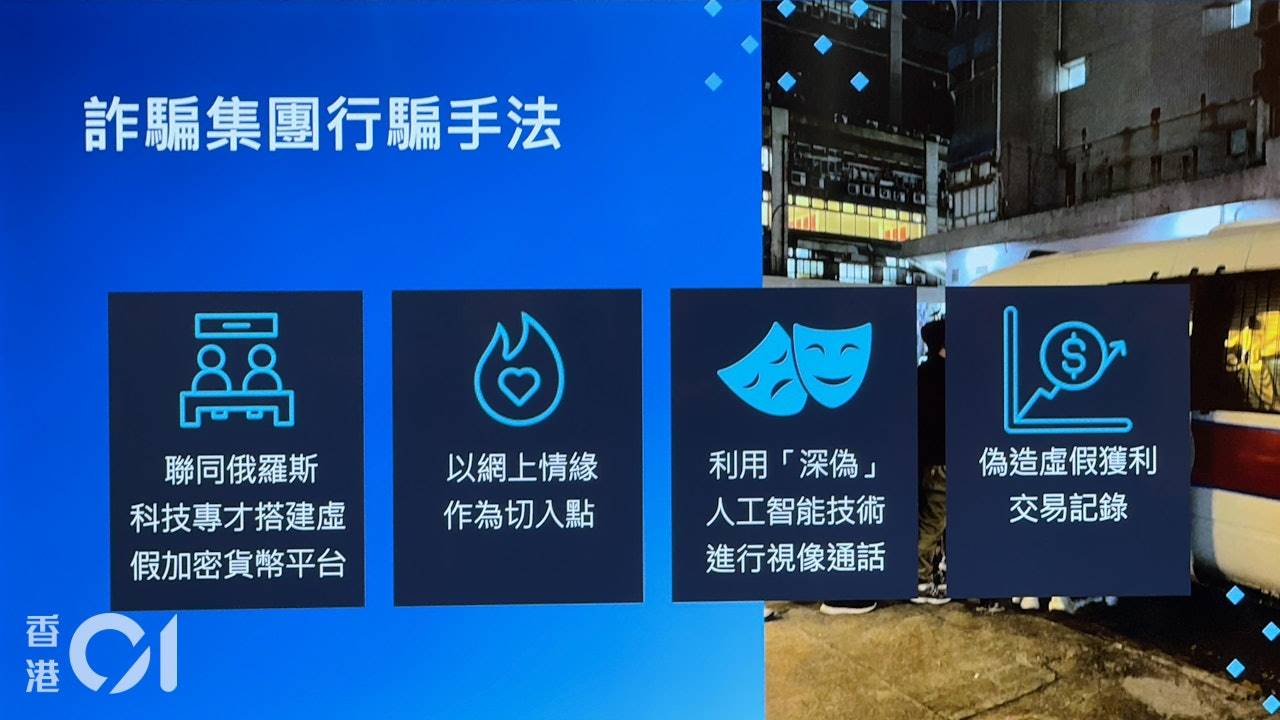
Hong Kong and Singapore police have repeatedly dismantled deepfake fraud rings since 2024. For example, in early 2025, Hong Kong police arrested 31 suspects in a case involving HK$34 million, with victims across Singapore, Japan, Malaysia, and other Asian regions. Key characteristics of these criminal organizations:
● Recruiting media graduates to create elaborate fake identities and backstories;
● Creating numerous phishing groups on Telegram using “highly educated, warm, friendly personas” to approach targets;
● Using a script of “friendship → guided investment → withdrawal obstacles” to lure users into investing on fake platforms;
● Forging chat logs, customer service conversations, and profit screenshots to enhance credibility;
● Inducing continuous top-ups under pretexts like “activating computing power” or “withdrawal review” (classic Ponzi structure).
https://user.guancha.cn/main/content?id=1367957
(4) Deepfake + Zoom Phishing
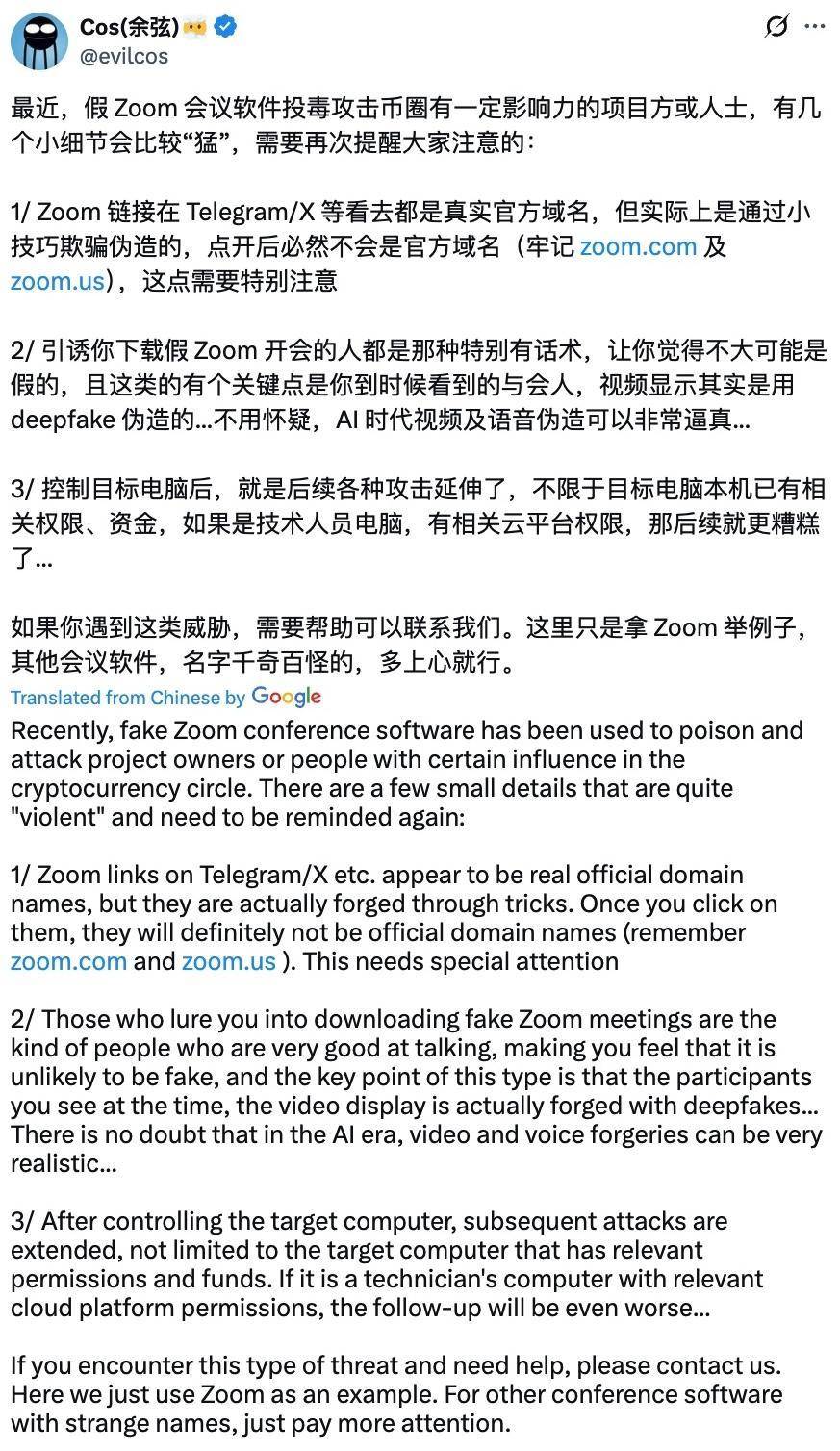
Scammers impersonate Zoom to send fake meeting invites, tricking users into downloading trojan-laced “meeting software.” During the call, “participants” use deepfake videos to mimic executives or tech experts, manipulating victims into authorizing transactions or transferring funds. Once devices are compromised, attackers remotely control them to steal cloud data or private keys.
https://x.com/evilcos/status/1920008072568963213
Technically, attackers use AI tools like Synthesia, ElevenLabs, and HeyGen to generate high-definition audio/video within minutes and distribute them via X/Telegram/YouTube Shorts.
Deepfake technology has become a core component of AI-driven fraud. In the age of AI, visual and auditory content reliability has sharply declined. Users must verify asset-related “authoritative information” through multiple channels and avoid blindly trusting “familiar faces or voices.” Project teams should also recognize brand risks posed by AI forgery, establish unique trusted communication channels, or adopt on-chain signature broadcasting for identity authentication to structurally resist spoofing attacks.
3.2 Social Engineering Tactics: Exploiting Psychological Vulnerabilities
Complementing high-tech methods are low-tech but highly effective social engineering attacks. Human nature remains the weakest and most overlooked link, leading many users to underestimate the threat. Scammers manipulate behavior through deception, guidance, intimidation, and exploitation of psychological weaknesses.
(1) AI Arbitrage Bot Scams
AI has become a hallmark of productivity enhancement, and scammers quickly exploit this trend by labeling scams with buzzwords like “generated by ChatGPT” to lower user guard.

The scam typically starts with detailed tutorial videos. Scammers claim the bot’s code was generated by ChatGPT, capable of monitoring new token launches and price fluctuations on blockchains like Ethereum, performing arbitrage via flash loans or price differences. They emphasize, “The bot automatically runs all logic—you just wait for profits.” This aligns perfectly with users’ preconceived notion that “AI = easy money,” further lowering vigilance.
By reducing technical barriers with persuasive language, scammers guide users to highly realistic Remix IDE interfaces (actually fake pages). At first glance, they appear authentic. Users are instructed to paste so-called “ChatGPT-written contract code.” After deployment, users are told to deposit startup capital into the contract address as initial arbitrage funds, with scammers hinting “the more you invest, the higher the return.” Upon clicking “Start,” instead of continuous profits, users lose access to their funds. The copied code contains hidden scam logic: once activated, deposited ETH immediately transfers to the scammer’s preset wallet. In essence, the entire “arbitrage system” is a polished money-grabbing tool.
According to SlowMist analysis, such scams follow a “spray-and-pray, small-bait” strategy, causing individual losses ranging from tens to hundreds of dollars. While per-user losses are relatively small, widespread distribution allows scammers to earn steady, substantial illegal profits. Since each loss is minor and actions seem “self-initiated” rather than direct fraudulent transfers, most victims remain silent. More concerning, these scams easily rebrand: changing the bot name or swapping templates allows scammers to relaunch operations swiftly.
Other social engineering tactics include: trojan job traps, fake coding interview tasks, phishing links via tweets/Telegram DMs, similar-address poisoning attacks, “pump-and-dump” tokens blocking sells, and fake staking platforms offering rewards. These attacks leverage trust (private messaging), greed (high returns), or confusion (forged interfaces and chats), constantly repackaging themselves to cause user fund loss through covert, user-assisted means.
3.3 Ponzi Schemes: Old Wine in New Bottles
As the crypto ecosystem rapidly evolves, traditional Ponzi schemes persist and adapt. Leveraging on-chain tools, viral social growth, and AI-powered deepfakes, they undergo a “digital evolution.” These scams often pose as DeFi/NFT/GameFi projects for fundraising, liquidity mining, or platform token staking. At their core, they remain classic Ponzi structures—“new money pays old investors”—collapsing when cash flow breaks or operators flee with funds.
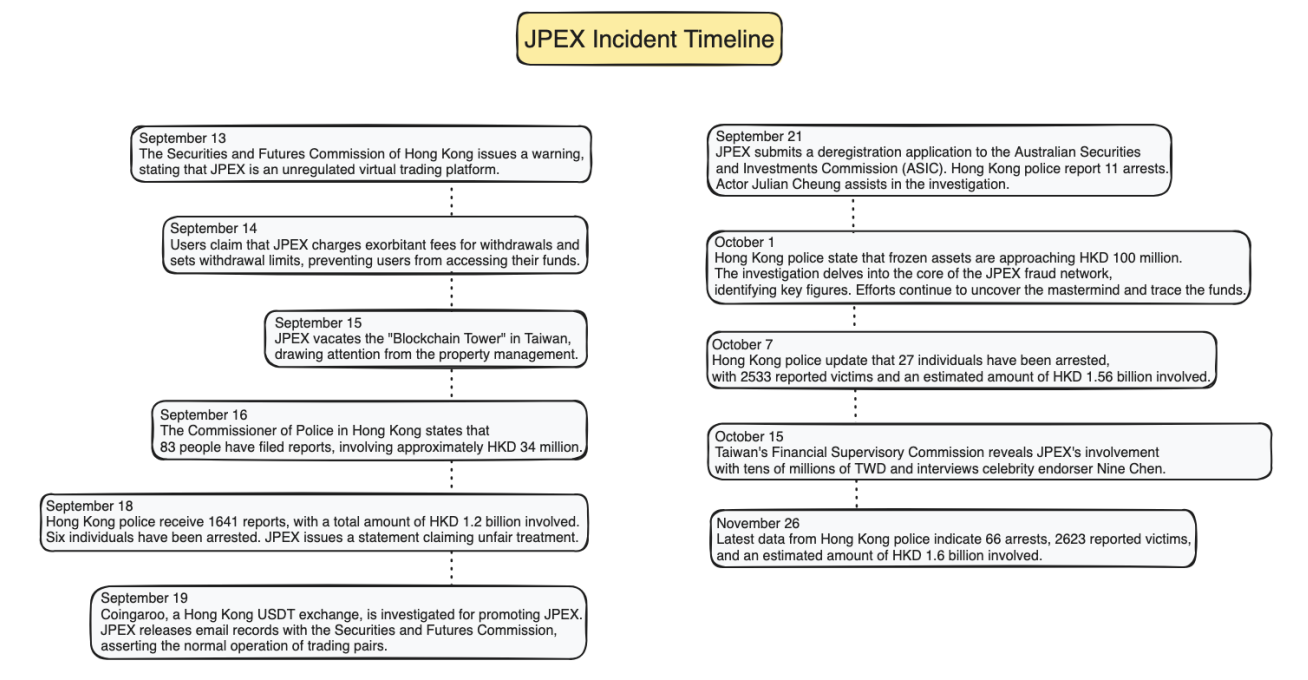
The 2023 JPEX incident that shook Hong Kong serves as a prime example. The platform claimed to be a “global exchange,” promoted its native token JPC via offline ads and celebrity endorsements, and promised “high stable returns” without regulatory approval or transparent disclosures, attracting massive user deposits. In September 2023, Hong Kong’s SFC labeled it “highly suspicious,” and police launched “Operation Iron Gate,” arresting multiple individuals. By year-end 2023, the case involved HK$1.6 billion, affecting over 2,600 victims—possibly the largest financial fraud in Hong Kong’s history.
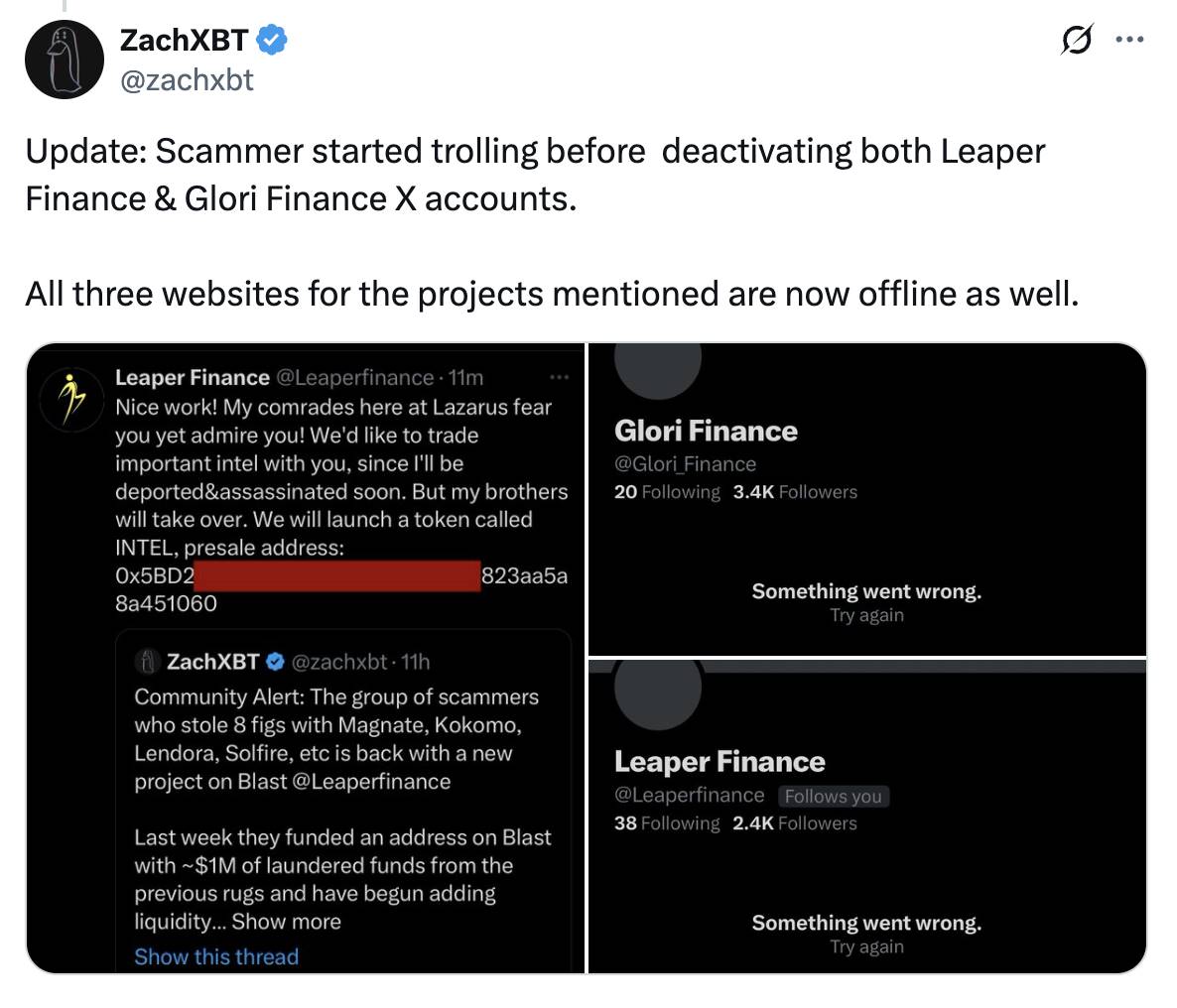
Beyond this, on-chain Ponzi schemes continue to evolve. In 2024, blockchain analyst ZachXBT exposed a scam group deploying Leaper Finance on the Blast chain. Previously behind Magnate, Kokomo, Solfire, and Lendora, this gang stole tens of millions of dollars by forging KYC documents and audit reports, pre-laundering funds, and artificially inflating on-chain metrics to lure investors. After reaching multi-million-dollar TVL, they rapidly drained liquidity and fled.
More shockingly, the group repeatedly targeted major chains including Base, Solana, Scroll, Optimism, Avalanche, and Ethereum, employing rapid “rebranding and skin-swapping” cycles.
For instance, their Zebra lending project on Base Chain once reached over $310,000 in TVL; Glori Finance on Arbitrum peaked at $1.4 million. Both were forks of Compound V2. They used seed funds extracted from other scams like Crolend, HashDAO, and HellHoundFi, forming a closed-loop fraud ecosystem.
Compared to traditional Ponzis, digital variants exhibit new traits:
● Greater technical camouflage: Using open-source contracts, NFT packaging, and fabricated on-chain data to create illusions of “technological innovation,” misleading users into believing they’re legitimate DeFi products.
● Complexified rebate structures: Masking cash flows under terms like “liquidity mining,” “staking rewards,” or “node dividends,” while secretly extracting funds through layered mechanisms and internal market manipulation.
● Viral social propagation: Relying on WeChat groups, Telegram channels, and KOL livestreams to drive user referrals, forming classic pyramid-style dissemination.
● Gamified UIs and identity forgery: Many projects adopt game-like interfaces and NFT IPs to appear “youthful” and “legitimate.” Some even use AI face-swapping and deepfakes to forge images/videos of founders or endorsers, boosting credibility.
For example, in February 2025, hackers hijacked Tanzanian billionaire Mohammed Dewji’s X account, using a deepfake video to promote a fake token $Tanzania, raising $1.48 million within hours. Such fabrication techniques are now widely used to forge founder videos, fake meeting screenshots, and counterfeit team photos, making it increasingly hard for victims to discern truth.
The following fraud red-flag checklist summarizes key warning signs and simple preventive measures for user reference.
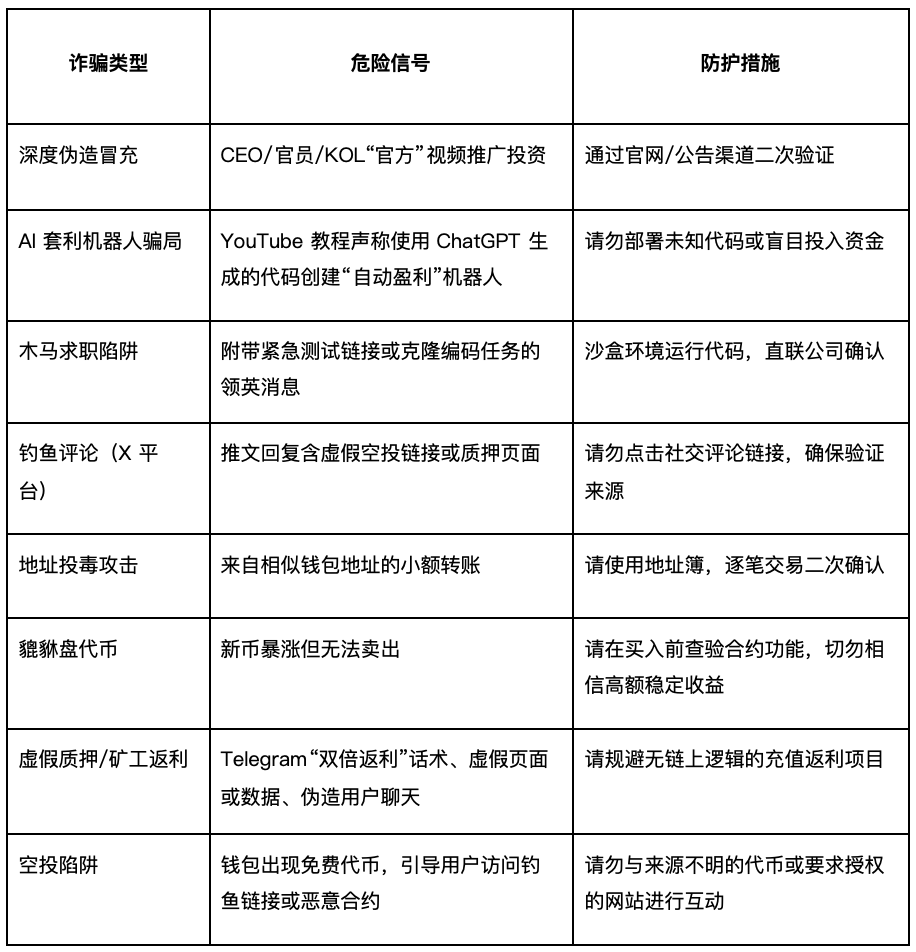
How to Stay Safe: Remain vigilant against suspicious or unsourced content—whether via LinkedIn, Telegram, or email; never run unknown code or install unverified files (especially under pretenses like job tests or app demos); bookmark official URLs; use browser plugins like Scam Sniffer; never connect your wallet to unknown links. Trust in the crypto world must be actively verified, not passively granted.
4. Strengthening Digital Defenses: Bitget’s Multi-Layer Security Architecture
Facing increasingly complex digital asset threats, Bitget has built a comprehensive security framework designed to protect every user. This section outlines strategic measures implemented in account protection, investment vetting, and asset safeguarding.
1. Account Protection: Real-Time Blocking of Unauthorized Access
Bitget employs a full suite of real-time monitoring tools to detect and alert users to any abnormal activity. When logging in from a new device, users receive detailed email notifications including anti-phishing codes, verification codes, login location, IP address, and device details. This immediate feedback enables prompt detection and handling of unauthorized access.
To reduce impulsive actions potentially induced by scams, Bitget implements a dynamic cooling-off period. Triggered by indicators like unusual login locations or suspicious transactions, this mechanism temporarily disables withdrawals for 1–24 hours, allowing users time to reassess and confirm whether account activity is legitimate.
Additionally, Bitget provides an official verification channel, enabling users to authenticate communications and effectively prevent phishing attacks.
2. Investment Review: Rigorous Evaluation of Digital Assets
Recognizing the surge of high-risk tokens in the crypto market, Bitget has established a thorough due diligence process for listing assets, including comprehensive background checks on project teams, in-depth analysis of tokenomics, evaluation of valuation and distribution models, and assessment of community engagement.
To further ensure accuracy, Bitget implements a dual-layer security audit system. Internal blockchain security engineers conduct thorough code reviews to identify vulnerabilities, while third-party authoritative agencies perform secondary audits to ensure completeness.
After listing, Bitget’s proprietary on-chain monitoring system continuously tracks trading and contract interactions in real time. Designed to adapt to emerging threats, the system constantly evolves and updates its threat models to respond swiftly to new risks.
3. Asset Protection: Comprehensive Safeguarding of User Holdings
Bitget adopts a dual-wallet strategy, using both hot and cold wallets to enhance security. The majority of digital assets are stored offline in multi-signature cold wallets, significantly reducing exposure to cyberattacks.
Moreover, Bitget maintains a massive protection fund exceeding $300 million to compensate users in the event of platform-related security incidents.
For Bitget Wallet users, the platform offers additional security features including phishing website alerts, built-in contract risk detection tools, and the innovative GetShield security engine. GetShield continuously scans dApps, smart contracts, and websites to detect potential threats before user interaction.
Through this multi-layered security architecture, Bitget not only protects user assets but also strengthens user confidence, setting a benchmark for security standards in the cryptocurrency exchange industry.
5. On-Chain Fraud Fund Tracking and Tagging
The previous sections described how scammers defraud cryptocurrency through various means, including deepfake technology. Typically, scammers attempt to transfer stolen funds and eventually convert them into fiat. These fund movements are traceable—blockchain analysis tools play a crucial role here. Such tools fall into three main categories: transaction monitoring, address screening, and investigation tools. This section focuses on how transaction monitoring tools detect and tag fraud-related funds, increasing the difficulty of laundering proceeds.
Transaction monitoring tools are widely adopted by crypto exchanges like Bitget. They scan incoming and outgoing transactions to identify and flag potential risks. A typical application is checking all user deposits to detect potential threats. Most normal user deposits won’t be flagged as high-risk and will be automatically processed and credited promptly. However, if funds originate from a known scam address, they will be marked as high-risk.
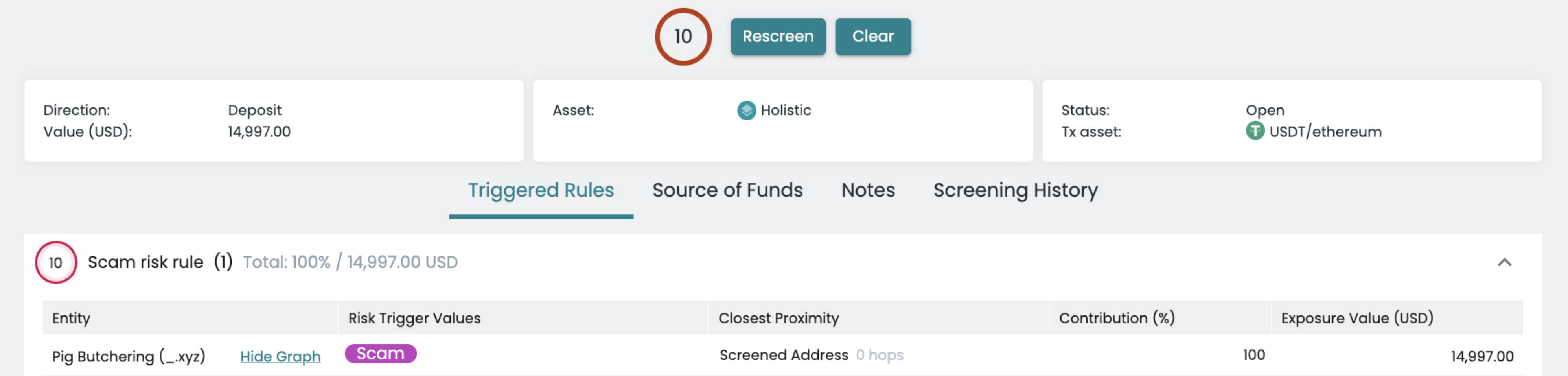
Let’s examine a real case. The image below shows a transaction monitoring tool analyzing a user deposit at a crypto exchange. As shown, a deposit is identified as linked to a “pig-butchering” investment scam address.
The tool assigns a maximum risk score of 10/10, triggering manual review—funds won’t be automatically credited, and the activity is escalated to the compliance team for manual verification.
Sophisticated criminal groups understand transaction monitoring mechanisms and often employ specific on-chain obfuscation techniques to hide fund trails. A typical method is “money laundering layers”: transferring stolen funds through multiple intermediate addresses to sever ties with the origin. Advanced monitoring tools can penetrate infinite layers of intermediaries to accurately pinpoint the criminal source. Criminals are also increasingly using cross-chain bridges, which will be discussed next.
5.1 Cross-Chain Bridges
In recent years, various blockchains have emerged. Users may be drawn to a particular chain due to its native cryptocurrency, dApp offerings, or services. Cross-chain bridges allow near real-time value transfer between chains. While primarily used by regular users, scammers are increasingly exploiting them to move illicit funds across chains. Their motivations include:
● Opportunity for Obfuscation: Certain mixing tools support only specific blockchains (e.g., most mixer sites handle Bitcoin only). Criminal groups often bridge to target chains to use mixing services before moving funds elsewhere.
● Increased Tracking Difficulty: Cross-chain transfers significantly complicate fund tracing. Even if investigators manually track one bridge transfer, repeated bridging greatly slows investigations. If funds are split, manually tracking all paths becomes impractical (as shown later, specialized tools enable seamless cross-chain tracking).
Criminal groups know some automated transaction monitoring tools stop tracking at bridge endpoints. The upper half of the image below illustrates such tools halting at cross-chain bridges, leaving exchanges seeing only funds from bridge addresses without prior path visibility. The lower half shows Bitget’s use of Elliptic’s transaction monitoring tool, which automatically penetrates bridges to fully reconstruct fund paths, exposing associated illegal entities.
The case study below describes how illegal entities systematically exploit multiple cross-chain bridges and blockchains to launder large-scale crypto funds—and how such activities can be detected using advanced tools.
|
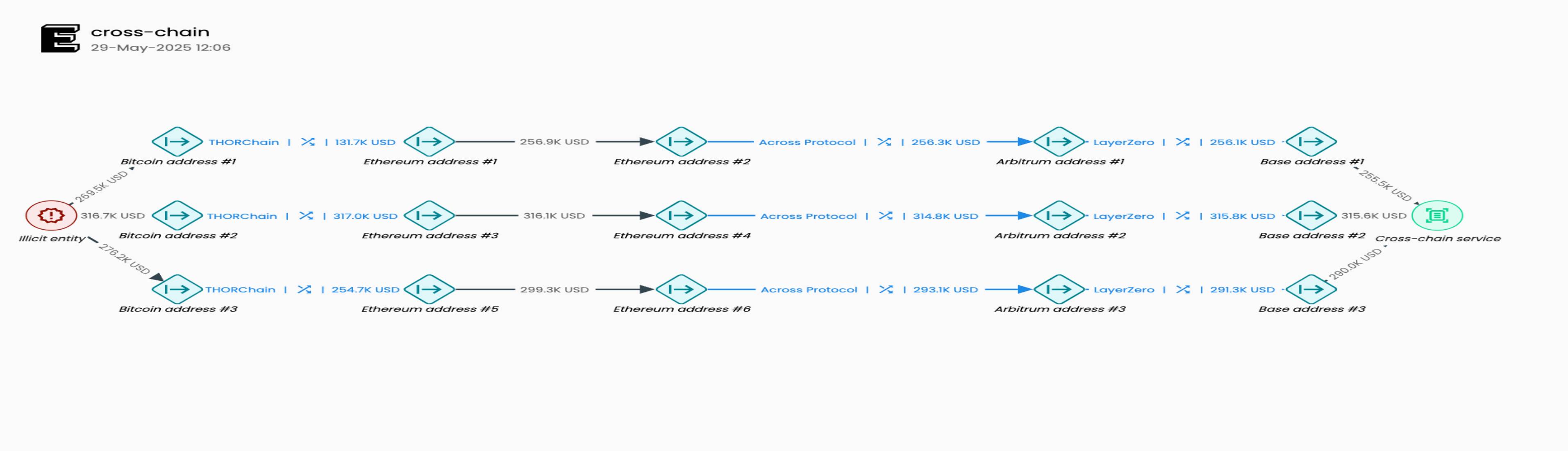
Case Study: The screenshot below from Elliptic’s investigation tool shows how a criminal group moved funds across multiple blockchains via cross-chain bridges, ultimately depositing them into a crypto service platform.
Funds originated on the Bitcoin chain (left), bridged to Ethereum, underwent internal transfers, then bridged to Arbitrum, followed by Base chain, and finally deposited into a crypto service platform. The image also highlights two other instances with identical patterns. Though not fully displayed, the same pattern occurred over ten times, indicating systematic money laundering. The intent is twofold: slow down investigators or create interference; prevent receiving exchanges from identifying the illicit origin. However, blockchain investigation tools supporting automatic cross-chain bridge tracking can seamlessly reconstruct complete paths. Transaction monitoring tools with cross-chain capabilities (like the Elliptic system used by Bitget) can automatically identify the original connection between funds and criminal organizations. |
5.2 Detecting Fraud Funds Through Behavior and Pattern Analysis
The earlier case relies on known illegal crypto address labels (e.g., pig-butchering addresses), typically sourced from victim reports, law enforcement collaboration, and other data channels. However, the growing scale of fraud (and low reporting rates) means not all addresses can be covered.
Hence, advanced transaction monitoring tools introduce behavioral detection as a supplementary defense. By automatically analyzing behaviors and patterns, systems infer whether a given address performs on-chain operations consistent with scam characteristics and flag related interactions accordingly. Such behavioral analysis is typically executed by specialized detection models (some using machine learning). To date, Elliptic’s behavioral detection identifies over 15 scam types (including pig-butchering, address poisoning, ice-fishing attacks, etc.), with detection capabilities continuously expanding.
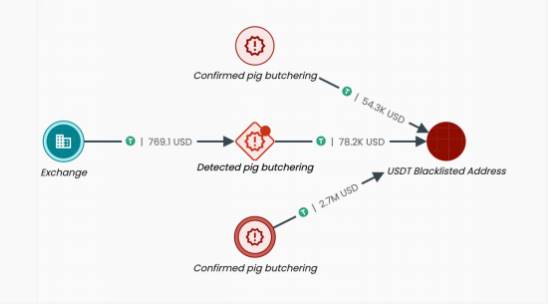
The example below demonstrates how behavioral detection prevents users from sending funds to scam addresses: Three addresses are linked to pig-butchering scams. The top and bottom ones were confirmed via victim reports. The middle one, though unreported, was flagged by the behavioral model as a potential pig-butchering address.
This address later received a transfer from an exchange. Had the exchange enabled behavioral detection alerts, the risk could have been identified pre-transfer, preventing fund loss. Ultimately, all three pig-butchering addresses funneled funds to the same destination, later frozen and blacklisted by Tether. All USDT held in that address was seized, further confirming the illicit nature of the funds.
| Click here to learn how Bitget’s integration of Elliptic’s blockchain analysis tool increased risk interception rate by 99%—an industry-leading solution supporting over 50 blockchains with automated cross-chain bridge tracking and behavioral detection capabilities. |
6. Protection Recommendations and Best Practices
Facing ever-evolving scam techniques, users must cultivate clear self-protection awareness and technical discrimination skills. Toward this end, SlowMist offers the following core anti-scam recommendations:
(1) Enhance Ability to Authenticate Social Media Content
Never click any links in comment sections or group chats—even if they appear “official.” For critical actions like wallet binding, airdrop claiming, or staking, always verify through project official websites or trusted community channels. Install security plugins like Scam Sniffer to detect and block phishing links in real time, reducing accidental exposure.
(2) Beware of New Risks Introduced by AI Tools
With the rapid development of large language models (LLMs), various new AI tools are emerging. The Model Context Protocol (MCP) standard has become a key bridge connecting LLMs with external tools/data sources. However, MCP adoption brings new security challenges. SlowMist has published a series of MCP security research articles, advising project teams to proactively audit and strengthen defenses.
(3) Use On-Chain Tools to Identify Risky Addresses and Ponzi Traits
For suspected rug pulls or fraudulent projects, use anti-money laundering tracking tools like MistTrack to check associated address risks, or quickly assess via GoPlus token safety tools. Check victim comments on Etherscan/BscScan for warnings. Maintain high skepticism toward high-yield projects—abnormally high returns usually carry extreme risks.
(4) Do Not Blindly Trust “Scale Effects” or “Success Stories”
Scammers often create illusions of profitability using large Telegram groups, fake KOL endorsements, and forged profit screenshots. Generally, project credibility should be verified through transparent channels like GitHub repositories, audited on-chain contracts, and official announcements. Users must develop the ability to independently verify information sources.
(5) Guard Against Social Trust-Based “File Inducement” Attacks
Increasingly, attackers use Telegram, Discord, and LinkedIn to send malicious scripts disguised as job opportunities or technical test invitations, tricking users into executing high-risk files.
User Protection Guide:
● Be wary of suspicious job or freelance offers requesting code download/run from GitHub. Always verify sender identity via company official websites or emails. Never trust “limited-time high-return task” narratives.
● Strictly review project sources and author backgrounds when handling external code. Refuse to run unverified high-risk projects. Execute suspicious code in virtual machines or sandbox environments to isolate risks.
● Exercise caution with files received via Telegram/Discord: disable auto-download, manually scan files, and be alert to script execution requests under the guise of “technical testing.”
● Enable multi-factor authentication and regularly change strong passwords. Avoid password reuse across platforms.
● Never click unverified meeting invites or software download links. Develop habits of verifying domain authenticity and confirming official platform sources.
● Use hardware or cold wallets for managing large assets, minimizing sensitive data exposure on connected devices.
● Regularly update operating systems and antivirus software to defend against new malware and viruses.
If device infection is suspected, immediately disconnect from the internet, transfer funds to a secure wallet, remove malicious programs, and reinstall the system if necessary to minimize losses.
Enterprise Protection Guide:
● Conduct regular phishing drills to train employees in identifying forged domains and suspicious requests.
● Deploy email security gateways to block malicious attachments and continuously monitor code repositories for data leaks.
● Establish incident response mechanisms combining technical defenses and employee awareness. This multi-layered strategy helps minimize risks of data breaches and asset loss.
(6) Remember Fundamental Investment Principles
● High-return promises = High risk: Any platform promising “stable high returns” or “principal-guaranteed profits” should be treated as high-risk.
● Viral growth based on referral recruitment is a red flag: Projects with referral bonuses or tiered “team earnings” structures can be preliminarily classified as pyramid schemes.
● Use on-chain analysis tools to spot abnormal fund flows: Platforms like MistTrack can track large abnormal movements and analyze team exit paths.
● Verify audit firms and team transparency: Be cautious of projects providing “fake audit reports” or superficial endorsements from minor audit firms. Users should confirm whether smart contracts are publicly audited by reputable third parties.
In summary, AI-era crypto scams have evolved from mere “technical exploitation” to dual-dimensional manipulation of “technology + psychology.” Users must enhance both technical recognition and psychological resilience:
● Verify more, act less impulsively: Do not lower guard due to “familiar faces, authoritative videos, or official backgrounds.”
● Question more, transfer less: Always scrutinize underlying logic, verify sources, and confirm safety before any asset operation.
● Resist greed, maintain skepticism: The more enticing a project’s “risk-free profit” promise, the higher the need for caution.
We recommend reading "Self-Help Manual for the Blockchain Dark Forest" by SlowMist founder Cos to master basic on-chain anti-scam skills and strengthen self-defense. Victims of theft may seek assistance from the SlowMist team.
Only by thoroughly understanding scam mechanisms, improving information discrimination, strengthening awareness of security tools, and cultivating disciplined habits can users safeguard their assets in an era filled with temptation and risk. Security cannot be achieved once and for all—it requires constant vigilance. Building a comprehensive cognitive framework and solid defensive habits is the only compass for navigating safely through the digital age and avoiding fraud traps.
7. Conclusion: Future Roadmap
Five years ago, fraud prevention meant “don’t click suspicious links.” Today, it means “seeing is no longer believing.”
When AI-generated videos, fake hiring processes, and tokenized Ponzi schemes turn trust into a weapon against users, the next phase of crypto security depends not only on smart technology but also on collective defense. Bitget, SlowMist, and Elliptic are building a joint defense network through shared threat intelligence, automated fund tracking, and cross-ecosystem risk tagging.
The conclusion is clear: security cannot rely on isolated measures. It must be networked, continuous, and user-centric.
To this end, Bitget will advance in three key directions:
● AI Red Team Exercises: Simulating novel fraud tactics to test system vulnerabilities.
● Compliance Data Collaboration Network: Partnering with regulators and compliant entities to build an intelligence-sharing ecosystem.
● Advancing Security Education: Empowering users with real-time threat awareness through the Anti-Scam Center.
Scammers keep evolving—we must upgrade too. In this industry, the most precious currency has never been Bitcoin, but trust.
To download the full report, click here.
Join TechFlow official community to stay tuned
Telegram:https://t.me/TechFlowDaily
X (Twitter):https://x.com/TechFlowPost
X (Twitter) EN:https://x.com/BlockFlow_News