








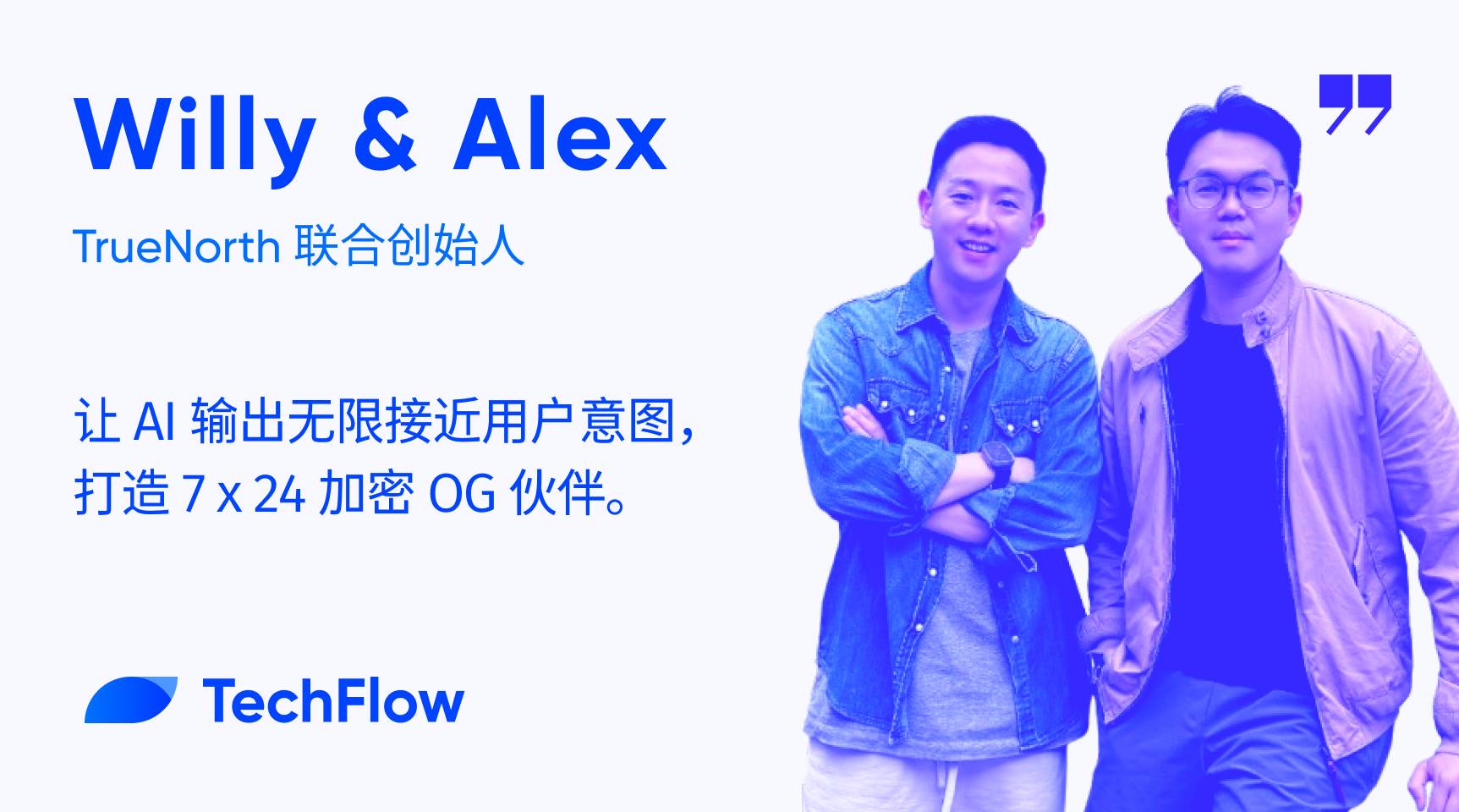
Conversation with TrueNorth Co-Founder: Aligning AI Output Closer to User Intent, Building a 7x24 Crypto OG Companion
TechFlow Selected TechFlow Selected
Conversation with TrueNorth Co-Founder: Aligning AI Output Closer to User Intent, Building a 7x24 Crypto OG Companion
Let's dive into the current fiercely competitive landscape of Crypto AI, exploring TrueNorth's unique positioning, core technological advantages, and future product evolution roadmap.
 Navigating Web3 tides with focused insights
Written by: TechFlow
In the fast-paced Crypto AI sector where an AI Meme can be launched in seconds, TrueNorth stands out as the first AI-driven value discovery engine in the crypto industry.
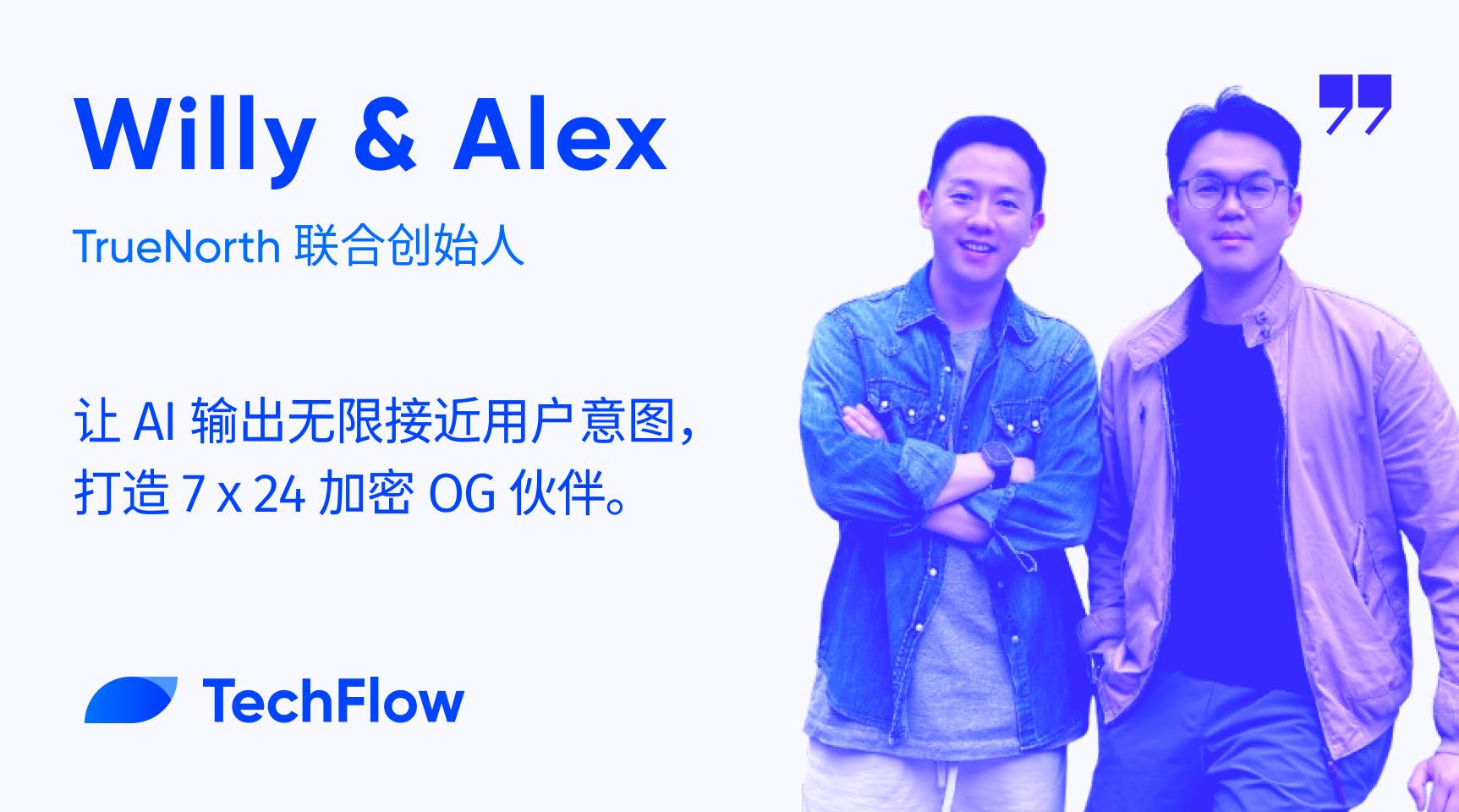
On the occasion of TrueNorth’s important closed beta launch, TechFlow sat down with Willy and Alex, co-founders of TrueNorth, for an in-depth conversation.
"TrueNorth is at the forefront of generative UI/UX—our front-end dynamically adapts its UI/UX in real time based on users’ investment preferences. Meanwhile, our Agent search achieves sub-10-second latency across multiple data sources, and with optimization, we can deliver user-level feedback within just a few seconds. Currently, no other crypto application can achieve this," said Alex.
At the same time, TrueNorth addresses the core needs of crypto users. Regarding the uniqueness of Crypto AI, both founders believe:
First, from the gap between user intent and actual outcome, crypto has the longest distance to bridge—but AI can dramatically shorten it. Second, crypto is close to money, and user goals are straightforward: make more profit or lose less. In short, Crypto AI solves more focused problems and has stronger practical applicability.
Through this dual lens of Web2 and Web3 perspectives, Willy shared how TrueNorth helps users quickly build understanding:
Crypto is an adventurous journey. TrueNorth aims to act like a compass, guiding people through industry noise to find optimal outcomes.
This article explores, through the eyes of Willy and Alex, TrueNorth’s unique positioning, core technological advantages, and future product roadmap amid intensifying competition in the Crypto AI space.
AI Can Solve Crypto's Biggest Pain Points
TechFlow: We're delighted to have this deep discussion. To begin, could you both introduce yourselves?
Willy:
Hello everyone, I’m Willy, co-founder of TrueNorth.
From mid-2022 to the end of 2024, I worked at WOO, a centralized exchange that also operates a decentralized trading platform called WOOFi. I started as COO and later served as Acting CEO. During my tenure, I led the company’s expansion into Europe, Southeast Asia, and South Korea, driving exponential growth. My responsibilities included overall strategy, business development, legal compliance, and particularly building the WOO ecosystem—overseeing DeFi expansion, cross-chain integration (across 14 chains including EVM and Solana), and WOO token listing. This was my first journey in the crypto world.
Prior to crypto, I was a Web2 founder. From 2015 to 2021, during the peak of SaaS, I ran a CRM and ERP-focused SaaS company with nearly 200 employees. We raised funding from seed to Series B, with major investors including Shunwei Capital, co-founded by Lei Jun. In 2021, I exited and began exploring crypto.
Alex:
Hello everyone, I’m Alex, co-founder of TrueNorth.
I come from an AI background, holding a PhD from the University of Michigan, Ann Arbor, specializing in AI & domain-specific computing. Before that, I was a researcher at Intel Labs, focusing on machine learning acceleration.
During my second year of PhD, I joined my first startup—an AI chip company called TianShu Zhixin—where I led software and hardware system development and headed North American R&D.
After graduating, around 2020, I returned to Shanghai and joined McKinsey, serving clients in semiconductors, cloud services, AI-powered retail, gaming, and other industries. I focused on go-to-market strategies and new business model execution.
Later, I moved to Temasek, Singapore’s sovereign wealth fund, where I managed technology investments across Greater China and the Asia-Pacific region, covering AI, semiconductors, and crypto, handling both private equity direct investments and public markets, as well as founder funds.
After two years at Temasek, I joined a leading AI chip company valued at approximately $2 billion post-investment. There, I oversaw product, strategy, and capital markets operations. Our product line included four generations of GPUs, and we built one of Western China’s largest AI data centers while securing several top-tier internet clients. After completing delivery last year and preparing the company for STAR Market IPO, I decided to fully dive into the AI startup wave.
I met Willy during my time at Temasek. Being deeply rooted in AI, when the Agentic AI wave emerged, I saw immense potential in combining AI with crypto—and we quickly aligned.
TechFlow: Both of you have rich Web2 experience and have now firmly committed to the Crypto + AI space. Could you share what makes this field especially compelling to you?
Willy:
When I first entered crypto from Web2, my biggest realization was: Web2 flattened information; Web3 should flatten money. By “flattening,” I mean making it easier for everyone to access the benefits technology brings to individuals and society. Based on this idea, I began to see that combining crypto and AI could unlock entirely new possibilities.
Balaji Srinivasan, former CTO of Coinbase, wrote a book called *The Network State*, which inspired me greatly. At a macro level, for example, U.S.-China tensions are accelerating the formation of cultural clusters—not defined by nations, but by networks—where digital identities and assets exist in decentralized forms.
I found this vision exciting, so I entered crypto. But over the past three-plus years, I’ve seen slow adoption progress due to various reasons—user experience issues, regulatory hurdles, etc. While technologies like chain abstraction and AA wallets have advanced, users still lack a clear entry point into Web3 or a way to enjoy crypto’s advantages. It wasn’t until early last year, when I discussed this with Alex, that I realized AI could play a pivotal role here—and that’s how TrueNorth came to life.
Alex:
I’d add that earlier, while working on Web2 companies, I observed many SaaS businesses already applying AI, especially in B2B contexts. I noticed early on that the rise of Agentic AI would fundamentally transform user interaction interfaces and habits.
In Web2, there’s a common pattern: SaaS providers aim to offer standardized products to scale efficiently, reduce costs, and improve effectiveness. But standardization fails to meet diverse needs—especially in complex scenarios requiring high customization.
The emergence of Agents dramatically shortens the gap between human intent and achieving desired outcomes, significantly enhancing user experience. This shift is already happening in Web2—particularly in verticals like law and healthcare, where interactions between users and AI have evolved. I spotted this trend a year before Agents gained mainstream attention. I believe this change is no less transformative than the Mobile Revolution—the moment the first iPhone introduced multi-touch, redefining UX/UI.
Agents represent such a paradigm shift. OpenAI may have popularized the idea of typing messages to an Agent, but today’s cutting-edge Agents go further: they proactively analyze user preferences and tell users what to pay attention to. This proactive output was a key assumption behind our original vision for the Agent revolution.
As for why Web3? Because among all user journeys, the distance between intent and outcome is greatest in crypto—in other words, friction is highest. A clear example: in crypto, decentralized infrastructure defines user experience, rather than user experience shaping the infrastructure.
Given this, we believe Agentic Technology can effectively solve crypto’s most painful challenges, helping users better capture alpha and financial opportunities. As Willy mentioned, combining AI and crypto can further flatten access to information and opportunities, serve personalized needs more effectively, and lower DeFi entry barriers. Our goal is to merge AI and crypto to address real pain points for the community and enhance the onboarding experience for future users.
Crypto AI Is Closer to Money and More Actionable
TechFlow: The narrative around Crypto + AI is heating up, yet some Web2 AI developers remain skeptical about Web3 AI—whether in terms of developer capability or product maturity. How do you view these perspectives? What is the core value of Web3 AI?
Alex:
Let me start with the first question: Why is Crypto AI different?
To me, crypto is an industry very close to money. All transactions occur on a transparent, public, and decentralized ledger. In a sense, if you dig deep enough, every secret lies exposed. This, I believe, is the biggest difference between crypto and traditional finance. Previously, fewer participants meant less data surfaced. But as more people enter crypto and analyze on-chain activity, we’ll realize: since vast amounts of on-chain data are publicly available facts, how can we process them in real-time and transparently, then present insights equitably to help more people develop clearer understanding of crypto?
Moreover, precisely because crypto is close to money, user intent from an AI perspective is much more direct, and there are far fewer branching paths toward fulfilling that intent.
For instance, when using a search engine, your queries can be highly divergent—you might ask about weather, food, or trivia. The path from query to intent involves many possible routes. But in crypto, user questions are simple and straightforward: How do I make money? How do I make more? Or how do I lose less? The loop between initial intent and final outcome is much clearer. AI can use existing data to democratize information, assist users in asset management, or plainly put, help uncover more wealth opportunities. That’s what makes Crypto AI special. Compared to Web2 AI, Crypto AI tackles more focused problems. Given the foundation of on-chain data, as long as information is aggregated well and tailored to individual needs, Crypto AI has strong practical viability.
Now, after discussing Crypto AI’s uniqueness, let’s address the second question: Why do people feel Crypto AI hasn't delivered?
If you observe closely, the grand narrative of Web2 AI revolves around breakthroughs in general-purpose capabilities. Take OpenAI—it can do everything: financial analysis, tracking F1 races. Its mission is to continuously enhance broad capabilities to drive real-world applications. That’s an ambitious and extremely challenging goal, attracting top talent globally.
In contrast, many Web3 Agents focus on solving concrete problems—poor UI/UX, lack of personalization, fragmented information. As previously stated, Crypto AI targets more specific problems. However, there are two phases in Crypto AI development.
First, Crypto AI can be quickly validated or falsified, because Agents directly face consumers. Users immediately perceive whether a product works well or not. In traditional crypto, falsification was hard. For example, launching a blockchain project takes years—its narrative evolves with market cycles, and it takes a long time to truly evaluate. But Crypto AI moves fast. The first wave of AI projects were mostly Memes, technically simplistic, with unclear real value—like GOAT, fun at launch but nobody cared what it actually said. In such a rapidly falsifiable environment, consumer-facing Crypto AI naturally faces stronger scrutiny.
Yet challenges bring opportunities. Once people recognize that Crypto AI is more than just Memes, the next question becomes: How can we do better? How can Crypto AI concretely solve real user problems? For example, in high-frequency, essential scenarios, helping users understand why prices rise or fall, what to watch, and what actions to take. There are many genuine issues waiting to be solved—that’s exactly what we aim to tackle with TrueNorth.
TechFlow: Building on your response—if there were a catalyst to attract more Web2 AI developers into Web3, what would it be?
Alex:
At a visionary level, the product we’re building is precisely that catalyst.
What TrueNorth does sounds simple: every morning, you check your wallet to see if you made money. TrueNorth aims to help you achieve better asset allocation—what to buy or sell, why prices move—and streamline the entire decision-making process, making it seamless. We want AI to provide personalized service for every user.
Currently, crypto penetration is only 5%, yet some CeFi users already use similar AI tools to manage assets and capture opportunities in crypto or DeFi. Could our product become the first tool the next 5% of users adopt when entering crypto?
I believe this is our true north star: Every new crypto user will inevitably have asset management needs and must know what opportunities to discover in this space. With exploding information and overwhelming noise, they need a smooth, intelligent tool to guide them—and draw more people into the ecosystem. I believe TrueNorth will be one of the key catalysts that pulls more Web2 developers into Web3.
In short: When people first encounter crypto, they’ll think of TrueNorth. TrueNorth will be the essential gateway into the crypto world.
TechFlow: Indeed, many newcomers—even to basic concepts—face confusion. Recently, a friend wanted to use USDT to subscribe to a foreign service but didn’t know how to buy USDT, how to transfer it, or what TRC/EVM addresses are. There are countless foundational gaps. As Alex just mentioned, bridging Web2 and Web3 for beginners requires thoughtful content and product design—a massive market opportunity.
Willy:
I completely agree. Many of my friends are in this situation. Our recent user interviews also revealed significant friction points during onboarding.
Regarding attracting more talent to build in crypto, I think it’s much harder now than before—many altcoins may never return. So today’s crypto projects must excel at identifying real user needs. This aligns with Silicon Valley methodologies from Web2: find a specific pain point and solve it through an app. When you clearly identify such a need, you can influence users and attract top talent to join your mission.
Once the pain point is identified, startups compete on depth of insight—technical implementation, execution roadmap, strategic thinking—which also attracts strong talent.
Third is execution capability. Just days ago, I posted a tweet sharing an image. As Alex noted, many things in crypto are hard to falsify. But from an application standpoint, we need clear metrics to measure performance—such as consistent, timely product delivery.
TrueNorth: Your 7x24 Crypto OG Companion
TechFlow: Earlier, you mentioned the vision: "When people first encounter crypto, they’ll think of TrueNorth." Project names often reflect core visions. Does "TrueNorth" carry deeper meaning?
Willy:
TrueNorth was actually Alex’s suggestion. We felt that most users entering crypto are like adventurers starting a journey. Crypto is risky—easy to lose money, flooded with information, full of traps, and highly complex. So this adventure needs a guiding force. "TrueNorth" is like the compass early Arctic explorers used—or like the aurora borealis lighting a path across frozen lands, illuminating the way so the journey feels less lonely.
Additionally, with so much industry noise, the word “True” in our name reflects our desire to lead people through the fog to truth, helping them reach their destination.
TechFlow: For someone encountering TrueNorth for the first time, how would you concisely describe the product to help them grasp its unique position in the crypto market?
Willy:
In short, TrueNorth is the crypto industry’s first AI-driven value discovery engine. This means TrueNorth integrates diverse data sources to help users stay ahead of market dynamics and improve investment decisions and efficiency.
Beyond that, TrueNorth offers strong personalization. It tailors investment insights based on users’ crypto knowledge and preferences. Through smart portfolio management—our AI Portfolio—it continuously monitors the market around your holdings and delivers signals aligned with your habits and future needs. These signals support investment decisions and effective risk management, simplifying and streamlining the entire trading process.
Alex:
I hope TrueNorth becomes the first app crypto users open each day. As we’ve discussed, users need to manage wallets, accounts, and understand market movements. In essence: What happened? Why did it happen? What should I do?
Theoretically, answering these questions requires visiting dozens of platforms. We want all those scattered insights to converge into one trusted place—helping users uncover the truth behind the data. In one sentence: a trusted companion guiding you through the chaos of crypto.
More vividly, TrueNorth has many features. Personified, it’s like your 7x24 crypto OG partner—you can ask it anything about crypto. Each morning, you wake up and check it first to understand market movements.
TechFlow: An interesting follow-up: sometimes AI lies. Hallucinations are widely criticized. TrueNorth provides users with extensive outputs. How can users trust its results? Or how do you ensure information accuracy?
Alex:
Excellent question. First, TrueNorth uses numerous and highly real-time data sources—both on-chain and off-chain. On-chain data includes live feeds from Solana, EVM, and other chains. Off-chain data includes Telegram pump groups, alpha chats, coordination circles (both overt and covert), and sentiment from Crypto Twitter.
We aggregate this vast amount of data with high precision. Underlying Agents use reinforcement learning to refine data interpretation based on real-time market changes. With abundant, timely inputs, AI performs cross-validation, forming a logical closed loop. Leveraging large models to synthesize these inputs yields insights closer to ground truth.
For example, you might see many people shilling a project on Twitter, or incentivizing visibility through rewards. But is the project genuinely good? Not always. Evaluating quality requires deeper data—market cap, on-chain liquidity, roadmap, team, etc. TrueNorth conducts multidimensional due diligence, presenting the most comprehensive and truthful picture without distorting outputs via external incentives.
This is one of TrueNorth’s key differentiators. It delivers authentic, data-driven feedback—entirely distinct from marketing shills. I believe this creates a uniquely valuable user experience.
“One Interface Per User,” Ultra-Low Latency Backend
TechFlow: Alex has touched on technical logic. Could you elaborate on TrueNorth’s leading technologies? What technical challenges deeply troubled your team? Any interesting stories behind the R&D process?
Alex:
Our tech stack consists of three core modules:
-
Generative UI/UX: TrueNorth features a dynamic, hyper-personalized interface that actively adapts to each investor’s behavior and evolving market conditions.
-
Agentic Flow: Our proprietary scalable intelligence architecture seamlessly integrates Discovery and Execution through advanced multi-agent collaboration. TrueNorth infers user intent from historical behavior and preferences, orchestrates complex investment workflows, reduces cognitive load, and simplifies operations.
-
RL Bootstrap: TrueNorth employs advanced reinforcement learning techniques—including self-play, multi-agent RL, and human-feedback-based RL—to continuously optimize agent performance.
I believe generative UI/UX is a highly forward-looking concept. While gaining attention now, our core goal is achieving true personalization.
Early on, when Willy and I discussed this, some pointed out that Web2 attempted customization but failed. Yet we believe Agents can finally solve the long-standing challenge of “one-size-fits-one” personalization.
In Web3, generative UI/UX is the key solution. During a user’s crypto journey, whether they care about technical indicators, TLDR summaries, personalized signals, or even a feature we call “Look Through Someone’s Lens”—viewing markets through a KOL’s perspective—how do we visually present what users care about? That’s exactly what generative UI/UX does: using AI to dynamically generate visual content—data modules, charts—at the front-end, much like widgets in Apple Health, fully customized to user preferences.
For example, Willy is a long-term investor; I’m a Meme investor. Our interests differ, and so do our front-end experiences. TrueNorth dynamically adjusts UI/UX based on investment preferences—a feat impossible before due to template-based design. Our breakthrough in generative UI/UX is a major innovation and a core product highlight.
The biggest challenge in achieving this was mastering customization. Web3’s advantage lies in wallet connectivity—user transaction history and behaviors are visible, enabling strong cold-start personalization. Based on this, our prototype already delivers stunning results.
The second story concerns Agentic Flow. The concept sounds simple—some say it’s just another framework like LangChain. But while easy to prototype, achieving production-grade reliability is extremely difficult.
For instance, our Agent search achieves sub-10-second latency across multiple data sources—and with optimization, user-level feedback in just seconds. No other crypto application currently achieves this.
Looking ahead, supporting hundreds of thousands or even millions of DAUs requires infrastructure beyond existing open-source frameworks—even the best Web2 frameworks can’t meet these demands.
Beyond ultra-low latency, our core challenge is designing an efficient Agent organizational structure. Behind every generative UI element sits an Agent—how does it quickly find answers and present them according to user preferences? This involves complex technical hurdles. Our core team previously built production architectures for Southeast Asia’s largest e-commerce and media platforms, so we planned scalability from day one. Achieving sub-second response times required building our own infrastructure and tech stack from scratch—a challenge most teams (in both Web2 and Web3) overlook in AI development. We’ve already made these critical breakthroughs.
TechFlow: TrueNorth is currently in closed beta. What feedback have you received—positive or negative? Any observations? Will there be new features or updates?
Willy:
We’ve found significant differences among users. For example, veteran crypto users and newcomers interpret the same event or data differently, and their expectations for product presentation vary widely. Their needs throughout the user journey also differ—new users, often with smaller portfolios, prioritize exploration and discovery, while professionals demand rapid iteration to keep pace with markets. Our research yielded insights, though some areas remain uncertain. We aim to address these varied needs through generative UI/UX.
Another challenge is user trust in AI. Our product doesn’t just display data—we analyze it to generate conclusions. Convincing users to trust AI-generated insights is difficult. We believe personalized service via generative UI/UX, combined with external validation, can gradually build trust in these insights.
Alex:
For future product development, we’re focusing on several key directions:
First is continuous advancement in personalization. We aim to deliver a unique experience for each user, supporting diverse user journeys and helping them forge personalized paths. Personalization remains a core pillar.
Second is expanding asset categories and dimensions, moving from single tokens to aggregating multiple events. We’ll approach this in two ways: first, Topics—giving assets and events temporal and cyclical context (e.g., U.S.-China relations). Second, product expansion—covering both large-cap and small-cap assets, and extending to on-chain products like RWA, offering finer granularity and broader discovery options.
Another key differentiator: We deeply prioritize understanding user intent and proactive recommendation. For example, when users ask, “Should I buy BTC now?” many Agents simply reply “No,” ending the conversation. But often, the real question is: “When should I buy BTC?” This is a crucial function of TrueNorth—we dig deeper into underlying intent. Every question a user asks, our Agent remembers and delivers a relevant answer at the right moment in the future—ensuring nothing falls through the cracks.
These features are central to our user-centric design. We’ll continue optimizing and rolling them out.
Crypto AI Trend: Bringing Output Infinitely Close to User Intent
TechFlow: The Crypto AI market is warming up. After the frenzy of AI Memes, what do you see as the next big trend driving Crypto AI?
Willy:
I see two main trends.
The first is products like TrueNorth. TrueNorth doesn’t showcase AI through a typical chatbot. Early AI products asked users to hand over funds for automated asset management—I find that too direct, and current infrastructure isn’t mature enough. Products like TrueNorth don’t overtly emphasize AI, yet they powerfully demonstrate its capabilities—especially along the user journey. TrueNorth makes AI feel tangible, accessible, and close to the user.
The second is defining Agent or Agency—a challenge both Web2 and Web3 face. I believe an Agent must possess autonomy (Autonomous Automation) and multi-step reasoning ability to fulfill complex user requests. This field still needs time to mature. Only when technology and ecosystems evolve can we achieve a true Agentic Economy—the ultimate goal of TrueNorth.
Alex:
Our market outlook is embedded in TrueNorth’s mission. In one sentence:
Drive user intent infinitely close to outcome.
This is an evolving journey: from intent, Google gave us links, GPT gave us answers, and Agents push further—toward outcomes, even optimal outcomes. We extend discovery into execution. Building this requires navigating a learning curve, but our vision remains unchanged: over time, the human role in the loop will diminish. Instead, efficient Agent-to-Agent collaboration delivering optimal results will become increasingly vital. I believe this is inevitable.
The current challenge is earning user trust in Agents—believing the discovered content is truthful, trusting their AI to uncover truths, and having confidence that Agents can execute outcomes reliably.
It’s a gradual process, but AI advances rapidly. The divergence between user intent and outcome in crypto isn’t as wide as elsewhere—most people seek wealth creation or better asset management. From this angle, the feedback loop for Crypto AI development and deployment will close exceptionally fast.
That’s why, in our planning, we’ve already embedded the evolution of the Agentic Economy into our entire product stack. We believe others will offer strong capabilities, but can they integrate with us at the distribution layer to deliver superior end-to-end service? As a core platform, we aim to drive the complete cycle from user intent to outcome. That’s our vision for the future.
TechFlow: Final question: macro factors like crypto policy, regulations, tariffs are strengthening ties between traditional and crypto finance. We’re approaching a richer on-chain financial ecosystem—but also facing an explosion of on-chain information. Do you see this as a major tailwind for TrueNorth’s growth?
Willy:
Definitely a positive development.
During my time at WOO, I worked extensively on licensing strategy. Comparing two years ago to now, crypto regulation has become relatively lenient—especially in the U.S. Even members of the Trump family are involved, indicating insider awareness. We should monitor them closely.
Overall, the current regulatory environment is relatively relaxed. Regulators like the SEC, CFTC, and DOJ have shown weak enforcement. In Europe, MiCA’s rollout hasn’t triggered visible crackdowns. This leniency bodes well for crypto’s development over the next three to four years.
However, lax regulation may attract bad actors exploiting regulatory gray zones. But I see this leniency as temporary. Future exposure of problems could trigger tightening. So while the current climate is favorable, we must remain cautious and avoid overreaching.
Join TechFlow official community to stay tuned
Telegram:https://t.me/TechFlowDaily
X (Twitter):https://x.com/TechFlowPost
X (Twitter) EN:https://x.com/BlockFlow_News
 深潮TechFlow


