
Is Ethereum Taking Off? Four Factors Could Boost Its Price
TechFlow Selected TechFlow Selected
Is Ethereum Taking Off? Four Factors Could Boost Its Price
The Ethereum Foundation is taking continuous actions, with funds continuously flowing into ETH spot ETFs.
 Navigating Web3 tides with focused insights
By: 1912212.eth, Foresight News
The author previously wrote an article titled "Wealth Effect Erodes: Can Ethereum Survive Its Midlife Crisis?" detailing how Ethereum has faced significant challenges in this cycle—lack of innovation, unclear direction, bloated teams—and consequently drawn intense criticism from the community. Vitalik was also taken off his pedestal and heavily criticized. However, after extreme market pessimism, a rebound emerged. In April this year, ETH surged from $1,400 to nearly $2,800.
Is Ethereum's fundamental situation improving? What notable changes have recently occurred in the much-criticized Ethereum ecosystem?
Ethereum Spot ETFs See Continuous Net Inflows
There was a time when Ethereum spot ETFs experienced prolonged net outflows. However, starting April 22 this year, capital began flowing back into the market. As of June 5, there were only seven days of net outflow, with all other days showing net inflows—including four days where single-day inflows exceeded $90 million, and seven days exceeding $60 million.
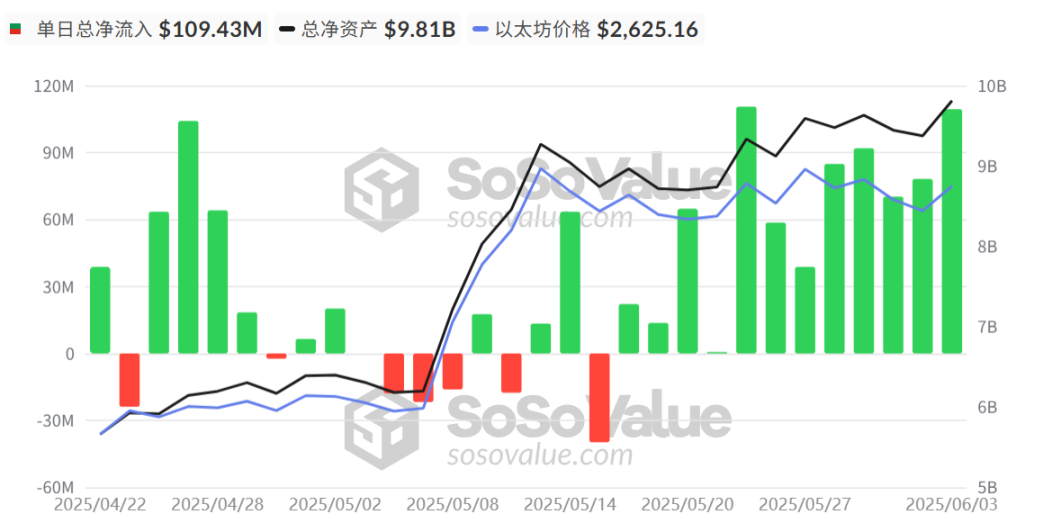
Data from SoSoValue shows that cumulative net inflows for U.S.-listed Ethereum spot ETFs have reached $3.23 billion, with no signs of slowing down.
In Talks with Major Sovereign Wealth Fund on Ethereum-Based Collaboration
Ethereum co-founder and Consensys CEO Joe Lubin said Tuesday that his company is in discussions with “major sovereign wealth funds and banks” from a “very powerful” nation about potential infrastructure development on Ethereum, covering both Layer 1 and Layer 2. However, specific details remain undisclosed, and market reactions are largely based on expectations. Confirmation and public announcement of such cooperation would undoubtedly provide a strong boost to market confidence.
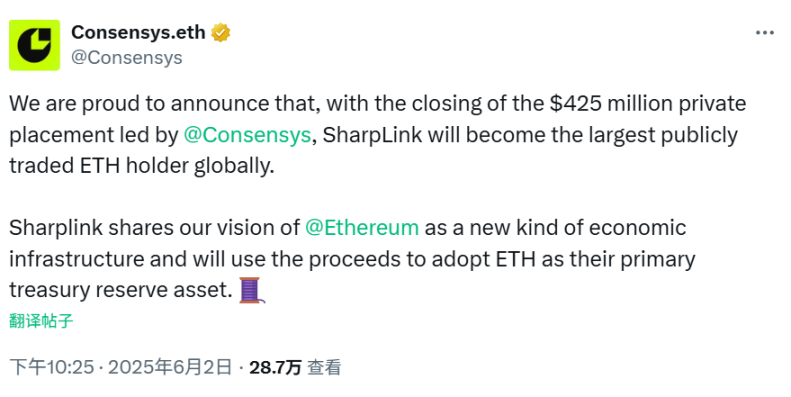
Besides, Consensys led SharpLink Gaming’s $425 million funding round, and Joseph Lubin will become Chairman of SharpLink’s Board following the completion of this financing.
Bitcoin had Strategy (MicroStrategy) accumulating aggressively, inspiring many companies to follow suit and creating strong buying pressure. Ethereum now needs corporate adoption to drive demand.
Nasdaq-listed SharpLink plans to use proceeds from this fundraising round to purchase Ethereum-native assets (ETH), holding it as a primary treasury reserve asset.
According to Bloomberg, Joe Lubin said he decided around six months ago—under the influence of prominent advocates of digital asset accumulation—to establish a company focused on investing in Ethereum’s native token. “I had dinner with Michael Saylor, did some research, and started discussing with colleagues how cool this idea could be,” Lubin said in an interview, referring to himself as founder and CEO of Consensys, a software infrastructure firm for Ethereum. “Nobody at our company had deeply explored this direction before. Later, we found there didn’t seem to be anything particularly risky about this strategy.”
Ethereum Foundation Cuts Staff and Reduces Operating Expenses
The Ethereum Foundation has long been criticized for its bloated organizational structure. On June 3, it finally took action by reducing staff and restructuring its research and development team, renaming the unit to "Protocol" to focus on core protocol design challenges. This move aims to address ongoing community criticism regarding the Foundation’s management and strategic direction. The restructured Protocol team will prioritize three key goals: scaling the base layer network, advancing blob storage expansion within data availability strategies, and improving user experience.
In its announcement, the Foundation stated that “some R&D team members will no longer continue their roles,” while encouraging other teams to absorb available talent. The exact number of layoffs was not disclosed. Additionally, the Foundation emphasized that the new team will enhance transparency around upgrade timelines, technical documentation, and research outputs. Hsiao-Wei Weng, Co-Executive Director, noted on social media X that the new structure is intended to enable more efficient progress on core projects.
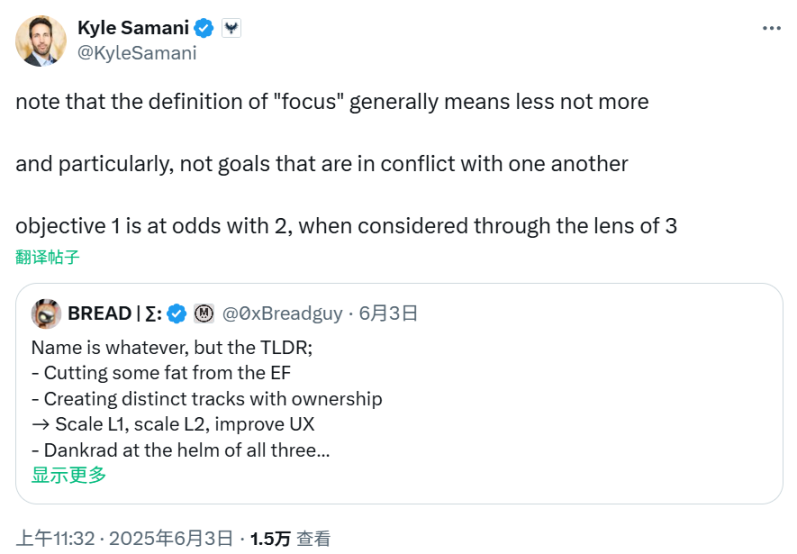
However, some argue critical issues remain unresolved. Kyle Samani, co-founder of Multicoin Capital, tweeted: “Note that the definition of ‘focus’ usually means doing less, not more—especially avoiding conflicting objectives. Yet looking at Goal 3 (L1/L2 scaling and UX improvement), Goal 1 (layoffs) contradicts Goal 2 (clarifying responsibilities).”
In June 2025, the Ethereum Foundation released a new fiscal management policy aimed at ensuring long-term financial sustainability. According to its official blog, the Foundation set an annual operating expense cap at no more than 15% of total assets, with plans to gradually reduce this to 5% over the next five years. Furthermore, it will maintain a 2.5-year operational expense buffer and regularly assess whether to sell ETH to replenish fiat reserves. This reflects a cautious approach to treasury management, especially amid volatile ETH price conditions.
The Foundation also stressed that on-chain funds will only be deployed into audited, decentralized DeFi protocols, primarily using low-risk strategies like staking and lending. These measures not only reduce financial risk but align with Ethereum’s “Defipunk” principles and privacy protection ethos.
In the past, every report of the Foundation selling ETH sparked community backlash. Now, by adopting a more prudent stance toward spending, these actions signal that the Foundation is cutting costs and optimizing resource allocation to lay a solid foundation for Ethereum’s long-term growth—also providing market reassurance by mitigating selling pressure.
Gas Limit Increased to 60 Million
Recently, Ebunker tweeted that Ethereum is expected to raise its block gas limit to 60 million, supported by 15% of validators. A higher gas limit allows blocks to process more transactions, thereby increasing network speed. Among various scalability paths, raising the gas limit offers one of the most immediate effects. Moreover, increasing the gas limit does not require system upgrades or code changes—only PoS validators signaling consistent support during block production can gradually push the network to adopt this change.
While Ethereum has historically scaled via L2 solutions and rollups, this approach has created significant problems. “L2s greatly weaken ETH’s value capture and easily lead to a fragmented, warlord-like ecosystem,” said Pi Ma, founder of Continue Capital, during a voice chat session.
Scaling the mainnet has now become inevitable. At the ETHGlobal Prague conference, Vitalik stated that Ethereum aims to increase L1 capacity by approximately 10x within a year, then take a breather before the next leap.

Ethereum’s current peak TPS has already risen to about 60. How high it can go from here remains to be seen.
Summary
Ethereum is undergoing multi-dimensional transformation across technology, finance, and ecosystem development. The Foundation’s fiscal reforms and R&D restructuring lay a foundation for long-term growth; Consensys’ collaboration talks with sovereign wealth funds suggest Ethereum’s emerging role in global finance; increased gas limits and ETF inflows inject vitality into network efficiency and market momentum.
Despite short-term concerns over selling pressure and cost debates, Ethereum maintains a leading position in the crypto market thanks to its technological advantages and institutional backing. Going forward, Ethereum must continue advancing in technical optimization and community governance to meet rising competition from rivals like Solana. 10x Research recently analyzed ETH performance, writing: “Although we expected a pullback a few days ago, the actual price movement has proven far more resilient than anticipated. From a technical standpoint, Ethereum is approaching the apex of a large triangular consolidation pattern—the breakout direction could send prices toward either $2,000 or $3,000. This move will be crucial, potentially driven by fundamental shifts or simply triggered by a major buyer entering the market.”
Join TechFlow official community to stay tuned
Telegram:https://t.me/TechFlowDaily
X (Twitter):https://x.com/TechFlowPost
X (Twitter) EN:https://x.com/BlockFlow_News
 Foresight News