Whales stir the market, HYPE hits new highs, Hyperliquid rebounds with explosive data across the board
TechFlow Selected TechFlow Selected
Whales stir the market, HYPE hits new highs, Hyperliquid rebounds with explosive data across the board
This decentralized derivatives exchange is re-entering the spotlight of the crypto world from a new angle after being "targeted."
 Navigating Web3 tides with focused insights
Author: Frank, PANews
Recently, as whales have stirred up massive waves on Hyperliquid, this decentralized derivatives exchange—after being hit by a "snipe attack"—is re-entering the spotlight of the crypto world from a new angle. Once an underdog challenger, Hyperliquid is now genuinely challenging the traditional dominance of centralized exchanges through a series of impressive data performances and rapid ecosystem expansion.
This article by PANews provides an in-depth analysis of Hyperliquid’s recent data to comprehensively present the true picture of its development.
Open interest hits repeated record highs, approaching OKX levels
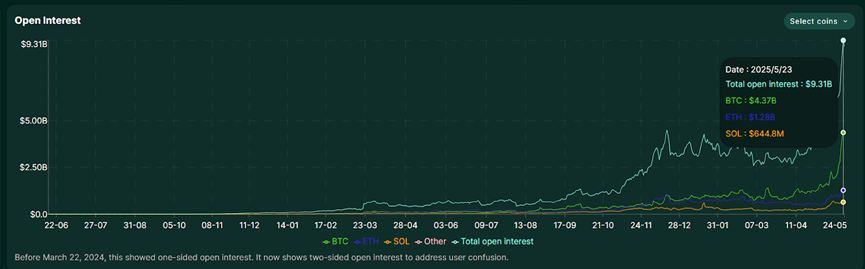
On May 23, Hyperliquid's open interest reached $9.31 billion, continuously setting new all-time highs. This figure is more than double the previous peak of $4.4 billion recorded in December last year. BTC and ETH together account for about half of the platform's total contract holdings.
In horizontal comparison with major CEXs, Hyperliquid's open interest is now on par with OKX. In terms of Bitcoin contract holdings, it ranks between 5th and 7th place alongside exchanges such as OKX, Bitget, and HTX. On May 23, Hyperliquid's DEX trading volume reached $714 million, roughly tripling from the $200 million at the beginning of the month.
As trading activity heats up, Hyperliquid's revenue has also seen dramatic improvement. Over the past 30 days, the platform generated $62 million in fees, ranking it 8th among protocols by revenue—just behind Jito and Pump.fun, and even surpassing Tron and Solana.

In March, Hyperliquid was repeatedly targeted by traders exploiting vulnerabilities in its order book to secure substantial profits (related reading: Hyperliquid Sniped Again: A Two-Hour Life-or-Death Drama, No Winners in the Top Exchange Hunting Game). During that period, capital inflows into Hyperliquid declined sharply—from $2.47 billion on March 1 to $1.85 billion on April 7, a drop of around 25%. However, as whales returned and began placing large contract orders that attracted market attention, capital flows reversed. As of May 26, net inflows had rebounded to approximately $3.5 billion—recovering all previous losses and reaching a new all-time high. The turnaround became especially evident in May, with single-day net inflows peaking at $240 million and averaging $53 million per day.
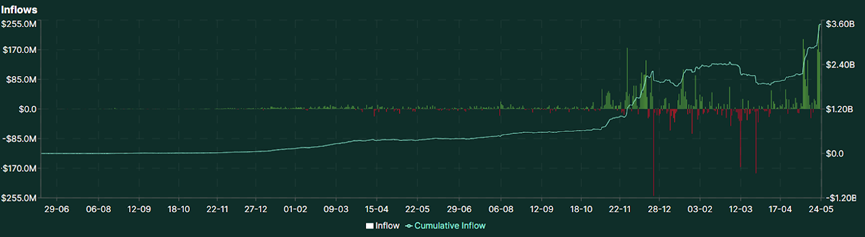
These inflows are closely tied to high-profile whale activities, such as those by James Wynn. Since May, multiple whales—including James Wynn and the so-called "50x Brother"—have frequently placed contract positions worth tens or even hundreds of millions of dollars on Hyperliquid. Under real-time observation by on-chain analysts, these moves have become market talking points and effectively served as free advertising for Hyperliquid. Interestingly, this transparent on-chain behavior creates a signal-following effect—an unique advantage for Hyperliquid as a decentralized exchange, one that traditional CEXs struggle to replicate.
Token market cap surpasses SUI; multiple new ecosystem protocols offer potential airdrops
With overall data trending positively, Hyperliquid’s governance token HYPE bottomed at $9.3 in April before entering a strong rally. By May 27, HYPE had surged to a high of $39.9—a maximum increase of approximately 329%. Its market cap peaked at $12.9 billion, surpassing SUI to rank as the 13th largest cryptocurrency by market value.
In the ecosystem space, Hyperliquid has made notable progress recently. In April, external DeFi protocols such as Morpho and Upshift began deploying on Hyperliquid. Several native protocols have also launched operations, with HyperLend, Felix, and HypurrFi each exceeding $100 million in TVL. As of May 27, Hyperliquid’s total TVL reached $1.46 billion, with the number of active protocols increasing to 27—16 of which are exclusive to the Hyperliquid ecosystem. Many of these protocols, still in early stages, have already introduced point programs, suggesting significant airdrop potential.

Additionally, the previous reliance on Arbitrum for fund transfers has significantly changed. New cross-chain tools such as Hyperunit, HyperSwap, and HyBridge now support direct asset transfers across more blockchains. In stablecoin issuance, Hyperliquid ranks sixth among all public chains with $3.6 billion in stablecoin market cap—surpassing longer-established chains like Arbitrum, Aptos, Sui, and TON. USDC dominates with $3.5 billion in issuance (97% share), while feUSD, Hyperliquid’s native stablecoin, currently has only $51 million in circulation, remaining in its early phase. Furthermore, USDT’s omnichain version USDT0 launched on Hyperliquid in May. Though current issuance is low, it represents a new critical channel for capital flow on the platform.
Shadows beneath the spotlight: user growth and trust remain challenges
While most metrics appear positive, some indicators show little momentum. For instance, cumulative new user additions have not surged recently, with daily new users numbering only in the hundreds—significantly lower than the thousands seen during Hyperliquid’s initial launch period. User acquisition appears weak. Daily unique traders have grown somewhat, peaking at over 30,000, but this still lags far behind major centralized exchanges. Additionally, trading volume remains heavily concentrated, with BTC, ETH, and SOL consistently accounting for around 50% of total volume. Other tokens struggle to gain traction, making it difficult for newly listed tokens to generate the kind of “listing effect” seen on top-tier exchanges. Recent listing auctions have been particularly lukewarm, with prices mostly ranging between $20,000 and $30,000.
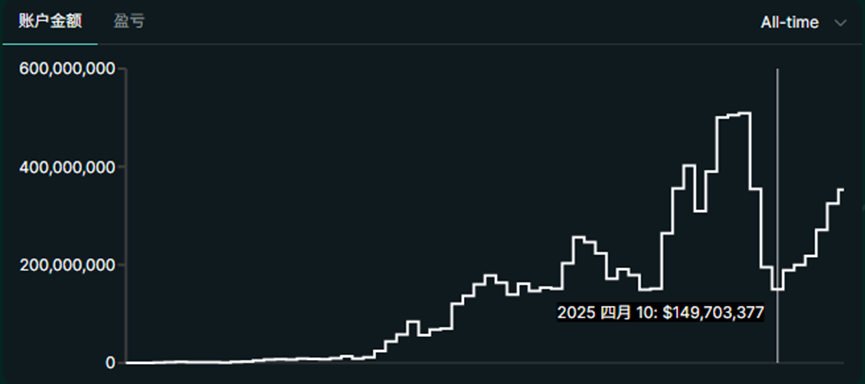
Moreover, during the earlier snipe attacks, Hyperliquid’s biggest direct loss came from reduced yields in the HLP treasury—the main source of liquidity. At the time, HLP treasury earnings dropped sharply from $63 million to $59 million. However, recent data shows yields have recovered to $64.7 million, reaching a new high. Yet, the lingering impact persists: treasury deposits fell from $500 million to a low of $149 million in March—a 60% loss. Although deposits have since rebounded to $350 million, they remain about 30% below prior peaks. This indicates that the snipe incident significantly damaged large depositors’ trust in Hyperliquid, and confidence has yet to fully return.
Overall, Hyperliquid has undoubtedly delivered an impressive performance recently. Whether measured by exponential growth in core metrics like open interest and trading volume, or by the strong market performance of its native token HYPE, the platform demonstrates clear upward momentum and heightened market attention. Notably, whale participation and transparent on-chain operations have provided Hyperliquid with a wave of free publicity.
Nevertheless, challenges remain beneath the surface. Sluggish new user growth and incomplete restoration of trust among HLP treasury depositors are issues Hyperliquid must confront as it aims for higher ground. Yet, on balance, Hyperliquid’s achievements prove it is becoming an increasingly significant force in the exchange landscape.
Join TechFlow official community to stay tuned
Telegram:https://t.me/TechFlowDaily
X (Twitter):https://x.com/TechFlowPost
X (Twitter) EN:https://x.com/BlockFlow_News
 PANews