Hyperliquid price breaks $30 again, questioned why it can suddenly rise?
TechFlow Selected TechFlow Selected
Hyperliquid price breaks $30 again, questioned why it can suddenly rise?
In the crypto world, being criticized by many is not scary—being irreplaceable is the trump card.
 Navigating Web3 tides with focused insights
Author: Bright, Foresight News
Hyperliquid, which was once questioned due to FUD in the first half of the year, has risen again.
On May 22, as BTC broke through the $110,000 mark, HYPE surged past 30 USDT, rising 14.79% in 24 hours, with its total FDV stabilizing at $29 billion, climbing to 14th place among cryptocurrencies by market cap. In contrast, a whale who initiated a short position worth $57.14 million in HYPE at around $20.4 on May 8 with 5x leverage is now facing an unrealized loss of $18.8 million. To avoid liquidation, this address has topped up margin three times, most recently adding $2.04 million in USDC just two hours ago to prevent forced liquidation.
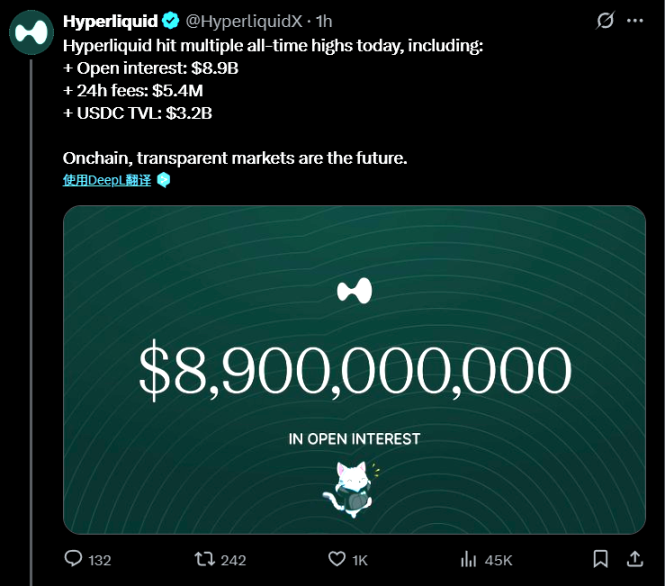
Meanwhile, Hyperliquid officially announced that several platform metrics hit record highs today, including open interest (OI) reaching $8.9 billion, 24-hour trading fees totaling $5.4 million, and total USDC locked reaching $3.2 billion.
Yet just two months ago, Hyperliquid was embroiled in near-bankruptcy of its treasury and a "decentralization" FUD crisis. Arthur Hayes, founder of Bitmart, directly attacked Hyperliquid on X, claiming "HYPE will return to zero," and urging people to "stop pretending Hyperliquid is decentralized."
Perpetual Demand on Chain Remains Strong
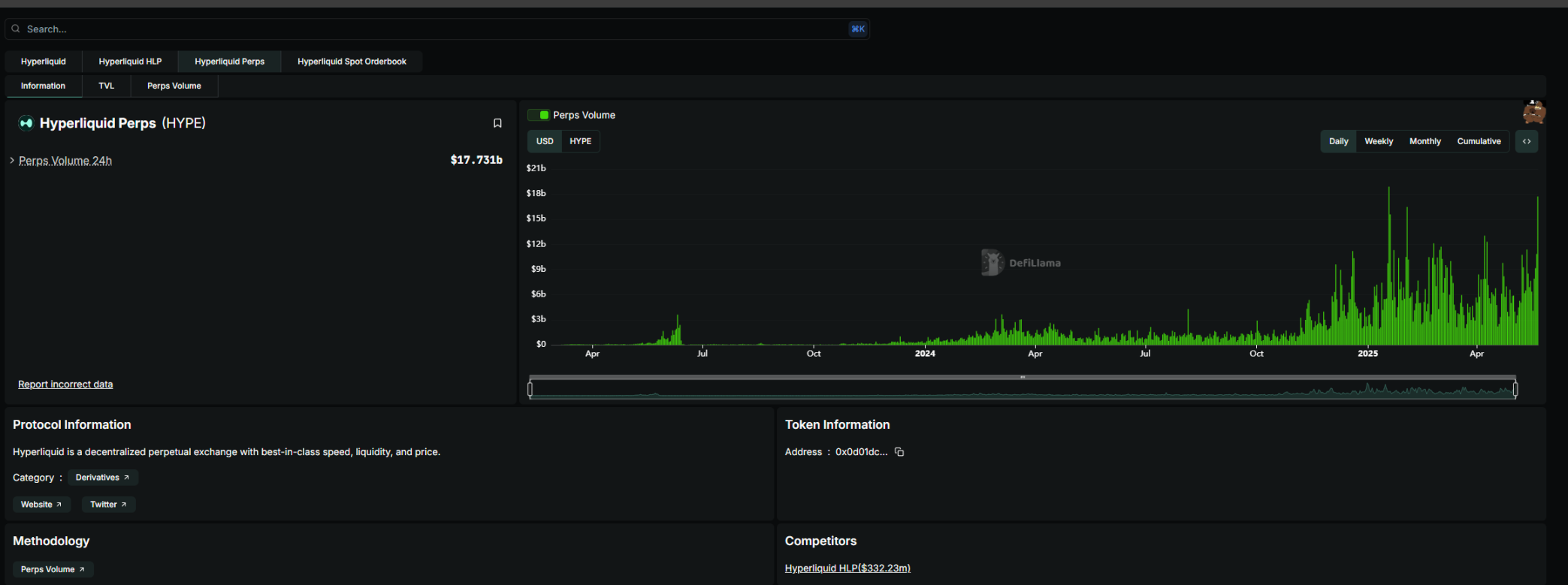
After the JELLY short squeeze calmed down, more and more whales have started choosing Hyperliquid. According to The Block data, Hyperliquid had already consistently captured around 9% of Binance’s futures trading volume for two consecutive months before the short squeeze occurred.
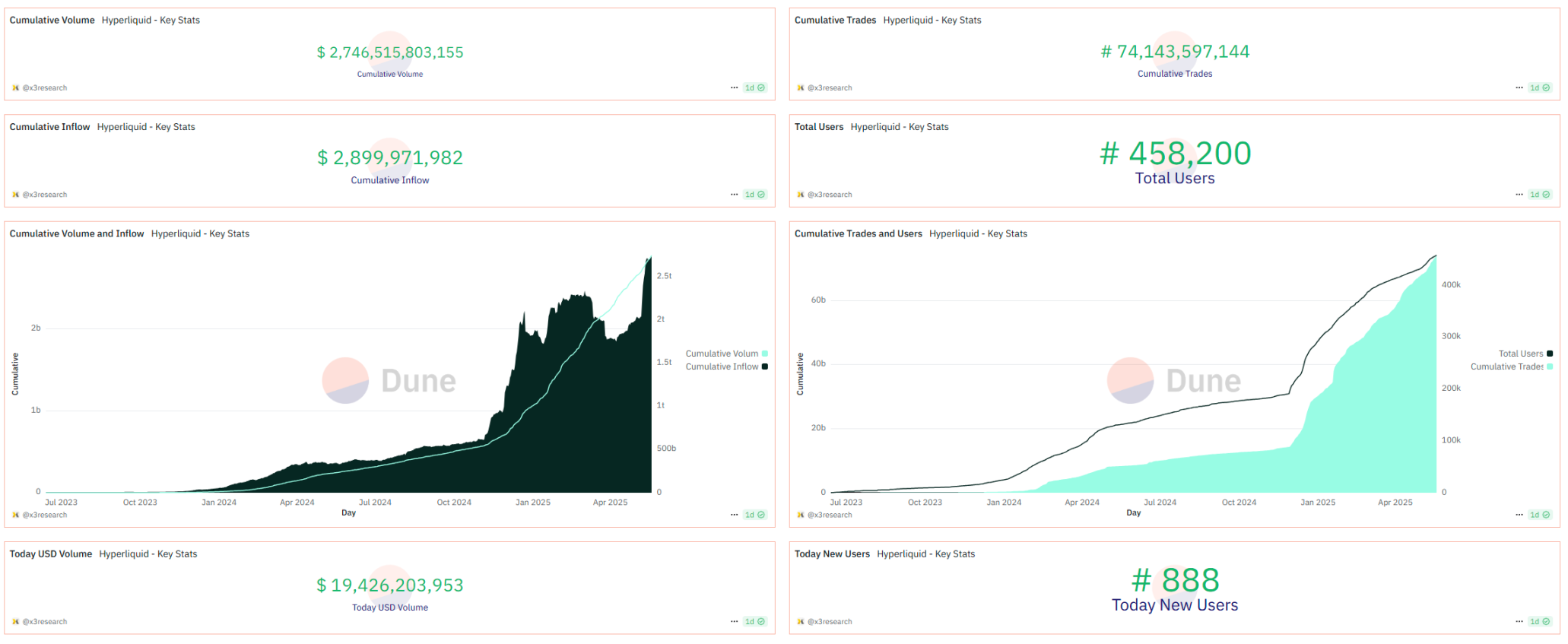
Dune data shows that both trading volume and user count on Hyperliquid are growing rapidly. So, have the whales forgotten about the short squeeze?
Hyperliquid chose not absolute decentralization, but prioritized capital efficiency and protocol security. As Zuo wrote in his article “Hyperliquid: 9% of Binance, 78% Centralized”—within the Perp DEX landscape, Hyperliquid's innovation lies not in architectural breakthroughs, but in adopting a “slightly centralized” approach: tokenizing GMX-style LP shares, combined with listing and airdrop strategies, continuously incentivizing market speculation, successfully capturing a derivatives market long dominated by CEXs. This isn't defending Hyperliquid—it reflects the fundamental nature of Perp DEXs: absolute decentralized governance cannot respond quickly enough during black swan events; efficient response requires a sword-holder.
Hence, whales have chosen to trust Hyperliquid—the sword-holder operating primarily via smart contracts with validator node voting as backup—over mature CEXs. Three key factors enabled Hyperliquid to emerge from the shadows.
First, anonymity demand. Many whales and large holders highly value personal privacy and wish to avoid potential withdrawal or transfer restrictions imposed by centralized exchanges.
Second, strong liquidity. Only pools large enough can accommodate whale-sized trades. In reality, only a few top-tier centralized exchanges match Hyperliquid’s liquidity levels.
Third, public positions. KOLs like James can create a “money-and-influence” cycle—using Hyperliquid’s on-chain transparency of large positions and profits to boost their influence, then leveraging that influence to encourage retail investors to follow their trades, thereby shaping market direction. On traditional CEXs, KOLs would need to connect exchange APIs to display holdings.
During this rally, whales on Hyperliquid have been extremely active. First came the “insider with 50x leverage” (prior to HYPE’s leverage cap change) making extreme moves, followed by meme legend James Wynn openly opening massive long positions. The latter, in particular, made over $40 million in profit from nearly $1 billion in long exposure during BTC’s surge to new all-time highs.
Additionally, to solve issues related to stablecoin yield and capital outflows, Hyperliquid launched its native stablecoin HUSD. HUSD integrates two core insights: bringing both the pricing asset used in trading (stablecoins) and the cash flows they generate fully into the exchange ecosystem. The result is a stablecoin with “public good” characteristics, transforming what were previously static reserve yields into active, compounding growth within the Hyperliquid ecosystem.
Recap: The JELLY Short Squeeze Shadow
Let’s rewind to the evening of March 26, when the meme coin JELLYJELLY suffered a short squeeze, spiking 429% within an hour. Hyperliquid Vault took over a JELLYJELLY short position after an address self-liquidated, initially facing over $10.5 million in unrealized losses. At the time, if JELLYJELLY reached $0.15374, Hyperliquid Vault would have lost its entire $230 million fund; further fund outflows would have lowered the liquidation price of JELLYJELLY even more.
Following the incident, OKX and Binance both announced listings of JELLYJELLY perpetual contracts that night. After Binance and OKX listed futures, Hyperliquid quickly delisted JELLYJELLY, and the massive losing short position in Hyperliquid Vault was settled.
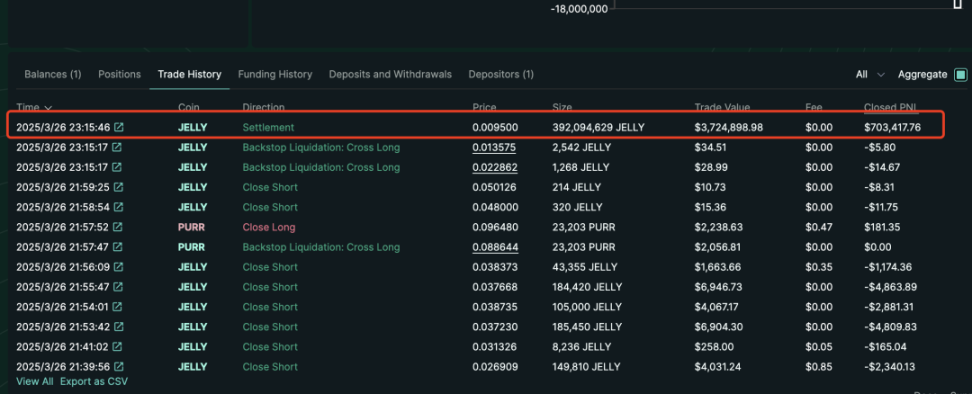
Just as bystanders assumed Hyperliquid had cut losses and admitted defeat, the situation took an “unexpected yet logical” turn. According to historical data from Hyperliquid’s official website, the JELLYJELLY short taken over by Hyperliquid Vault was closed at $0.0095 at 11:15 PM, avoiding the anticipated multi-million dollar loss. The HLP Vault even profited $703,000 from the position. Subsequently, Hyperliquid stated that after detecting signs of suspicious market activity, the validator set held a meeting and voted to delist the JELLY perpetual contract. All users except those from flagged addresses would receive full compensation from the Hyper Foundation.
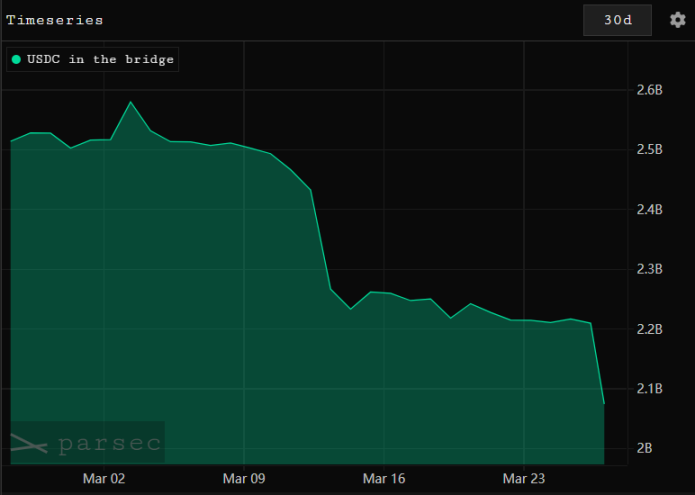
According to Parsec dashboard data, within hours of the Jelly liquidation event, Hyperliquid saw a net outflow of $140 million in USDC. Earlier, around the ETH whale long liquidation event between March 12 and March 16, Hyperliquid experienced nearly $300 million in net USDC outflows over four days. From February 26 to March 26, Hyperliquid’s USDC balance dropped from approximately $2.5 billion to $2.07 billion.
In response to this incident, many CEX CEOs and others criticized Hyperliquid, arguing that despite branding itself as a decentralized exchange, Hyperliquid operates more like an offshore CEX without KYC/AML checks, and its immature practices could lead to another FTX 2.0. However, some pointed out that the major exchanges themselves are the most likely instigators behind this coordinated attack on Hyperliquid. User off_thetarget revealed on X that as early as March 24, someone contacted him to help push for JELLYJELLY’s listing on Binance. After assisting in connecting with Binance’s listing team, he received feedback indicating that listing MEMEs wasn’t likely anytime soon. Yet, less than two days later, Binance decided to list JELLY contracts—an obvious inconsistency.
This wasn’t the first time Hyperliquid faced such an issue. On March 13, a whale using 50x leverage opened a ~$300 million long position in ETH on Hyperliquid, briefly achieving $8 million in unrealized gains. However, the user later withdrew most of the principal and profits, driving up the liquidation price until the position was eventually liquidated, netting around 1.8 million USDC. Meanwhile, the platform’s insurance fund (HLP Vault) incurred approximately $4 million in losses. Hyperliquid Vault data showed that after the whale triggered the liquidation mechanism, HLP lost $3.45 million.
In response, Hyperliquid announced it would adjust leverage limits to optimize liquidation management and enhance market buffer capacity during large-scale liquidations. BTC maximum leverage will be adjusted to 40x, and ETH maximum leverage to 25x.
Considering Hyperliquid’s scale and Hype’s price performance, as a project with TGE in 2024, its Perp DEX serves a genuine, essential on-chain demand. In crypto, being universally criticized isn’t scary—irreplaceability is the trump card.
Join TechFlow official community to stay tuned
Telegram:https://t.me/TechFlowDaily
X (Twitter):https://x.com/TechFlowPost
X (Twitter) EN:https://x.com/BlockFlow_News
 Foresight News