The digital transformation of the dollar: stablecoins are rapidly reshaping the global financial landscape
TechFlow Selected TechFlow Selected
The digital transformation of the dollar: stablecoins are rapidly reshaping the global financial landscape
"Stablecoins" are becoming a support point for the US dollar.
 Navigating Web3 tides with focused insights
Author: Zhao Ying
As the U.S. dollar's dominance wavers, the stablecoin market is rapidly expanding, potentially becoming a new pillar for the dollar and reshaping the global financial system?
According to Fengwen Trading Desk, Jim Reid, Deutsche Bank’s global macro and thematic research head, noted in a recent report that stablecoins are expanding at an unprecedented pace, and corporate finance executives are already sensing the wave of change. Reid stated:
This week I attended a corporate finance conference on the U.S. West Coast, and all CFOs have noticed increasing stablecoin transactions in their businesses—it’s a growing market.
"Stablecoins" are digital assets, with over 99% of their market capitalization pegged to the U.S. dollar. They effectively function as money market funds supporting the U.S. short-term debt market—for example, Tether has become one of the major holders of U.S. Treasuries.
The United States is accelerating stablecoin regulatory legislation, with payments being a major use case. Regulation could open the door to broader adoption of payments. Although the GENIUS stablecoin bill was recently rejected, Deutsche Bank expects significant progress on this legislation this year.
Analysts believe the stablecoin market has immense potential, and payment applications could lead to wider acceptance of crypto infrastructure. Citigroup estimates that in the long term, the potential market size for stablecoins is substantial, reaching $1.6–3.7 trillion by 2030 under base and optimistic scenarios.
What Are Stablecoins? How Do They Work?
Stablecoins are digital assets usable for payments and exhibit lower volatility than other cryptocurrencies due to their 1:1 peg to "stable" assets. Deutsche Bank’s report指出 that there are four main types of stablecoins: fiat-backed, asset-backed, crypto-backed, and algorithmic.
Currently, dollar-backed stablecoins dominate the market, with over 99% of stablecoin market capitalization pegged to the U.S. dollar. These stablecoins hold over $120 billion in U.S. reserve assets and effectively serve as money market funds supporting the U.S. short-term debt market.
Citibank’s report further explains that stablecoins have become a key component of the cryptocurrency ecosystem: first, they serve as the gateway to decentralized finance—tracking growth in stablecoin issuance helps assess the health and expansion of the overall digital asset environment; second, stablecoins can be seen as a store of value without the inherent volatility of native tokens.
One use case for stablecoins is reserves—their “safe-haven” characteristics increase their appeal as a store of value amid current market volatility. Another potential use case is payments and cross-border transactions, where regulatory clarity could pave the way for broader adoption.
Stablecoins—The Digital Extension of Dollar Dominance, a New Source of Demand for U.S. Debt?
The impact of stablecoins on the U.S. bond market is growing. According to Deutsche Bank data,
As of March 2025, Tether’s holdings of U.S. Treasuries reached $98.5 billion, a figure nearly zero in 2020, now placing it among the major overseas holders of U.S. debt.
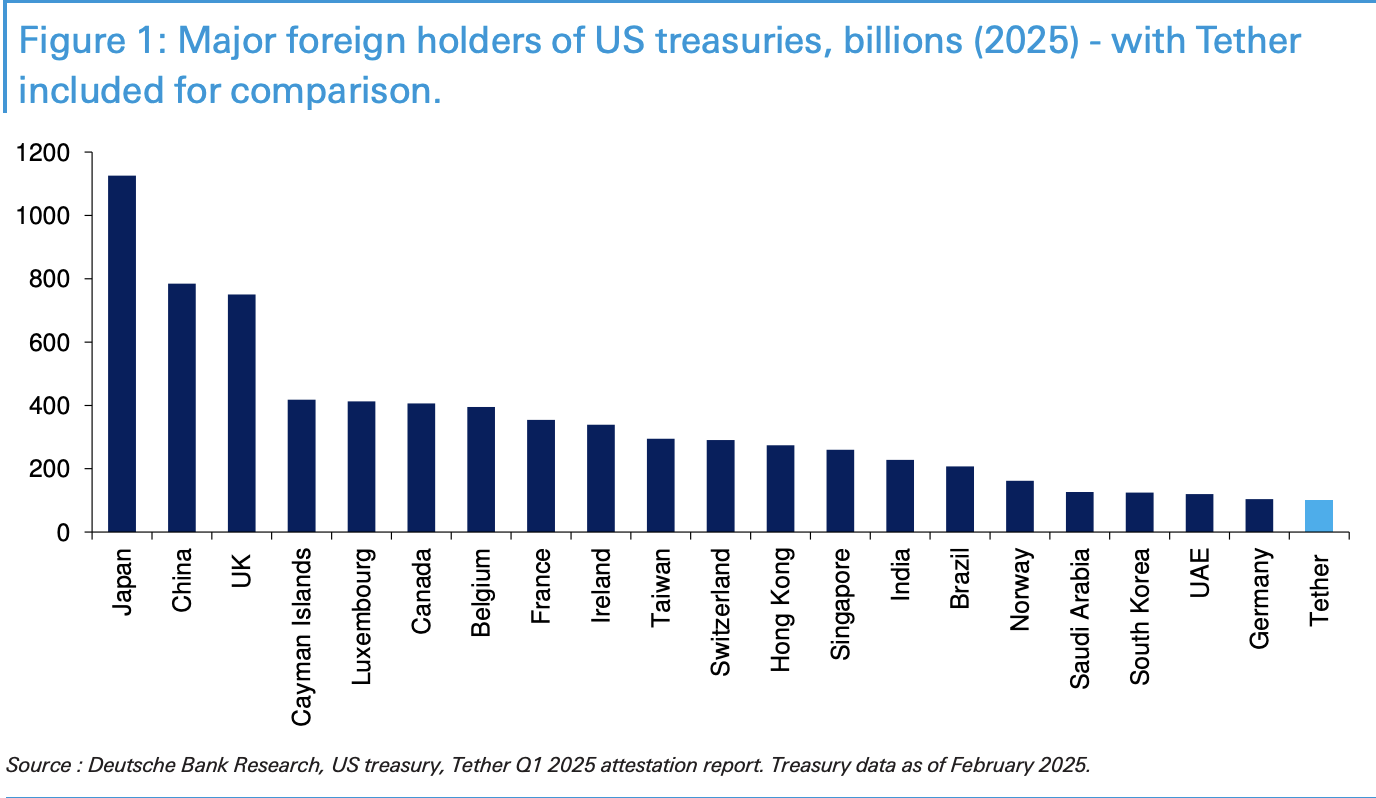
Citigroup also notes that large stablecoin issuers have become increasingly significant holders of U.S. Treasuries:
In particular, dollar-pegged stablecoins are becoming a growing source of demand for U.S. Treasury bills. Two primary reasons cited by the U.S. Secretary of Commerce and Secretary of the Treasury for pushing legislation are: increasing demand for short-term Treasuries and strengthening the dollar’s role as the world’s reserve currency.
Major stablecoin providers like Tether have become important holders of U.S. Treasuries. Since proposed legislation requires stablecoin issuers to hold short-term U.S. Treasuries, this creates a new source of demand for U.S. short-term debt.
However, Citigroup analysts also point out two mitigating factors: first, if any inflows come from existing U.S. Treasury holders, either directly or indirectly, the demand effect would be weakened. For example, funds moving from money market funds to stablecoins would represent substitution rather than a net increase in overall demand. Second, while supporting short-term demand, long-term debt demand may remain unaffected.
Stablecoins are becoming increasingly important in digital dollar infrastructure, according to Deutsche Bank:
It is very much in America’s interest to boost stablecoin demand, thereby reinforcing the dollar—especially when stablecoin adoption accelerates, as their “safe-haven” feature makes them an attractive store of value amid current market volatility.
Citigroup’s report states:
The U.S. dollar still dominates foreign exchange reserves. The dominance of dollar-based stablecoins stems not only from first-mover advantage but also reflects the dollar’s “exorbitant privilege” as the preferred reserve currency. The stablecoin market has enormous potential—Citigroup estimates it could reach $1.6 to $3.7 trillion by 2030.
At the same time, Citigroup warns that since euro-denominated stablecoins were launched under Europe’s MiCA regulatory framework, non-dollar stablecoin market capitalization has increased, coinciding with a weakening dollar and cracks in the “American exceptionalism” narrative. While euro-based stablecoins currently hold only a small share, developments in this space could be a leading indicator of shifts in the dollar’s status.
U.S. Stablecoin Legislation Is Moving Forward Rapidly
The United States is accelerating efforts to regulate stablecoins. According to media reports, the Senate’s GENIUS Act failed to advance to a full vote, but is expected to gain bipartisan support. The House bill has passed committee and awaits a full chamber vote.
Deutsche Bank’s report指出 that the U.S. is currently accelerating efforts to establish a regulated, dollar-backed stablecoin ecosystem by August this year. The GENIUS stablecoin bill was recently rejected, but significant progress on the legislation is expected this year.
Citibank analysis shows two stablecoin bills are currently progressing through the U.S. legislative process: the STABLE Act in the House and the GENIUS Act in the Senate. Both include similar provisions on consumer protection and reserves, but differences remain that require reconciliation and revisions.
Both bills focus on payment functionality—so-called “payment stablecoins”—and include provisions related to anti-money laundering (AML), national security, consumer protection, and reserve requirements. Reserve requirements mandate 1:1 backing using short-term U.S. Treasuries, repos, and insured deposits.
Analysis suggests that a stable regulatory environment will clear the path for broad stablecoin adoption, with payments emerging as a key use case.
Join TechFlow official community to stay tuned
Telegram:https://t.me/TechFlowDaily
X (Twitter):https://x.com/TechFlowPost
X (Twitter) EN:https://x.com/BlockFlow_News