$106,000 as the "death line"? China and U.S. reconcile—why did Bitcoin plunge from record highs?
TechFlow Selected TechFlow Selected
$106,000 as the "death line"? China and U.S. reconcile—why did Bitcoin plunge from record highs?
In the long term, Bitcoin is evolving from "digital gold" to a "cross-border value transfer protocol."
 Navigating Web3 tides with focused insights
Author: Lawrence
1. Protocol Implementation: The "Seesaw Effect" Amid Shifting Risk Appetite
On May 12, Beijing time, China and the United States reached a tariff truce agreement in Geneva, pressing the "pause" button on years of trade tensions. The agreement includes a 90-day suspension of 24% reciprocal tariffs, maintaining a 10% base rate, and establishing a third-party consultation mechanism. This development directly triggered a 3% surge in S&P 500 futures and a 4.35% gain for Nasdaq. However, Bitcoin unexpectedly dropped from a high of $105,720 to a low of $100,700, creating a rare "stock-bond divergence" pattern. At the time of writing, BTC has rebounded to $102,600.
Data Insight:
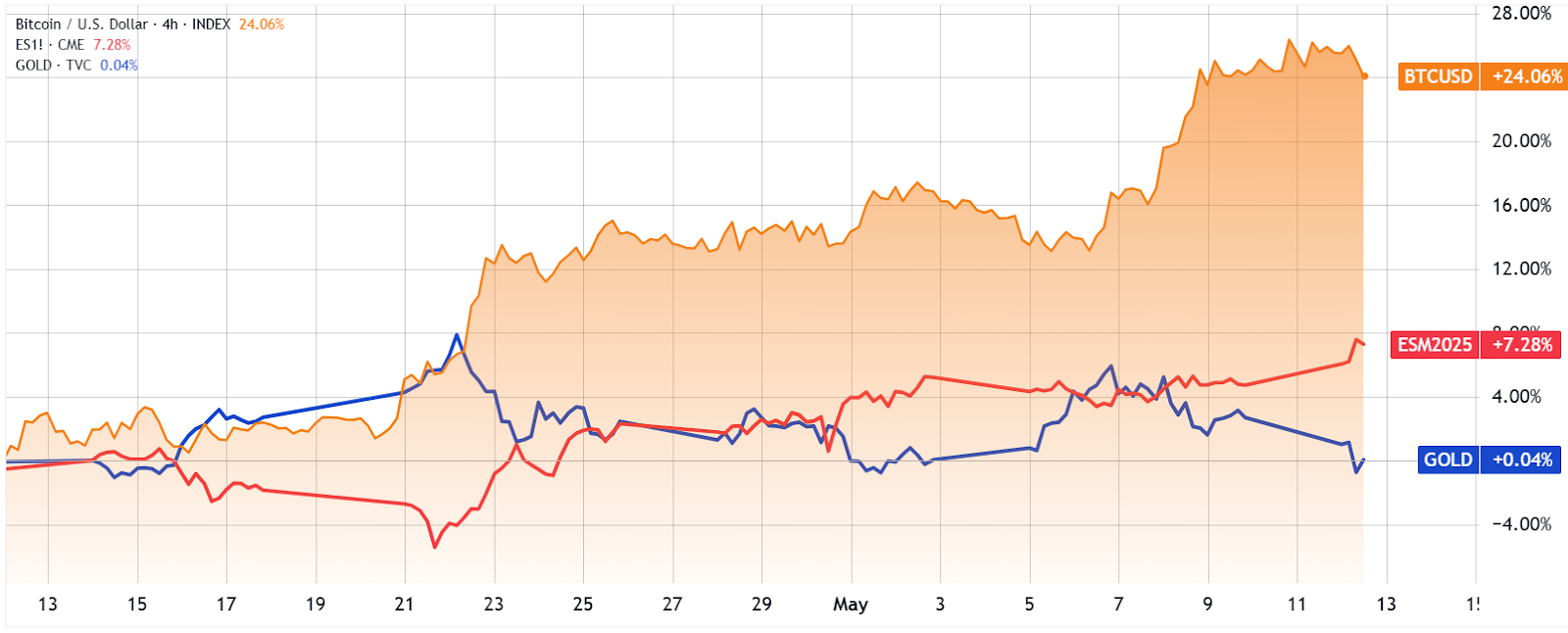
Bitcoin/USD (orange) vs. S&P 500 Index Futures (red) and Gold (blue). Source: TradingView
Short-term Capital Rotation: Over the past 30 days, Bitcoin has risen 24%, while the S&P 500 gained only 7% and gold prices remained flat. As the trade deal reduces market uncertainty, some capital has flowed back from crypto assets into traditional equities, pushing the 30-day correlation between Bitcoin and traditional markets to a record high of 83%1.
Institutional Holdings – A Double-Edged Sword: MicroStrategy and its affiliates recently acquired an additional 13,390 BTC, bringing their total holdings to 119,000 BTC (6% of circulating supply). While this is seen as a long-term positive, market concerns have emerged over potential "price manipulation" risks due to concentrated holdings—especially as their average cost rises above $100,000, increasing expectations of short-term selling pressure.
2. Technical Battle: $106,000 as the Bull-Bear Dividing Line
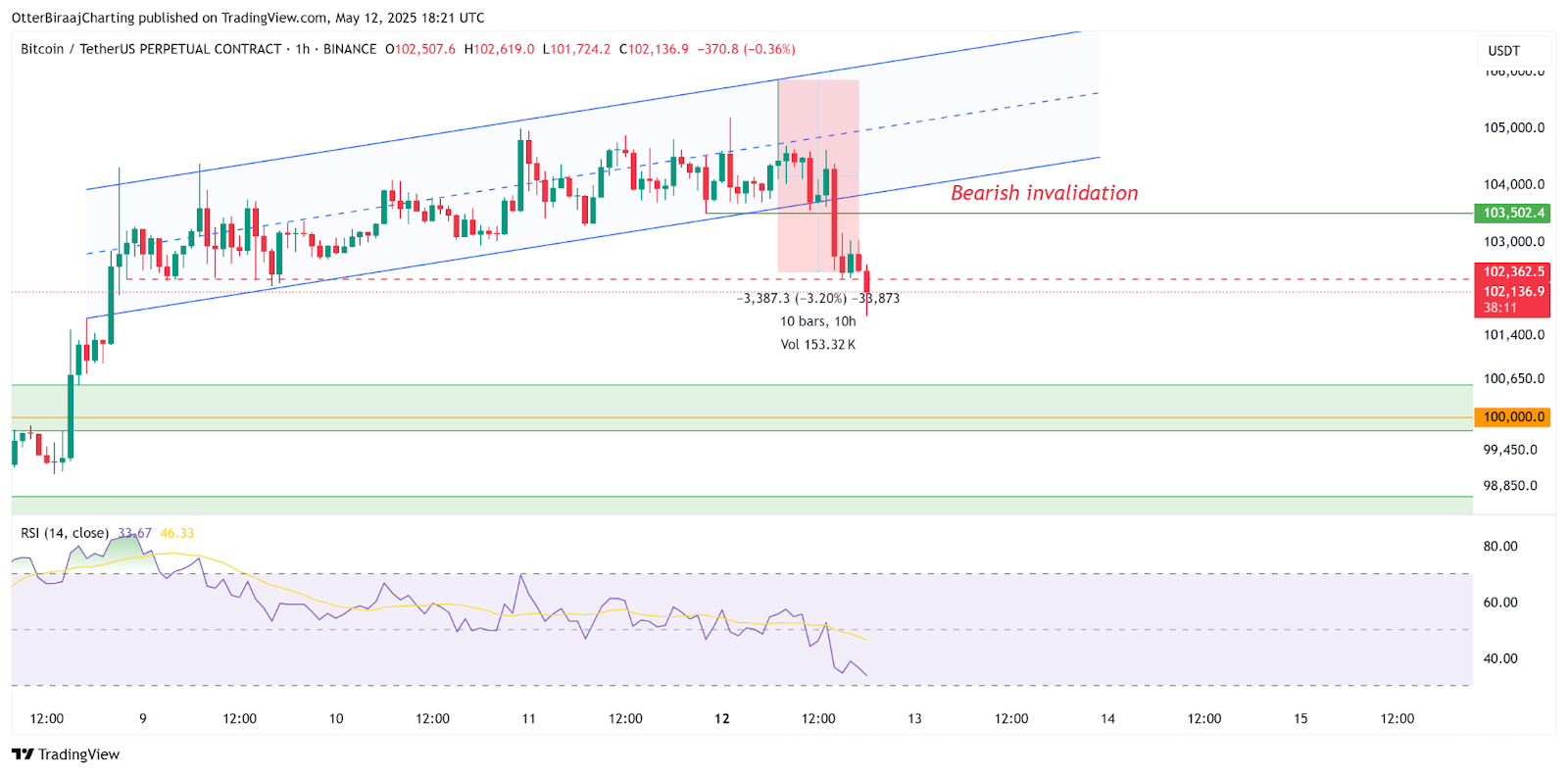
On May 12, Bitcoin briefly broke above $105,800 before rapidly retreating to $101,400. The one-hour chart shows price falling below the lower boundary of an ascending channel.
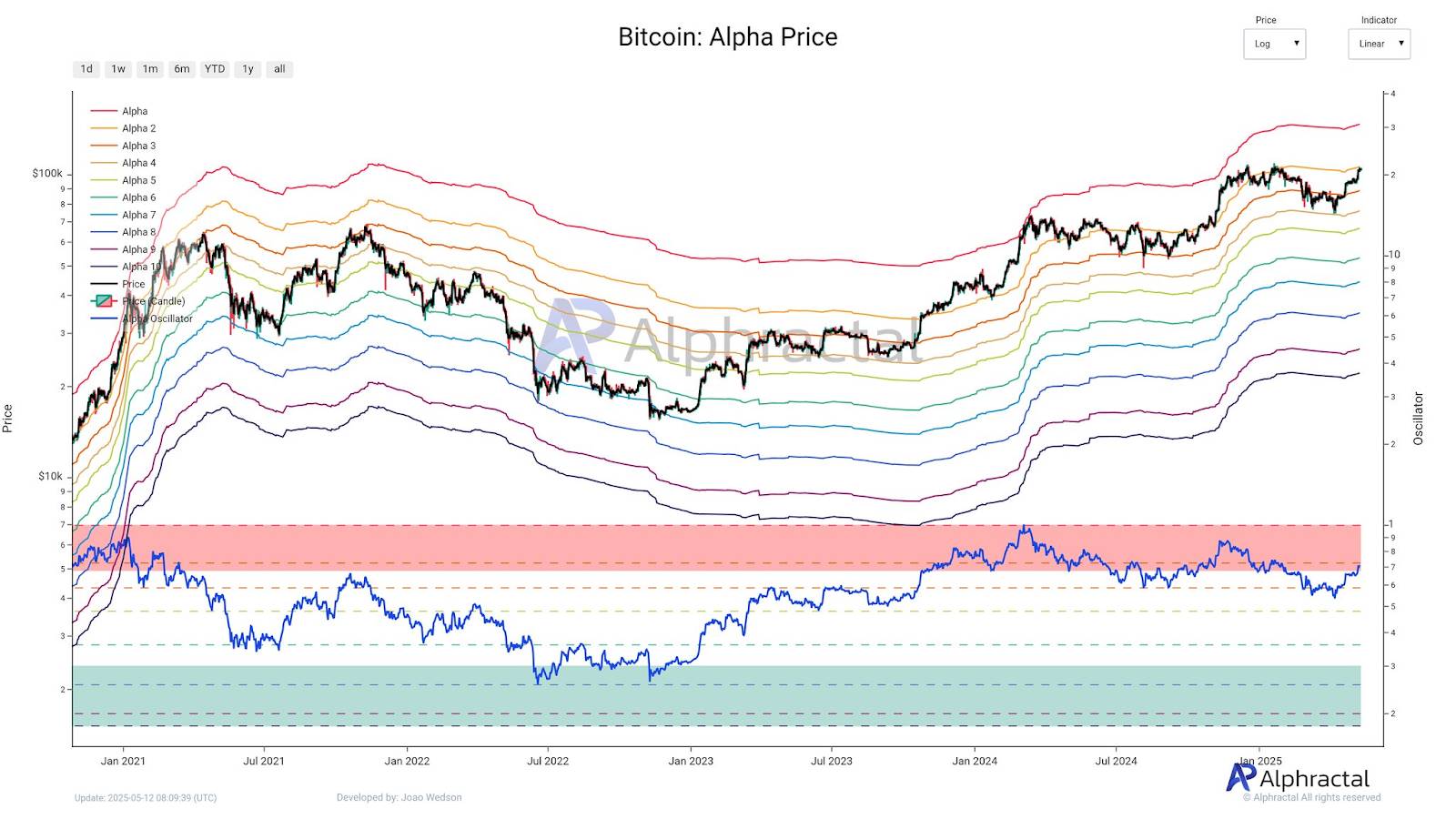
Bitcoin Alpha Price Levels. Source: X.com
Joao Wedson, CEO of Alphractal, noted that a resistance zone known as the "Alpha Price" exists near $106,000, where long-term holders may trigger profit-taking.
Key Risk Indicators:
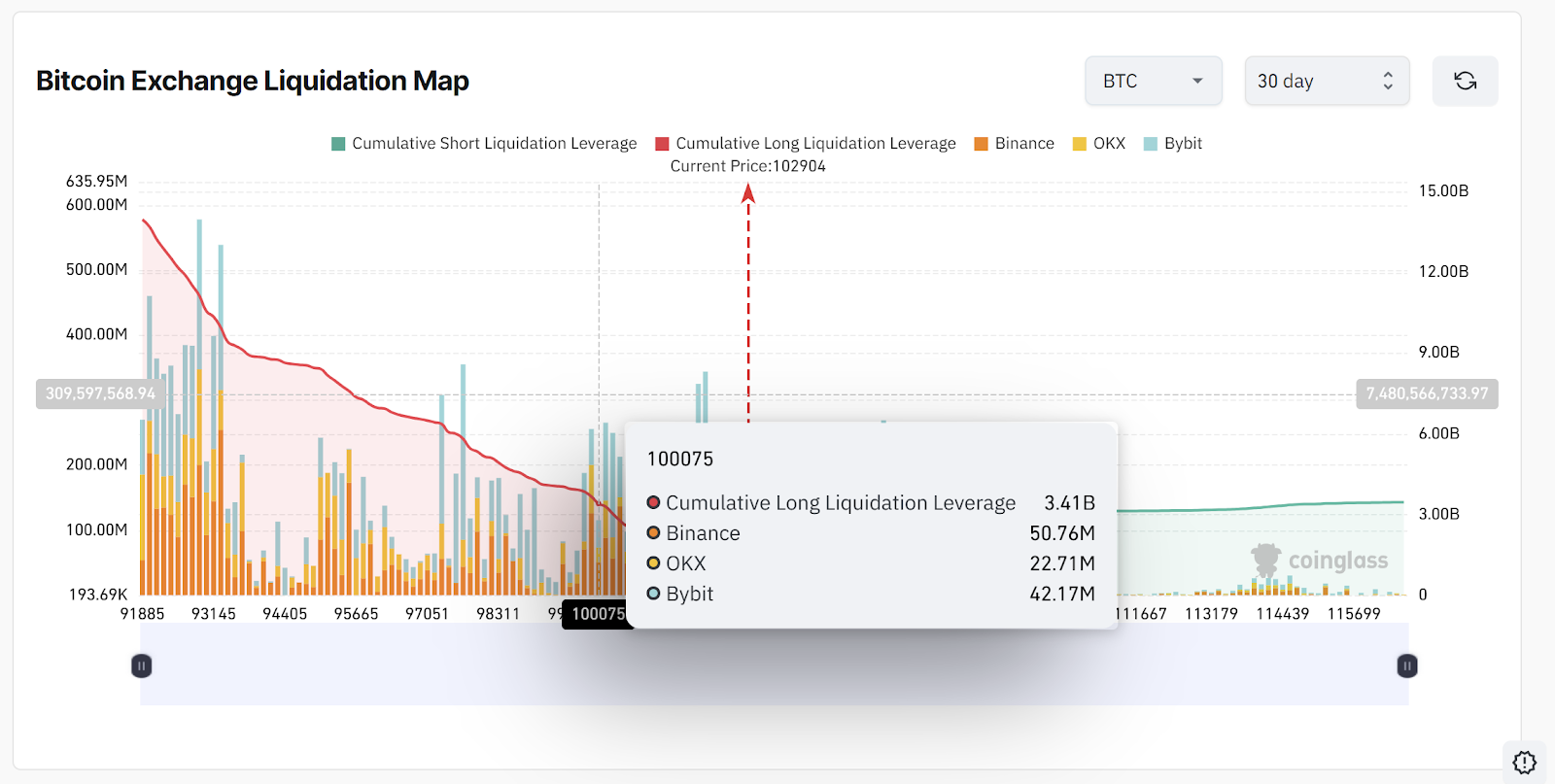
Liquidation Magnet Effect: CoinGlass data shows that if prices fall to $100,000, approximately $3.4 billion in long leveraged positions face liquidation risk, creating short-term downward pressure.
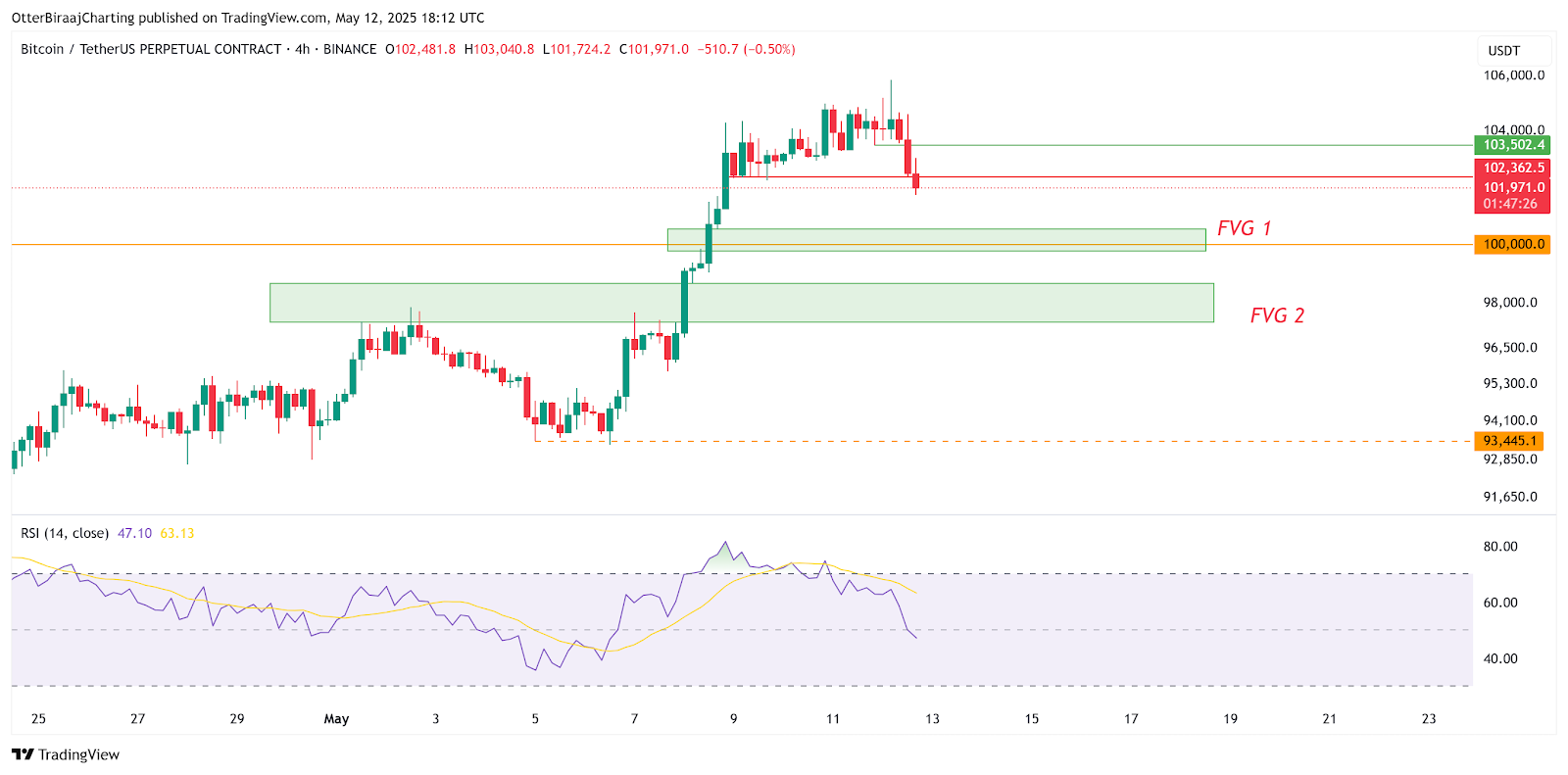
Support Zone Confirmation: The four-hour chart indicates that $99,700–$100,500 represents a recent "Fair Value Gap" (FVG). A break below could lead to further declines toward $97,363–$98,680, implying an 8% correction.
3. Macro Variables: The "Butterfly Effect" of CPI Data and the Dollar Index
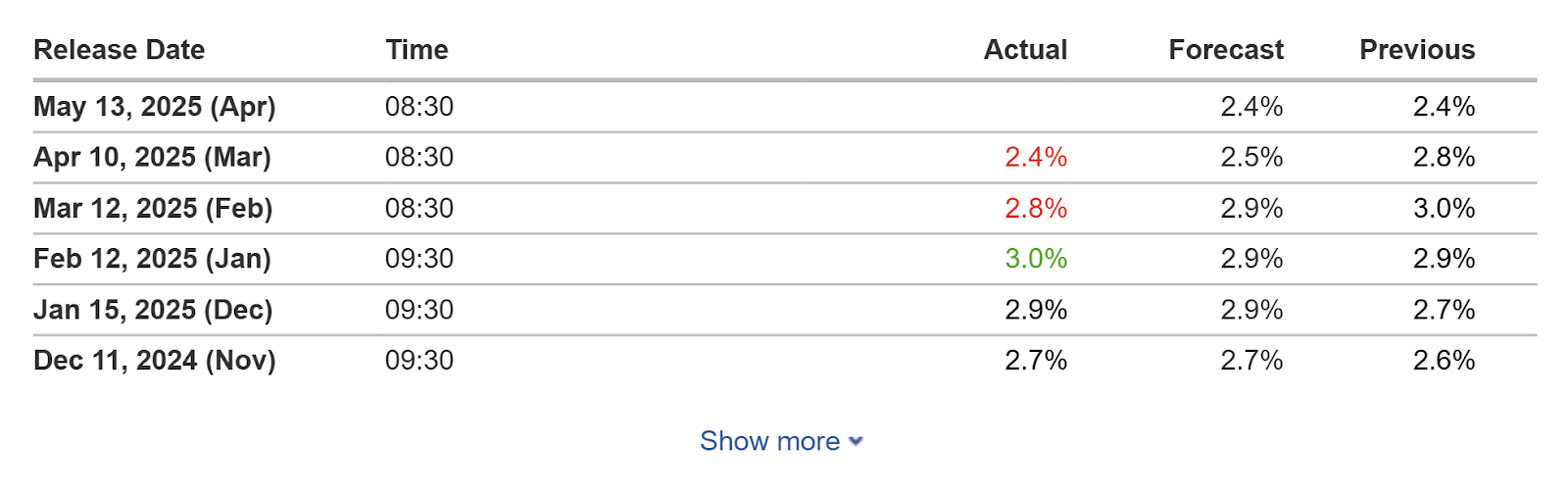
The U.S. April CPI data released on May 13 became a market focal point. March’s CPI came in at 2.4% (below the expected 2.5%). If April data continues this downward trend, it could strengthen expectations of Fed rate cuts, benefiting risk assets. Conversely, a rebound in inflation might push the U.S. Dollar Index (DXY) above its 30-day high, exerting downward pressure on Bitcoin.
Correlation Logic:
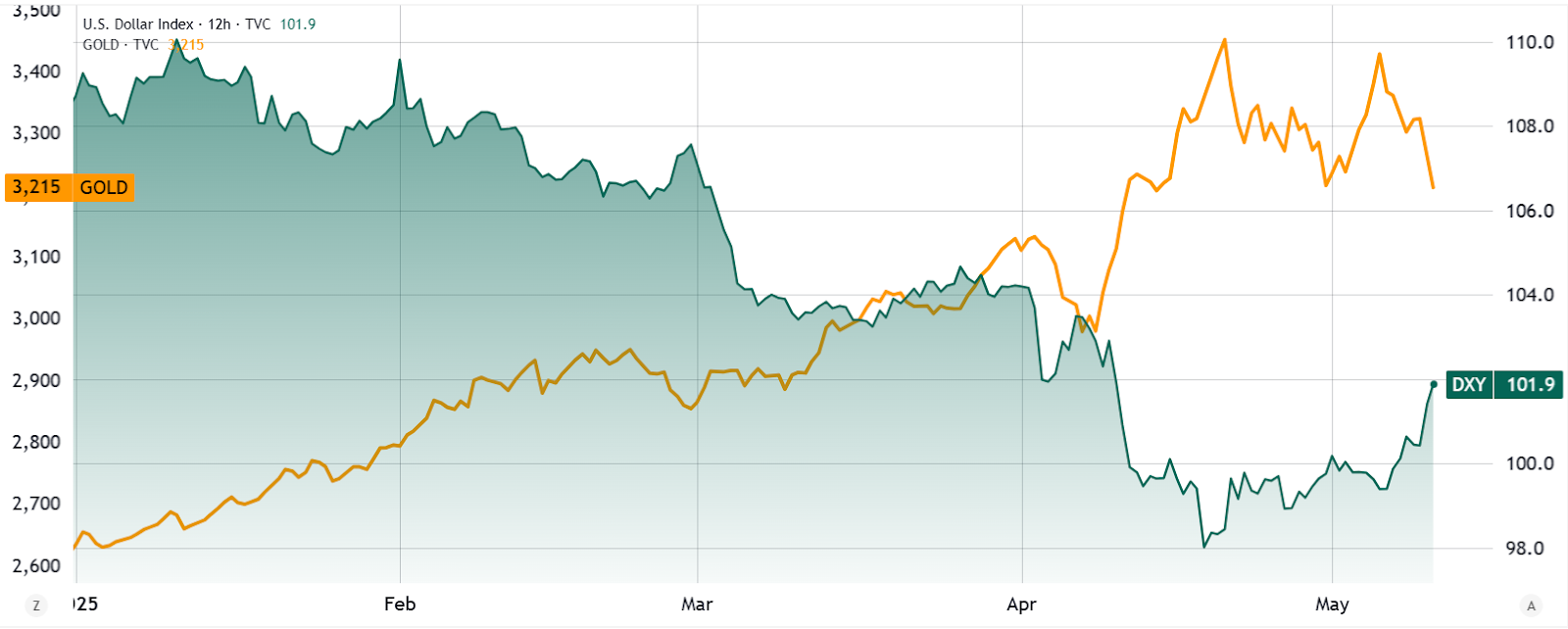
Gold/USD (left) vs. U.S. Dollar Index (right). Source: TradingView
Bitcoin-Gold "Safe-Haven Substitution": On May 12, gold fell 3.4% while DXY climbed to a 30-day high, reflecting investor rotation from scarce assets to the dollar and equities. This shift confirms the short-term positive correlation between Bitcoin and gold.
Long-Term Narrative Amid Weakening Dollar Hegemony: Despite short-term setbacks, the "local currency settlement pilot" clause in the agreement could erode the dollar's dominance in trade settlements. Historical data shows that during the 2018–2020 trade war, Bitcoin initially corrected but eventually broke above $20,000. Its attribute as a "decentralized settlement tool" may regain prominence over the medium to long term.
4. Diverging Market Sentiment: Whale Exits vs. ETF Inflows – A Contradictory Signal
On-chain data shows a decrease of 12 addresses holding over 10,000 BTC, along with a 1.8% drop in exchange reserves, suggesting some large holders are taking profits.
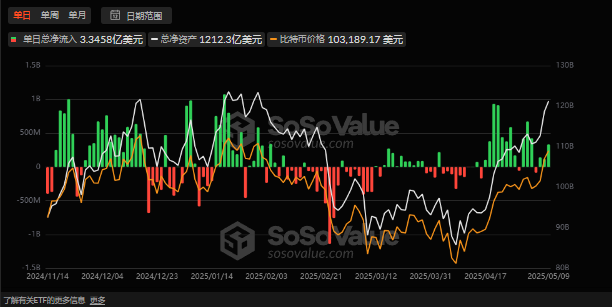
However, U.S. spot Bitcoin ETFs recorded a net inflow of $2 billion between May 1–9, indicating institutional investors continue a "buy-the-rally" strategy.
Analyzing Structural Contradictions:
Retail Leverage Risk: Altcoin trading volume has surged 280%, though HTX Research notes leverage levels remain within safe ranges. In contrast, Bitcoin contract positions are heavily concentrated between $98,000 and $100,000, making the market prone to "long-short squeezes."
Institutional "Flooring" Mechanism: Wall Street giants like BlackRock have established liquidity dominance through ETFs, reducing Bitcoin’s daily volatility from 18% to 9%, gradually shifting pricing power toward traditional capital.
5. Future Scenarios: Short-Term Volatility and Long-Term Paradigm Shift
Scenario One (Optimistic):
If CPI data comes in below expectations and Fed rate cut speculation intensifies, Bitcoin could quickly recover above $105,000 and test the $120,000 level. Institutional accumulation and ETF inflows would form a "moat," making a drop below $100,000 less than 20% likely.
Scenario Two (Cautious):
If CPI rebounds and strengthens the dollar, BTC may test support at $97,000–$99,000. However, MicroStrategy’s $21 billion capital increase capacity provides ample "ammunition," limiting long-term holder sell pressure. After a correction, price may enter a range-bound consolidation between $90,000 and $110,000.
Conclusion: Finding Certainty Amid Uncertainty
Bitcoin’s short-term volatility is essentially a tug-of-war over pricing power between traditional finance and the crypto ecosystem. Investors should remain vigilant about leverage risks and policy variables, but focus more on evolving fundamentals: as tariff barriers collide with blockchain technology, Bitcoin is evolving from "digital gold" into a "cross-border value transfer protocol."
Bitcoin’s true victory lies not in defeating fiat currencies, but in proving humanity’s need for diversified value anchors.
Join TechFlow official community to stay tuned
Telegram:https://t.me/TechFlowDaily
X (Twitter):https://x.com/TechFlowPost
X (Twitter) EN:https://x.com/BlockFlow_News