Will the rejection of the U.S. stablecoin bill and regulatory cooling affect the revival of the altcoin season?
TechFlow Selected TechFlow Selected
Will the rejection of the U.S. stablecoin bill and regulatory cooling affect the revival of the altcoin season?
Prioritize consolidating dollar hegemony, or strictly prevent profit shifting?
 Navigating Web3 tides with focused insights
By: Ashley, Penny
Since Trump returned to the White House, the stablecoin bill—once widely watched and seemingly progressing smoothly—has recently hit a snag. The GENIUS Act, formally known as the Guiding and Establishing National Innovation Using Stablecoins Act, is a piece of legislation introduced in the U.S. Senate on February 4, 2025, aiming to establish a comprehensive regulatory framework for "payment stablecoins" within the United States. Its goals include fostering financial innovation, protecting consumers, preventing illicit financial activities, and reinforcing the U.S. dollar's dominant position in the global financial system.
This landmark crypto bill encountered unexpected resistance during negotiations, as nine key Democratic senators publicly rejected support for the Republican-revised version introduced last week on May 3. On May 9, the Senate voted 48–49 to reject the Stablecoin Innovation and Security Act, with Democrats collectively opposing the motion to advance the bill. The legislation sought to create the first federal regulatory framework for dollar-pegged stablecoins—one of the cornerstones of Trump’s crypto policy.
On the same day, the long-running legal battle between Ripple and the SEC finally came to an end, drawing renewed attention from Democrats to Ripple’s ties with political interests. Democrats have openly emphasized the need to prohibit the Trump Organization from participating in the cryptocurrency sector. Amid overlapping conflicts of interest and partisan rivalry, can Trump still carry out his original plans and build a new crypto empire?
Political Interest Transfers Create Rifts Between House and Senate
Looking back at 2024, both chambers of Congress had been largely aligned on crypto legislation. In May of last year, the House passed the FIT21 Act (Financial Innovation and Technology for the 21st Century Act) by a vote of 279 to 136, establishing a new regulatory framework for digital assets. With 71 Democrats voting in favor, bipartisan consensus was evident. The bill emphasized the Commodity Futures Trading Commission’s (CFTC) role in crypto regulation, aiming to promote innovation through clear rules, which Representative Young Kim called “a new era for U.S. crypto regulation.” Though slower in pace, the Senate also advanced its own initiative—the Lummis-Gillibrand Payment Stablecoin Bill—led by Senators Cynthia Lummis and Kirsten Gillibrand, aiming to set standards for stablecoins. In March this year, the House repealed a crypto tax rule from the Biden administration with bipartisan support, while the Senate did not oppose it outright; both sides shared common goals of providing legal certainty for the industry and safeguarding investors.
Owing to successful campaign fundraising efforts and Trump’s return to politics, the cryptocurrency industry has seen a surge in influence. If passed, this stablecoin bill would mark the first major crypto reform achieved in the Senate after years of lobbying.
However, recently the Senate has delayed passing a comprehensive bill similar to FIT21, and negotiations over stablecoin regulation have stalled due to opposition from key Democrats. On May 2, Senate Minority Leader Chuck Schumer urged Democratic colleagues behind closed doors not to commit support for the GENIUS Act yet, seeking more room for amendments. A divergence in attitude toward crypto regulation has emerged between the two chambers, primarily because the crypto industry’s ties with political groups have grown increasingly tight—with suspicions that many political actors are manipulating markets for personal gain.
The well-known lawsuit between Ripple and the U.S. Securities and Exchange Commission (SEC) serves as a prime example. On May 9, court filings revealed that Ripple and the SEC had reached a settlement agreement to lift the injunction imposed on Ripple in August 2024, requiring Ripple to pay only $50 million of the $125 million civil penalty to the SEC, with the remaining $75 million to be returned to Ripple. Both parties agreed not to appeal or seek vacatur of prior rulings.
Ripple’s Chief Legal Officer, Stuart Alderoty, emphasized “case closed” on social media, calling it the “final update,” attempting to project compliance and ease market concerns. Additionally, Ripple CEO Brad Garlinghouse announced high-profile plans to invest $2 billion in acquisitions across the crypto industry, shifting focus from the case itself to business expansion. He also cited financial damages caused by litigation, estimating that XRP holders may have lost up to $15 billion in value due to legal proceedings.
Although the settlement does not explicitly determine whether XRP qualifies as a security, Ripple leveraged narratives around “favorable policy” and “institutional collaboration” to drive price volatility of XRP. David Sacks, appointed by Trump as the so-called “crypto czar,” previously claimed publicly that “Ripple won the SEC lawsuit,” advocating for the legitimacy of tokens such as XRP, SOL, and ADA.
Ripple’s repeated claims of compliance have failed to truly advance the legalization of cryptocurrencies. Instead, its settlement with the SEC appears to mask deeper patterns of interest transfer—especially given that XRP holders reportedly suffered losses of up to $15 billion during the litigation, further fueling suspicion of market manipulation. Democrats question whether these statements are linked to the Trump family’s crypto holdings, prompting veteran Senator Richard Blumenthal to launch a preliminary investigation into potential conflicts of interest and misconduct involving Trump-affiliated businesses. Calls within the Democratic Party to investigate crypto interest groups are growing louder, directly affecting progress on crypto legislation.
According to The Block, Senate Majority Leader John Thune has filed a motion to end debate on the GENIUS Act (officially titled the Stablecoin Innovation Act of 2025), with a crucial procedural vote scheduled for Thursday. Spearheaded by Senator Bill Hagerty, the bill requires stablecoins to be fully backed by liquid assets such as U.S. dollars or short-term Treasury securities. Passage requires 60 votes. Currently, Republicans hold 53 seats and Democrats 47, meaning Republicans must secure support from at least seven Democrats.
Nine Democratic senators, including Ruben Gallego, jointly opposed the current version, demanding stronger oversight of foreign issuers and enhanced anti-money laundering provisions. Senator Richard Blumenthal has sent inquiry letters to World Liberty Financial—a Trump-linked crypto firm—investigating potential conflicts of interest. On the Republican side, Rand Paul criticized excessive stablecoin regulation, while Senator Josh Hawley expressed concern about tech giants issuing stablecoins.
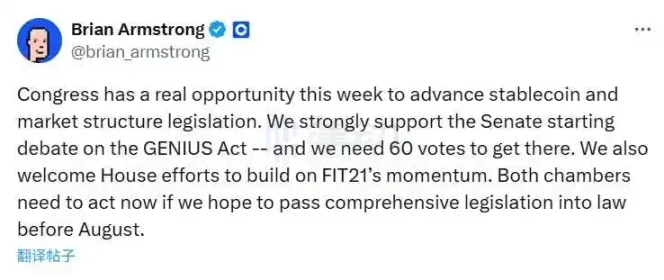
In response, Coinbase CEO Brian Armstrong stated that Congress faces a critical opportunity this week to advance stablecoin and market structure legislation. Coinbase strongly supports Senate debate on the GENIUS Act, which requires 60 votes to proceed. Coinbase also welcomes House efforts to maintain momentum from FIT21. To pass comprehensive legislation into law before August, both chambers must act immediately.
What Are the Key Points of Contention?
The core objective of the GENIUS Act is to establish a federal regulatory framework for stablecoins, ensuring their stability relative to the U.S. dollar while promoting innovation in the crypto industry. The bill received bipartisan backing in the Senate Banking Committee in March this year.
The most likely source of division stems from Trump himself—the so-called “crypto president.” From NFTs and meme coins to DeFi and stablecoins, Trump has deeply intertwined his personal brand with the crypto community. Recently, a single ticket to the highly publicized “Crypto and AI Innovators” dinner reportedly cost as much as $1.5 million.
Most conspicuous among these ventures is his stablecoin fund project. Trump launched a stablecoin through the crypto company World Liberty Financial and secured a $2 billion deal backed by a fund supported by the Abu Dhabi government—moves that sparked backlash and opposition from Senate Democrats. Reports indicate that Trump’s crypto assets account for nearly 40% of his net worth—approximately $2.9 billion—including substantial stakes in World Liberty Financial and the issuance of $TRUMP and $MELANIA meme coins.
White House spokesperson Anna Kelly argued that Trump’s assets are managed via a trust run by his children, denying any conflict of interest, and stressed Trump’s commitment to making the U.S. the “global capital of crypto.” However, on May 6, Senator Richard Blumenthal sent letters to World Liberty Financial and Fight Fight Fight LLC—the company behind the $TRUMP meme coin—requesting communications records involving the Trump family, the Trump Organization, and foreign governments to probe potential conflicts of interest.
The GENIUS Act, originally expected to undergo a procedural vote this week, has now stalled amid ethical controversies and allegations of conflicts of interest. Leading members of the Banking Committee, including Senator Elizabeth Warren, argue that the bill could enable presidential profiteering and urge the Senate to reject it. She circulated a memo to all Democratic senators highlighting deficiencies in the bill related to anti-corruption measures, consumer protection, financial system stability, and national security. The memo recommends prohibiting elected officials and their families from engaging in stablecoin-related businesses to avoid conflicts of interest.
Meanwhile, Senator Jeff Merkley introduced the End Crypto Corruption Act on May 6, banning presidents, vice presidents, members of Congress, and their immediate family members from profiting off crypto assets. The bill has been co-sponsored by ten Democratic senators, including Kirsten Gillibrand and Angela Alsobrooks—both original co-sponsors of the GENIUS Act—indicating deep internal concern within the Democratic Party over Trump’s crypto operations.
Related reading: “WSJ: Democrats Target Trump’s Crypto Empire,” “Did Trump Make Over $100 Million in His First 100 Days Back in the White House? Senate Wants Answers…”
In addition, stablecoin giant Tether has also come under fire. According to two anonymous Democratic aides, Senate Minority Leader Chuck Schumer (D-NY) urged fellow Democrats during a private meeting on Thursday not to pledge support for the bill, arguing they should use their leverage to push for further revisions. He specifically questioned the bill’s regulatory provisions regarding foreign firms like Tether, noting that the GENIUS Act lacks stringent oversight of foreign companies such as Tether, potentially opening doors to money laundering and terrorist financing.
This morning, the U.S. Senate voted 48–49 to reject the Stablecoin Innovation and Security Act, with Democrats unanimously blocking the motion to advance the bill. The legislation required 60 votes to move to final Senate consideration, but Republicans currently hold only a narrow 53–47 majority. Democrats are demanding explicit provisions banning executive branch officials—including former President Trump and his family members—from holding or trading cryptocurrencies, along with strengthened anti-corruption clauses. Will policy prioritize consolidating dollar dominance or preventing illicit interest transfers? As partisan battles intensify, the path forward for crypto development may face even greater challenges.
Join TechFlow official community to stay tuned
Telegram:https://t.me/TechFlowDaily
X (Twitter):https://x.com/TechFlowPost
X (Twitter) EN:https://x.com/BlockFlow_News
 BlockBeats