








Binance Chinese Influencers Face-to-Face AMA Recap: From Agent to AgenticWorld, Mind Network Builds a Trusted Security Foundation with FHE
TechFlow Selected TechFlow Selected
Binance Chinese Influencers Face-to-Face AMA Recap: From Agent to AgenticWorld, Mind Network Builds a Trusted Security Foundation with FHE
By supporting multi-chain operations, offering token incentives, and providing an open SDK and development environment, Mind Network is accelerating the global adoption of this infrastructure among developers and intelligent systems. This not only represents a proactive response to the convergence of AI and blockchain technologies but also lays the foundation of trust and collaboration for the future AgenticWorld.
 Navigating Web3 tides with focused insights
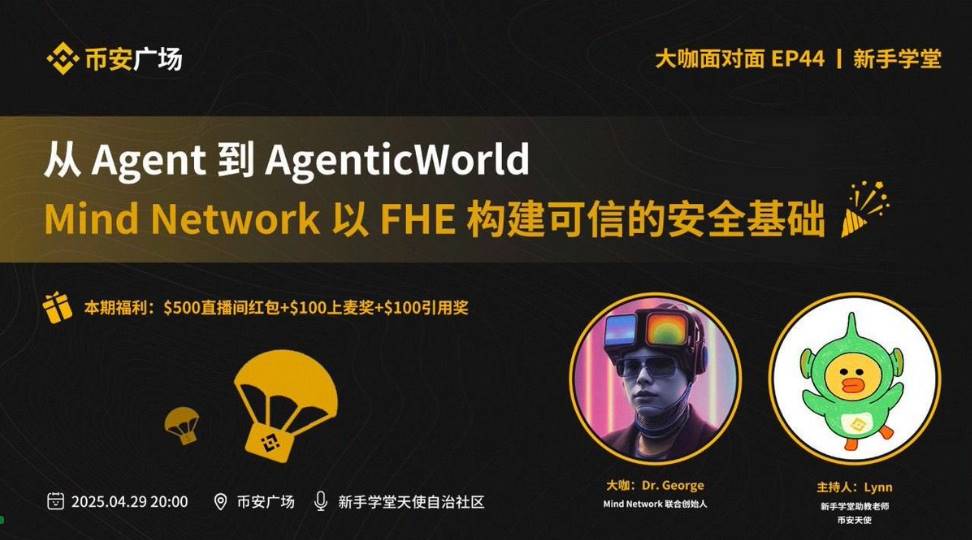 In April 2025, Dr. George, co-founder of Mind Network, was invited to participate in the Binance-hosted live AMA session 【Binance Chinese-Speaking Influencers Face-to-Face AMA】. The session focused on "How FHE Builds the Trusted and Secure Infrastructure for Agentic AI," delivering an in-depth technical discussion.
Dr. George systematically explained Mind Network's vision and technical roadmap, discussed core challenges in integrating AI with Web3, and shared how Mind Network addresses these issues through FHE technology.
Below is a curated summary and key highlights from the Q&A session.
1. The Future of Agentic AI and Mind Network’s Positioning
Dr. George outlined five evolutionary stages of AI. Current models like ChatGPT, Gemini, and DeepSeek primarily operate within the first two stages:
- L1: Conversational AI – Understanding and interacting via natural language;
- L2: Reasoning AI – Performing basic logical reasoning and planning;
- L3: Predefined Task Agents – Automated tools executing tasks based on fixed workflows;
- L4: Autonomous Agentic AI – Capable of independent thinking, judgment, planning, and execution of complex tasks;
- L5: Organizational AI – Multiple intelligent agents collaborating autonomously, forming self-organizing systems, i.e., an “Agent World”.
Mind Network focuses on the critical transition from L3 to L4— building truly autonomous and collaborative Agent AI.
George emphasized that Agent AI will become the dominant form of deep AI and Web3 integration over the next 2–10 years, and the widespread adoption of FHE technology is key to making this possible.
2. FHE: The Core Technology Connecting AI and Web3
Dr. George pointed out that current blockchain systems and ZK (zero-knowledge proof) technologies face three fundamental bottlenecks when serving Agentic AI:
- Verification: How can we trust off-chain AI execution results on-chain?
- Consensus: How can multiple AI agents reliably collaborate and reach decisions?
- Encryption: How can computation and interaction occur while data remains encrypted?
Mind Network proposes using FHE as the underlying execution environment to enable a system where “data remains encrypted, processes are verifiable, and results achieve consensus.” By building an FHE VM, on-chain verification layer, and consensus protocols, Mind Network packages these capabilities into modular SDKs for developers to build trusted agents.
This model has already been successfully applied in various scenarios, such as verifying the integrity of DeepSeek model versions or enabling multiple quantitative trading agents to reach consensus without revealing their proprietary strategies.
Additionally, Mind Network’s core platform, AgenticWorld, has officially launched, allowing developers to train and deploy agents using FHE and explore multi-agent protocol standards such as MCP and A2A.
3. Four Pillars of Security: The Technical Foundation of a Trusted Agent World
To support the trustworthy operation of Agentic AI in real-world applications, Mind Network has established four core security pillars:
- Data Security – Using FHE to protect user data throughout computation;
- Communication Security – Ensuring encrypted communication between agents to prevent data leaks and identity spoofing;
- Computational Security – Guaranteeing that AI inference and execution logic remain encrypted and verifiable end-to-end;
- Consensus Security – Enabling multiple agents to form trusted consensus on tasks, mitigating probabilistic errors inherent in AI systems.
FHE serves as the mathematical foundation underpinning these four pillars, breaking the old paradigm of “computation requires decryption” and enabling true privacy-preserving computation.
For example, with DeepSeek integration, users can verify whether the model they are using is the official release version and interact with it while keeping input data private. This significantly enhances the usability of large models in enterprise and financial applications where privacy is paramount.
4. Multi-Chain Support: A Unified Execution Environment for Cross-Chain Agents
From the outset, Mind Network has supported multi-chain deployment, including its own FHE-dedicated chain, MindChain, and major public chains like BNB Chain (BSC).
This design stems from the principle that “Agentic AI adoption rate = user experience”: agents trained on one chain should be able to work across chains, avoiding “capability fragmentation” and “experience discontinuity.”
Mind Network has developed a cross-chain synchronization mechanism for agent states, tasks, and incentives—not just a traditional bridge, but a foundational architecture designed specifically for cross-chain agent collaboration across their lifecycle.
Users can deploy agents on BSC and participate in tasks on MindChain, or vice versa, with consistent capabilities and rewards across chains. This mechanism lays the groundwork for AgenticWorld’s future global deployment.
5. $FHE: The Economic Engine Powering AgenticWorld
On the economic front, Dr. George introduced Mind Network’s native utility token $FHE, which plays three key roles in AgenticWorld:
- Service Exchange Medium – Agents use $FHE to pay for services and model capabilities;
- Ecosystem Incentive Tool – Developers and users earn $FHE rewards for training, deploying, and collaborating;
- Governance Credential – Used for voting on governance proposals, agent whitelisting, parameter upgrades, and other on-chain decisions.
$FHE is now listed on Binance Launchpool and major exchanges. Its detailed token distribution and economic mechanisms are publicly documented, aiming to ensure long-term community sustainability.
Toward the end of the AMA, Dr. George responded to several community-submitted questions. Below are the highlights from the open Q&A:
1. Is FHE technology actually useful in real-world “untrusted” scenarios? Can you provide examples?
Yes. Mind Network has deployed an on-chain FHE-based random number generation mechanism: multiple agents submit encrypted random inputs, which are aggregated cryptographically to produce a final random number. No participant can manipulate or predict the outcome.
This approach suits privacy-sensitive, trustless collaboration scenarios such as jointly generating seeds, submitting model proofs, or reaching consensus decisions.
2. Could using FHE turn AI into a “black box,” risking privacy leaks or misuse?
FHE itself is a neutral technology whose primary value lies in securing privacy during encrypted computation. Mind Network’s agents are designed for compliant and trusted use cases, such as model verification, multi-agent consensus, and secure Web3 asset computation.
Regarding concerns about reverse-engineering input data, George noted that FHE uses quantum-resistant encryption algorithms, making mathematical inversion impossible unless there is a flaw in implementation. Overall, the technology is secure and trustworthy.
3. Is Mind Network’s FHE自主研发 (self-developed)? Will it be too heavy or affect efficiency?
FHE does have high computational costs due to its mathematical nature. To address this, Mind Network adopts a “off-chain execution + on-chain verification” architecture: FHE VM performs ciphertext computation off-chain, with only essential results submitted on-chain, striking an optimal balance between privacy and efficiency.
Additionally, Mind Network collaborates closely with open-source cryptography leaders like Zama to continuously optimize performance and module compatibility.
4. Is AgenticWorld live? Can regular users participate?
Yes, AgenticWorld is live. Users can now create and register their own intelligent agents, participate in Hub tasks on-chain, and earn rewards. The first Advance Hub, the DeepSeek Hub, went live yesterday.
Developers can also earn $FHE incentives by participating in testing, submitting PRs, or validating models.
5. Are agents only for developers? Will there be tools for regular users?
Agents are not limited to developers. In the future, numerous C-end user-facing agent tools will launch, including:
- Web3 asset monitoring agents;
- Automated research/trading assistants;
- Daily task execution tools powered by multi-agent collaboration.
Mind Network is building an ecosystem akin to an Agent App Store, enabling ordinary users to manage and utilize their on-chain agents as easily as mobile apps—empowering agents to work for users and generate income.
Conclusion
Mind Network is building a trusted, secure operational framework for the next generation of AI. Leveraging FHE as a foundation, it combines encrypted data, secure communications, verifiable computation, and robust consensus mechanisms to deliver a modular infrastructure purpose-built for Agentic AI.
By supporting multi-chain operations, offering token incentives, and providing open SDKs and development environments, Mind Network is accelerating the global adoption of this infrastructure among developers and intelligent systems.
This is not only a proactive response to the convergence of AI and blockchain technologies, but also lays the foundation of trust and collaboration for the future AgenticWorld.
Join TechFlow official community to stay tuned
Telegram:https://t.me/TechFlowDaily
X (Twitter):https://x.com/TechFlowPost
X (Twitter) EN:https://x.com/BlockFlow_News






