The Hottest MEME of the Weekend: How HOUSE Ignited the Solana Craze with Anti-Real-Estate Ideology
TechFlow Selected TechFlow Selected
The Hottest MEME of the Weekend: How HOUSE Ignited the Solana Craze with Anti-Real-Estate Ideology
The project, through meme culture, community mobilization, and technical support, expresses discontent with global high housing prices, becoming a symbolic resistance by young people against the housing crisis.
 Navigating Web3 tides with focused insights
By Luke, Mars Finance
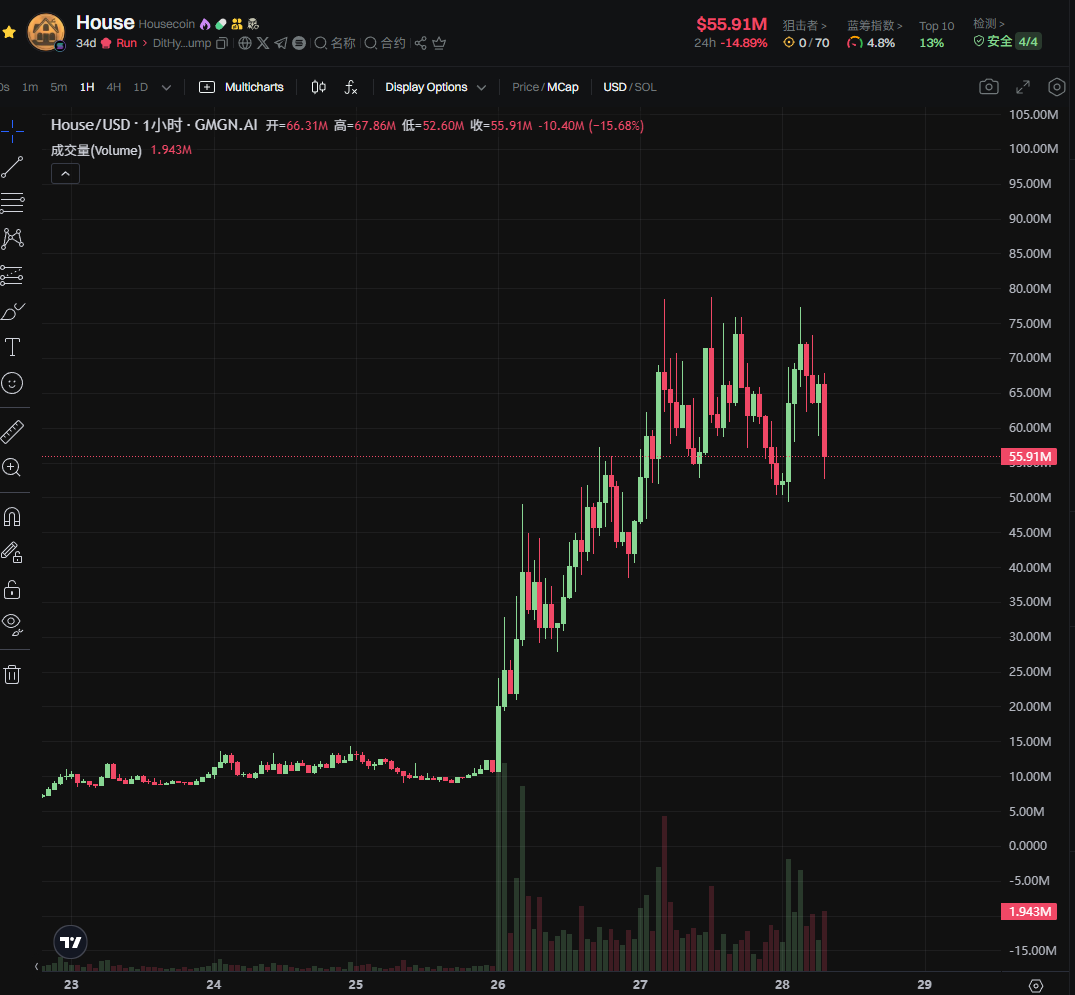
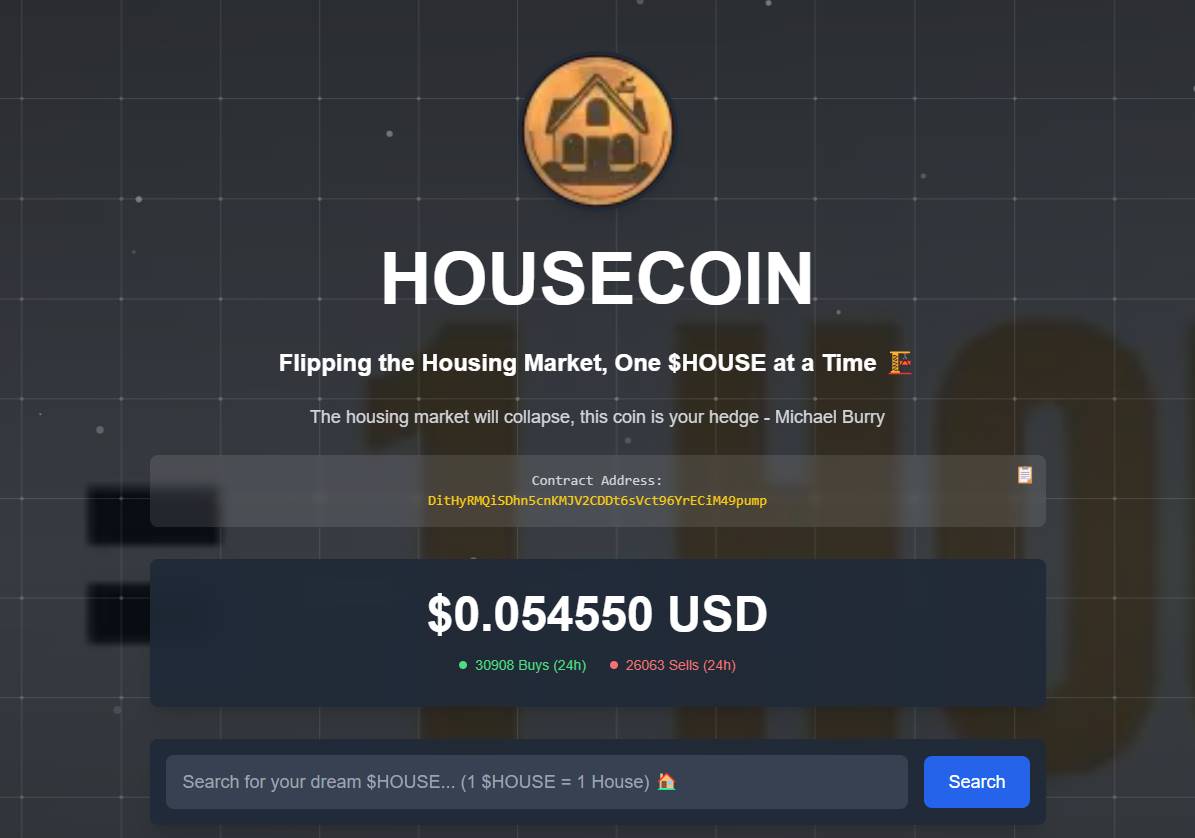
On April 27, 2025, $HOUSEcoin (hereinafter HOUSE), a meme coin on the Solana ecosystem, surged to a market cap of $75 million, hitting an all-time high. Since its launch via Pump.fun on March 25, the project skyrocketed from obscurity to become a focal point in the crypto community within just one month. Its website slogan—"Flipping the Housing Market, One $HOUSE at a Time"—resonates powerfully, while a quote attributed to Michael Burry—“The housing market will collapse, this coin is your hedge”—adds a revolutionary symbolic weight. Against the backdrop of global home prices rising by 48% and younger generations losing hope of homeownership, HOUSE has transformed economic anxiety into a decentralized rebellion. How did this meme coin ignite global resonance? Why does its anti-real-estate narrative strike such a deep chord? Let’s dive into the story of HOUSE.
What Is HOUSEcoin?
$HOUSEcoin is a meme coin built on the Solana blockchain and launched through Pump.fun, positioned as a bold satire of the global real estate market. Its core ideology is anti-real-estate, channeling young people's anger and mockery toward unaffordable housing. As stated on its official site, HOUSE aims to "flip" the housing market—not only mocking speculative property flipping but also challenging systemic injustice. The reference to Burry evokes memories of the 2008 subprime crisis, suggesting that HOUSE serves as a hedge against a potential housing bubble.
Technically, HOUSE is designed for simplicity: a total supply of 998.8 million tokens, with 60% allocated to the community, 20% to liquidity pools, and the remainder reserved for development and marketing. Solana’s high throughput (processing up to 65,000 transactions per second) and low fees (averaging $0.00025 per transaction) have enabled rapid dissemination of the token. On-chain data shows over 18,000 holders and a Telegram community exceeding 35,000 members, demonstrating strong grassroots momentum.
The cultural symbolism of HOUSE is its driving force. The pixelated “house” logo surrounded by flames symbolizes the overthrow of traditional real estate systems. Community members call themselves “Homeless Hodlers,” rallying behind the satirical slogan “1 HOUSE = 1 House,” dreaming of replacing unattainable physical homes with digital tokens. A widely shared meme features a dilapidated shack priced at $1 million next to the HOUSE logo with the text: “Buy $HOUSE, burn down the old system.” This fusion of humor and rage has elevated HOUSE into a phenomenon within meme culture.
Global Resonance of Anti-Real-Estate Sentiment
Amplifying Economic Pain Points
The narrative of HOUSE is rooted in harsh reality: global housing markets have become inaccessible. According to World Bank 2025 data, the price-to-income ratio in major cities globally has reached 12:1—meaning an average person must work 12 years without spending a cent to afford a home. In London, Sydney, and San Francisco, this ratio exceeds 18:1. In the U.S., the average home price has climbed to $580,000, pushing the median age of first-time buyers to 39—the highest ever. Wages have grown only 6% since 2018, far outpaced by the 48% surge in housing prices, while student debt and soaring rents further crush homeownership dreams.
HOUSE transforms this economic distress into narrative fuel. It claims to be a “hedge” against a collapsing housing market, echoing Burry’s legendary $700 million profit from shorting the subprime market in 2008. Though the authenticity of Burry’s quote remains unverified, it strikes an emotional nerve: posts on X declare, “Your house will eventually be worthless—hedge with $HOUSE.” This narrative turns economic despair into speculative resistance, making HOUSE a digital ballot cast by disillusioned youth.
Global Spread Through Meme Culture
HOUSE’s anti-real-estate sentiment extends beyond economics—it has evolved into a cultural movement. The community amplifies the absurdity of the housing market through memes, short videos, and NFTs. A TikTok video viewed 3 million times shows a Gen-Z renter tossing a mortgage contract into a fire while holding a HOUSE flag, captioned: “30-year mortgages are slavery; $HOUSE is freedom.” Another popular Discord meme juxtaposes a $2 million apartment with a single HOUSE token, asking: “Which one is the real scam?”
These cultural artifacts resonate because they reflect shared global experiences. In Japan, sky-high housing costs force many so-called “parasite singles” to live with their parents well into their 30s; the Japanese Telegram group for HOUSE already has 5,000 members. In Spain, where youth unemployment hits 25%, local artists have created street graffiti themed around HOUSE. The team has translated promotional materials into Spanish, Korean, and Chinese, with non-English users accounting for 40% of the audience—evidence of the narrative’s global appeal. These memes aren’t just jokes—they’re outlets for collective rage.
Execution Power of an Anonymous Team
The founding team of HOUSE remains anonymous, communicating solely through the X account @HousecoinOnSol and Telegram channels. On-chain analysis reveals the token contract (address: DitHyRMQiSDhn5cnKMJV2CDDt6sVct96YrECiM49pump) was deployed on March 25, 2025. The developer wallet shows links to other meme projects in the Solana ecosystem, indicating experienced hands behind the scenes. Despite anonymity, their execution has been impressive.
On April 10, the team launched “Burn the Mortgage,” a progressive web app (PWA) allowing users to “purchase” and “burn” virtual overpriced properties by holding $HOUSE—a direct jab at housing bubbles. Within 48 hours, the app attracted 10,000 users, propelling the market cap from $10 million to $25 million. On April 20, the team announced the release of 10,000 HOUSE NFTs—uniquely designed virtual “houses” granting governance rights and eligibility for airdrops. Following the announcement, trading volume spiked 200%, pushing the market cap past $50 million. The team declared on X: “We don’t build houses—we build revolutions.” This blend of anarchist ethos and efficient delivery embodies the chaotic spirit of meme coins.
Rumors add to the mystique. A Telegram moderator known as “Homeless Hodler” revealed that team members are spread across three continents, often coding in cafes and co-working spaces. While unconfirmed, these stories enhance the mythos of a decentralized uprising.
Community Culture and Global Context
A Culture of Decentralized Resistance
HOUSE’s success stems not just from technology, but from its unique community culture. Telegram and Discord servers serve as gathering places for “Homeless Hodlers,” where members share memes, discuss housing struggles, and even organize virtual protests. On April 15, the community launched the “Burn the House” airdrop, distributing $150,000 worth of HOUSE tokens to 7,000 wallets. The promotional video—a virtual luxury mansion exploding—garnered 500,000 views in 24 hours, sending trading volume soaring to $30 million.
The community also demonstrates remarkable creativity. A “meme contest” on Reddit drew 2,000 participants, with the winner receiving $5,000 in HOUSE. One winning entry depicted a young man at a bank counter, holding a HOUSE token instead of paperwork, with the caption: “I don’t need your 30-year loan—I have $HOUSE.” This organic cultural production elevates HOUSE beyond a mere token into a decentralized platform of resistance.
Catalyzed by Global Conditions
HOUSE’s rise is inseparable from the broader global context. In 2025, multiple countries face housing crises: Toronto’s price-to-income ratio stands at 16:1, Sydney’s youth homeownership rate has dropped to a 20-year low, and in Chinese megacities like Shanghai, soaring prices have forced young people to abandon homeownership entirely. The IMF warns that global real estate leverage (debt-to-asset ratio) has returned to 2008 levels, increasing the risk of collapse. HOUSE’s narrative lands precisely on this nerve—its claim that “the housing market will collapse” may be hyperbolic, but it resonates deeply with public anxiety.
Additionally, the crypto culture surrounding Solana provides fertile ground. Platforms like Pump.fun have drastically lowered the barrier to launching meme coins—by Q1 2025, meme coins on the platform collectively surpassed a $2 billion market cap. Decentralized exchanges like Raydium and Jupiter offer high liquidity for HOUSE, with the HOUSE/SOL trading pair accounting for 70% of volume. This ecosystem support allows HOUSE to evolve rapidly from niche meme to global phenomenon.
The Deep Power of Anti-Real-Estate Narrative
Symbolic Protest or Real Hedge?
HOUSE claims to be a “hedge” against a housing crash, but its function leans more symbolic than financial. Unlike Burry’s credit default swaps, HOUSE lacks any mechanism to directly profit from falling home prices—its value depends on community belief and market momentum. Yet this limitation is part of its charm: HOUSE isn’t a complex derivative; it’s a protest symbol. Buying HOUSE isn’t about arbitrage—it’s about expressing discontent with the housing system.
This symbolic resistance drives action. The April 15 “Burn the House” airdrop didn’t just boost trading—it sparked conversations about housing inequality. The community plans to launch “HOUSE DAO” in May, enabling token holders to vote on future initiatives, such as funding affordable housing programs or supporting anti-eviction campaigns. These efforts suggest HOUSE aims to evolve from meme to social force.
Risks and Limits of the Narrative
While powerful, the anti-real-estate narrative carries risks. Its angry tone may alienate potential supporters. On X, some praise HOUSE’s rebellious spirit, while others warn it’s “emotional hype.” Burry’s quote, though attention-grabbing, could mislead investors into overestimating HOUSE’s financial utility. History shows meme coins like Dogecoin often struggle to sustain long-term value due to lack of utility.
Moreover, the complexity of real estate markets undermines the certainty of the “crash” narrative. Even as U.S. mortgage debt reaches $13 trillion in 2025, central banks and governments typically stabilize markets via low interest rates or subsidies. If prices stabilize or policy reforms ease the crisis, HOUSE’s narrative could lose traction. The community must continuously innovate to keep the story alive.
Potential as a Cultural Catalyst
Despite risks, HOUSE’s narrative has already sparked widespread discussion. In April 2025, a UK housing NGO referenced HOUSE in a report, calling it “a digital protest by youth against systemic injustice.” On X, academics debate whether HOUSE could inspire policy changes, such as rent control or land tax reform. With 40% of its user base speaking non-English languages, HOUSE’s global reach shows it transcends borders and cultures, uniting youth worldwide.
HOUSE’s true strength lies in transforming anger into creation. Memes, NFTs, and PWAs are not just marketing tools—they are the digital legacy of a generation priced out. Whether or not the housing market collapses, HOUSE has already given millions of overlooked individuals a voice. As one post on X put it: “$HOUSE isn’t about buying a house—it’s about owning your anger.”
Conclusion: Meme or Movement?
With a peak market cap of $75 million, $HOUSEcoin has transcended its status as a Solana-based meme coin to become a digital uprising against unaffordable housing. Its anti-real-estate narrative fuses economic frustration with meme culture, while the anonymous team’s execution—from the “Burn the Mortgage” app to the upcoming HOUSE DAO—complements passionate community engagement. Yet, its reliance on emotion and high volatility presents challenges. Will HOUSE fade with the meme wave, or catalyze real-world change?
In 2025, from Tokyo to Toronto, rising prices have crushed countless dreams. HOUSE has become a flame of symbolic resistance. “Flipping the Housing Market, One $HOUSE at a Time” is more than a slogan—it’s a battle cry. Will you join the rebellion, or watch from the sidelines?
Join TechFlow official community to stay tuned
Telegram:https://t.me/TechFlowDaily
X (Twitter):https://x.com/TechFlowPost
X (Twitter) EN:https://x.com/BlockFlow_News