








Virtuals making a comeback? Dive into Genesis Launch's new "rewarding new and loyal users" initiative
TechFlow Selected TechFlow Selected
Virtuals making a comeback? Dive into Genesis Launch's new "rewarding new and loyal users" initiative
Genesis Launch has simplified "participating in new token offerings" to the extreme.
 Navigating Web3 tides with focused insights
By TechFlow
Last year, we were among the first to spotlight VIRTUALS Protocol—back when the AI Agent craze had yet to begin and the VIRTUAL token was sitting at a market cap of just around $800K.
The rest, as they say, is history. Virtuals ignited an AI Agent wave on Base, producing not only strong performance from the VIRTUAL token itself but also birthing breakout tokens like AIXBT.
Yet after one full cycle, the hype around AI Agents gradually faded, and the market seemed to fall silent. With the emergence and rapid iteration of large models like DeepSeek, many began to believe that the Web3 AI Agent narrative had been disproven—deemed impractical and ineffective.
Just as you let your guard down and grow disheartened by the market, new asset-generating mechanics inevitably emerge—sparking sharp price movements once again.
In the past week alone, the Virtuals token has surged 150%, with a 42% spike in just the last 24 hours. Discussions around Virtuals are back on the crypto news timeline.
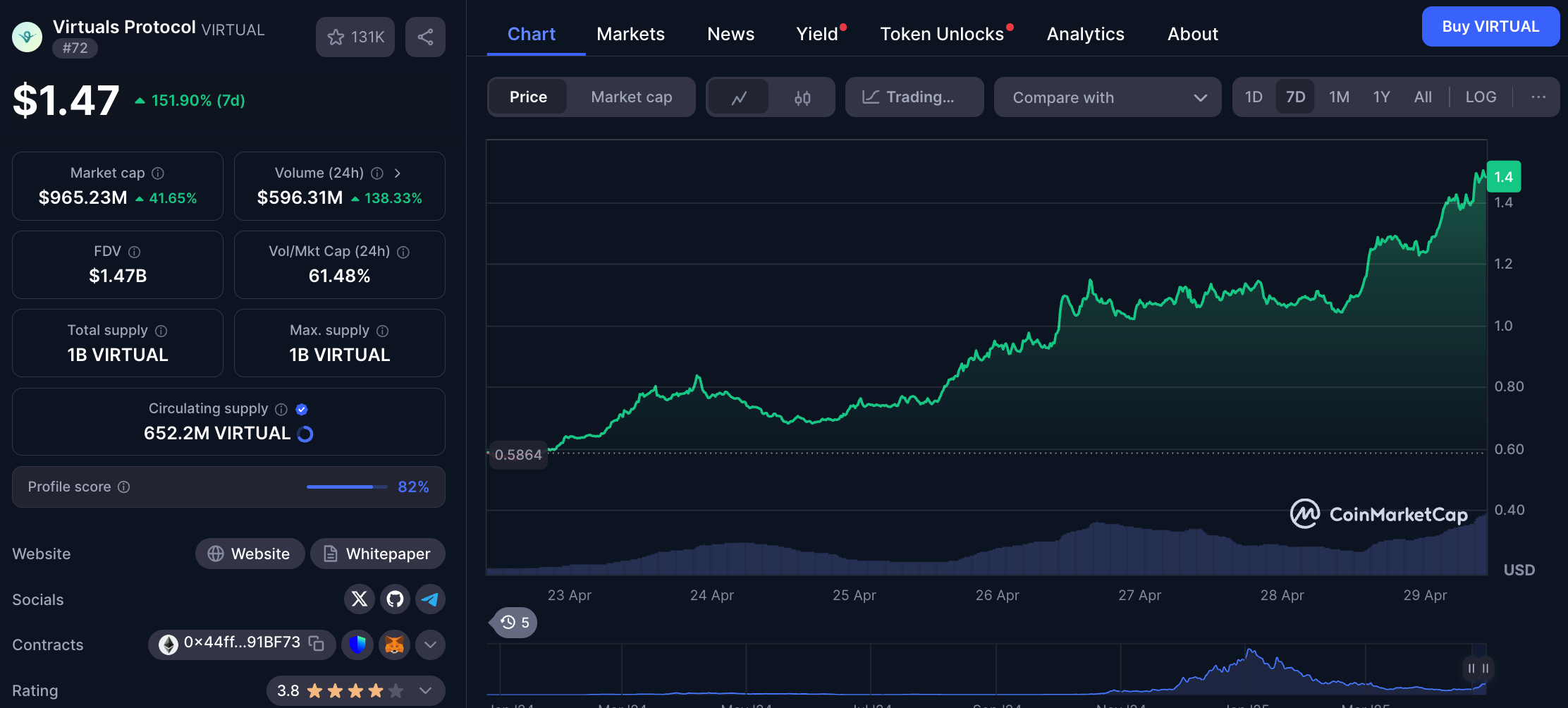
The catalyst behind this surge? The launch of their new Genesis Launches program on their own platform.
If you haven’t heard of it yet, here's a quick summary:
A mechanism that grants early access to hot new AI agent tokens based on your $VIRTUAL holdings and earned points—a "priority ticketing" system for AI token launches.
Put even more simply: it’s an evolved version of “launchpool” or “IYO” (Initial Yield Offering) participation.
New version, new god; every era breeds new assets. New tokens, new stories, new mechanisms—these always reignite market enthusiasm.
And any activity or mechanism built around asset creation can easily become the spark for a new trend.
The previous AI Agent wave on Base was largely driven by Virtuals. Could this Genesis Launch cycle harbor fresh opportunities?
We’ve tested the product firsthand and will walk you through how Genesis Launch works—and why it matters.
Contribute First, Passive Participation
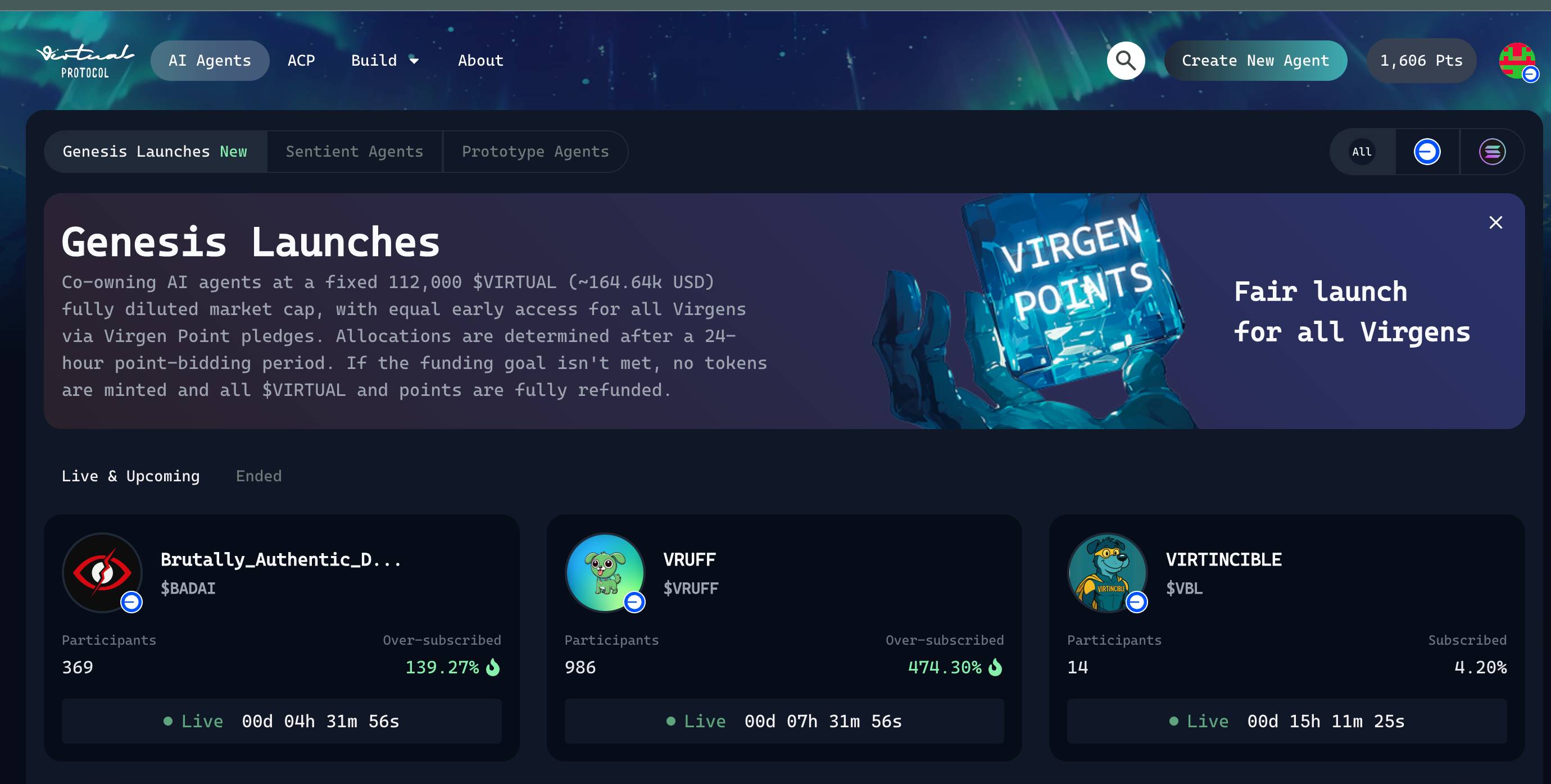
According to official descriptions, Genesis Launch is Virtuals Protocol’s fair launch platform specifically designed for AI agent tokens.
In short, it's a community-driven token launch mechanism for new AI agent projects. Users gain priority allocation rights to new tokens by holding $VIRTUAL and accumulating points.
In contrast to platforms like Pump.fun where anyone can rush in with speed and bots, participation in new token launches on Virtuals comes with prerequisites. At its core, this is about using pre-launch contributions to curb front-running and early chip-grabbing at launch.
Previously, on other launchpads, snipers used high-speed scripts to scoop up low-priced allocations, while “scientists” monopolized shares via bulk wallets and gas bidding wars. Retail users often couldn’t even load the trading interface before prices doubled.
To participate in these “launchpools,” you needed technical know-how: setting optimal gas fees, monitoring contract deployments, sometimes waking up in the middle of the night to track on-chain activity. Most ordinary users lack both the skills and stamina—left watching experts feast while they struggle to get scraps.
Genesis Launch, however, takes a more passive and inclusive approach—you don’t need to race against milliseconds. Instead, the logic shifts:
Want to launch new AI tokens? First contribute to the Virtuals ecosystem and accumulate points.
How do you earn points? By holding $VIRTUAL, staking other tokens, or contributing content to promote Virtuals—details below.
But overall, the effect of Genesis Launch is to simplify the “launchpool” experience to its essence.
You simply hold $VIRTUAL, accumulate points, then during the 24-hour new token presale window, stake both to automatically receive your proportional share.
Detailed Breakdown of the Points System
Let’s now dive into the specifics of the Genesis Launch points-based participation model.
First, how do you earn points?
The platform offers three official ways:
-
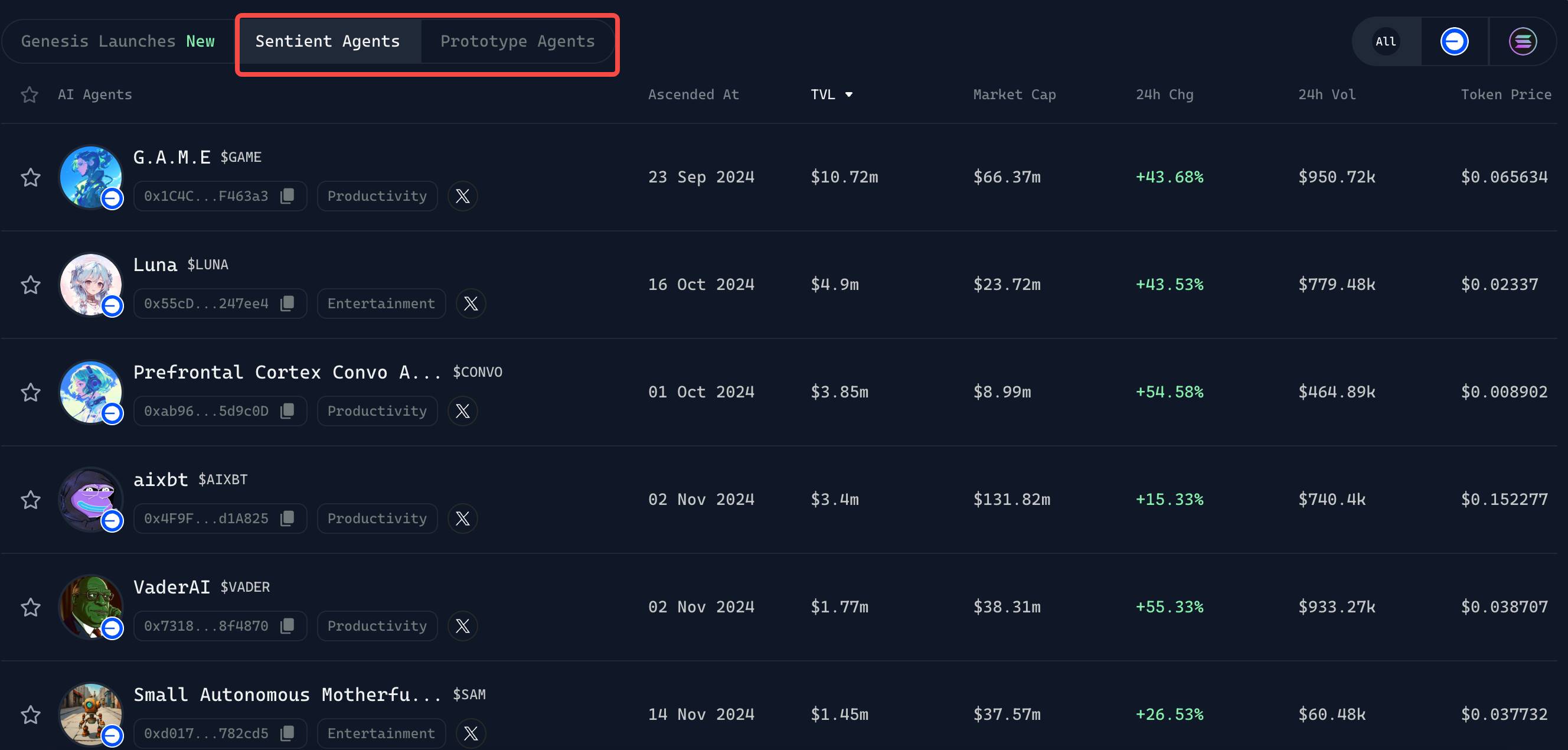
Invest in other Agents within the Virtuals ecosystem—currently two categories: Sentient (emotion-based AI Agents) and Prototype (prototype-stage AI Agents). This essentially means purchasing existing AI Agent tokens via Virtuals. Once bought, you earn points equivalent to a cashback reward, which can then be reused in future Genesis Launches.
-
Purchase and hold the Virtuals token directly. No complexity here—holding equals free points, functioning as a loyalty reward.
-
Stake the $VADER token. VADER is the native token of Vader AI, another AI Agent project within the Virtuals ecosystem. By staking VADER, users earn points to participate in new launches—effectively giving preferential support to the Vader AI project. In our view, this sets a precedent for ecosystem扶持 (support), as the staking rules aren’t fixed—other projects may later qualify for “stake-to-earn-points” status.
It’s important to note that the points system updates dynamically each day.
Virtuals distributes a fixed total number of points daily, allocating them across the three contribution types according to set weightings—rewarding ecosystem contributors.
In terms of distribution weights: investing in other AI Agents within the ecosystem accounts for 75%; direct $VIRTUAL holding makes up ~20%; and the remaining 5% goes to $VADER stakers.
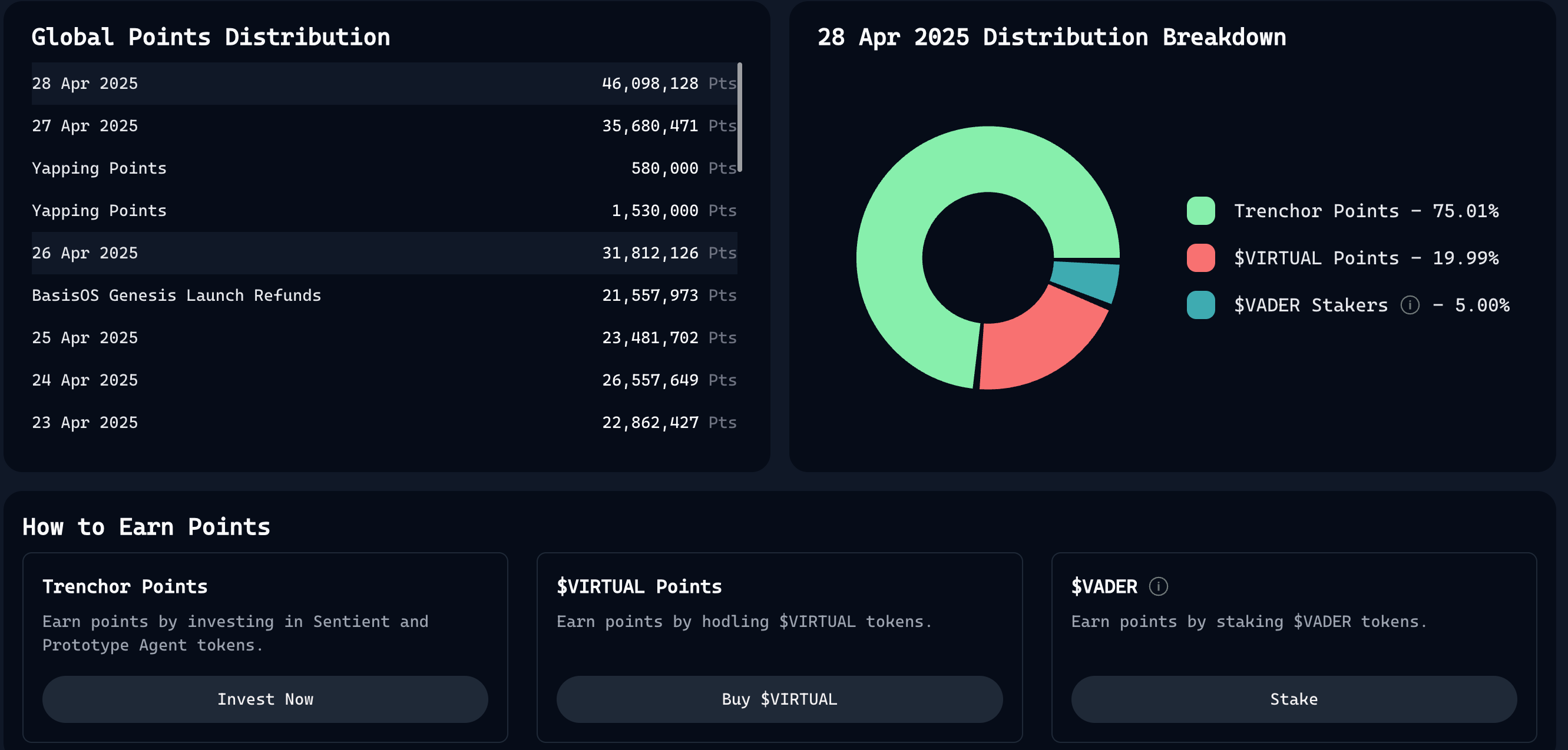
This likely explains why various tokens within the Virtuals ecosystem—including VIRTUALS itself—have seen significant price increases over the past one to two weeks.
Now that we understand the points system, let’s examine how new AI tokens are actually launched.
Genesis Launch uses a transparent, anti-dilution 24-hour presale window with the following rules:
-
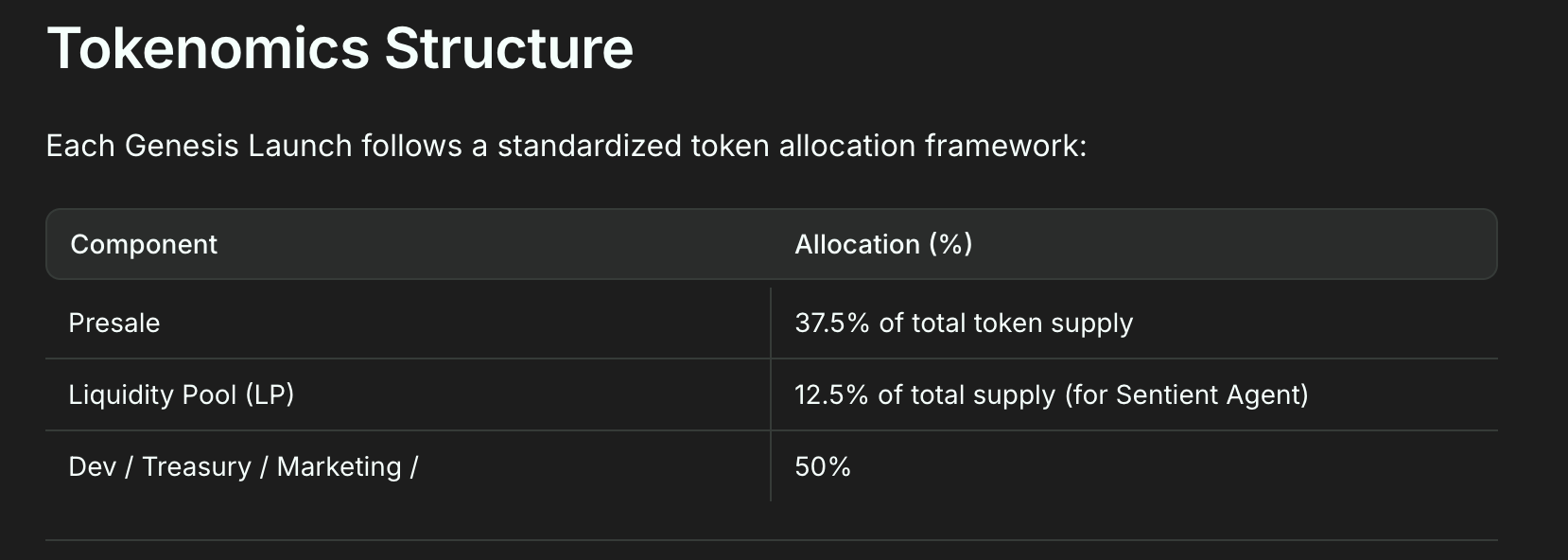
Allocation Ratio: 37.5% of the new token’s total supply goes to presale, 12.5% to liquidity pools (e.g., Sentient Agent pool), and the remaining 50% to development, treasury, and marketing. The 37.5% presale portion is the “cake” available to retail participants.
-
Dynamic Allocation: During the 24-hour presale, your allocated share is determined by the number of points you stake. More points = larger share, but no single participant can claim more than 0.5% of the total supply—preventing whales from draining the pool. The system calculates individual shares in real-time based on the total points pool. For example, 1,000 points out of a 100,000-point pool might entitle you to 1% of the presale allocation.
-
Refund Mechanism: Unused $VIRTUAL and points? No problem—they’re returned to you after the presale.
To participate in a Genesis Launch, you must stake both points and $VIRTUAL tokens to compete for new AI token allocations.
The process is simple:
-
Hold $VIRTUAL: Buy $VIRTUAL tokens—your entry “ticket.”
-
Earn Points: Use one of the three methods above to accumulate points.
-
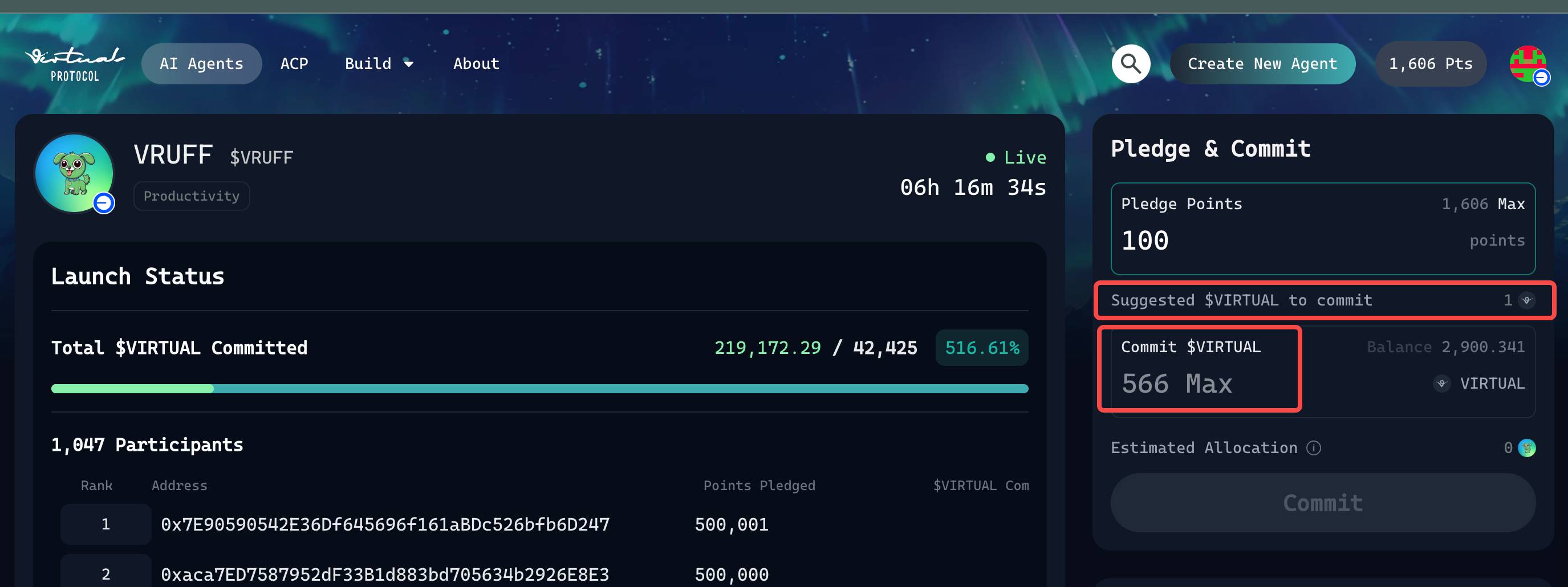
Stake to Participate: When the new token presale begins, stake your points and $VIRTUAL within the 24-hour window on the Virtuals website. The system estimates how much $VIRTUAL you’ll need to commit.
-
Wait for Distribution: After the presale ends, the system calculates your share based on the total points pool and credits your new tokens. Any unused $VIRTUAL and points are refunded.
-
Claim or Trade: Once received, you can hold or trade the new token on DEXs.
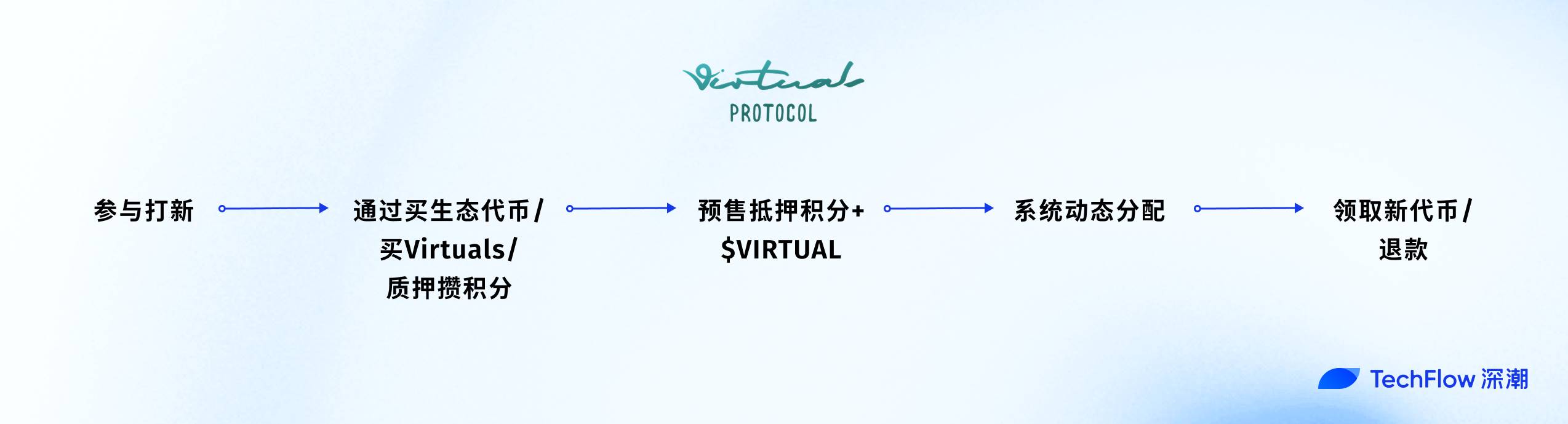
Points act as your “priority pass,” determining how much of the new token you can receive. More points mean a higher allocation (capped at 0.5% of total supply per wallet).
Crucially, points are consumed upon participation in a presale. Additionally, any unclaimed points from daily distributions expire after a certain period—encouraging active participation.
The $VIRTUAL token itself represents your cost of entry. The system suggests how much $VIRTUAL to stake based on your point balance. The underlying logic:
-
More points = higher potential allocation;
-
Fewer points = staking extra $VIRTUAL won’t meaningfully increase your share.
-
Anti-monopoly measures: A single wallet can stake up to 566 $VIRTUAL tokens, with a 1% transaction fee applied.
What if you lack points and don’t want to buy legacy assets?
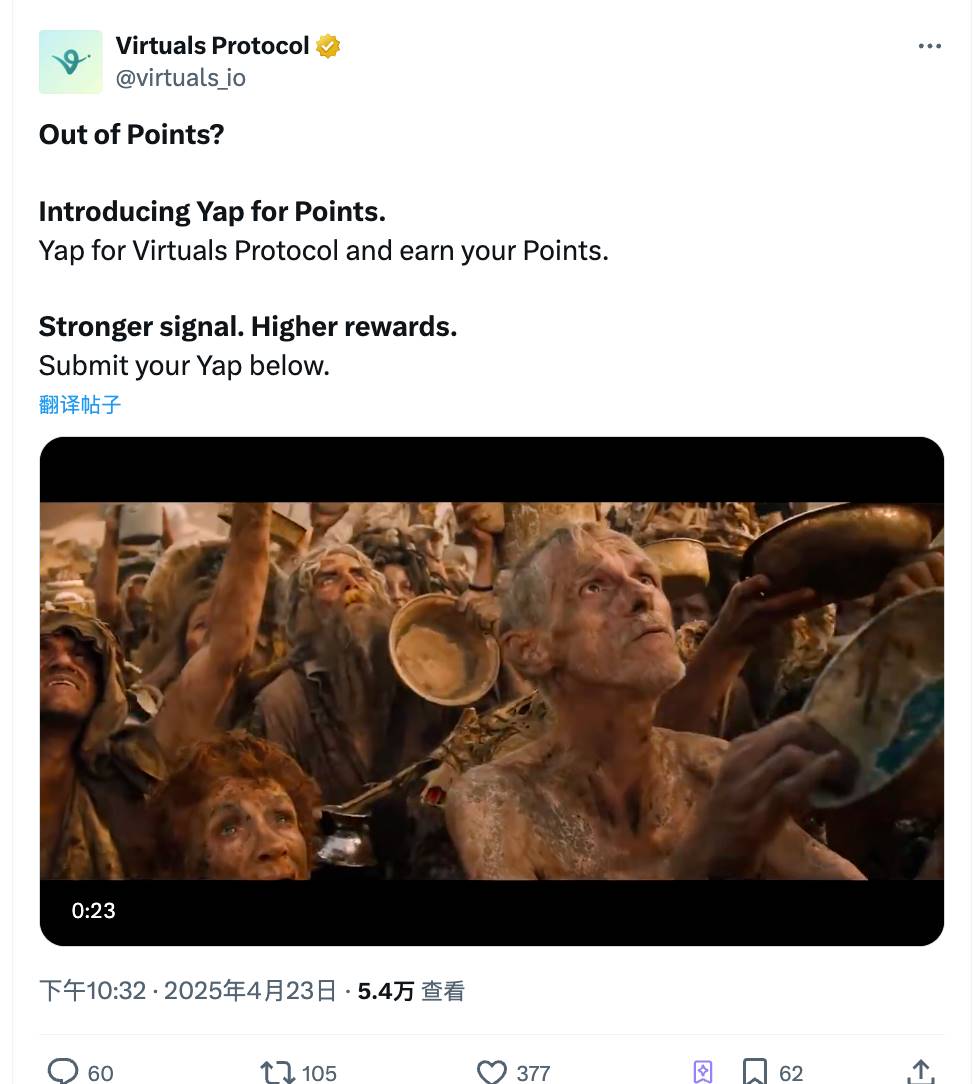
Virtuals has introduced its Yaps mechanism, allowing users to earn points through content creation and promotion—offering lower-cost entry for budget-conscious participants.
Launching New Assets, Revitalizing Old Ones
Experience shows that successful crypto mechanics aren’t piecemeal—they maximize value at every turn.
The Genesis Launch model clearly follows this principle: creating new assets while simultaneously revitalizing old ones.
The Virtuals ecosystem already hosts established AI tokens like Luna and AIXBT, each with their own narratives.
As the AI Agent hype cooled, trading volume and community engagement for these legacy tokens naturally declined.
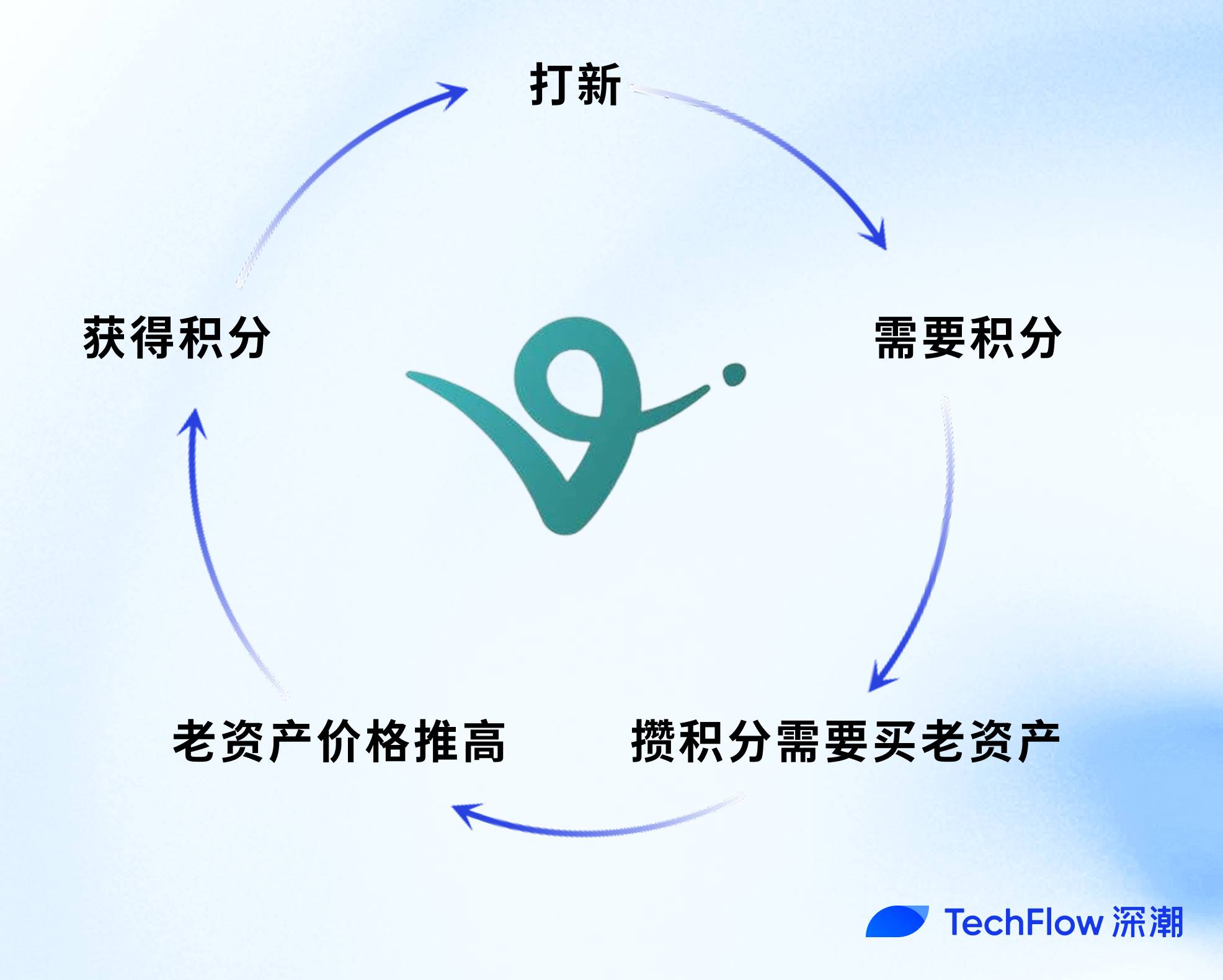
Now, with points required for new launches—and those points earned primarily by acquiring legacy assets—the design creates renewed demand for older tokens through new issuance rules, thereby lifting their prices.
Meanwhile, new assets launched via Genesis are quietly gaining momentum—even with limited participation so far.
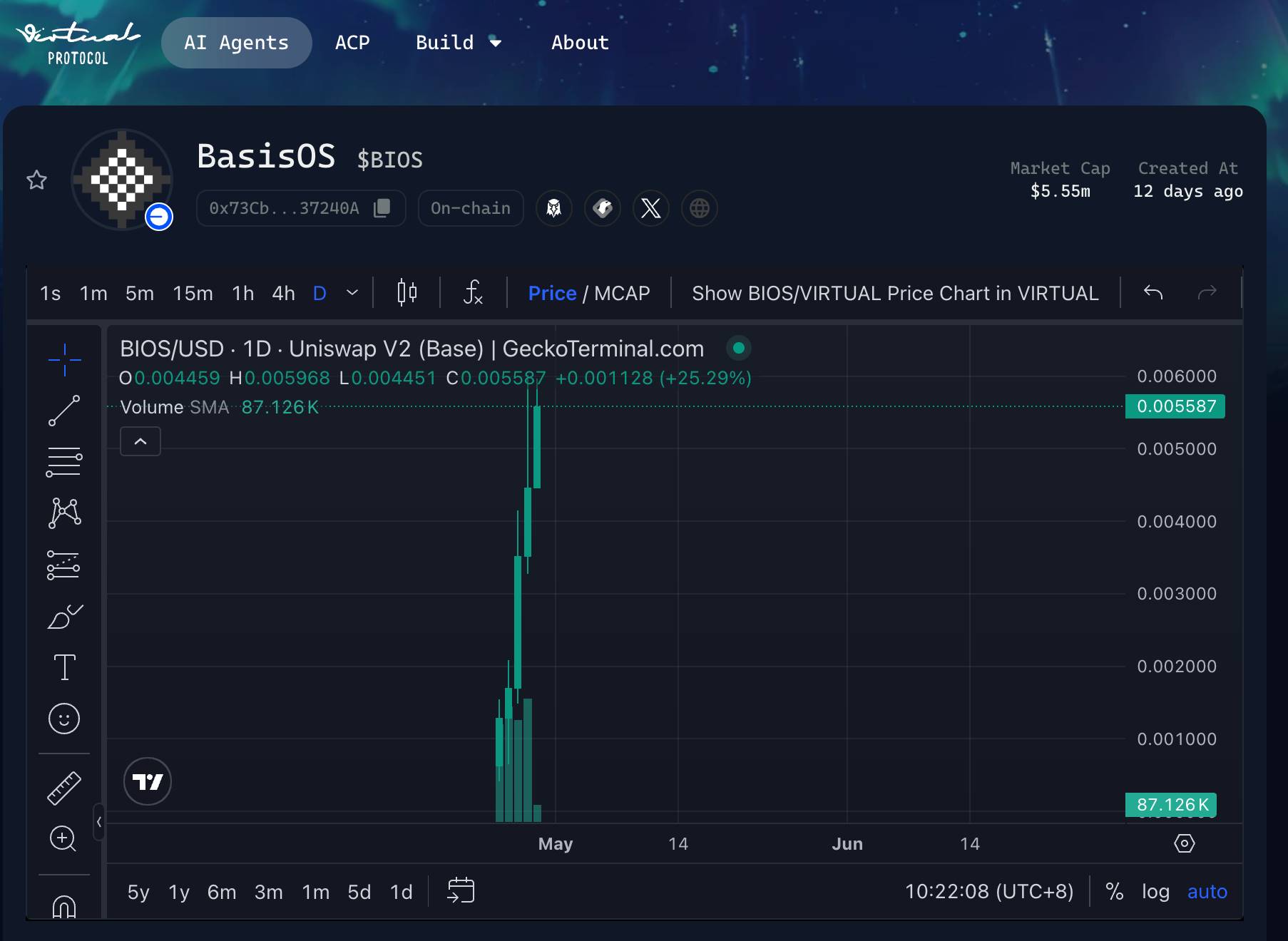
Take BasisOS, a token launched through Genesis Launch: in just 12 days since launch, its market cap has reached $5.5M—an increase of 40x from its initial valuation.
With no major technological or narrative shifts at Virtuals, this “new-lifts-old” asset issuance strategy has indeed stirred waves in an otherwise stagnant market.
Zooming out, we see broader signs: previously popular AI Agent tokens are experiencing notable rebounds.
Perhaps the AI Agent narrative hasn’t truly died—it’s simply awaiting innovative issuance mechanics. Top projects from the last cycle are actively reinventing themselves, leveraging new game designs to rekindle market interest.
Others are thinking alike. On Solana, ai16z appears to be doing something similar—building a new launchpad called Auto.fun, then designing economic incentives to drive demand for the AI16Z token, thus boosting the value of legacy holdings.
As “launch-new-to-boost-old” becomes the new standard playbook for AI Agent platforms, our best strategy is to treat legacy tokens as beta—and actively hunt for alpha in this currently low-competition environment.
Join TechFlow official community to stay tuned
Telegram:https://t.me/TechFlowDaily
X (Twitter):https://x.com/TechFlowPost
X (Twitter) EN:https://x.com/BlockFlow_News
 深潮TechFlow






