








Exclusive Interview with PolyFlow CFO: When Payments Become "Time Alchemy" – The PayFi Financial Restructuring Equation
TechFlow Selected TechFlow Selected
Exclusive Interview with PolyFlow CFO: When Payments Become "Time Alchemy" – The PayFi Financial Restructuring Equation
The ultimate significance of PayFi goes far beyond improving efficiency or reducing costs—it transforms payment itself into a declaration of financial sovereignty for ordinary people.
 Navigating Web3 tides with focused insights
In traditional financial systems, "payment" is often seen as the endpoint of value transfer. PayFi, however, redefines payment as a starting point. While Visa processes tens of thousands of transactions per second yet still requires multiple days to complete cross-border settlements, and while small and medium enterprises bear 6.5% cross-border payment costs while still needing to front capital, a financial revolution driven by on-chain payments is quietly unfolding through innovative PayFi protocols—PolyFlow applies the "alchemy of time" to payments, turning every transaction into a credit credential and every payment into accumulated financial momentum.
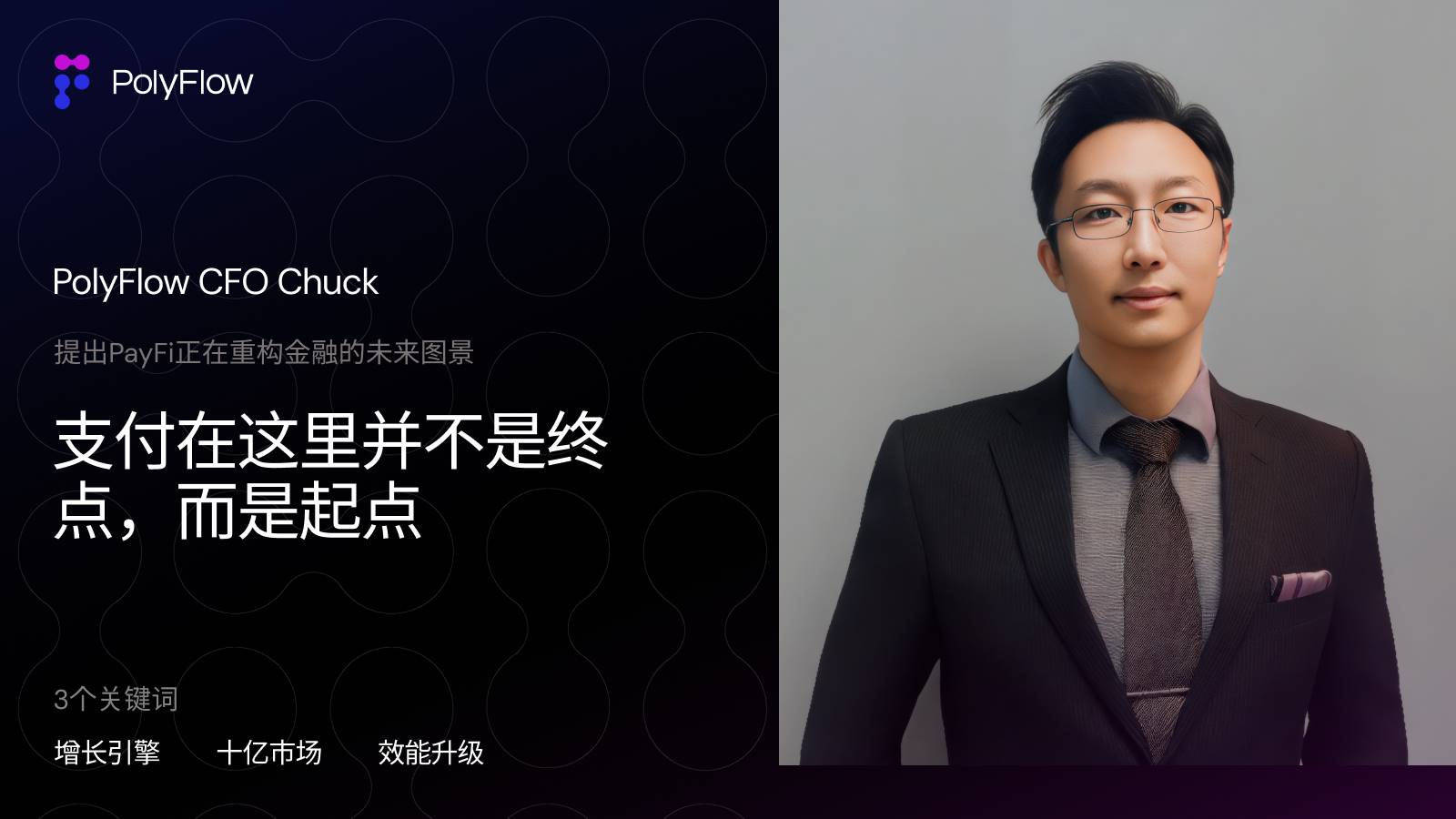
"PolyFlow is building an open network where everyone globally can easily spend cryptocurrency, earn rewards, and establish a financial identity," said Chuck, CFO of PolyFlow. In our conversation with him, we look forward to witnessing a future vision: instant settlement, enabling 1.4 billion underbanked individuals to leap over the banking account gap, transforming consumer data into income-generating assets.
How PayFi Transforms Payments from Cost Centers into Revenue Engines
Journalist: As a CFO with 15 years of experience in international investment banking finance, how has your traditional finance background influenced your strategic leadership in this Web3 project?
PolyFlow CFO Chuck: During my tenure as Finance Director in the Americas division of an investment bank, I deeply recognized two core bottlenecks in traditional cross-border payments: the disconnection between information flows and capital flows. Take SWIFT, for example. Its messaging system enables efficient information transmission, but capital flows remain constrained by national clearing systems and foreign exchange controls, resulting in average cross-border payment times of 3–5 days and fees ranging from 6% to 10%. This disconnect is especially pronounced in emerging markets—Philippine merchants, for instance, face total costs of up to 9% when receiving USD payments.
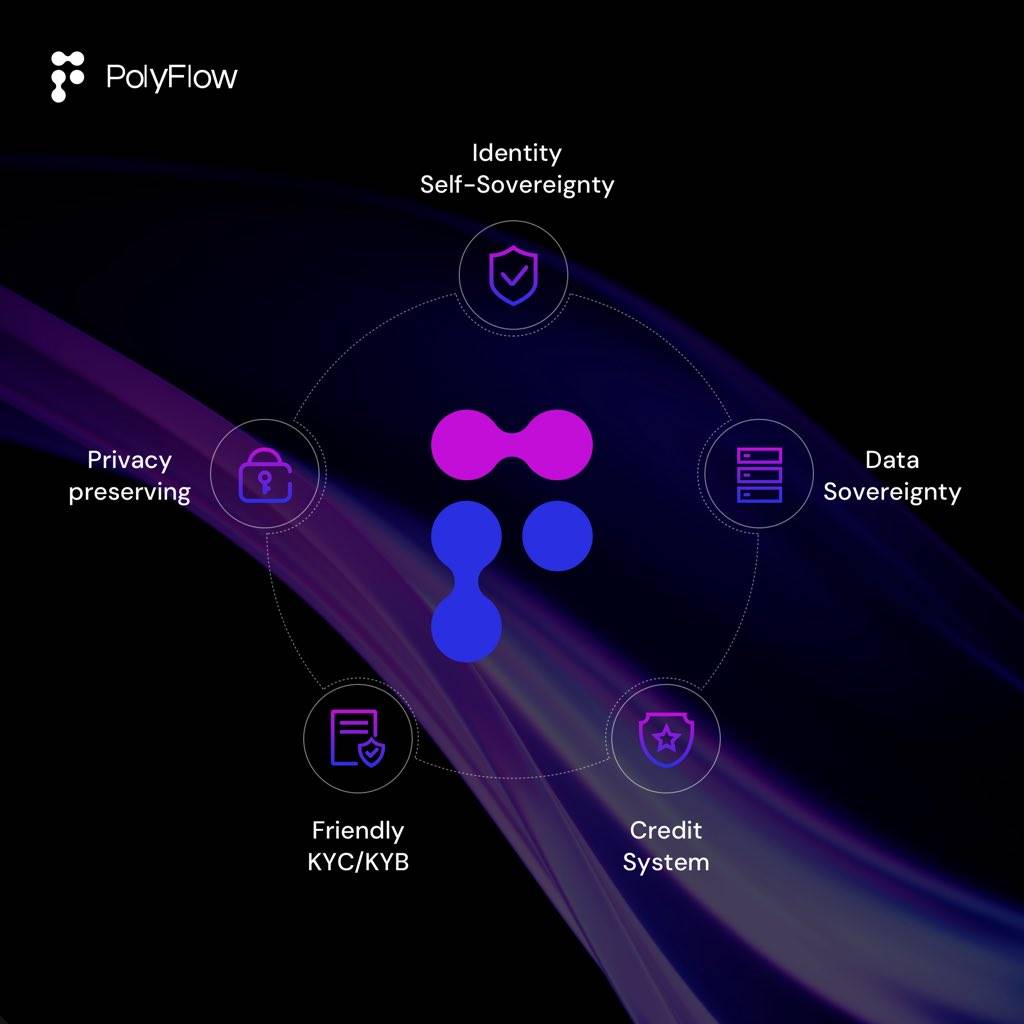
PolyFlow’s architecture stems directly from this insight. We use a modular design to separate information flow (PID) from capital flow (PLP), allowing blockchain to serve as a “highway” for value transfer rather than a “toll booth.” PID (Payment ID) builds users’ on-chain identity systems, so that each crypto payment becomes not just “spending,” but also “filing”—turning consumption into credentials for future credit applications, data monetization, and access to financial services. Meanwhile, PLP (PolyFlow Liquidity Pool) aims to seamlessly connect RWA and DeFi, bridging on-chain financial scenarios to create a PayFi ecosystem accessible to all.
For example, trade settlements from Brazil to China via PLP smart contracts can achieve T+0 settlement with cost reductions of 50%–80%. This “compliant self-custody” model preserves DeFi’s composability, avoids risks of centralized custody, and generates yield from real-world payments—an embodiment of integrating traditional financial risk control thinking with Web3 technological paradigms.
Thus, in PayFi, payment is no longer an endpoint—it is a beginning.
Journalist: What fundamentally differentiates current PayFi solutions from traditional payment systems?
PolyFlow CFO Chuck: Traditional payment networks resemble “consumptive pipelines,” charging 1.5%–6% fees without generating derivative value. PayFi breaks through by creating a “value-adding pipeline.”
Take PolyFlow’s vision: When a Brazilian coffee farmer receives payment through a PLP pool, they could not only settle instantly (T+0) but also generate over 4.5% annualized yield within DeFi protocols. This “interest-bearing payment” model would not only save hundreds of millions of cross-border workers billions annually in remittance losses but, more importantly, allow each of their transaction records to accumulate as on-chain credit via PID. With sufficient on-chain credit history, a farmer in Africa could secure a DeFi loan to purchase seeds for Arabica coffee plantations.
The Key Battles for PayFi Adoption
Journalist: From your perspective, what innovations and experiments are currently underway in PayFi? How do you anticipate growth drivers over the next 6–12 months?
PolyFlow CFO Chuck: Payments represent a multi-trillion-dollar market. We believe PayFi must shift from conceptual innovation to real-world application, tightly integrating with both B2B and B2C use cases. At PolyFlow, we’re building a three-layer growth matrix:
-
Infrastructure penetration: As an on-chain identity protocol, PID will integrate with major public chains such as Solana, BNB Chain, Stellar, and Ripple to strengthen user on-chain identity. Additionally, we aim to steadily grow the TVL of the PLP pools within six months to support future applications like cross-border settlement and supply chain finance.
-
Application layer breakout: We're actively exploring practical PayFi use cases. A pilot collaboration with a Brazilian bank is about to launch, expected to bring tens of millions of dollars in monthly incremental volume. We also aim to significantly improve KYC efficiency and reduce chargeback rates for crypto card merchants through PID-KYC integration.
-
Ecosystem expansion: We are preparing to officially launch the PolyFlow Dapp, featuring Scan-to-Earn—turning every payment into an act of building the future. In early April, we launched the PolyFlow Points Campaign (Seed Season), which attracted over one million receipt uploads and recorded 1.4 million transactions in just two weeks, fueling our on-chain credit model training. User and community enthusiasm is a major growth driver.
Journalist: How does PolyFlow’s points mechanism fundamentally differ from other projects’ ‘farm-and-dump’ points models?
Chuck: Traditional points systems suffer from three persistent flaws: platform ownership of data, decoupling of incentives from real value creation, and barriers to cross-ecosystem circulation. PolyFlow addresses these uniquely:
-
Behavioral ownership: Within the PolyFlow Dapp, users’ spending behaviors are tied to their PID. Each uploaded receipt generates a verifiable credential (VC), forming a “digital footprint.” For example, after scanning a Starbucks receipt, a customer earns points and may choose to authorize anonymized data—such as purchase frequency and amount brackets—to brands seeking insights, earning data revenue in return.
-
Scenario integration: Point accrual spans both B2C and B2B contexts. Consumers build on-chain credit identities via Scan-to-Earn; businesses that adopt PolyFlow payment tools can convert invoice flows and factoring financing across their supply chains into “enterprise credit points,” qualifying for better rates and liquidity support.
-
Dual-track economy: Points can be redeemed for future airdrop rights or used as “on-chain credit credentials” to unlock borrowing capacity.

Journalist: How does PID differ from traditional DID? What problems can PID actually solve?
PolyFlow CFO Chuck:
-
Compliance dimension: Through integration with various ecosystems, PID enables “lightweight compliance,” reducing KYC costs and drastically shortening verification time, accelerating crypto adoption. Imagine an Indonesian merchant initiating a $50 million transaction with a Saudi client—the system automatically retrieves compliance credentials from both parties’ PIDs and completes atomic settlement on the Solana chain, bypassing redundant reviews by 5–7 intermediaries in traditional pathways.
-
Currency dimension: The hybrid liquidity algorithm of PLP pools reduces reliance on fiat intermediaries in currency conversion, while dynamically matching optimal routes based on PID credit ratings. We aim to lower foreign exchange conversion costs and volatility for emerging market currencies through PayFi innovation.
-
Time dimension: Consumption data captured via Scan-to-Earn is recorded via PID, with users retaining full control over data sharing. For instance, when a user scans a Starbucks purchase, anonymized data such as spending frequency and amount ranges can be authorized to Visa for credit scoring, earning data income—enabling ordinary consumers to participate in data capital markets for the first time.
The Incremental Payment Revolution of PayFi
In Chuck’s narrative, PolyFlow demonstrates unique strategic discipline: avoiding both detached “financial Lego” constructs and short-term “PvP” traffic battles. By building foundational layers through two key modules—PID and PLP—and reshaping data production relationships via the Dapp’s Scan-to-Earn feature, PolyFlow’s “from payment to finance” incremental innovation may well be the true key to PayFi’s long-term, inclusive success.
The ultimate significance of PayFi extends far beyond efficiency gains or cost reduction—it transforms payment itself into a declaration of financial sovereignty for ordinary people. When an Indonesian fisherman leverages a single fish sale record to access a DeFi loan, when an African coffee farmer turns sales data into on-chain credit lines, when 1.4 billion underbanked individuals can join global financial markets simply by connecting online—this payment revolution led by PolyFlow is pushing Satoshi Nakamoto’s vision of “peer-to-peer electronic cash” into far broader territory.
The greatness of technology lies not in the speed of disruption, but in the power it gives to ordinary people. The PayFi infrastructure built by PolyFlow, guided by the principles of “payment as infrastructure, data as capital, credit as power,” is rewriting the foundational code of financial civilization: “In ten years, everyone will be astonished that they once tolerated such inefficient financial systems—just as today we cannot imagine a world without smartphones.”
Join TechFlow official community to stay tuned
Telegram:https://t.me/TechFlowDaily
X (Twitter):https://x.com/TechFlowPost
X (Twitter) EN:https://x.com/BlockFlow_News
 @Polyflow_PayFi






