ZKSync in the Eye of the Storm: Developer Matter Labs Sued for Stealing Core Technology, Under Pressure from Token Theft Scandal and Ecosystem Contraction
TechFlow Selected TechFlow Selected
ZKSync in the Eye of the Storm: Developer Matter Labs Sued for Stealing Core Technology, Under Pressure from Token Theft Scandal and Ecosystem Contraction
The L2 project ZKsync is still grappling with a trust crisis triggered by the hack of its airdrop distribution contract, and now its developer, Matter Labs, has become embroiled in legal disputes and public controversy over allegations of intellectual property theft.
 Navigating Web3 tides with focused insights
By Nancy, PANews
One crisis after another. The trust crisis triggered by the recent hack of ZKsync's airdrop distribution contract has yet to subside, and now its developer, Matter Labs, is embroiled in legal disputes and public backlash over allegations of intellectual property theft.
Matter Labs Sued by BANKEX for Alleged Technology Misappropriation and Poaching Core Team
On March 19, Igor Khmel, CEO of digital asset banking platform BANKEX, along with affiliated entities, filed a lawsuit in the Supreme Court of the State of New York. The suit alleges that former employees Alexandr Vlasov and Petr Korolev misappropriated core BANKEX technology during their employment, secretly founded competing company Matter Labs, and used it to secure more than $450 million in venture capital funding.
LinkedIn profiles show that Vlasov currently serves as Head of R&D at Matter Labs, where he has worked for 6 years and 8 months, primarily focusing on preparing Ethereum mainnet releases for Plasma and developing GPU-based zkSNARK provers for next-generation Plasma protocols. Prior to this, from March 2018 to January 2019, Vlasov was Chief Research Scientist at the BANKEX Foundation, leading the implementation of Plasma and building an entire suite of backend systems and smart contracts enabling practical Plasma operations. Another key figure, Korolev, is now founder of blockchain security firm OXORIO. He served as co-founder and operations lead at Matter Labs from August 2018 to January 2020. Before joining Matter Labs, Korolev was CEO and co-founder of the BANKEX Foundation, where he established the organization’s R&D infrastructure. Among four major projects he led or advanced during his tenure, Plasma development was listed as a top priority.
The complaint reveals that as early as 2017, Vitalik Buterin, co-founder of Ethereum, approached BANKEX and commissioned the team to develop operational software related to "Plasma," which was then seen as a key solution for scaling Ethereum. At the time, Vlasov and Korolev—both BANKEX employees—led the project's technical development. BANKEX provided financial, human, and community resources to support the work, which was open-sourced on GitHub and presented at multiple developer conferences, earning public recognition from Vitalik himself.
However, according to the lawsuit, in February 2018 while still employed at BANKEX, Vlasov created a new GitHub account under the name “Matter Labs” and uploaded a code repository nearly identical to BANKEX’s existing “Plasma Contract,” without attributing BANKEX or complying with the original Apache/MIT license requirements. Vlasov later released the “Web3Swift Library” under his personal name—a clear conflict of interest and violation of intellectual property rights.
On August 13, 2018, Vlasov and Korolev abruptly resigned without prior notice or technical handover. Within a week, they publicly released the Matter Labs whitepaper detailing a Plasma scaling architecture, deliberately omitting any mention of its origins at BANKEX. The whitepaper not only reused code structures and algorithm designs previously developed at BANKEX but also cited their achievements at events like the “ETHWaterloo Hackathon” and Vitalik’s endorsement—without disclosing these were accomplished under BANKEX’s banner. It further repackaged BANKEX’s publicly available Plasma tech demos, diagrams, and algorithmic details as original Matter Labs innovations.
Even more seriously, shortly after leaving, the two induced key BANKEX engineers to collectively defect. Matter Labs’ initial technical team was almost entirely composed of former core BANKEX members, including Sergey Korolev (Petr’s brother), COO of the BANKEX Foundation, as well as senior engineers Anton Nezlobin, Georgy Fesenko, and Konstantin Panarin. On GitHub, official BANKEX project pages were even modified to display a message: “web3swift development has been frozen, please use [matter-labs/web3swift],” openly leveraging BANKEX’s reputation to redirect users.
With the loss of its core technology and engineering team, BANKEX quickly collapsed. Mid-2018, the company had a valuation of $530 million and annual revenue of $6.5 million, but by year-end, its value had shrunk to just $200 million. Unable to secure funding due to the hollowing out of its technological foundation, BANKEX ceased operations entirely in 2019. Khmel reportedly reached out to Vitalik seeking emergency support from the Ethereum Foundation but received no response. In February 2019, when the Ethereum Foundation announced its fifth round of grants, Matter Labs topped the list while BANKEX was completely excluded.
The complaint further alleges that other parties—including Matter Labs CEO Alex Gluchowski, Chris Burniske (partner at Placeholder and former director), and investment firms Dragonfly and Placeholder Capital—are also complicit, either knowingly participating in or facilitating the alleged IP theft, making them named defendants in the suit.
In response to the allegations, Matter Labs told CoinDesk: “These claims are baseless. The central assertion—that ZKsync is built upon code developed by BANKEX—is entirely false. ZKsync is an original technology, not based on or derived from any BANKEX code. We have full confidence in the integrity of our work and look forward to addressing these unfounded allegations in court once we receive formal service.”
Reputation Hit Hard, Ecosystem Activity Shrinks Dramatically
In fact, this isn’t the first time Matter Labs has faced accusations of copying. Back in 2023, fellow ZK-focused project Polygon publicly criticized zkSync for replicating its open-source code without permission and using misleading language in its release notes. In response, zkSync stated that only about 5% of the Boojum module was based on Polygon’s Plonky2 library—and that proper attribution had been clearly marked on GitHub.
Moreover, last May, Matter Labs sparked a joint protest from ZK ecosystem projects after attempting to file a trademark application for “ZK.” Although it eventually withdrew the application, founder Alex’s subsequent comments defending the move—claiming opposition to “intellectual property” altogether and stating everything they create is released under free and open-source licenses—only intensified criticism regarding perceived misuse of open-source principles.
These controversies have severely damaged ZKsync’s reputation. Compounding the damage, ZKsync recently plunged into another trust crisis due to a security breach. On April 15, the ZKsync team announced that the admin account for its airdrop distribution contract had been compromised. Attackers exploited the sweepUnclaimed() function to mint approximately 111 million unclaimed ZK tokens from the airdrop contract. The incident was limited to the airdrop contract, and attackers could not exploit it further. According to Alex, the breach resulted from a leaked operator key—not from any compromise of the project’s source code. Nearly a week later, ZKSync posted again, offering a 10% bounty for the return of stolen funds within a 72-hour window. If hackers returned the funds within the deadline, the matter would be publicly resolved; otherwise, it would escalate to criminal investigation and be handed over to law enforcement.
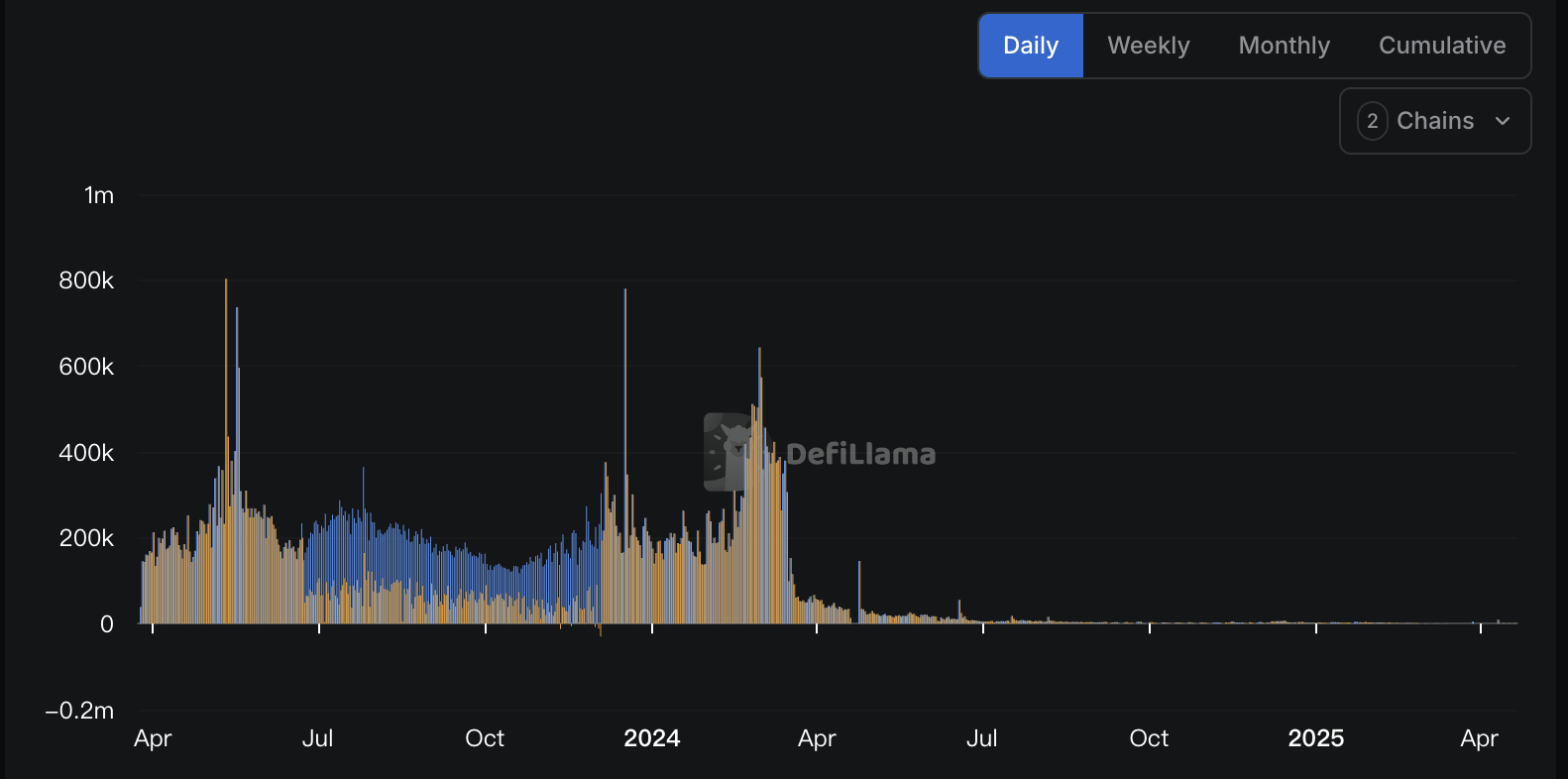
Today, the once high-flying ZK star project faces mounting market challenges. Data shows that zkSync’s ecosystem activity has significantly declined. According to DeFiLlama, daily revenue and fees on ZKsync—once routinely in the hundreds of thousands of dollars—have plummeted. Since June last year, they’ve remained below $10,000 for extended periods, with multiple recent days recording zero.
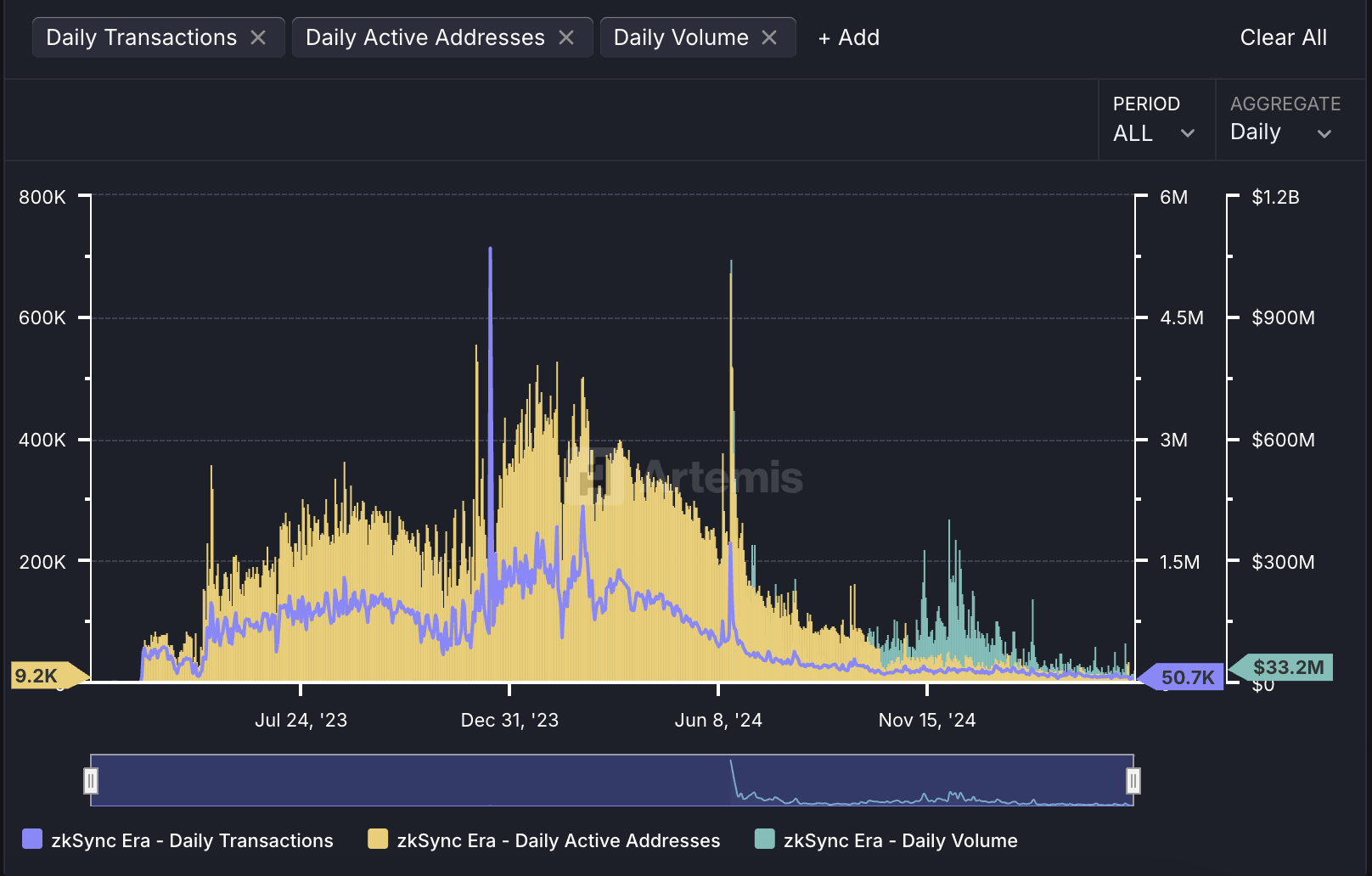
Meanwhile, Artemis data shows that as of April 21, ZKsync’s daily active addresses have crashed from a peak of 445,000 to just 9,200—a drop of over 97%. Over the same period, daily transaction counts fell from a record high of 5.2 million to 50,700, while transaction volume dropped from over $770 million at its peak to just $3.32 million today—a decline exceeding 95%.
From allegations of technological infringement and the airdrop contract hack to a rapidly shrinking ecosystem, zkSync now struggles amid a deepening crisis of trust and intensifying competition in the marketplace.
Join TechFlow official community to stay tuned
Telegram:https://t.me/TechFlowDaily
X (Twitter):https://x.com/TechFlowPost
X (Twitter) EN:https://x.com/BlockFlow_News
 PANews