ByteDance presses the AI Agent acceleration button
TechFlow Selected TechFlow Selected
ByteDance presses the AI Agent acceleration button
After the impact of DeepSeek, Manus, and others at the beginning of 2025, major companies are redefining their next strategic moves.
 Navigating Web3 tides with focused insights
Author: Wan Chen
DeepSeek-R1’s exceptional writing, GPT-4o’s Studio Ghibli-style image generation, OpenAI o3’s ability to deduce geographic locations from images…
These have been the wave after wave of viral, groundbreaking AI products over the past two months. It's clear evidence that reinforcement learning has finally achieved generalization, and multimodal models are becoming increasingly practical. This also means 2025 is truly the year when Agent applications begin to land—and accelerate.
Manus, the recently popular AI Agent team, previously revealed that last December, Claude 3.5 Sonnet reached a level of capability in long-horizon planning and step-by-step problem solving sufficient for building Agents—this was the prerequisite for Manus’ creation.
Now, with deep reasoning models and multimodal models maturing further, there will undoubtedly be more Agents capable of handling complex tasks.
Based on this outlook, on April 17, ByteDance’s cloud and AI service platform, Volcano Engine, launched a more powerful model—the Doubao 1.5 Deep Thinking Model—targeting enterprise markets. This marks the first public debut of the inference model behind Doubao App, ByteDance’s flagship AI application. Alongside it, Volcano Engine also released Doubao Text-to-Image Model 3.0 and an upgraded visual understanding model.
Tan Dai, President of Volcano Engine, believes that “deep thinking models are the foundation for building Agents. A model must be capable of thorough reasoning, planning, and reflection, and must support multimodality—just as humans possess vision and hearing—so Agents can better handle complex tasks.”
As AI evolves toward end-to-end autonomous decision-making and execution, entering core production workflows, Volcano Engine has prepared an architecture and toolkit enabling Agents to operate within both digital and physical worlds—its OS Agent solution and AI-native cloud inference suite—to help enterprises build and deploy Agent applications faster and more cost-effectively.
In Tan Dai’s view, developing an Agent is akin to developing a website or app. Relying solely on model APIs isn’t enough; developers need many AI-native cloud components. In the past, cloud native had its core tenets such as containers and elasticity; today, AI-native cloud will have similar key elements. Through continuous innovation, exploration, and rapid execution in AI-native technologies—such as middleware, evaluation, monitoring, observability, data processing, security safeguards, and components like Sandbox—Volcano Engine aims to become the optimal infrastructure solution for the AI era.
01 Doubao Deep Thinking Model: Thinking, Seeing, and Searching Like Humans
Since DeepSeek-R1’s release early this year, many consumer-facing applications have integrated the R1 reasoning model—except Doubao App. In early March, Doubao App launched its “Deep Thinking” mode, powered by ByteDance’s self-developed Doubao Deep Thinking Model.
Now, this inference model—the Doubao 1.5 · Deep Thinking Model—is officially released and available for experience and API access via the Volcano Ark platform.
With web search enabled, Doubao can think through problems just like humans—pause, search, then continue thinking—ultimately aiming at problem resolution.
Here’s an example in a shopping scenario: given constraints such as budget and size, users ask Doubao to recommend a suitable camping gear set.
To solve this, Doubao first breaks down key considerations and plans what information is needed. Then, identifying missing data, it performs online searches. It conducts three rounds of search: first checking price and performance to stay within budget and meet requirements; next considering children’s specific needs; finally factoring in weather conditions and searching for detailed reviews. By thinking while searching, it gathers all necessary context before delivering a reasoned recommendation.
Beyond thinking-with-searching, the Doubao Deep Thinking Model also possesses visual reasoning capabilities—like humans, it doesn’t just reason from text, but also from what it sees.
Take ordering food, for instance. With the upcoming May Day holiday, travelers abroad no longer need to take photos of menus and upload them to translation apps. The Doubao Deep Thinking Model can directly assist with menu selection based on images.
In the example below, the model first converts currency to manage budget, considers preferences of elderly family members and children, carefully avoids allergenic dishes, and directly proposes a menu plan.
Web connectivity, reasoning, inference, multimodality—the Doubao 1.5 · Deep Thinking Model demonstrates comprehensive reasoning abilities, capable of solving more complex problems.
According to technical reports, the Doubao 1.5 · Deep Thinking Model achieves high completion rates in domain-specific reasoning tasks—for example, matching OpenAI o3-mini-high’s score on the AIME 2024 math reasoning test, and approaching o1-level performance in programming competitions and scientific reasoning. On general tasks such as creative writing and humanities Q&A, the model also shows strong generalization, making it suitable for broader use cases.
The Doubao Deep Thinking Model also features low latency. Its technical report reveals the model uses a Mixture-of-Experts (MoE) architecture with 200B total parameters but only 20B activated parameters, achieving top-tier model performance with relatively small active parameter counts. Thanks to efficient algorithms and a high-performance inference system, Doubao’s API service maintains ultra-low latency of just 20 milliseconds even under high concurrency.
Additionally, its multimodal capabilities enable diverse applications. For instance, it can understand complex enterprise project management flowcharts, quickly identify critical information, and—with strong instruction-following ability—accurately answer customer queries according to the diagram. When analyzing aerial imagery, it can assess regional development feasibility by combining terrain features.
Besides the reasoning model, the Doubao large model family also introduced updates to two other models. On the text-to-image front, Doubao launched the latest version 3.0, delivering improved text layout rendering, photorealistic image generation, and 2K high-resolution output.
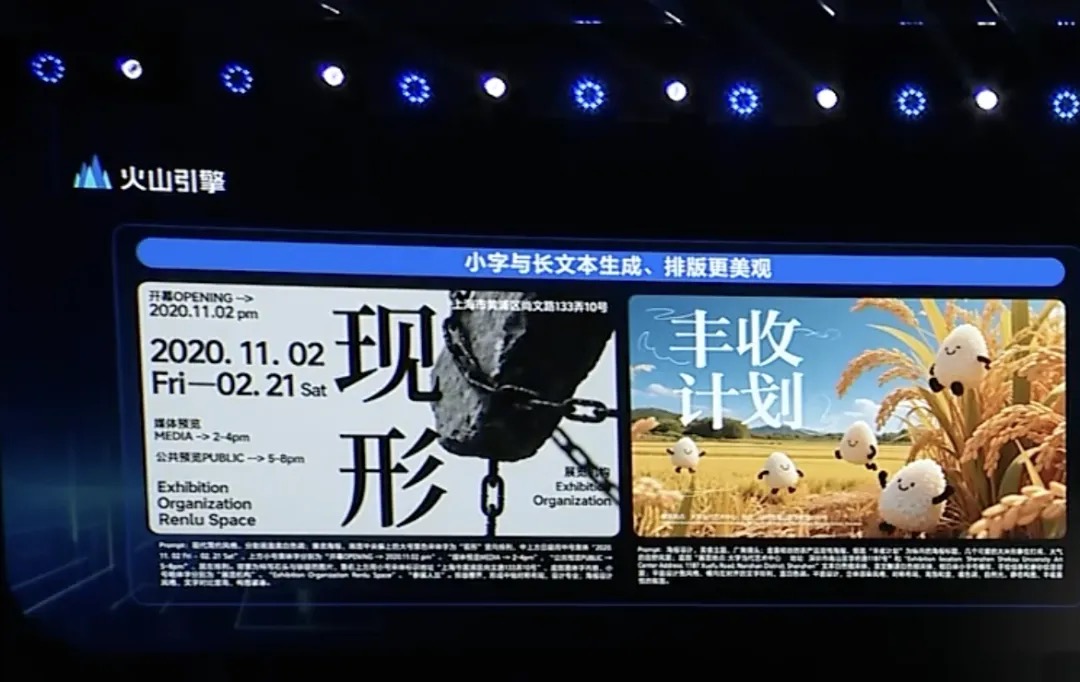
The new version not only effectively addresses challenges in generating small text and long paragraphs but also improves overall image layout. For instance, the posters “Manifestation” and “Harvest Plan” (far left) show fine details and natural composition, ready for immediate use.
The second upgrade is the Doubao 1.5 Visual Understanding Model. This version brings two major improvements: more precise visual localization and smarter video comprehension.
In visual localization, the Doubao 1.5 Visual Understanding Model supports bounding box and point-based localization for multiple objects, small objects, and general objects. It also enables object counting, description of localized content, and 3D localization. Enhanced localization expands application scenarios—from offline store inspections and GUI agents to robot training and autonomous driving development.
Video understanding capabilities have also significantly improved, including memory retention, summarization, speed perception, and long-video comprehension. Enterprises can leverage these to create engaging commercial applications. For example, in home settings, combining video understanding with vector search allows semantic querying of home surveillance footage.
For instance, cat owners who want to know their pet’s daily activities can now simply search “What did my kitten do at home today?” and instantly receive relevant video clips.
With visual understanding and robust reasoning capacity, many previously impossible applications are now achievable—cameras with such capabilities will be more appealing, and AI glasses, AI toys, smart cameras, and smart locks will gain new growth opportunities.
02 The Cloud Enters the Agentic AI Era
Recently, OpenAI researcher Yao Shunyu (core author of Deep Research and Operator), in his article “The Second Half of AI,” pointed out that reinforcement learning has finally found a path to generalization—not limited to specific domains like AlphaGo defeating human champions—but achieving near-human competitive levels across software engineering, creative writing, IMO-level mathematics, and mouse-and-keyboard operations.
Under these circumstances, competing on leaderboard scores—or achieving higher scores on increasingly complex benchmarks—has become easier, yet outdated.
Now, the real competition lies in problem definition: What real-world problems should AI solve?
In 2025, the answer is productivity Agents. AI application scenarios are rapidly entering the Agentic AI era, where AI can complete professional, time-consuming, end-to-end tasks. In response, Volcano Engine is building foundational infrastructure to help enterprises define their own general-purpose Agents.
The most crucial component is the model itself—one capable of autonomous planning, reflection, and end-to-end decision-making and execution, moving into core production processes. It also requires multimodal reasoning to interact with the real world using “ears, mouth, and eyes” to accomplish tasks holistically.
Beyond models, the Infra tech stack must continuously evolve. As MoE architecture proves more efficient and becomes mainstream, cloud infrastructure and tools must adapt to support its complex, flexible scheduling demands.
In general-purpose Agent scenarios, Volcano Engine introduces its enhanced architecture and tools—the OS Agent Solution—enabling large models to operate both digital and physical worlds. For example, an Agent can control a browser to search product pages and compare iPhone prices, or remotely use Jianying (CapCut) on another computer to edit videos and add music.
The current OS Agent Solution includes the Doubao UI-TARS model, veFaaS function services, cloud servers, cloud phones, and other products, enabling operation over code, browsers, computers, mobile devices, and other Agents. Among them, the Doubao UI-TARS model integrates screen visual understanding, logical reasoning, interface element localization, and operational actions, breaking free from traditional automation tools' reliance on predefined rules, providing a model foundation for Agent interactions closer to human behavior.
In general Agent use cases, Volcano Engine empowers organizations, individuals, and specialized fields to define and explore their own Agents through this OS Agent Solution.
For vertical-domain Agents, Volcano Engine explores areas leveraging its strengths—such as the previously launched “Intelligent Coding Assistant Trae” and data product “Data Agent,” which maximizes data processing power by building a data flywheel.
Meanwhile, widespread Agent adoption brings massive increases in model inference consumption. To address large-scale inference demands, Volcano Engine has developed the AI-native ServingKit inference suite, reducing deployment time and inference costs—GPU usage drops by 80% compared to traditional solutions.
Tan Dai believes that to meet the demands of the AI era, Volcano Engine will focus efforts in three areas: continuously optimizing models to maintain competitiveness; relentlessly reducing costs—including monetary expense, latency, and increasing throughput; and making products easier to deploy, such as developer tools like Koozi and HiAgent, and native AI cloud components like OS Agent. By maintaining technological and product leadership, market share will naturally follow. According to IDC’s recently published “China Public Cloud Large Model Services Market Analysis, 1Q25,” Volcano Engine leads the market with a 46.4% share.
In December last year, the average daily token calls for Doubao large models reached 4 trillion. By the end of March this year, that number had exceeded 12.7 trillion—an over 106x surge in less than a year since the model’s initial launch. Looking ahead, as deep thinking models, visual reasoning, and AI cloud infrastructure continue to improve, Agents will drive even greater token consumption.
Join TechFlow official community to stay tuned
Telegram:https://t.me/TechFlowDaily
X (Twitter):https://x.com/TechFlowPost
X (Twitter) EN:https://x.com/BlockFlow_News
 极客公园
极客公园