








Crypto Morning Brief: Trump says he will significantly reduce tariffs on China, Bitcoin breaks $93,000
TechFlow Selected TechFlow Selected
Crypto Morning Brief: Trump says he will significantly reduce tariffs on China, Bitcoin breaks $93,000
The son of the U.S. Secretary of Commerce is leading the launch of a $3 billion cryptocurrency investment initiative.
 Navigating Web3 tides with focused insights
Author: TechFlow
Yesterday's Market Dynamics
Trump: Will Significantly Reduce Tariffs on China
According to The Hill, President Trump stated on Tuesday that he will "significantly reduce" the current up to 145% tariffs on Chinese goods, though not to zero. The White House has indicated it is "paving the way for an agreement with China," and Treasury Secretary Bessent expects the U.S.-China trade war to "cool down." The Trump administration has received trade negotiation proposals from 18 countries and said further measures will be taken if no agreements are reached after the 90-day pause period.
IMF World Economic Outlook Report: 40% Probability of U.S. Recession in 2025
According to Jinshi Data, the IMF's World Economic Outlook report estimates a 40% chance of recession in the United States in 2025, up from 27% projected in October last year. Global inflation is expected to reach 4.3% in 2025 and 3.6% in 2026, with inflation forecasts for advanced economies significantly revised upward. Rapidly escalating trade tensions and high uncertainty are expected to have a major impact on growth across all regions. Inflation expectations for emerging economies in 2025 have been slightly lowered from 5.6% to 5.5%.
Standard Chartered: Concerns Over Fed Independence Could Drive BTC to New Highs
According to Walter Bloomberg, Jeff Kendrick of Standard Chartered stated in a report that if concerns over the Federal Reserve's independence persist, Bitcoin could reach new all-time highs.
He noted that due to its decentralized ledger, this cryptocurrency serves as a hedge against risks within the existing financial system. This risk is currently manifesting through risks facing U.S. Treasuries, following President Trump’s suggestion that he might remove Fed Chair Jerome Powell over his willingness to cut interest rates.
Kendrick pointed out that investors are demanding a significantly higher yield premium for long-term Treasuries over short-term ones, which benefits Bitcoin. Standard Chartered forecasts Bitcoin to rise to $200,000 by the end of 2025.
Son of U.S. Commerce Secretary Leads Launch of $3 Billion Cryptocurrency Investment Initiative
According to Jinshi Data citing the Financial Times, Cantor, a financial services firm led by Brandon Lutnick, son of U.S. Commerce Secretary Howard Lutnick, is collaborating with SoftBank, Tether, and crypto exchange Bitfinex to form a joint Bitcoin investment vehicle exceeding $3 billion.
Three sources familiar with the matter said the consortium will pool billions of dollars worth of crypto assets held by its partners, emulating the successful path of Strategy (MSTR.O)—a software company transformed into a crypto investor now holding tens of billions of dollars worth of Bitcoin, with its market capitalization soaring to $91 billion.
This move comes amid the Trump administration’s push for crypto-friendly policies. Sources added that Tether will contribute $1.5 billion worth of Bitcoin, while SoftBank and Bitfinex will contribute $900 million and $600 million worth respectively.
Publicly Traded U.S. Company DeFi Development Corporation Purchases $11.5 Million Worth of SOL
According to Globe Newswire, Nasdaq-listed DeFi Development Corporation (formerly Janover, ticker: JNVR) announced the purchase of 88,164 Solana (SOL) tokens, valued at approximately $11.5 million. Following this acquisition, the company’s total holdings of SOL amount to 251,842 tokens, with a total value of about $34.4 million (including staking rewards).
The company stated that the newly acquired SOL will be immediately staked, providing security to the Solana network while earning native yield. This transaction forms part of the company’s recently completed $42 million financing plan. Under a reserve policy approved by the board on April 4, the company intends to accumulate crypto assets long-term and operate one or more Solana validator nodes to support network security and earn staking returns.
Binance Alpha to List DOLO, Airdropping 260 Tokens to Eligible Users
According to official announcement, Binance Alpha will list Dolomite (DOLO), with trading expected to begin on April 24 Beijing time, exact timing pending. To celebrate the listing, eligible Binance Exchange users will receive an airdrop of 260 DOLO tokens to their Alpha accounts 10 minutes after trading commences.
To qualify, users must maintain an average daily balance of at least $50 across Binance Exchange and wallet between 00:00 UTC April 15, 2025, and 23:59 UTC April 21, and have cumulatively purchased at least $100 worth of Alpha products on Binance Exchange.
Hyperlane: HYPER Airdrop Now Claimable
The Hyperlane Foundation announced on social media that eligible users who registered during the pre-claim phase can now claim HYPER. The claiming period runs from 20:00 Beijing time April 22 to 21:00 May 22.
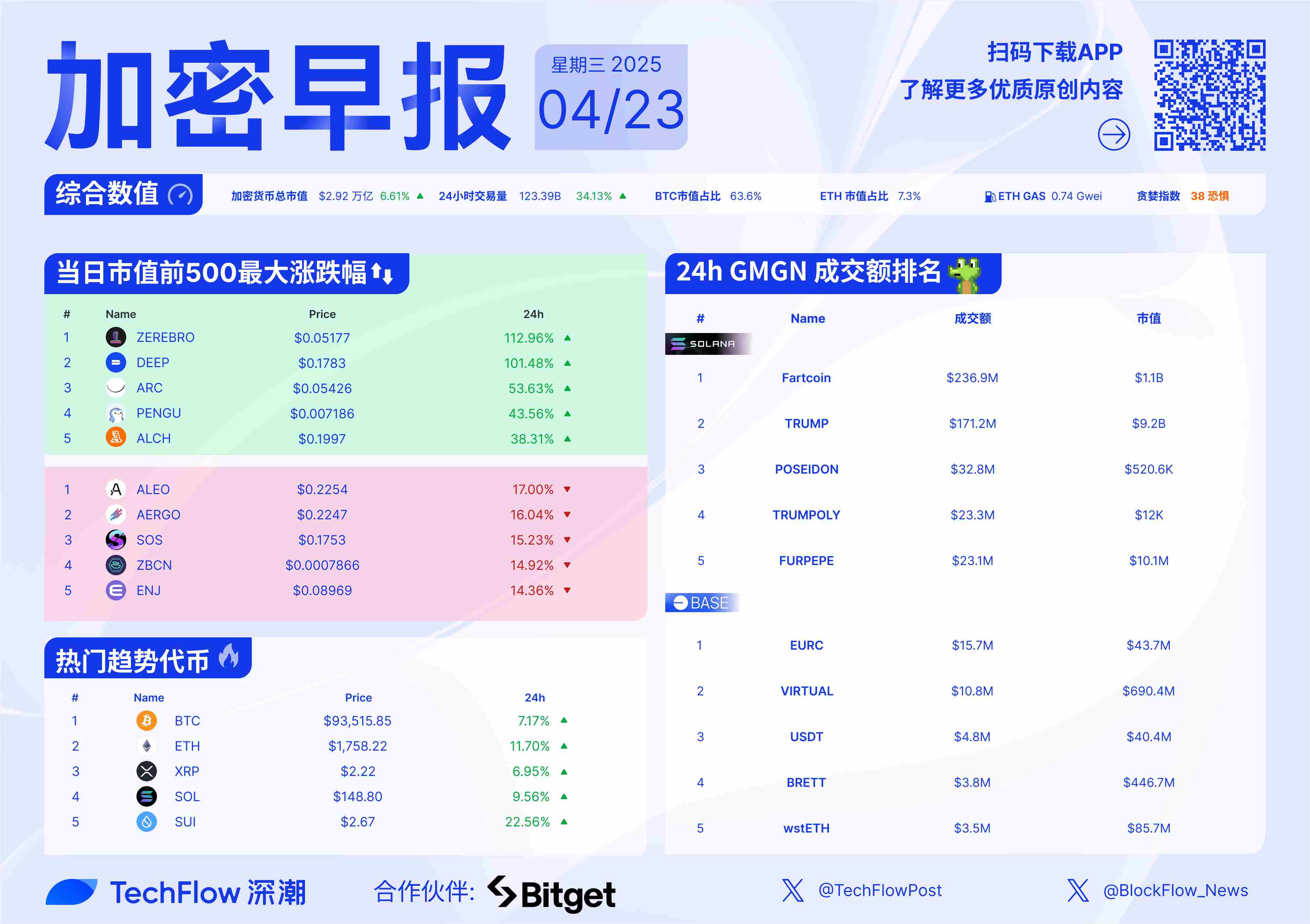
Fartcoin Market Cap Surpasses BONK, Up 16.5% in 24 Hours, Exceeds $1 Billion
According to HTX data, Fartcoin’s market cap has surpassed that of Bonk. Fartcoin’s current market cap stands at $1.01 billion, up 16.5% in the past 24 hours, compared to BONK’s market cap of approximately $986 million.
Metaplanet CEO: Target to Hold 10,000 Bitcoins by Year-End
Simon Gerovich, CEO of Metaplanet, confirmed today that the company has become Asia’s largest publicly listed Bitcoin holder and ranks tenth globally. The company currently holds 4,855 BTC and aims to reach 10,000 BTC by year-end.
JD.com VP: JD Stablecoin Enters Hong Kong “Sandbox” Testing
According to reports by Mei Jing Network, Dr. Shen Jian Guang, Vice President and Chief Economist of JD Group, stated in an exclusive interview with Every Day Economic News in Hong Kong that JD has entered the Hong Kong stablecoin issuance “sandbox” testing phase. He added that legislation related to stablecoins in Hong Kong is still under development without finalized regulations. Once the draft Stablecoin Ordinance is approved, the Hong Kong Monetary Authority is expected to issue detailed implementation rules accordingly.
Market Movements
Suggested Reading
"Disruptor" Backpack: Completing the FTX Puzzle, Leveraging Compliance to Lead TradFi
This article explores the development of the crypto exchange Backpack and its ties to FTX, emphasizing the importance of compliance in the crypto finance industry. Through innovative product design and a global compliance strategy, Backpack aims to become a key driver of crypto finance expansion in 2025.
Plain Language Explainer: What Vitalik Means by Proposing RISC-V to Replace EVM
This article discusses Ethereum founder Vitalik Buterin’s proposal to replace the Ethereum Virtual Machine (EVM) with RISC-V to improve execution efficiency and compatibility. RISC-V, an open-source instruction set, could resolve EVM compatibility issues and enhance smart contract performance. While this proposal may make Ethereum faster and more competitive, it also carries risks such as increased system complexity and the need for developers to adapt to new tools. Community opinions are divided—supporters see it as a crucial step forward, while opponents worry about excessive risks.
Comparing Four Leading RWA Protocols: Ondo, OpenEden, Plume, and Ethena
This article examines real-world asset tokenization (RWA), a key growth vector in the crypto space, offering a detailed comparison of four prominent RWA protocols: Ondo, OpenEden, Plume, and Ethena. It analyzes their core value propositions, market strategies, challenges, and potential to bring traditional financial assets on-chain.
This article details the entrepreneurial journey of Coinbase founder Brian Armstrong and shares his insights on the cryptocurrency industry. It traces his evolution from selling candy on campus to becoming a crypto billionaire, offering his predictions and strategies for the crypto market.
Chiang Mai’s Digital Nomad Exodus: The Reality Behind Low-Cost Living
This article discusses the rise and fall of Chiang Mai as a digital nomad hub. Although Chiang Mai initially attracted many remote workers with its low cost of living and freelancer-friendly environment, over time some began feeling isolated and dissatisfied, leading to a significant exodus. The article argues this trend is not solely due to external factors like air pollution, but also relates to personal mental well-being and difficulties integrating into local culture.
Join TechFlow official community to stay tuned
Telegram:https://t.me/TechFlowDaily
X (Twitter):https://x.com/TechFlowPost
X (Twitter) EN:https://x.com/BlockFlow_News
 深潮TechFlow






