Trump reignites global asset correlation: dollar plunges, gold hits record high, Bitcoin bounces back strongly
TechFlow Selected TechFlow Selected
Trump reignites global asset correlation: dollar plunges, gold hits record high, Bitcoin bounces back strongly
The Shaking of Global Asset Pricing Power and the Return of Non-Sovereign Safe-Haven Anchors
 Navigating Web3 tides with focused insights
By ChandlerZ, Foresight News
On April 22, U.S. financial markets were once again thrust into turmoil. The Dow Jones Industrial Average dropped 971 points, the Nasdaq Composite fell over 2.5%, and the S&P 500 lost its foothold above the 5200 level. All seven of the tech megacaps declined, with Tesla and Nvidia falling more than 5.7% and 4.5% respectively. The VIX volatility index surged nearly 14%, breaching 33, signaling a rapid rise in systemic risk-aversion across markets.
The U.S. dollar weakened in tandem, falling below the 98 threshold to hit a fresh 18-month low. Both the ICE Dollar Index and Bloomberg Dollar Spot Index posted among their worst monthly performances since 2009. Meanwhile, gold broke through $3,400, reaching another all-time high. Bitcoin briefly surpassed $88,000 overnight before pulling back to around $86,300 alongside the stock market selloff. After U.S. equities closed, however, it regained strength and climbed back above $88,800—while most altcoins failed to reclaim their earlier highs.
According to Coinglass data, total liquidations across the crypto market reached $261 million in the past 24 hours, with $141 million in long positions and $121 million in short positions liquidated. Bitcoin accounted for $88.58 million in liquidations, while Ethereum saw $67.59 million.
Price movements are merely symptoms—the deeper reality is a collective repricing of the global asset anchoring structure and the historic resurgence of non-sovereign assets emerging through institutional cracks.
The Independence of the Federal Reserve Faces Political Reengineering
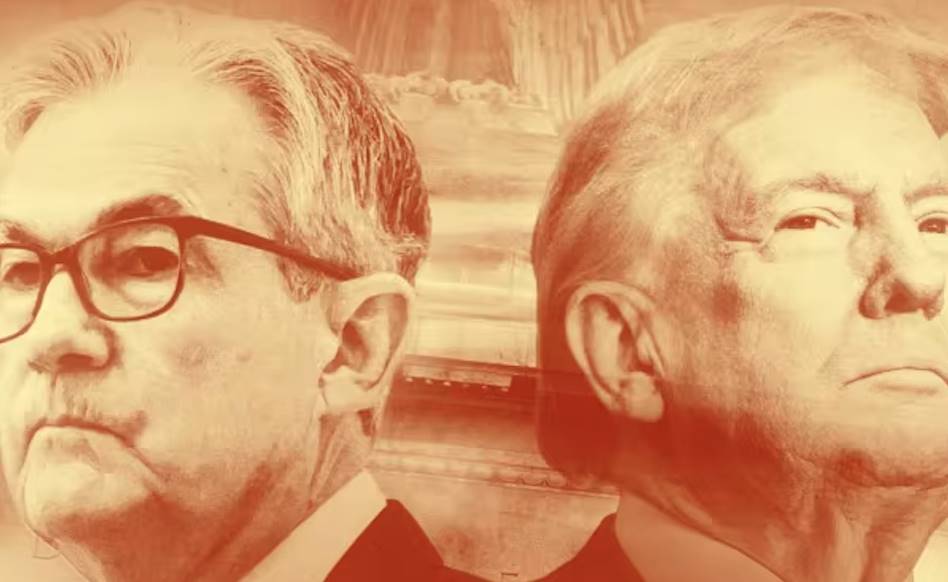
Trump has once again publicly attacked Federal Reserve Chair Jerome Powell, demanding “immediate rate cuts, or else the economy will slow down.” Market confidence in the Fed’s political neutrality is now under unprecedented pressure. This marks the second time in just days that Trump has openly pressured monetary policy decisions—not only posting on Truth Social about “excessively tight” policies but also repeatedly suggesting he may consider replacing Powell.
Bloomberg reports that Trump’s team is currently examining whether there is legal authority to dismiss Powell. On April 18, Kevin Hassett, Director of the White House National Economic Council, confirmed publicly that Trump and his advisors are “reviewing options” regarding Powell’s position.
This move touches one of the most sensitive red lines for global investors: Is the Federal Reserve still an independent central bank, insulated from electoral politics? For four decades, the Fed has played a pivotal role in the global asset allocation system precisely because of this perceived independence.
Yet today, the question of “whether Powell can keep his job”—a question previously considered unthinkable—has become one of the key variables watched closely by global financial capital. As a result, safe-haven capital is accelerating its shift into non-sovereign assets.
Notably, this sell-off is not simply a reaction to short-term interest rate expectations, but rather a direct response to uncertainty surrounding decision-making rules themselves. When investors can no longer trust that interest rates are set based on economic fundamentals rather than political cycles, the credibility of the dollar as a stable anchor begins to erode.
Over the past decade, global capital has widely allocated to U.S. Treasuries and dollar-denominated assets based on trust in the Federal Reserve’s professional judgment and institutional independence. But if that trust begins to fray, U.S. bonds will no longer be seen as unconditional safe-haven assets, and the dollar will lose its inherent premium status—triggering a fundamental reassessment of the entire global asset anchoring framework.
Why Gold and Bitcoin Rise Together: The "Anchoring Reconstruction Mechanism" Amid Institutional Distrust
For decades, the core structure of the global financial system has relied on an implicit assumption of institutional trust—that the Federal Reserve remains policy-neutral, the U.S. government honors its credit obligations, and market rules are stable and information transparent.
It is precisely this institutional trust that grants U.S. Treasuries their status as a risk-free rate benchmark and enables the dollar to function as the world’s primary reserve currency. But when executive power increasingly intervenes in monetary policy, this foundational assumption comes under threat. In response, global capital does not wait for the next Fed meeting—it immediately begins re-evaluating what truly credible assets actually are.
Gold has served as a store of value for thousands of years. Its price reflects not only inflation expectations but also a vote on institutional stability. Historically, every major surge in gold prices has coincided with declining confidence in traditional fiat monetary systems:
-
In 1971, following the collapse of the Bretton Woods system and the severing of gold's link to the dollar, gold prices soared;
-
After the 2008 global financial crisis, gold rapidly appreciated to record highs;
-
Today, amid growing skepticism over political interference in the Fed, gold has once again hit new all-time peaks.
This pattern persists because gold’s core advantage lies in its independence: it relies on no national credit, resists policy manipulation, and carries zero default risk. Amid increasing politicization of institutions and short-termism in policymaking, gold offers temporal autonomy and historical continuity.
Bitcoin rises in tandem with gold not because it mimics central banking functions, but precisely because it is *not* subordinate to any central bank.
Its issuance follows mathematical rules; its supply cap is hardcoded and immune to political terms, election cycles, or fiscal deficits. Bitcoin’s appreciation expresses deep skepticism toward the "man-made" monetary system.
When the Federal Reserve’s independence is questioned and the dollar becomes subject to executive influence, a segment of market capital begins viewing Bitcoin as a potential “de-politicized store of value.”
Especially when Treasury creditworthiness is constrained (due to unsustainable fiscal trajectories), gold appears overheated (with high premiums potentially reducing risk-adjusted returns), and regulated crypto ETF channels gradually open (enhancing accessibility), Bitcoin assumes a hybrid role—as both “digital gold” and a “decentralized alternative to the dollar.”
Signals of Regulatory Shift: Atkins’ Appointment and Systemic Adjustment in Financial Governance
As Trump intensifies pressure on the Fed, Paul S. Atkins was sworn in as the 34th Chair of the U.S. Securities and Exchange Commission (SEC). While procedurally routine, this appointment sends a powerful policy signal. Atkins, a prominent advocate of financial market liberalization during the Bush era, has long argued that regulation should serve the market rather than dominate it. His ascension suggests a potential paradigm shift in the philosophy guiding U.S. capital markets.
This transition is particularly significant within the context of digital assets. If Atkins adheres to his established principles, we may see unprecedented regulatory easing in areas such as crypto ETF approvals, tokenized real-world asset (RWA) issuance, and the design of token economic models.
However, this laissez-faire tendency could also introduce structural risks. While boosting short-term optimism, it may simultaneously blur regulatory consistency and long-term predictability. Markets have largely operated under frameworks built on clear rules, defined thresholds, and measurable boundaries. A softening of regulatory stance risks undermining this sense of institutional clarity, leading to disorientation among market participants. The crypto industry already operates at the regulatory periphery—and now, instead of clearer boundaries, that edge may become even more uncertain due to shifting policy winds.
In other words, Atkins’ appointment signifies a subtle restructuring of the U.S. financial governance framework: by decentralizing control over traditional regulatory tools, space for market self-governance expands dramatically—but at the cost of potentially losing the last line of unified oversight. For the digital asset sector, this represents both an opening of a compliance opportunity window and a period of intense institutional博弈 (strategic contestation).
Join TechFlow official community to stay tuned
Telegram:https://t.me/TechFlowDaily
X (Twitter):https://x.com/TechFlowPost
X (Twitter) EN:https://x.com/BlockFlow_News
 Foresight News