The challenge of Ethereum: How to address value leakage in modular stacks?
TechFlow Selected TechFlow Selected
The challenge of Ethereum: How to address value leakage in modular stacks?
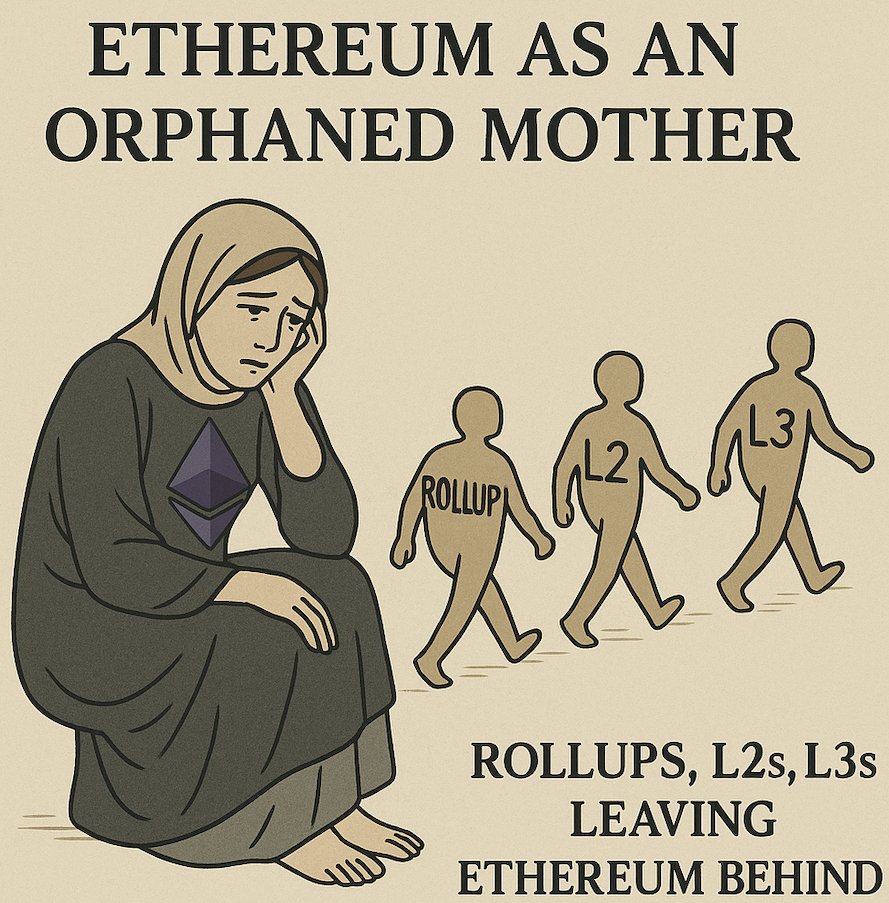
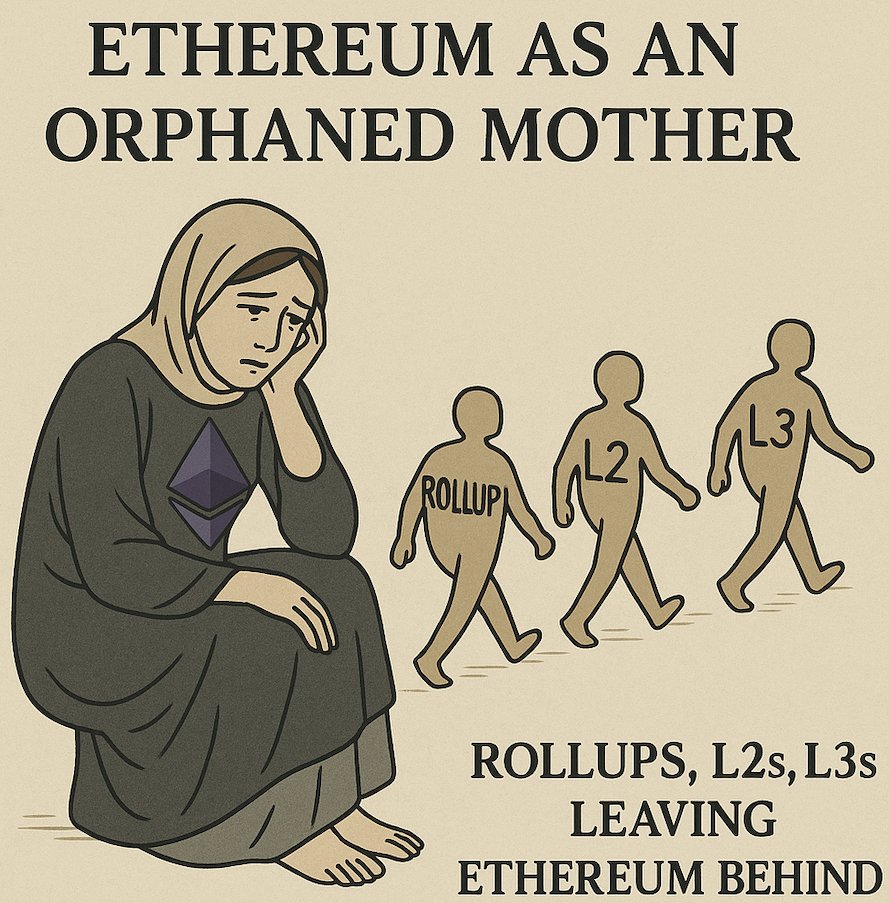
Ethereum is like a mother who has been abandoned.
 Navigating Web3 tides with focused insights
Author: papiofficial
Translation: zhouzhou, BlockBeats
Editor's note: This article discusses Ethereum's evolving role amid advancements in technologies such as Rollups, L2s, and L3s. As projects launch their own chains via Rollup-as-a-Service (RaaS), teams are increasingly focusing on products, users, and tokens rather than alignment with Ethereum. Using the metaphor of the "orphaned mother," the author suggests Ethereum is becoming a distant "mother" to projects that have moved away from it, with ETH as an asset being diluted in the process. The author asks: If Ethereum does not want to become this kind of "mother," how should it respond to this shift?
The following is the original text (slightly edited for clarity):
The Ethereum community has spent considerable time debating whether Rollups, L2s, and L3s extract value from Ethereum L1. Over the past 24 hours, @ameensol, @haydenzadams, @wmougayar, @siobh_eth, @TrustlessState, and others have deeply engaged in this discussion.
My view is: any action that moves transactions and activity off Ethereum L1 is fundamentally a form of value extraction.
This isn't necessarily bad. But I believe that in the long run, it does impact the ETH asset.
Let me explain from two angles: one using an analogy with Toyota, and another drawn from my experience advising a real-world Rollup project.
While working at Toyota, I learned a principle from my lean mentor called Genchi Genbutsu (現地現物)—meaning "go and see for yourself." Don't rely solely on dashboards or secondhand reports; go directly to the source and experience reality firsthand. This philosophy profoundly shaped how I analyze ecosystems like Ethereum.
Genchi Genbutsu teaches you to avoid the trap of abstraction.
Data is helpful, yes—but without direct, first-hand experience, data remains incomplete.
I've participated in the launches of several Rollup projects, and each time I've observed the same transformation. And that’s where things get interesting.
Here, I want to introduce a concept: the "orphaned mother."
In philosophy, this term refers to disciplines like physics, mathematics, and economics—all of which originated within philosophy.
Philosophy gave birth to them, but as its "children" grew up, they left. In the end, philosophy became the orphaned mother.
Every new Rollup, L2, or L3 brings Ethereum one step closer to becoming that orphaned mother.
A few years ago, I advised a Rollup project focused on a specific domain. The team were all die-hard Ethereum believers—I had known them since ETH San Francisco back in 2017.
At first, they were idealists.
They used Rollup-as-a-Service providers like @gelatonetwork, @alt_layer, @conduitxyz, or @Calderaxyz—excellent companies that served their clients well.
The setup was incredibly simple: within under 30 minutes, they had their own chain.
And right at that moment, everything began to change.
After launch, their mindset shifted. They were no longer just builders—they became entrepreneurs.
Their focus turned to product, users, community, growth. Their full attention went to their own chain and token.
Alignment with Ethereum? That dropped out of the top ten priorities.
This isn't criticism—it's simply what happens.
When you operate your own chain, your thinking changes. You optimize your own flywheel, your own incentives, your own token.
Ethereum becomes the orphaned mother.
Back to Genchi Genbutsu—go and see for yourself.
Launch your own Rollup. Use a RaaS. Try growing it. Issue your own token. Experience it firsthand—and you’ll feel how your mindset shifts from ETH-maxi to token founder. You’ll sense the transformation.
Let me summarize:
(1) Launching your own chain transforms you from an Ethereum-aligned builder into a business owner.
(2) This ownership mindset makes ETH optional.
(3) Don’t just take my word—go verify it yourself.
This isn't good or bad. It just *is*. But if Ethereum wants to avoid becoming the orphaned mother in the modular stack, it must confront this dynamic head-on.
In this model, the ETH asset is indeed diluted. The question is: how do we respond?
Join TechFlow official community to stay tuned
Telegram:https://t.me/TechFlowDaily
X (Twitter):https://x.com/TechFlowPost
X (Twitter) EN:https://x.com/BlockFlow_News
 @shmula