Ethereum at the Crossroads: Strategic Breakthrough in Restructuring the L2 Ecosystem and Value Capture Framework
TechFlow Selected TechFlow Selected
Ethereum at the Crossroads: Strategic Breakthrough in Restructuring the L2 Ecosystem and Value Capture Framework
This article aims to analyze Ethereum's most pressing strategic challenges and propose practical solutions.
 Navigating Web3 tides with focused insights
By Momir @IOSG
TL;DR
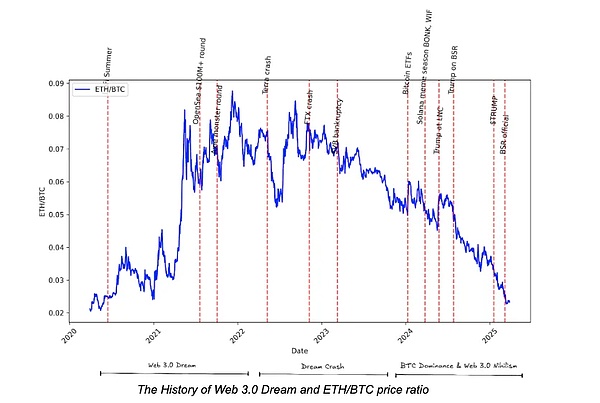
The euphoria surrounding the Web3 vision has faded since 2021, and Ethereum is now facing severe challenges. Not only has market perception of Web3.0 shifted, but Ethereum is also under intense pressure from emerging platforms like Solana competing for the remaining market share. Critical issues—such as Layer 2 fragmentation, erosion of value accrual, dilution of ecosystem control, and lack of decisive leadership—are further degrading Ethereum's user experience and economic value. As Layer 2 networks gain more influence, Ethereum’s overall dominance is being undermined. These factors have collectively triggered one of the most dramatic price corrections in ETH’s history.
Yet hope remains: by advancing L2 interoperability, prioritizing ETH-centric infrastructure development, and adopting bold, performance-driven leadership, Ethereum can still reclaim its former glory. Its robust foundational architecture and vibrant developer ecosystem remain enduring strengths. However, restoring ETH’s premier status will require swift and strategic action.
The shift from the Web3.0 utopia to a harsher reality has forced markets to reevaluate Ethereum’s core value proposition. The once-celebrated ideal of a “user-owned, decentralized internet” has been replaced by a more cynical narrative: that crypto is either a store-of-value game dominated by Bitcoin or merely a digital casino. This sentiment reversal has hit Ethereum particularly hard—it positions itself as the foundation of a new internet paradigm, yet now faces growing skepticism.
Even more critically, Ethereum is no longer the sole standard-bearer for the Web3.0 vision. Regardless of whether one holds an optimistic or pessimistic view of the industry’s future, it’s evident that platforms like Solana are becoming new hubs for crypto-native consumer activity. In this context, this article aims to analyze Ethereum’s most urgent strategic challenges and propose actionable solutions to help it regain its leading position amid an evolving landscape.
Core Challenges
Ethereum faces many challenges, but this analysis focuses on four most pressing issues—L2 fragmentation, declining value capture, eroding ecosystem control, and the absence of strategic leadership.
L2 Fragmentation and User Experience Friction
The most visible crisis is Layer 2 network fragmentation. The proliferation of competing execution layers has fractured user experience and on-chain liquidity, undermining Ethereum’s once-prized composability advantage—a strength that remains clearly intact on monolithic blockchains like Solana.
For users, inconsistent protocols, standards, and bridges make the seamless interactions Ethereum once promised increasingly difficult to achieve. Developers must maintain multiple versions of their protocols across various L2s, while startups face complex go-to-market strategies due to fragmented ecosystems and limited resources. As a result, many consumer-facing applications have migrated to Solana, where users and entrepreneurs can focus on entertainment and innovation rather than navigating fragmented infrastructure.
Diluted Ecosystem Control: A Growing Threat
More troubling is that Ethereum’s decision to outsource its scaling roadmap to L2s is steadily weakening its control over its own ecosystem. General-purpose L2 rollups generate powerful network effects as they build their own ecosystems, gradually forming moats that are difficult to cross. Over time, these execution layers gain increasing influence relative to Ethereum’s settlement layer, potentially leading communities to overlook the importance of the mainnet settlement layer. Once assets begin to exist natively on execution layers, Ethereum’s ability to capture value and exert influence will be severely diminished, reducing the settlement layer to a commoditized service.
Erosion of Value Accrual: A Structural Challenge
The rise of L2s has significantly impacted ETH’s value capture, with these platforms increasingly capturing MEV and transaction fee revenue, thereby reducing the value flowing back to Ethereum’s mainnet. This shift redirects economic benefits from ETH holders to L2 token holders, weakening the fundamental investment appeal of holding ETH. While this trend presents an inevitable challenge for any Layer 1 token—whether modular like Ethereum or monolithic chains—Ethereum experiences it earlier and more acutely due to its pioneering adoption of an L2-centric roadmap.
It is foreseeable that as application-layer dominance in MEV capture becomes the norm, not only monolithic chains but even L2s themselves will face value capture crises. While not unique to Ethereum, developing sophisticated strategies to address this structural issue remains a critical priority.
Leadership Crisis: The Idealism Trap
In responding to these challenges, Ethereum has revealed deep-seated deficiencies in strategic leadership. The community remains caught in a recurring tension between efficiency goals and egalitarian values, delaying critical progress. Meanwhile, the commitment to “credible neutrality” in governance—initially intended to reduce regulatory and state-level risks—often becomes a hindrance to decisive strategic decisions. Furthermore, ETH holders lack mechanisms to directly influence major strategic choices, leaving selling their tokens as their only way to express dissatisfaction.
In hindsight, these issues, while easy to identify, may stem partly from concerns about regulatory and national-level risks rather than a lack of insight into governance and leadership.
Strategic Response: Challenges and Solutions
L2 Fragmentation: A Self-Correction Mechanism
Two paths exist to resolve the L2 fragmentation crisis:
First, rely on market forces (natural selection) to enable organic consolidation, eventually resulting in 2–3 dominant general-purpose L2s capturing the majority of activity. The rest would either exit the competition or pivot to become vertical-specific rollup providers;
Second, establish binding interoperability standards to eliminate friction among rollup ecosystems and prevent any single execution layer from building monopolistic moats.
Ethereum should act during its current window of influence over L2s to implement the second approach. It must recognize that this influence is eroding daily—the slower the action, the weaker the strategic impact. By building a unified L2 ecosystem, Ethereum could reclaim the composability advantages of the mainnet era and compete directly with monolithic chains like Solana on user experience.
However, relying solely on market-driven consolidation would leave ETH’s future bleak. If a power-law distribution emerges around 2–3 dominant execution layers, Ethereum’s influence over them may drastically diminish. In such a scenario, each execution layer would likely prioritize its own token’s value accrual, marginalizing ETH and weakening Ethereum’s economic model. To avoid this outcome, Ethereum must act decisively to shape its L2 ecosystem and ensure that value and control remain tied to the mainnet and ETH.
Value Recapture Mechanisms
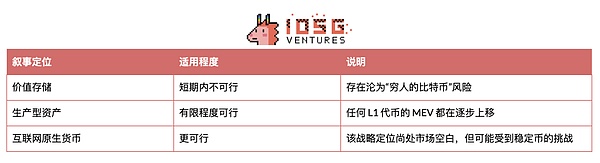
Relying solely on the “productive asset” narrative is not a sustainable long-term strategy for ETH (or any Layer 1 token). The window for Layer 1s to dominate MEV capture may last at most five years, as value accrual continues its established migration up the application stack. Meanwhile, Bitcoin has firmly captured the “store of value” narrative, making any attempt by ETH to compete in this space likely to be perceived as “digital silver” to Bitcoin’s “digital gold.” Even if ETH eventually demonstrates clear advantages in value storage, such a transformation could take at least a decade—an unbearable wait for Ethereum. Therefore, in the interim, Ethereum must carve out a unique narrative to maintain market relevance.
Positioning ETH as the “internet-native currency” and the highest-quality on-chain collateral represents the most promising direction for the next decade. While stablecoins dominate as payment mediums in on-chain finance, they still rely on off-chain ledgers. The role of a truly internet-native, unstoppable currency remains unclaimed—and ETH holds a first-mover advantage here. However, achieving this requires Ethereum to reassert control over its universal execution layers and prioritize ETH adoption over the unchecked proliferation of Wrapped ETH standards.
Regaining Ecosystem Control
Ethereum can reclaim ecosystem ownership through two key pathways: First, enhance Ethereum L1 performance to match centralized chains, ensuring zero-latency experiences for consumer apps and DeFi; Second, launch an Ethereum-native rollup, focusing all business development and adoption efforts there. By concentrating ecosystem activity on infrastructure controlled by ETH, Ethereum can reinforce ETH’s central role. This requires a shift from the outdated “ETH-compatible” paradigm to an “ETH-dominant” ecosystem model, prioritizing direct control over core resources and maximizing ETH’s value capture.
However, both regaining ecosystem control and boosting ETH adoption involve difficult decisions that may alienate key contributors such as rollup teams and liquid staking providers. Ethereum must carefully balance the need for stronger control against the risk of community fragmentation to ensure ETH successfully establishes its new role as the cornerstone of the ecosystem.
Leadership Renewal
Ultimately, Ethereum’s leadership must evolve to meet governance and strategic challenges. Leaders must adopt a performance-oriented mindset, greater urgency, and pragmatic approaches to ecosystem development. This shift requires moving beyond rigid adherence to “credible neutrality,” especially when defining product roadmaps and positioning ETH as an asset, calling instead for bolder decision-making.
Meanwhile, the market has expressed dissatisfaction with Ethereum’s practice of outsourcing critical infrastructure—from rollups to staking—to decentralized entities. To reverse this, Ethereum must move beyond the old “aligned with ETH” model and embrace a new “driven by ETH” paradigm, ensuring core infrastructure is unified under a single token economy ($ETH). This will further solidify ETH’s centrality and restore market confidence in Ethereum’s strategic direction.
Marketing Challenges and Narrative Potential
Despite its challenges, Ethereum possesses deep strengths that support its standing in the crypto space—strengths often downplayed by its leadership, allowing negative narratives to overshadow its core value. Systematically outlining these advantages can help build a more objective framework for understanding Ethereum’s potential.
Proven Infrastructure
Alongside Bitcoin, Ethereum delivers unmatched decentralized security, meeting the stringent requirements of sovereign institutions and large financial organizations. Its consensus mechanism provides security far exceeding other smart contract platforms, ensuring true censorship resistance—an essential feature for infrastructure managing trillions in value. Ethereum’s DeFi ecosystem has secured approximately $76.32 trillion in cumulative value (TVL × days), with extremely rare major security incidents. Its time-tested security moat continues to deepen.
Currently, over $120 billion in stablecoins are hosted on Ethereum—accumulated largely during periods of unclear regulation and limited institutional adoption. As regulatory clarity improves and institutional demand grows, stablecoin volumes on Ethereum are projected to exceed $1 trillion within the next decade. This growth stems not just from new issuance, but from trust built in Ethereum’s security and composability, potentially cementing its role as a global financial backbone.
Forward-Looking Design
Ethereum’s architecture is notably forward-thinking. Compared to Bitcoin, it offers a more robust transition path toward quantum resistance, and its culture of continuous technical evolution drives innovation. Unlike $BTC, which may face constraints on security budgeting in the future, Ethereum’s flexible monetary policy enables strong security incentives while adapting to market conditions, ensuring long-term resilience.
Unparalleled Developer Ecosystem
Ethereum hosts the largest and most diverse developer community in blockchain, with nearly a decade of accumulated knowledge and best practices. This intellectual and social capital creates another moat for the EVM ecosystem, sustaining its lead in innovation speed and application scale.
Modular Architecture: The Only Path to Scalable Decentralization
Ethereum’s modular design has made significant progress in balancing decentralization, scalability, and security. Over time, it has become increasingly clear that monolithic chains aiming for global financial scale inevitably sacrifice decentralization. In contrast, Ethereum’s modular strategy represents the only viable path to sustainable scaling while preserving trust minimization and decentralization—a strategic choice whose correctness will become ever more apparent with time.
Most Customizable Tech Stack
Ethereum’s L2 ecosystem offers unmatched customizability, making it the preferred platform for vertical applications and institutional adoption. Institutions can build dedicated L2s atop Ethereum L1, leveraging technologies like fully homomorphic encryption (FHE) for privacy. Companies like Robinhood can replicate traditional finance order-flow payment models via “pay-for-sequencing” on their own L2s. These L2s are anchored to Ethereum L1—the world’s most secure public ledger—creating unique safety redundancy: even if an individual L2 fails, users can fall back to L1 for trustless settlement. This “ultimate safety net” is a distinctive value proposition of the Ethereum ecosystem.
Market Signals: ETH Enters Historic Oversold Territory
ETH’s recent price action has made it an unfavored asset among investors, with ETH holders expressing their lack of confidence through selling. This sharp downturn has occurred only six times in ETH’s ten-year history, with five happening in its early years. For Ethereum, now entering its tenth year, experiencing such a severe revaluation in maturity is an unmistakable warning signal to the entire ecosystem. Historical data shows that the previous five similar drawdowns were followed by strong rebounds within six months—offering a glimmer of hope amid current struggles. Yet whether ETH can repeat history or continue its steep decline will depend entirely on the strategic signals released by Ethereum’s leadership in the near term and the execution of its strategy over the next twelve months. While challenges persist, the situation is not irreparable. With a clear and actionable strategy, a strong recovery remains possible.
To reclaim its industry leadership and restore market confidence in ETH, Ethereum must immediately address the following core challenges: First, enforce robust L2 interoperability standards to mitigate fragmentation and preserve the seamless composability that defined the mainnet era; Second, shift from the outdated “aligned with ETH” model to an “ETH-driven” ecosystem, prioritizing L1 scaling and Ethereum-native rollups to reestablish control and maximize ETH’s value capture; Finally, leadership must evolve toward performance-driven decision-making, abandon rigid “credible neutrality,” and unify critical infrastructure under the $ETH token economy. Failure to act decisively risks Ethereum being overtaken by competitors like Solana and reduced to a commoditized settlement layer.
Join TechFlow official community to stay tuned
Telegram:https://t.me/TechFlowDaily
X (Twitter):https://x.com/TechFlowPost
X (Twitter) EN:https://x.com/BlockFlow_News
 IOSG Ventures