








The End of On-Chain Snipers? A Quick Read on Virtuals Protocol's New Launch Mechanism, Genesis
TechFlow Selected TechFlow Selected
The End of On-Chain Snipers? A Quick Read on Virtuals Protocol's New Launch Mechanism, Genesis
End Chain Snipers and Malicious Schemes?
 Navigating Web3 tides with focused insights
By KarenZ, Foresight News
As the hype around AI agents cools down, the industry is undergoing a reconstruction of fair launch mechanisms. On April 17, Virtuals Protocol launched a new mechanism called Genesis Launch on Base, aiming to redefine the rules of token distribution.
According to official descriptions, Genesis Launch is a protocol-layer primitive built specifically for AI agent token allocation, upgrading token launches into a proof system. Its three core features include: an access rights system based on contribution points, transparent and traceable on-chain allocation logic, and an automated refund mechanism designed to protect participant interests.
What Is Genesis Launch?
As an innovative token distribution mechanism within the Virtuals Protocol ecosystem, Genesis Launch centers on the principles of "fairness, openness, and efficiency," striving to create a permissionless, level playing field. Through a points staking and dynamic allocation model, it ensures early supporters receive a reasonable share of tokens while effectively curbing on-chain sniping and manipulation by small colluding groups.
For AI agent development teams, Genesis Launch enables rapid accumulation of a broad user base during the project's initial phase. This diverse and decentralized holder structure not only increases market visibility and aligns stakeholder incentives but also accelerates token circulation, laying a solid foundation for long-term project growth.
For ecosystem participants (Virgens), the contribution-based entry and fair allocation system offers early access to high-potential AI agent projects. If the launch succeeds, each participant can receive allocated agent tokens at the same early price based on their committed points and pledged VIRTUAL tokens.
Furthermore, Genesis Launch transforms the traditionally opaque early exposure model by introducing quantifiable participation criteria, significantly enhancing transparency and fairness in project launches. Additionally, mechanisms such as full refunds for failed launches and single-wallet caps effectively address two major industry pain points: “early bird traps” and “whale dominance.”
How Does Genesis Launch Work?
Each token launch follows this process:
-
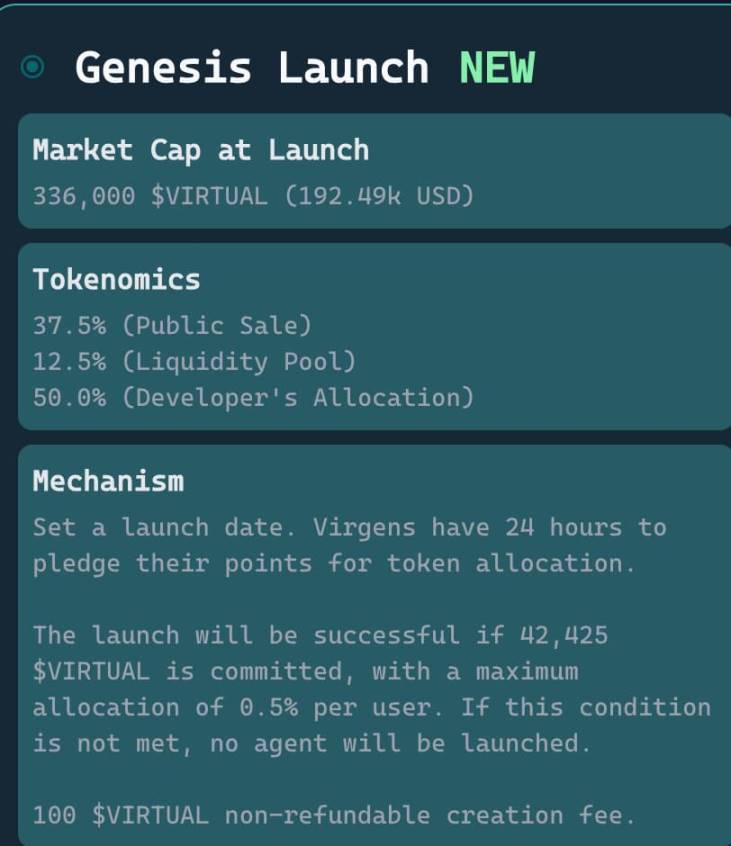
AI Agent Initiates Token Launch: Creating a new agent requires a non-refundable fee of 100 VIRTUAL tokens, regardless of the launch outcome;
-
Users Commit Points: Users have 24 hours to pledge Genesis Points to participate in the presale;
-
System Dynamically Estimates Allocations: The system calculates estimated allocations based on the total points pledged by all users. Simultaneously, users deposit a corresponding amount of VIRTUAL tokens to secure their allocation. The more points pledged, the higher the maximum possible allocation;
-
Allocation Locked: Final allocations are determined at the end of the 24-hour window based on the total committed points;
-
Launch Outcome: If the total pledged VIRTUAL is below 42,425, the launch fails and all committed points and pledged VIRTUAL tokens are fully refunded. If the total exceeds 42,425 VIRTUAL, the launch succeeds, and any excess VIRTUAL and unallocated points are fully refunded. The refund process is automatically executed by smart contracts;
-
Token Claim: After a successful launch, users claim their allocated tokens via the user interface.
Core Mechanisms of Genesis Launch
Points Acquisition System: Incentivizing Value Contribution
As mentioned, Genesis distributes agent tokens based on Genesis Points, which reflect users’ contributions to the ecosystem. This mechanism ensures tokens go to genuine contributors rather than short-term speculators.
In early April, Virtuals introduced the Virgen Points system, issuing points in real time to active supporters of the Virtuals ecosystem. Notably, points expire after 30 days—this design encourages sustained engagement and supports long-term ecosystem sustainability.
Users can earn points through the following activities:
-
Investing in Prototype Agents (pre-graduation tokens) and Sentient Agents (successfully graduated tokens that raised at least 42,425 VIRTUAL);
-
Holding VIRTUAL tokens;
-
Staking VADER (5% of daily points are allocated to VADER stakers).
Dynamic Allocation Mechanism
Genesis employs a dynamic allocation strategy where users’ estimated allocations adjust in real time as other participants commit points. However, before the 24-hour window closes, users may increase their pledged points and VIRTUAL deposits at any time, allowing flexible adjustments to their investment strategy.
Notably, participants compete for 37.5% of the total token supply during the public sale, with a per-user cap of 0.5% of the total supply—effectively preventing excessive token concentration.
Standardized Tokenomics
All AI agent projects launched via Genesis adhere to a unified token distribution framework:
-
Public Sale: 37.5% of total supply;
-
Liquidity Pool: 12.5%;
-
Developers, Treasury, Marketing (Dev/Treasury/Marketing): 50%.
Summary
Virtuals Protocol’s Genesis Launch mechanism, powered by its contribution-driven allocation model and dynamic adjustment strategy, establishes a more transparent and efficient launch platform for AI agent projects and participants within its ecosystem. It not only significantly reduces the risk of market manipulation but also drives the sustainable and healthy growth of the Virtuals ecosystem.
Join TechFlow official community to stay tuned
Telegram:https://t.me/TechFlowDaily
X (Twitter):https://x.com/TechFlowPost
X (Twitter) EN:https://x.com/BlockFlow_News
 Foresight News






