








ZK crashed, how are the Layer2 Four Heavenly Kings doing now?
TechFlow Selected TechFlow Selected
ZK crashed, how are the Layer2 Four Heavenly Kings doing now?
The project that once taught us our first lesson on the blockchain is now itself scrambling to survive.
 Navigating Web3 tides with focused insights
Author: Scof, ChainCatcher

What Happened
On the evening of April 15, ZKsync's token ZK experienced an abnormal price drop, falling over 14% within 24 hours and briefly dropping below $0.04. Following the incident, exchanges including Bithumb suspended deposits and withdrawals for ZK.
According to on-chain data, the actual attack occurred around 8 PM on April 13 (UTC+8). The attacker accessed an admin account of an airdrop distribution contract and called the sweepUnclaimed() function, minting approximately 111 million unclaimed airdropped tokens. The attacker then gradually sold about 66 million of these tokens and transferred them across chains. By the time the event was publicly disclosed on April 15, around 44.68 million tokens remained in the attacker’s address.
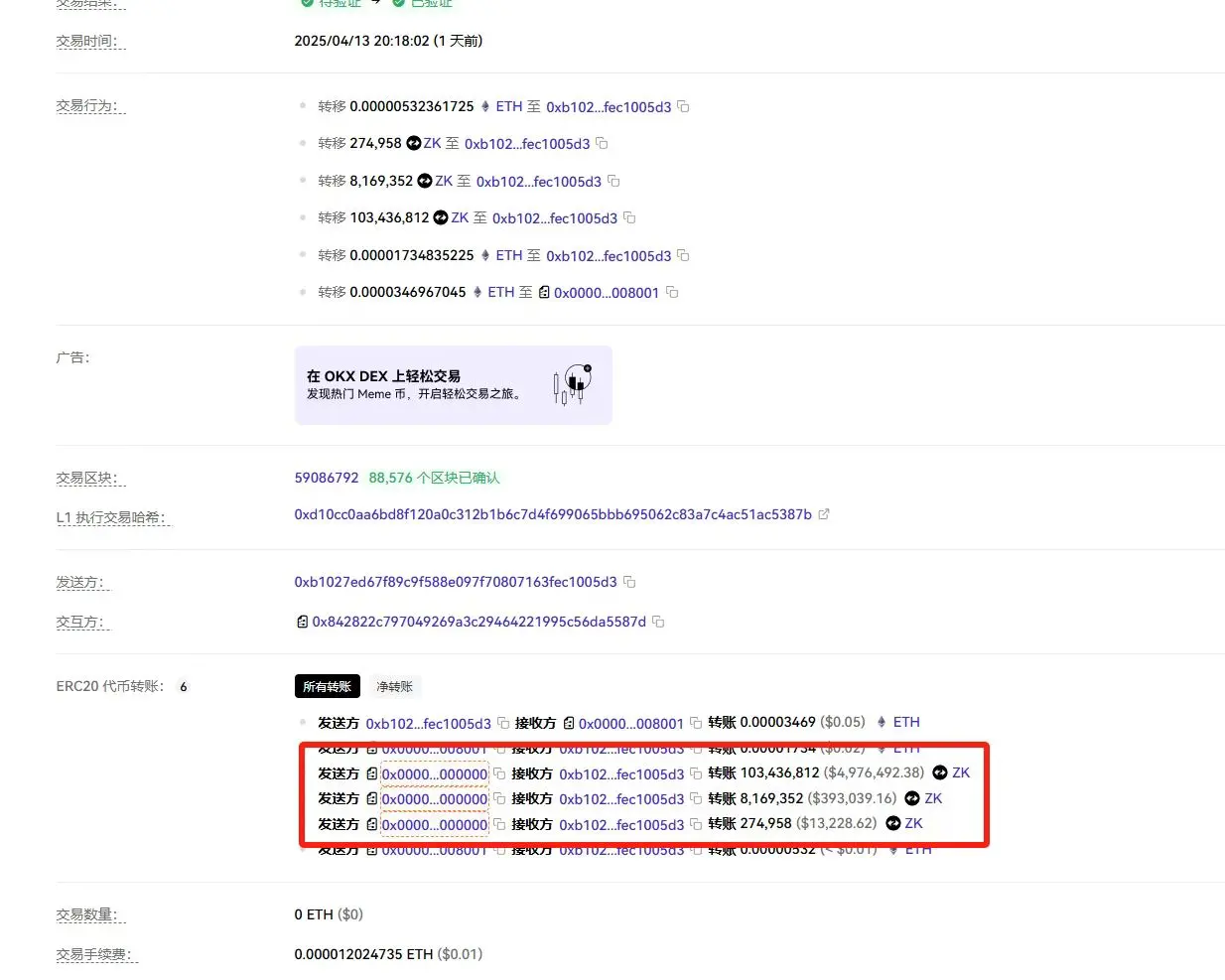
At 9 PM on April 15, the community first reported this abnormal minting and dumping activity on social media platforms. ZKsync officially confirmed that the incident stemmed from the compromise of admin private keys for three airdrop distribution contracts, resulting in unauthorized token minting. The team emphasized that only the airdrop contracts were affected, with no impact on the core ZKsync protocol, the main ZK token contract, governance contracts, or other token distribution plans. Circulating supply increased by approximately 0.45%, equivalent to about $5 million in value.
On the night of the incident, the ZKsync team coordinated with exchanges in an attempt to freeze related funds and urged the attacker to return the tokens to avoid legal consequences. They stressed that the exploited vulnerability could no longer be reused and that the rest of the system remained secure.
Following the event, ZK briefly rebounded but has yet to recover to pre-incident levels. Investigations are ongoing, and the project team stated they will release further details later.
From "Four Heavenly Kings" to "Doomed"?

ZKsync, Arbitrum, Optimism, and Starknet—once collectively hailed as Ethereum Layer2’s "Four Heavenly Kings"—have taken vastly different paths. Notably, many people I know began their journey into blockchain through farming airdrops from these very projects, learning foundational concepts like wallets, interactions, and gas fees along the way. These projects not only represent technical efforts to scale Ethereum but also served as gateways into crypto for countless users.
Both ZKsync and Starknet belong to the ZK Rollup camp and were once seen as representatives of technical excellence, emphasizing higher security and data validity. ZKsync promotes zkEVM compatibility to leverage existing Ethereum tooling and lower developer barriers, while Starknet sticks with its proprietary Cairo language framework, achieving greater performance potential at the cost of slower ecosystem growth. In contrast, Arbitrum and Optimism adopted the earlier-maturing OP Rollup approach, using optimistic proofs for transaction finality and quickly gaining market traction due to superior developer tooling and compatibility.
In terms of ecosystem development, Arbitrum is currently the strongest performer, hosting established native DeFi projects like GMX and maintaining a diverse application landscape. Optimism has focused more on governance and architectural expansion, launching the OP Stack and partnering with Coinbase to roll out Base mainnet—laying the foundation for a "modular alliance chain" structure. ZKsync’s ecosystem buzz peaked around its airdrop period; afterward, numerous projects abandoned the chain, severely damaging user and developer confidence. Starknet continues to face slow development cycles and lags behind in ecosystem expansion.
When it comes to user activity, Arbitrum remains far ahead, leading in both active addresses and transaction volume. Optimism follows closely behind. ZKsync saw a spike during its airdrop phase, but activity rapidly declined and daily active users have since dropped to low levels. Starknet maintains steady but stagnant metrics, struggling to achieve meaningful growth.

Total Value Locked (TVL) clearly reflects the gap between these projects. According to DefiLlama, Arbitrum leads all L2s with $2.1 billion in TVL, demonstrating some degree of economic self-sustainability. Optimism maintains high expectations thanks to the extensibility of OP Stack. ZKsync has consistently underperformed in revenue generation, with TVL only fluctuating slightly around key events and showing little sustained growth. Starknet faces similar challenges, with both income and TVL remaining small.
Cross-chain bridge inflows further highlight disparities in ecosystem vitality. Per Dune analytics, Arbitrum’s official bridge has cumulatively bridged over 4 million ETH, ranking first among all Layer2 projects. ZKsync ranks second with approximately 3.7 million ETH bridged—a seemingly strong figure—but recent activity shows a sharp decline. In the past seven days alone, only 14 users utilized ZKsync’s official bridge, transferring just 5 ETH in total, nearly indicating operational stagnation. Meanwhile, Optimism and Starknet have not surpassed 1 million ETH in cumulative bridging volume.

Notably, despite Arbitrum’s solid performance in on-chain ecosystem growth and continued user engagement, its token price has been disappointing. From a peak of around $2.4 last year, ARB has dropped over 88%. Yet, its market cap still holds above $1.3 billion. This divergence may stem from continuous token unlocks since launch, creating persistent selling pressure and weighing down price performance.
The former "Four Heavenly Kings" of Layer2 once symbolized Ethereum's scaling future and served as entry points for millions. But after experiencing technological deployment, airdrop speculation, security incidents, and project divergence, today’s Layer2 landscape no longer shines as brightly.
The once-repeated promises of “high performance, low cost, strong security” now seem less compelling. How long can narratives built around Layer2 as an entry point endure? Amid constant outflows of capital and attention, are Layer2 solutions truly bridges to mass adoption—or merely transitional phases? Will the projects once full of promise stall mid-evolution?
Join TechFlow official community to stay tuned
Telegram:https://t.me/TechFlowDaily
X (Twitter):https://x.com/TechFlowPost
X (Twitter) EN:https://x.com/BlockFlow_News
 ChainCatcher 链捕手









