








"Tit-for-tat tariff war" enters second phase, global risk assets begin bottoming out
TechFlow Selected TechFlow Selected
"Tit-for-tat tariff war" enters second phase, global risk assets begin bottoming out
Whether the subsequent "reciprocal tariffs" will escalate tensions, whether the Federal Reserve will cut interest rates "in a timely manner," and whether the U.S. economy will fall into recession have become key points of observation.
 Navigating Web3 tides with focused insights
By 0xWeilan
BTC opened the week at $78,370.15 and closed at $84,733.07, rising 6.84% for the week with a volatility of 14.89%. Trading volume continued to expand noticeably. For the first time since late January, BTC price effectively broke above the upper boundary of its descending channel, approaching the 200-day moving average.
This week, Trump's "reciprocal tariff war" remained the biggest exogenous variable in global macro finance. Its dramatic developments stunned the world, while China responded with its strongest countermeasures yet.
In this game of mutual confrontation, the side that blinks first is likely to lose. Launching tariffs against the entire world has triggered visible or latent resistance from global forces across politics, business, and capital markets.
Ultimately, this led to capital flight from U.S. markets, resulting in a rare triple sell-off across U.S. stocks, bonds, and the dollar.
Facing mounting financial crisis, the Trump administration chose to back down—either partially delaying implementation of reciprocal tariffs, reducing their intensity, expanding exemptions, or signaling goodwill toward its main rival, China, through public statements. As such, the "reciprocal tariff war" gradually entered its second phase, with multiple parties expected to begin negotiations and compromise.
Risk asset markets, which had plummeted during the initial phase, rebounded sharply. Perhaps the most dangerous stage triggered by the reciprocal tariff conflict is behind us—but ensuing chaos will continue to dominate all markets. The crisis won't dissipate easily, nor will it avoid triggering new crises. Whether subsequent tariff actions escalate further, whether the Fed will cut rates "in time," and whether the U.S. economy slides into recession have become key focal points.
Policy, Macro Finance & Economic Data
As most countries lacked the capacity to counter the "reciprocal tariffs," China and the EU emerged as the primary forces resisting American hegemony, with China’s tit-for-tat response serving as the backbone.
After several rounds of escalation, U.S. tariffs on Chinese goods reached 145%, while China’s retaliatory tariffs on U.S. goods climbed to 125%. This effectively eliminated the possibility of normal trade, prompting China to announce it would no longer respond to any further U.S. tariff hikes.
On April 10, the U.S. suspended reciprocal tariffs on most countries (excluding China), retaining a 10% "base tariff" while initiating negotiations. U.S. equities surged in response, with the Nasdaq recording the second-largest single-day gain in history.
China’s seemingly passive stance actually placed immense pressure on the U.S. On April 12, the U.S. exempted certain Chinese products from the 145% "reciprocal tariff," including smartphones, tablets, laptops, semiconductors, integrated circuits, flash memory, and display modules.
What truly pushed the Trump administration into the "second phase" wasn’t just China’s retaliation—but also strong opposition from within the U.S. political and business communities, along with severe turmoil in stock, bond, and currency markets.
On Monday, April 7, all three major U.S. equity indices plunged sharply to new lows, entering or nearing technical bear market territory. The next day, the VIX fear index spiked to 52.33—the third-highest level since the 2008 subprime crisis and the 2020 pandemic crisis.
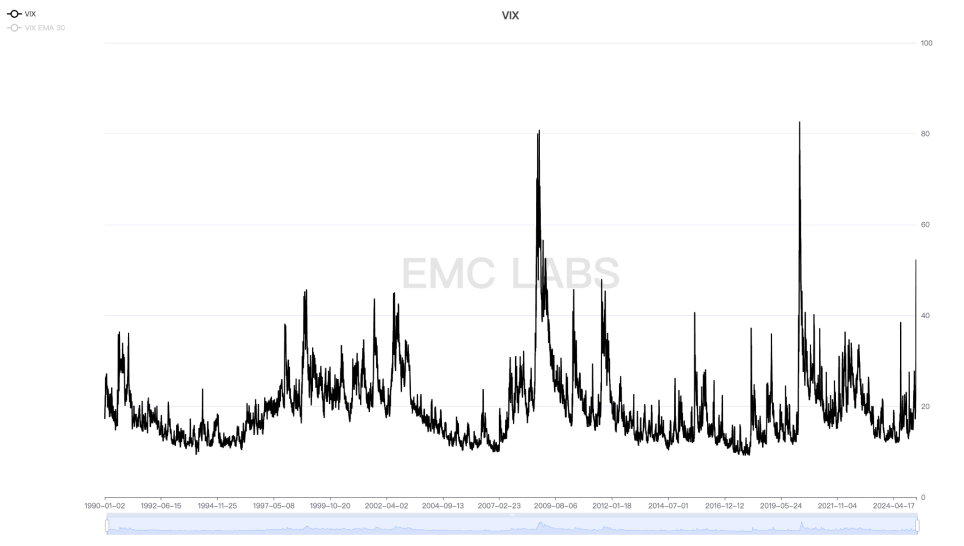
S&P 500 VIX Index
Meanwhile, short-term Treasury yields fell as low as 3.8310% on Thursday, while long-term yields rebounded sharply on Friday, closing at a high of 4.4950%.
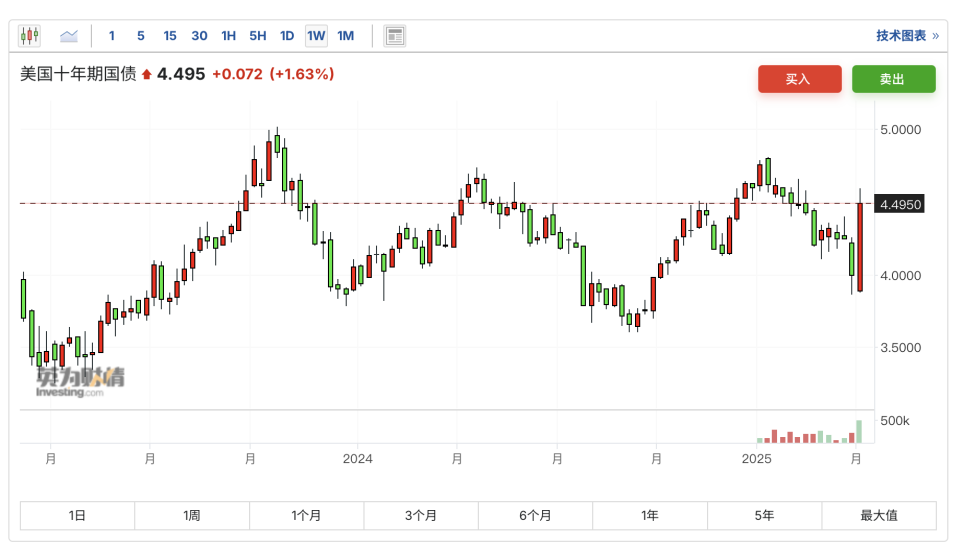
U.S. 10-Year Treasury Yield
Following massive selloffs in equities, bond investors joined the retreat. Combined with capital outflows from the U.S. to Europe and other regions, the U.S. Dollar Index (DXY) also declined sharply.
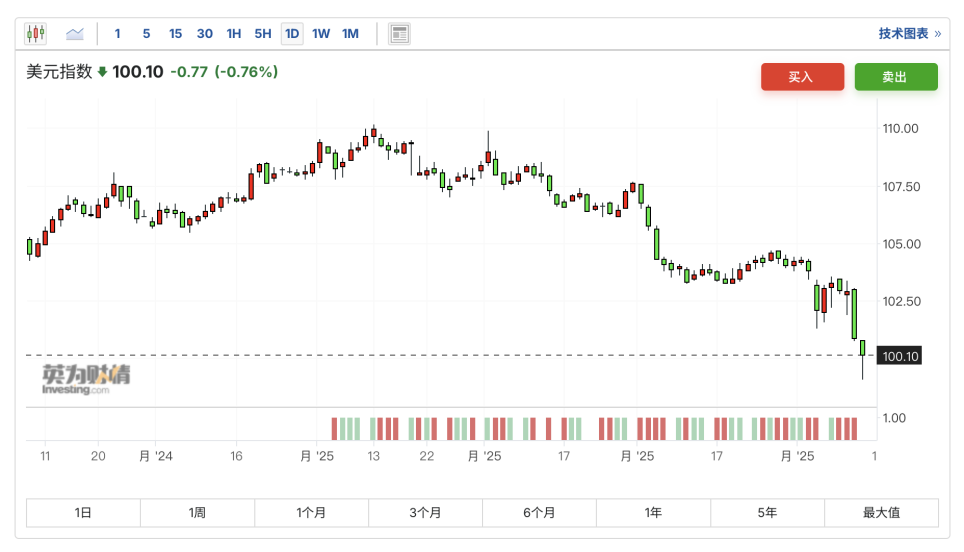
U.S. Dollar Index
The triple blow to stocks, bonds, and the dollar forced the Trump administration to signal a de-escalation of the tariff war and release an exemption list. At the same time, the Federal Reserve turned dovish. Boston Fed President Collins stated in a Friday interview with the Financial Times that the Fed was “absolutely prepared” to deploy various tools to stabilize financial markets if necessary.
Tariff relief and verbal support from the Fed temporarily calmed U.S. financial markets. On Friday, all three major indices ended the turbulent week with gains.
EMC Labs assesses that the U.S. reciprocal tariff war has entered Phase Two. Market fears have eased slightly, and markets are beginning to bottom out. However, given the Trump administration’s unpredictability and significant risks around U.S. economic recession and inflation (this week’s University of Michigan consumer sentiment index dropped further to 50.8), a V-shaped recovery remains unlikely.
Selling Pressure & Liquidations
This week saw some easing in selling pressure from both short-term and long-term holders, halting three consecutive weeks of panic-driven liquidations. Total on-chain sales amounted to 188,816.61 BTC, with 178,263.27 BTC sold by short-term holders and 10,553.34 BTC by long-term holders. Short-term holders incurred large losses again on April 7 and April 9 amid global market panic.
Long-term holders continue to act as a stabilizing force, accumulating nearly 60,000 BTC this week, reflecting ongoing tightness in market liquidity. By weekend close, short-term holders remained collectively underwater by approximately 10%, indicating persistent market stress.
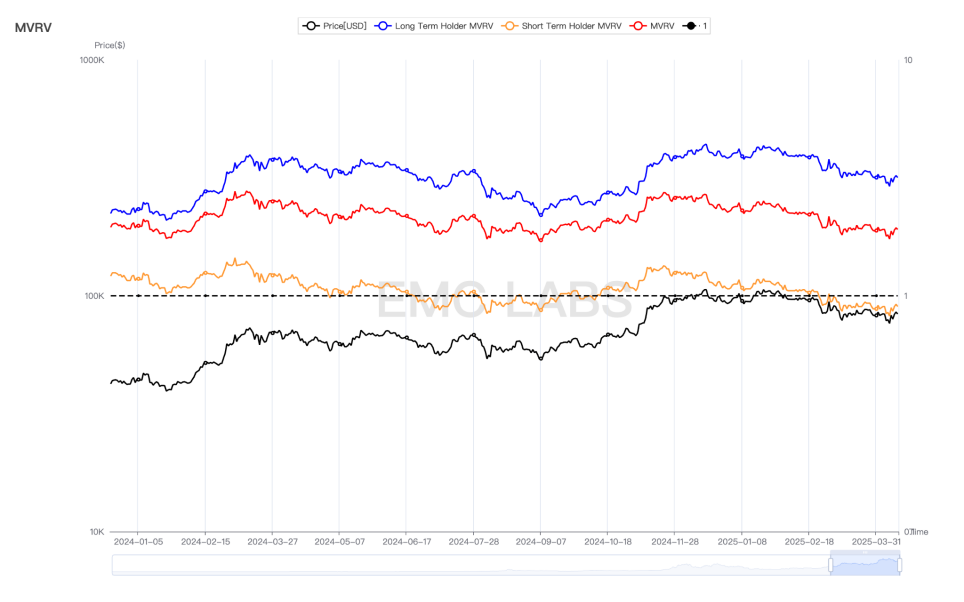
On-chain Market-Wide Unrealized PnL
Cycle Indicators
According to eMerge Engine, the EMC BTC Cycle Metrics indicator stands at 0.125, suggesting the market is in a mid-cycle recovery phase.
Join TechFlow official community to stay tuned
Telegram:https://t.me/TechFlowDaily
X (Twitter):https://x.com/TechFlowPost
X (Twitter) EN:https://x.com/BlockFlow_News






