








Trump's "shocking moves" with heavy emphasis on loyalty tests—how will they impact the future of crypto?
TechFlow Selected TechFlow Selected
Trump's "shocking moves" with heavy emphasis on loyalty tests—how will they impact the future of crypto?
The coming months may be a true test for the entire cryptocurrency market.
 Navigating Web3 tides with focused insights
Author: Fairy, ChainCatcher
Editor: TB, ChainCatcher
In April, a series of "tariff dramas" unfolded as Trump once again stirred up massive waves across global markets.
This time, however, his wielding of the tariff stick seems to go beyond mere economic interests. Tariffs appear to have become a tool for a "compliance test"—an attempt by Trump to gauge how much economic pressure other nations are willing to tolerate and how obediently they will respond to Washington's hardline policies.
Amplified by his unconventional tactics, the global economy swiftly plunged into a deepening abyss of uncertainty: stock markets plunged, foreign exchange markets fluctuated wildly, and the crypto market was dragged down with them—Bitcoin rode a rollercoaster as fear and speculation spread hand in hand.
Within this climate of uncertainty and strategic probing, how will the crypto market evolve? The coming months may prove to be a true test for the entire cryptocurrency ecosystem.
The Power Experiment Behind Tariffs
This tariff storm is no longer just a conventional economic policy shift—it resembles more of a raw behavioral psychology experiment.
"Who will obey? Who dares resist? Who chooses silence?"
Trump plays the role of a manipulator, creating uncertainty and carefully adjusting variables to observe reactions from countries worldwide. Tariffs are no longer merely economic instruments—they've become his "compliance test" button.
The rhythm of this latest "test" has been tightly orchestrated: first, broad-based tariffs applied to create systemic pressure; then, an opening for negotiations dangled to invite dialogue; followed by a temporary suspension of tariffs on most countries to signal de-escalation, while applying maximum pressure on those who "resist."
Below is a timeline of the tariff events, revealing the calculated progression of this "test":
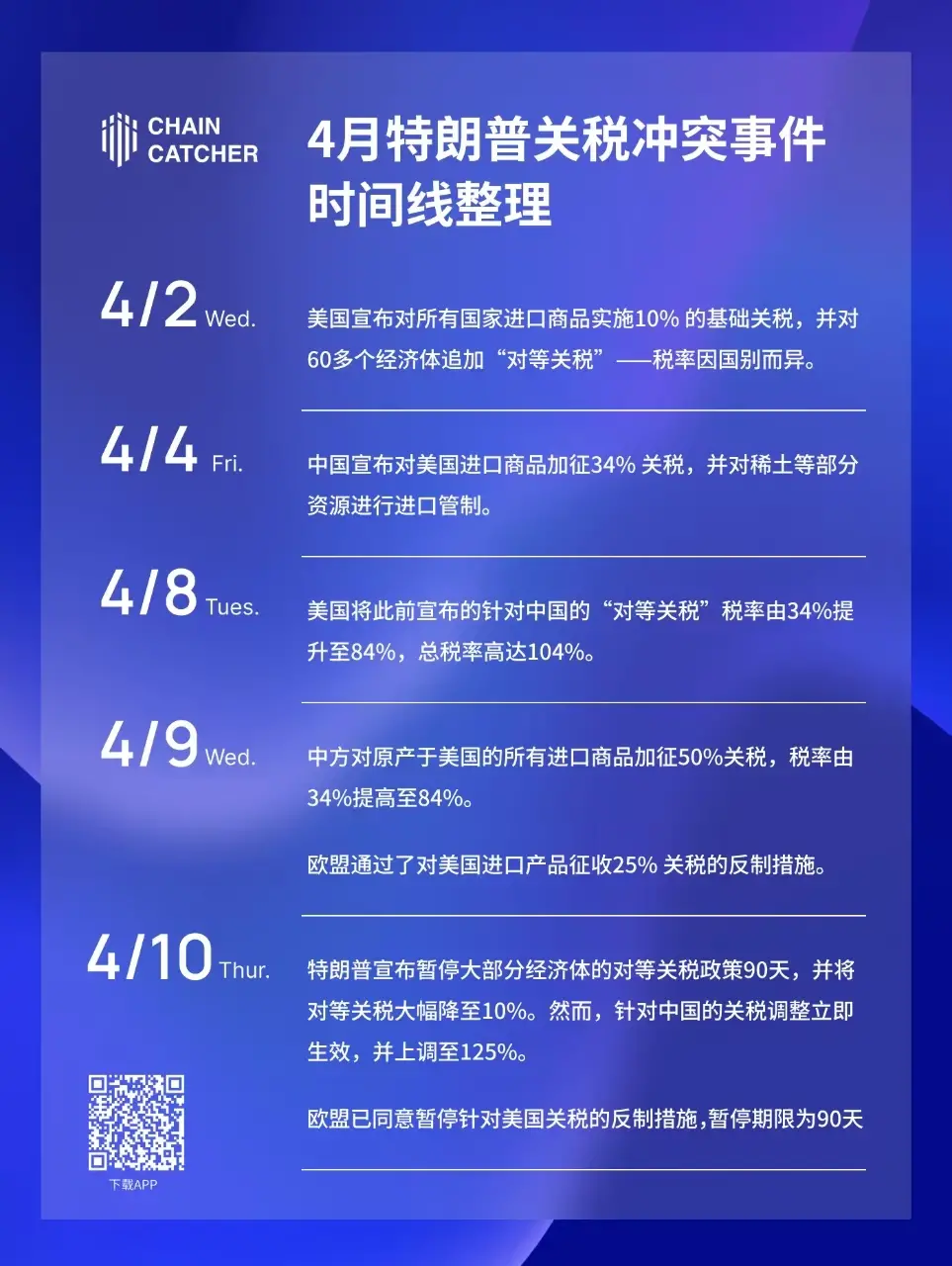
"China has shown great disrespect toward world markets. I hereby announce that the United States will raise its tariffs on China to 125%. Over 75 countries have called U.S. representatives to begin negotiations. Upon my strong recommendation, none of these countries have retaliated against the United States in any way. I have authorized a 90-day pause."
Trump’s statement reads less like a diplomatic announcement and more like a "progress report" on his compliance test—translated simply: "You behave, I pause for 90 days; you talk back, I hit you with 125% tariffs."
Yet, this is far from over. The 90-day "pause" feels more like a silent observation period—a buffer zone. No one can predict what Trump will do next. What remains for global markets is a heavier cloud of uncertainty and deeper strategic maneuvering.
As this "compliance experiment" continues to shake financial systems, what does the future hold for the crypto market?
Bitcoin's Rollercoaster Ride: A Bull Trap or the Dawn of a New Era?
Last week, Bitcoin briefly dropped below $77,000—but after Trump announced a 90-day suspension of reciprocal tariffs on most countries, prices quickly rebounded, surpassing $82,000. Still, market interpretations of this policy shift vary widely.
Viewpoint One: The Crypto Rally Might Be a "Bull Trap"—Proceed with Caution
QCP Capital, a crypto investment firm, argues that Bitcoin’s current rally could represent a "classic bull trap." While Trump’s decision to pause new tariffs lifted Bitcoin and other cryptocurrencies, his continued escalation against China may prompt strong countermeasures from Beijing—turning short-term market euphoria into a classic bull trap.
QCP adds that although the temporary policy adjustment has eased market anxiety in the short term, risks remain. Market makers may use this rally as an opportunity to offload holdings, especially given potential selling pressure in the coming months. Therefore, QCP advises investors to remain cautious.
Jeff Mei, COO of BTSE, shares a similar view: "The market reaction reflects optimism that most trade partners will enter negotiations with the U.S., avoiding a full-scale trade war. That said, continued tariff hikes on China and Beijing’s retaliatory measures could trigger a major realignment of global trade, fundamentally altering how the global economy operates. Until we see how this process unfolds over the coming months, we remain cautious."
Viewpoint Two: Tariff Tensions Will Fade—Crypto Could Surge by August–September
Charles Hoskinson, founder of Cardano, holds a more optimistic outlook on the future of crypto. He believes tariff tensions will ultimately lose their bite, as the world realizes that negotiations are underway and that this is part of the broader U.S.-China power struggle. He notes that some countries will side with the U.S., others with China, but eventually, markets will stabilize. People will adapt to this new normal, and the Federal Reserve may begin cutting interest rates. With large amounts of capital flowing into financial markets, a significant portion could eventually pour into crypto.
He predicts: "The crypto market may stagnate for the next three to five months, but by August or September, we could see a surge in speculative interest—a wave that might last six to twelve months."
Viewpoint Three: Short-Term Volatility, Long-Term Boost for Bitcoin Adoption
Grayscale argues that the crypto market’s near-term performance will hinge on trade negotiations between the White House and other nations. While these talks could lead to reduced tariffs, setbacks and retaliatory actions along the way may still amplify market volatility, leaving trade conflicts highly uncertain in the coming weeks.
Nevertheless, Grayscale points out that Bitcoin’s price volatility is significantly lower than that of the stock market, and speculative traders hold smaller positions within the crypto market. If macroeconomic risks ease in the coming weeks, they believe the crypto market is poised for a rebound.
In the medium to long term, Grayscale suggests that higher tariffs could positively impact Bitcoin—especially if they contribute to stagflation and weaken demand for the U.S. dollar. As international trade patterns shift, Bitcoin could see broader adoption, particularly in scenarios where dollar demand declines.
Matt Hougan, Chief Investment Officer at Bitwise, similarly believes that increased tariffs will lead to a weaker dollar. Given Bitcoin’s inverse correlation with the U.S. Dollar Index, dollar depreciation typically coincides with rising Bitcoin prices. In the long run, a weakening dollar could propel Bitcoin and other hard assets into the role of emerging reserve assets.
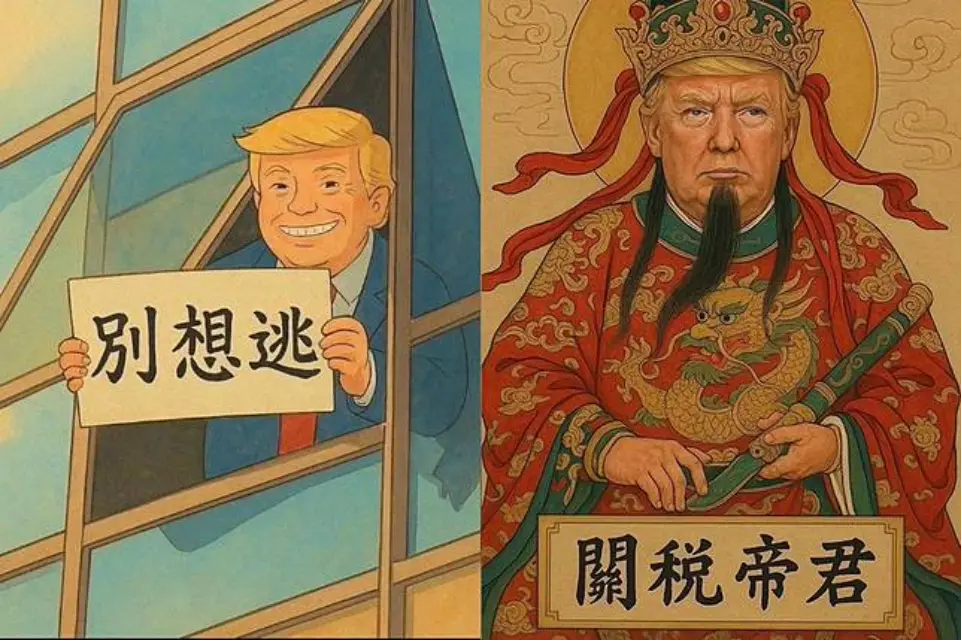
Finding certainty amid chaos, building order from disorder. Since its inception, Bitcoin has weathered countless storms. Regardless of how Trump’s policies evolve, the crypto market has repeatedly demonstrated its resilience in times of uncertainty.
The path ahead remains unclear. All we can do is wait—and let time reveal the final act of this unfolding drama.
Join TechFlow official community to stay tuned
Telegram:https://t.me/TechFlowDaily
X (Twitter):https://x.com/TechFlowPost
X (Twitter) EN:https://x.com/BlockFlow_News
 ChainCatcher 链捕手











