With total funding reaching up to $85 million, what is Blackbird—a Web3 project targeting the restaurant industry—playing at?
TechFlow Selected TechFlow Selected
With total funding reaching up to $85 million, what is Blackbird—a Web3 project targeting the restaurant industry—playing at?
The trillion-dollar food and beverage economy is the most fundamental and largest consumer sector, making it an ideal "testing ground" for widespread adoption of cryptocurrency.
 Navigating Web3 tides with focused insights
By Zen, PANews
Recently, Web3 restaurant loyalty and payment platform Blackbird announced it has successfully raised $50 million in its Series B funding round. Amid a prolonged downturn in the primary market, this substantial raise highlights the crypto industry's anticipation for mass adoption of consumer-facing applications—and reflects strong confidence from top-tier crypto investors in the project’s potential.

In the traditional restaurant industry, high intermediary commissions and various service fees have become an unbearable burden for many small and medium-sized restaurants, prompting urgent demand for new solutions. At the same time, the cryptocurrency sector is in dire need of genuine consumer-facing products and practical use cases. Two industries facing their own challenges may now find synergy by complementing each other through deep integration.
So what exactly is Blackbird building on blockchain and cryptocurrency technology, and how much potential does it hold?
$85 Million Raised, Targeting the Massive Restaurant Market
Founded by Ben Leventhal, Web3 restaurant loyalty and payments platform Blackbird aims to revolutionize loyalty and payment systems within the restaurant industry. Leventhal brings over 20 years of experience in food and technology—back in 2005, he co-founded Eater, a food media site initially focused on New York City’s dining and nightlife scene, which was later acquired by digital media company Vox Media in 2013. In 2014, he co-launched Resy, an online restaurant reservation platform that American Express acquired in 2019.

Ben Leventhal, Founder of Blackbird
After years immersed in the restaurant industry, Leventhal came to recognize the limitations of traditional loyalty and reservation systems. While they can drive short-term traffic, they fail to create truly “deeply connected” long-term relationships between restaurants and diners. He believes that for the restaurant industry to achieve sustainable economic development, it must ensure restaurants retain more value and build a reward and loyalty ecosystem—this insight gave rise to Blackbird and defines its mission.
Food is fundamental. The multi-trillion-dollar restaurant economy represents one of the largest and most basic consumer sectors—an ideal “testing ground” for cryptocurrencies to achieve widespread adoption. As such, Blackbird, aiming to break through via consumer applications built on blockchain and crypto technology, has drawn significant attention and support from leading crypto venture capitalists. According to public information, since its founding in 2022, Blackbird has raised approximately $85 million in total:
-
October 2022: Blackbird announced an $11 million seed round led by Union Square Ventures, Shine Capital, and Multicoin Capital;
-
October 2023: Blackbird closed a $24 million Series A round led by a16z Crypto, with participation from QED, Union Square Ventures, Shine, Variant, and several restaurant groups;
-
April 2025: Blackbird completed a $50 million Series B round led by Spark Capital, with Coinbase and a16z crypto among participants. Leventhal noted the funds were secured in Q4 2024 and declined to disclose the implied valuation.

Blackbird Investors Lineup
Arianna Simpson, General Partner at a16z, pointed out that the restaurant industry consists of millions of local small business owners globally, who are largely at the mercy of tech platforms that extract significant commissions from restaurant profits—commissions that often keep rising. This, she said, is where blockchain can make a difference: improving profit structures. "Ben Leventhal’s vision is to build a network owned by restaurants and diners themselves—and only blockchain makes that possible," she stated.
Disintermediation and Low Cost: Flynet Mainnet Built for Restaurants
One of Blackbird’s key goals is eliminating unnecessary intermediaries—including payment processors and other third-party services standing between restaurants and customers. Leventhal estimates that restaurants typically lose 3% to 5% of revenue to these third parties, despite receiving little commensurate value in return. By building a blockchain-based platform, Blackbird seeks to establish a more direct connection between restaurants and diners, reducing costs and enhancing the overall dining experience.
On February 27, 2025, Blackbird officially launched the Flynet mainnet. Built as a Layer 3 on Base, Coinbase’s Layer 2 chain, Flynet aims to move restaurant payments and membership rewards fully onto the blockchain, creating a new model for disintermediated, low-cost payments and incentives.
Flynet is Blackbird’s transaction network tailored specifically for the restaurant industry. On this foundation, Blackbird will build a rewards and loyalty ecosystem designed to optimize connections among three core stakeholders: restaurants, diners, and staff—recording activities between any two parties. According to Ben Leventhal, Flynet offers four key advantages:
-
Reduced Intermediary Costs: Traditional credit card processing fees exceed 3.75%, while Flynet charges a flat 2% fee, returning 1.5% instantly to restaurants for customer acquisition and retention;
-
Data Ownership Returned: Both restaurants and consumers gain control over their data and can selectively share it, enabling deeper insights into customer preferences and improved marketing efficiency;
-
Seamless Modern Experience: Integrated with the Blackbird app, customers can pay instantly via QR code or one-click checkout without physical cards or waiting for bills—enabling true second-level on-chain settlement;
-
Unlocking a New Loyalty Economy: Flynet supports a cross-restaurant tokenized points system. Restaurants can design customized reward programs based on on-chain behavior and incentivize frequent users with exclusive experiences like hidden menus or chef meetups.
As a decentralized network, Flynet is ultimately intended to be governed by its users—holders of the native $F2 token. $F2 serves as the native currency of the Flynet mainnet, used to pay gas fees and confer governance rights. The team plans to airdrop 13% of the token supply to early users and restaurants, with the remaining 87% allocated to internal stakeholders, treasury, and future growth-phase participants. The previously designed $FLY token will remain as a loyalty point within the Blackbird app, redeemable for meal discounts and platform benefits.
In addition, upon Flynet’s launch, Blackbird introduced a developer portal inviting ecosystem partners and developers to build additional applications on the network, including data visualization tools, data markets, consumer analytics, third-party access, and marketing solutions.
Blackbird Club: A Tiered Loyalty Program Beyond Points
Alongside the $50 million Series B announcement, Blackbird unveiled Blackbird Club—a tiered loyalty program designed to reward its most dedicated users through surprise and exclusive experiences rather than simple point redemptions. Members receive generous perks, including guaranteed reservations, early access to events, tasting sessions of secret menus, and private gatherings for friends and family.
"Our goal in creating the club is to bring together exceptional restaurants and outstanding guests," Blackbird said. Founding member restaurants include Gjelina, La Tête d'Or, and Barbuto in New York; SPQR, Frances, and Octavia in San Francisco; and Leon's, Melfi's, and Renzo in Charleston.

Traditional restaurant loyalty programs follow a “swipe-and-collect-points” or “spend-back” model—more spending equals more points, which can be redeemed for vouchers or discounts. This approach, known as Transactional Loyalty, essentially rewards “money spent” rather than meaningful relationships.
Blackbird Club introduces Experiential Recognition—the idea that making customers feel genuinely “welcomed” and “special” isn’t about points, but about whether they’re integrated into the restaurant’s culture, forming emotional bonds and identity recognition. Through three pillars—rewards, access, and convenience—and two membership tiers (Blackbird Club 3X and Blackbird Club 5X)—the program shifts focus from pure spending to visit frequency and community contribution. It values whether you're part of the restaurant’s culture—not just the size of your wallet.
At its core, Blackbird transforms loyalty from a tool into a cultural bond—merging Web3 technology with emotional dining experiences to restore warmth, respect, and community to the act of eating out. Blackbird also plans to launch a version for restaurant professionals, offering recognition and rewards to chefs, servers, and managers—groups often overlooked under traditional loyalty models. As Blackbird puts it: "Those who take good care of guests should also be well taken care of."
Web3 Loyalty Programs: High Potential, But Hard to Execute?
Customer loyalty has always been a critical battleground for brands competing for consumer attention. Especially in the restaurant industry, when taste and quality control offer limited differentiation, businesses often rely on innovative models and marketing strategies to deliver novel and enjoyable experiences—forging deeper emotional ties with customers.
Taking Luckin Coffee as an example, its “user-as-member” operating model disrupted traditional point systems by lowering participation barriers and dramatically increasing user reach. Regular push notifications with time-limited offers and friend-sharing incentives have effectively boosted repurchase rates. Additionally, brand collaborations have proven powerful in refreshing user perception and amplifying exposure. Luckin’s partnerships with Maotai and *Tom and Jerry* sparked widespread buzz and became cultural phenomena; more recently, McDonald’s collaboration with *Minecraft* gained popularity on social media due to its creativity and interactivity.
In contrast, Web3 loyalty programs have yet to find a viable path. Starbucks Odyssey, once hailed as a promising NFT-based loyalty initiative, was ultimately discontinued in March 2024. Its failure underscored issues such as complex participation processes, unclear value propositions, and declining mainstream interest in digital collectibles after the NFT hype faded. This suggests that merely granting users ownership of an NFT is far from sufficient to build a sticky, enduring loyalty system.
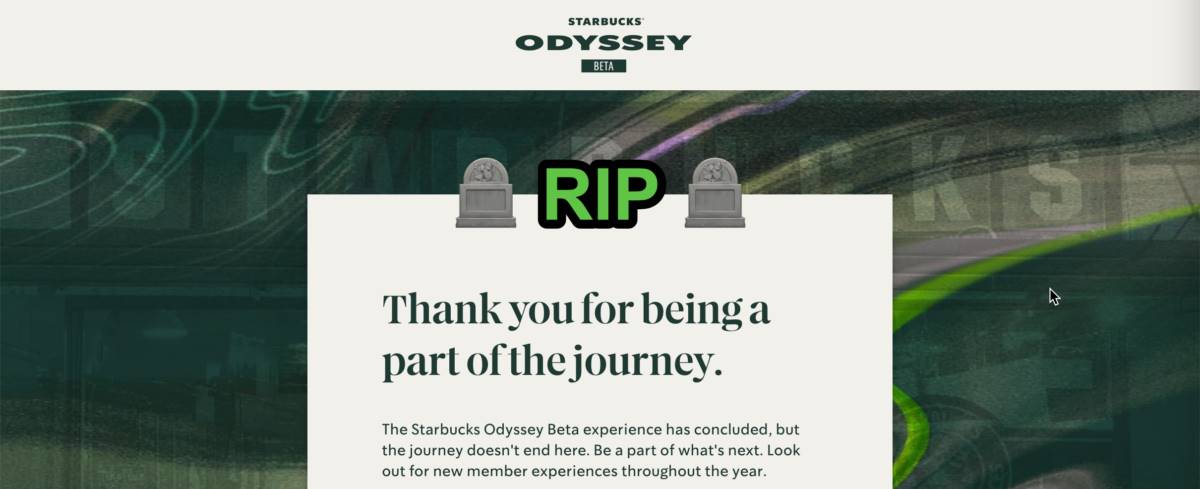
"In Memoriam": Starbucks Odyssey
Jesse Walden, founder and managing partner of Variant, argues that truly sustainable loyalty ecosystems—like Blackbird—should be built on decentralized transaction networks, where every purchase is recorded on-chain and users are incentivized and empowered through native tokens, generating network effects and long-term engagement. In contrast, Odyssey offered only one-way NFT distribution, lacking on-chain interactions and token mechanisms, making it difficult to sustain user participation or foster community co-creation.
Of course, for a still-early-stage project like Blackbird, numerous challenges lie ahead—including regulatory uncertainty, market volatility, and the risk that token price fluctuations and speculative behavior could undermine the project’s core value proposition. Moreover, in an environment where traditional loyalty operations are already mature and competition fierce, it remains uncertain whether Blackbird can maintain lasting competitive advantage. Even more fundamentally, there is broad debate over whether blockchain is truly an essential infrastructure for such systems.
As Blackbird founder Ben Leventhal candidly admitted: "I don’t think it necessarily needs to be built on blockchain." He noted that Visa’s network, in some ways, follows principles similar to Flynet—yet operates without blockchain.
"We do believe that over time, certain opportunities will emerge as critically important—and those will be rooted in being on-chain," Leventhal added. These include how Blackbird and restaurants store customer profiles and activity data, and tie into his broader vision: that every restaurant guest could eventually become a shareholder of Blackbird.
Join TechFlow official community to stay tuned
Telegram:https://t.me/TechFlowDaily
X (Twitter):https://x.com/TechFlowPost
X (Twitter) EN:https://x.com/BlockFlow_News
 PANews