New Chair in 48 Hours, SEC Turns Into "Crypto Dad"
TechFlow Selected TechFlow Selected
New Chair in 48 Hours, SEC Turns Into "Crypto Dad"
After Paul Atkins took office, he quickly pushed for loosening cryptocurrency regulations, advancing ETF approvals, regulatory guidance, and litigation settlements simultaneously.
 Navigating Web3 tides with focused insights
By Ashley
On April 10, 2025, the SEC welcomed its new chair, Paul Atkins. Nominated by President Trump and confirmed by the Senate in a 52–44 vote, Atkins immediately declared establishing a digital asset regulatory framework as his "top priority," promising a transparent SEC that actively incorporates input from industry and consumers—marking a sharp departure from the closed, heavy-handed regulatory style of the past. Atkins quickly became the focal point for the crypto industry. Within 48 hours of taking office, a series of regulatory tailwinds emerged: multiple crypto-related lawsuits initiated under former SEC Chair Gary Gensler were dropped, the SEC issued guidance urging detailed disclosures when issuing cryptocurrencies, and even stepped in personally to guide projects on how to launch tokens. This flurry of activity has led many to wonder: Is Trump’s SEC about to become the “crypto dad”?
SEC’s New Chair Lights Three Fires of Favorable Moves
Atkins is no stranger to the SEC, nor to crypto. He previously served as an SEC commissioner from 2002 to 2008, gaining extensive regulatory experience. Afterward, he founded Patomak Global Partners, offering compliance and risk strategy consulting to financial and digital asset firms, including crypto exchanges and DeFi platforms. He also led the advocacy group Token Alliance, publicly supporting innovation in digital assets. Disclosures show he and his spouse hold up to $6 million in crypto-related assets.

On April 9, 2025, the Senate confirmed Atkins’ nomination with unanimous Republican support, signaling a major shift at the SEC—from Gensler’s enforcement-first approach to a market-friendly stance. During his tenure, Gensler launched over 100 crypto-related enforcement actions, asserting most tokens fall under securities law and maintaining a skeptical view of the industry. In contrast, Atkins advocates for principle-based regulation that provides clear, practical rules for digital assets. At his March 28 Senate Banking Committee hearing, he explicitly stated that digital assets are the SEC’s top priority for the year, pledging to work with the Commodity Futures Trading Commission (CFTC) and Congress to close regulatory gaps and enhance U.S. global competitiveness in Bitcoin and blockchain finance.
Atkins succeeds Mark Uyeda, who had served as acting chair following Gensler’s resignation in January. Under Trump’s crypto-friendly administration, Uyeda had already laid the groundwork for transformation—dropping several crypto enforcement cases and repealing SAB 121, an internal rule restricting crypto asset custody by public companies. Atkins’ arrival accelerates this deregulatory trend. His term runs until June 2026, during which he may drive significant changes in crypto regulatory policy.
Atkins’ first move ignited financial markets. His pro-market stance delivered a strong boost to the financialization of crypto assets. On his first day in office—April 10—the SEC approved options trading for spot Ethereum ETFs, a milestone that expands investor access. Additionally, Atkins supports streamlining private market regulations, proposing to redefine accredited investors based on financial sophistication rather than net worth, potentially lowering the barrier to crypto investment.
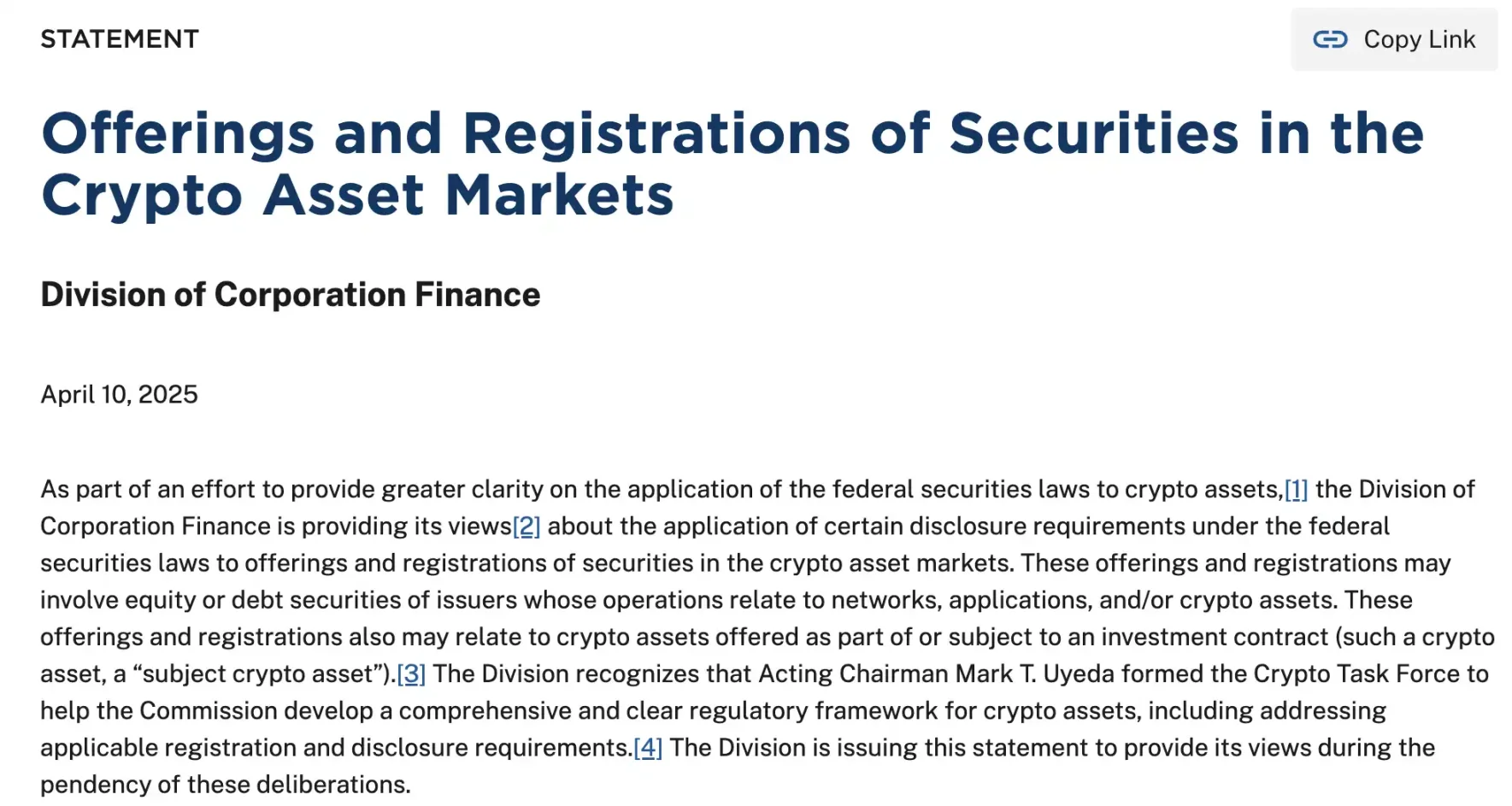
The second fire was lit through future regulatory guidance. On his second day, the SEC released non-binding guidance stating: “These offerings and registrations may involve equity or debt securities of issuers related to networks, applications, and/or cryptographic assets. They may also involve crypto assets that are part of, or subject to, an investment contract (such crypto assets referred to as ‘underlying crypto assets’).” The statement urges companies issuing or handling tokens that may be deemed securities to provide detailed disclosures—including business operations, token roles, network development milestones, and token holder rights. While it still doesn’t clarify exactly which cryptocurrencies qualify as securities, the guidance draws from the SEC’s observations of existing corporate disclosures to offer the industry a clearer reference framework. This hands-on guidance reflects a shift from “enforcement instead of oversight” to “guidance instead of enforcement,” aiming to reduce market uncertainty through communication and transparency, so the industry no longer operates on shaky ground, constantly testing boundaries.
The third fire melted away the frozen “problem cases” left over from Gary Gensler’s tenure, showing a more lenient attitude toward past crypto litigation. On April 11, Helium network developer Nova Labs announced the SEC had dropped its unregistered securities charges. Previously, the SEC had sued over three Nova Labs tokens—HNT, MOBILE, and IoT. With Atkins in charge, the case quietly ended, setting a positive precedent for similar projects. On the same day, the long-running lawsuit between the SEC and Ripple reached a settlement, with both parties jointly moving to pause the appeal; Ripple will pay a $50 million fine, while the remaining $75 million will be returned to the company.
To further promote regulatory clarity, the SEC’s Crypto Task Force plans to host four public roundtables between April and June 2025, covering crypto trading, custody, asset tokenization, and DeFi. Commissioner Hester Peirce dubbed it a “Spring Sprint to Clarity,” signaling a shift from confrontation to cooperation. The first session, held April 11, focused on “Tailoring Regulation for Crypto Trading,” with follow-up meetings exploring the convergence of traditional finance and blockchain, and the alignment of DeFi with American values.
What Other Moves Does the “Crypto Dad” Have?
Atkins’ rapid actions since taking office are deeply rooted in the broader policy environment of the Trump administration, which aligns closely with pro-crypto initiatives.
Since returning to the White House, Trump has consistently eased regulations. First, the approval process for crypto ETFs has made remarkable progress. ETF applications for XRP and Solana, previously stalled due to Gensler’s hardline stance, are now receiving more favorable reviews within the SEC. Industry insiders expect multiple ETFs to be approved within 2025, significantly boosting market liquidity. Second, market makers like Citadel Securities and Wintermute have returned, enhancing market liquidity, trading efficiency, and regulatory compliance. Meanwhile, stablecoin legislation is advancing rapidly. Trump has repeatedly voiced support for stablecoins, viewing them as tools to increase demand for U.S. Treasuries, strengthen the dollar’s digital dominance, and reinforce the greenback’s global leadership. In April, the Senate Banking Committee passed the GENIUS Act, introduced by Republican Senator Bill Hagerty, establishing licensing, reserve, and disclosure requirements for stablecoin issuers under a lightweight regulatory framework. Atkins stated the SEC will coordinate with the CFTC to clarify whether stablecoins are securities or commodities and supports state-level regulatory exemptions for stablecoins with market caps below $10 billion to encourage innovation.
Moreover, today Trump signed a bill repealing the IRS’s broker rule for DeFi platforms, removing a major obstacle to DeFi development. The 2024 rule had classified DeFi platforms as brokers, requiring them to file tax forms on users’ behalf—a move widely criticized by the industry. Trump said upon signing that the rule “stifled American innovation” and “invaded the privacy of ordinary Americans.” This marks the first crypto-related law signed by the Trump administration, underscoring a clear pattern: from appointing a market-friendly SEC chair to repealing restrictive rules, the administration is actively creating a permissive environment for digital assets, aiming to position the U.S. as a global hub for digital finance.
Under Trump’s leadership, the federal government appears to be fostering a more relaxed crypto policy climate. Multiple crypto ETFs approved, long-standing lawsuits dropped, major market makers returning, and the repeal of the DeFi broker rule—all suggest the Trump administration is trying to stimulate industry growth by reducing regulatory barriers. However, this policy shift has also raised concerns. Senator Elizabeth Warren criticized Atkins’ ties to Wall Street and advisors linked to FTX, arguing his background could compromise regulatory impartiality. Critics also warn that overly lax regulation might lead to market chaos and increased risks for investors.
Balancing strict market discipline with nurturing innovation and growth remains a challenge. Whether this “crypto dad” can strike the right balance between innovation and protection—and thereby elevate the U.S. digital asset market to global prominence—remains to be seen. One thing is certain: with strong support from the Trump administration, the SEC’s crypto policies will continue to draw global attention, and the future of America’s digital asset market may well be starting a bold new chapter here.
Join TechFlow official community to stay tuned
Telegram:https://t.me/TechFlowDaily
X (Twitter):https://x.com/TechFlowPost
X (Twitter) EN:https://x.com/BlockFlow_News
 BlockBeats