Trump lost over $500 million in one week to wage a tariff war
TechFlow Selected TechFlow Selected
Trump lost over $500 million in one week to wage a tariff war
In a highly interconnected global market, no one can truly remain unaffected.
 Navigating Web3 tides with focused insights
By Penny
Since Donald Trump announced on April 3 his plan to impose "reciprocal tariffs" on major trading partners including China, Japan, and Vietnam, stock markets worldwide have experienced varying degrees of decline. U.S. equities saw a historic crash: following the announcement, Nasdaq 100 futures plunged 4.7% in a single day, S&P 500 futures dropped 5%, and Dow Jones futures at one point fell by 1,822 points. By April 9, the S&P 500 had lost 18.9% from its February peak, wiping out $5.8 trillion in market value—the worst four-day losing streak since 1950. Technology stocks became the hardest hit: Apple's share price plummeted 23% over four days, while the combined market capitalization of seven tech giants—Microsoft, Nvidia, and others—shrank by $1.65 trillion, primarily due to risks of supply chain disruptions. With 75% of Apple’s components produced in Asia, the tariff-driven cost pressures are immense. According to Bloomberg, global equity market value has shrunk by $10 trillion overall. Vietnam’s stock market dropped over 6% in a single day, Japan’s Nikkei 225 tumbled nearly 3%, and Europe’s three major indexes all declined more than 1%.
In times of systemic collapse, no one remains unscathed. While global investors face devastating losses, Trump himself has not escaped the fallout of this worldwide downturn.
A Personal Wealth Loss of $500 Million
According to Forbes’ report on April 8, Trump’s net worth was estimated at $4.7 billion on April 2 when he unveiled his sweeping tariff proposal. But within less than a week, his fortune had fallen to $4.2 billion—a loss of $500 million in just seven days. The largest portion of this decline came from his stake in Trump Media and Technology Group (TMTG). Since April 3, the company’s stock has dropped approximately 5%. Trump owns 114.75 million shares, translating to a paper loss of about $170 million from this holding alone.
Beyond TMTG, Trump also holds significant positions in major tech companies. As a presidential candidate, he is required under Federal Election Commission (FEC) rules to file annual personal financial disclosure reports by May 15, detailing assets, liabilities, income sources—including stock investments. His most recent 2024 disclosure reveals holdings in Apple, Microsoft, Nvidia, Amazon, Alphabet (Google), Meta Platforms, Berkshire Hathaway, PepsiCo, and JPMorgan Chase, each valued between $100,000 and $1 million. Notably, his stakes in Apple, Microsoft, and Nvidia each exceed $500,000. The total value of these disclosed stocks ranges from $2.25 million to $4.75 million. If Trump did not significantly alter his portfolio after filing, the recent market plunge would have inflicted substantial paper losses on his wealth.
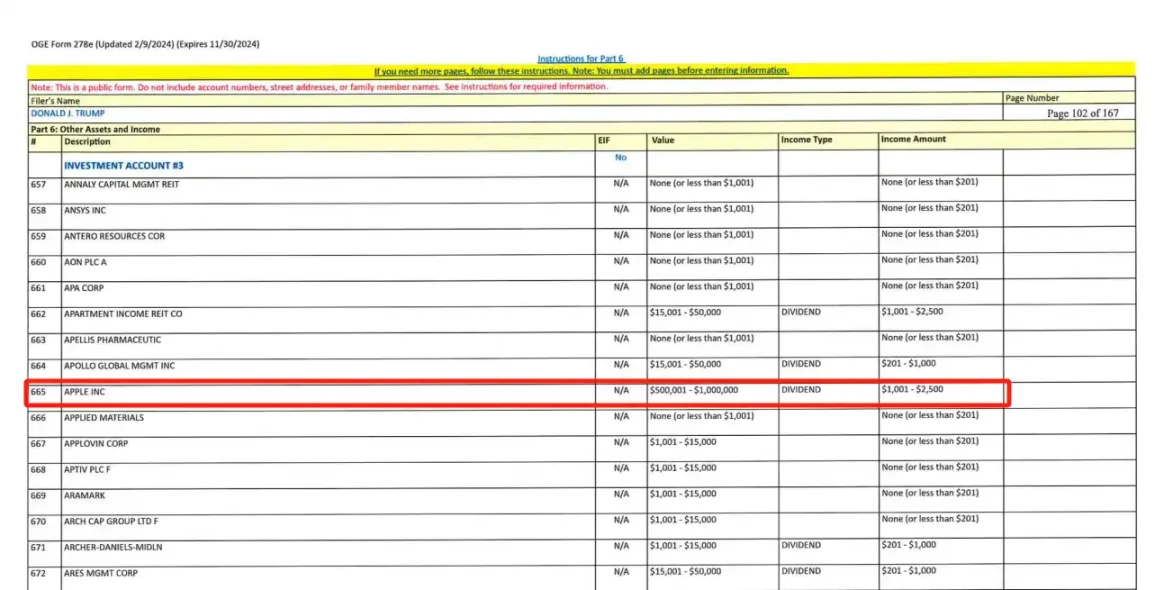
Source: Trump’s personal financial disclosure report
In addition, the real estate portfolio tied to the presidency declined in value from $660 million to $570 million during this period—a reduction of about $90 million. His golf-related assets also suffered, as many golf balls, clubs, and apparel sold through branded stores rely on imported goods.
Moreover, Trump’s family-linked crypto initiative WLFI incurred massive losses from ETH trades. On April 9, data from Lookonchain showed that a wallet likely associated with WLFI sold 5,471 ETH at an average price of $1,465, receiving $8.01 million. This address had previously spent around $210 million to purchase 67,498 ETH at an average cost of $3,259 per ETH. It now faces an unrealized loss of approximately $125 million.
World’s Richest Individuals Losing Billions Overnight
The UK’s Guardian reported that after Trump’s April 3 tariff announcement, the world’s top 500 billionaires collectively lost $536 billion in the first two days of stock trading—marking the largest two-day wealth decline ever recorded by the Bloomberg Billionaires Index. Among them, several individuals who support Trump or attended his January inauguration saw their fortunes shrink significantly, most notably Elon Musk and Mark Zuckerberg. Below is the Bloomberg Real-Time Billionaires Ranking as of April 9.
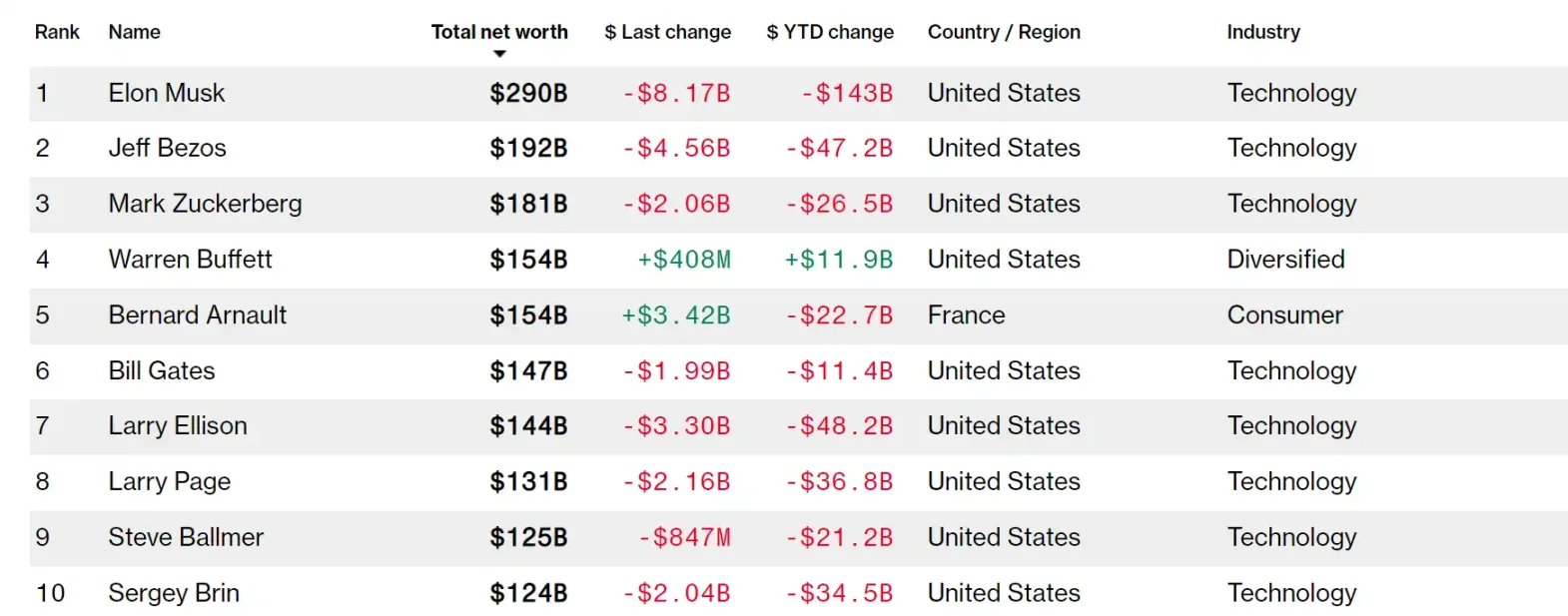
Bloomberg Billionaires Ranking as of April 9
Elon Musk, CEO of Tesla and the world’s richest person, has been one of the most prominent and controversial figures aligned with the Trump administration—and also the biggest loser. Amid the stock selloff, Musk’s net worth erased $31 billion by last Friday’s close. From the start of the year through April, his wealth has declined by approximately $143 billion. Nonetheless, he remains the world’s wealthiest individual, with a net worth of $290 billion.
Mark Zuckerberg, founder of Facebook and owner of Instagram and WhatsApp, ranked second in losses, shedding over $27 billion. The world’s third-richest person, with an estimated net worth of $181 billion, was severely impacted by Meta’s market value collapse. Tariff wars have disproportionately hurt tech firms, and Meta’s shares dropped nearly 14% over two days. Many of the world’s largest corporations depend heavily on Asian markets for manufacturing, semiconductor supplies, and IT services—regions among those facing the harshest tariffs under Trump’s policy. Just weeks before Trump took office, Zuckerberg made a high-profile “pivot to Trump,” but so far this year, his personal fortune has still evaporated by more than $26.5 billion.
Jeff Bezos, founder of Amazon and owner of The Washington Post, ranked third with a two-day loss of $23.5 billion. As the world’s leading importer of consumer goods, Amazon’s market cap has shed hundreds of billions of dollars this year. Chinese sellers account for over 50% of Amazon’s third-party marketplace, and its cloud computing division relies heavily on technology manufactured in Asia. In February, Bezos’ $10 billion Climate and Biodiversity Fund ceased funding one of the world’s most important climate certification organizations—an act some interpreted as yielding to Trump and his anti-climate agenda. Bezos, the world’s second-richest person, currently has an estimated net worth of $192 billion, down $47.2 billion so far this year.
Not all billionaires saw declines amid the two-day rout. Warren Buffett, the astute chairman and largest shareholder of investment firm Berkshire Hathaway, saw his wealth rise to $154 billion this year. Although he lost $2.57 billion during the two-day market crash, his net worth has increased by $11.9 billion year-to-date.
Trump’s tariff strategy represents a high-risk experiment that tightly binds personal political agendas with global financial markets. The massive erosion of wealth suffered by Trump and other ultra-rich individuals within just a few days not only exposes the conflict of interest between policymakers and capital markets but also reveals the self-defeating paradox of protectionism in a globalized era. When politicians attempt to build walls with tariffs, it is often their own financial empires that crumble first. For investors, this storm reaffirms a timeless truth: in today’s deeply interconnected global markets, no one can truly remain insulated.
Join TechFlow official community to stay tuned
Telegram:https://t.me/TechFlowDaily
X (Twitter):https://x.com/TechFlowPost
X (Twitter) EN:https://x.com/BlockFlow_News
 BlockBeats