








Vitalik's Latest Speech: Building Ethereum L1 as the Core of the "World Computer"
TechFlow Selected TechFlow Selected
Vitalik's Latest Speech: Building Ethereum L1 as the Core of the "World Computer"
Ethereum is striving to fully prepare for mainstream mass adoption.
 Navigating Web3 tides with focused insights
Compilation: KarenZ, Foresight News
On April 9, at the "2025 Hong Kong Web3 Festival" during the ETHAsia 2025 event, Ethereum founder Vitalik Buterin delivered a keynote speech titled "The Future of Ethereum L1," addressing key topics including scalability improvements for Ethereum L1, future roadmap and technical upgrades, synergistic development between L1 and L2, and the impact of account abstraction on user experience.
Vitalik first analyzed Ethereum's current state: L1 throughput stands at 15 transactions per second (15 TPS). The gas limit has recently been increased to 36 million, approximately six-fold over the past decade. Meanwhile, L2 throughput has reached about 250 TPS, marking significant progress in scalability.
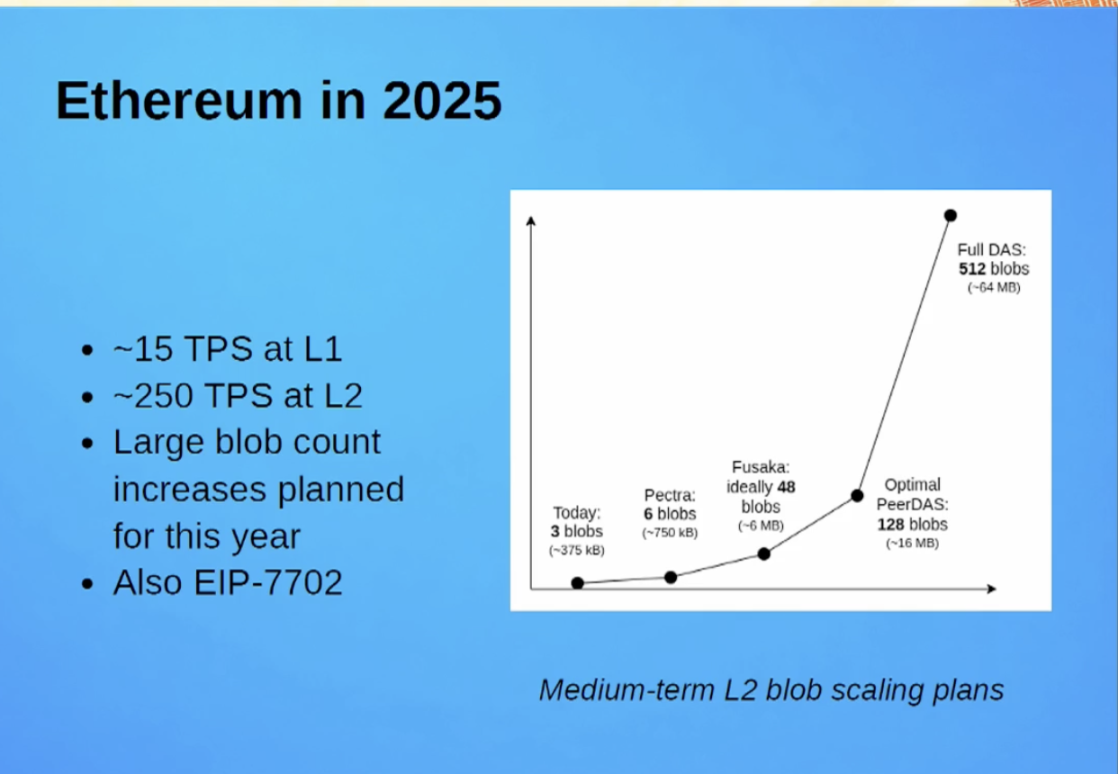
The upcoming Pectra upgrade will increase blob capacity from 3 to 6. Currently, 3 blobs amount to around 375KB, generating 375KB of data every 12 seconds—approximately 20KB per second, corresponding to roughly 250 TPS. With blob capacity doubled to 6, TPS could reach 500. However, further blob scaling heavily depends on the Fusaka upgrade expected in Q3 or Q4 this year. Under ideal conditions, Fusaka could scale blob capacity up to 48; if full DAS is eventually implemented, blob capacity could reach as high as 512, potentially enabling Ethereum L2 TPS to soar into the tens of thousands.
In addition, EIP-7702 has made substantial progress—it represents essentially the first step toward account abstraction, enhancing both account intelligence and security.
Nonetheless, scaling Ethereum L1 remains essential. Even if users widely adopt L2s in the future, L1 must still fulfill critical functions. Especially when L2s fail, L1 needs to provide remediation mechanisms or support large-scale user withdrawals.
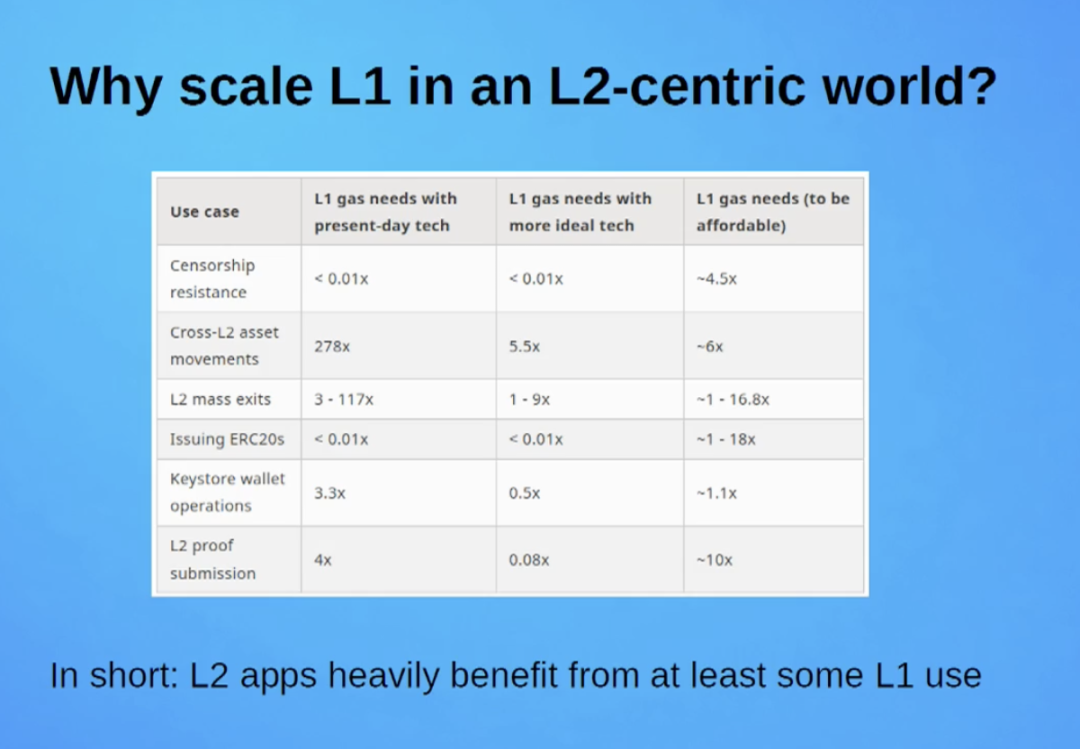
This means that despite rapid L2 development, improving L1 scalability remains crucial for censorship resistance and cross-L2 asset transfers. So what changes might result from further expanding L1?
-
Scaling technologies used on L2 can also be applied to L1 in the future;
-
L2 leverages the asymmetry between production and verification—a concept L1 itself can adopt;
-
In such a scenario, what roles would L2s play? 1) Hyperscaling (exceeding native DA capabilities); 2) Sequencing (lower latency, MEV protection...); 3) Different virtual machine (VM) designs.
In other words, L1 can learn from L2 scaling techniques, while L2 continues focusing on hyperscale transaction processing and experimental adoption of new technologies.
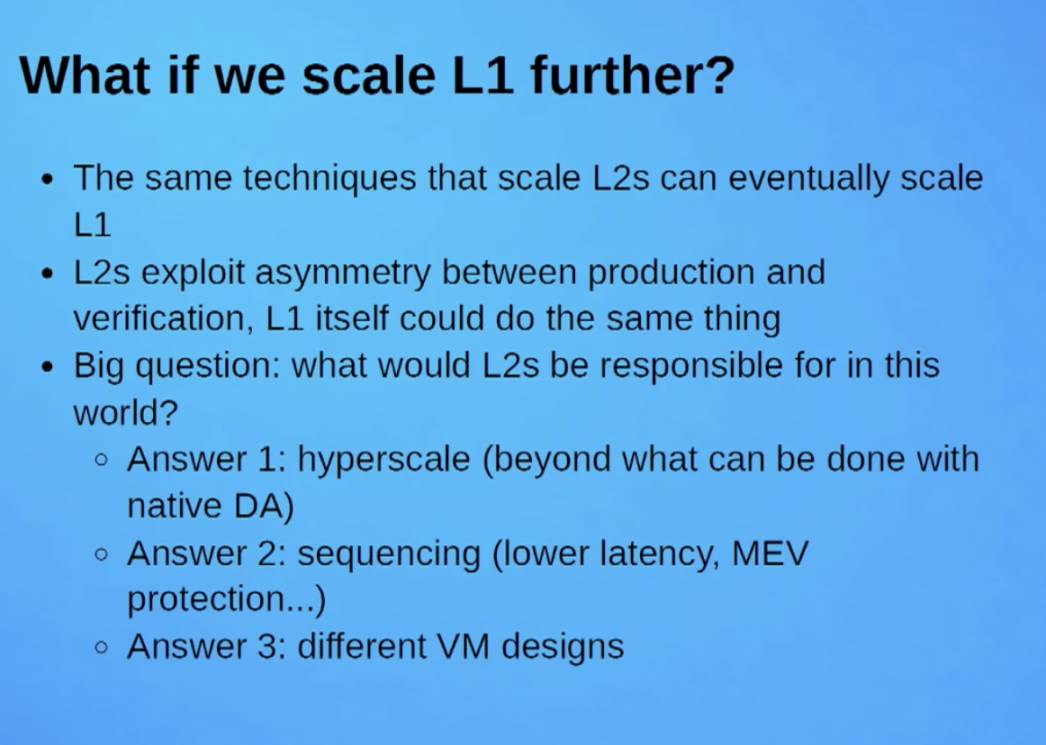
Vitalik stated that in short-term planning, a series of proposals are expected to roll out by 2026. These aim to significantly raise Ethereum’s gas limits while ensuring node decentralization remains intact and secure. Proposals currently under consideration for the 2026 roadmap include:
-
Block-level access lists (enabling I/O parallelization);
-
Deferred execution;
-
Multi-dimensional calldata gas pricing;
-
Repricing;
-
EIP-4444 (Historical Data Expiry): Removes the requirement for every Ethereum node to store full historical records, instead using peer-to-peer networks to distribute historical data storage more efficiently;
-
FOCIL.
Vitalik also summarized the advantages enabled by account abstraction:
-
Enhanced security and user experience;
-
Quantum resistance;
-
Paymaster: Allows others to pay your gas fees, or enables payment in tokens other than ETH;
-
Native support for smart contract wallets;
-
L1 leadership with L2 following.
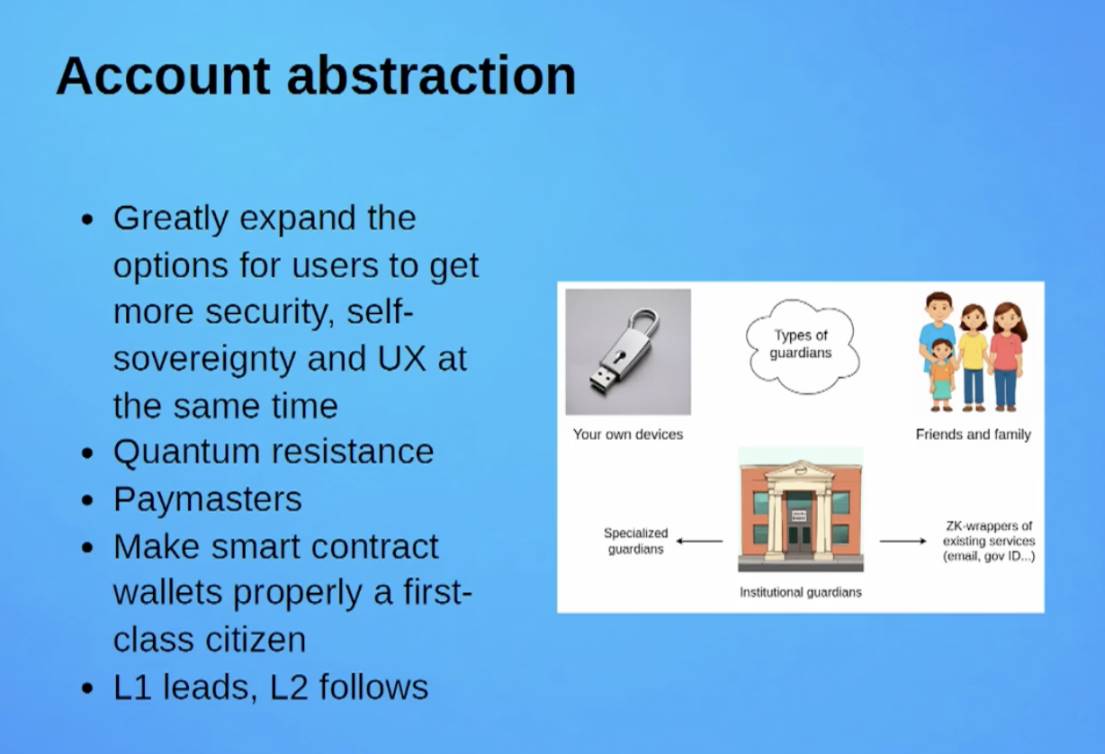
Furthermore, through technologies like Social Recovery and Guardians, Ethereum will offer more decentralized solutions for identity verification and asset control.

In other areas, Ethereum is actively exploring enhancements in L1 privacy features, EVM upgrades, protocol cleanup and simplification, improved quantum resistance at the consensus layer, optimization of protocol security and simplicity, and reduction of slot time.
Overall, we need to improve both L1 and L2, rethink Ethereum’s diversified development—including AI-based approaches—and enhance application layers to truly advance the Ethereum ecosystem. Ethereum is striving to fully prepare for mainstream mass adoption, with the ultimate goal of establishing Ethereum L1 as the core of a “world computer,” securely and efficiently supporting diverse applications.
Join TechFlow official community to stay tuned
Telegram:https://t.me/TechFlowDaily
X (Twitter):https://x.com/TechFlowPost
X (Twitter) EN:https://x.com/BlockFlow_News
 @VitalikButerin






