Why is Wyoming's multi-chain stablecoin WYST facing skepticism from Republican colleagues?
TechFlow Selected TechFlow Selected
Why is Wyoming's multi-chain stablecoin WYST facing skepticism from Republican colleagues?
The Wyoming Stablecoin WYST has entered the testing phase across multiple blockchain networks, but following the announcement, the project has faced scrutiny from senior Republican politicians, sparking concerns over Wyoming's development of a CBDC (central bank digital currency).
 Navigating Web3 tides with focused insights
Author: Weilin, PANews
At the DC Blockchain Summit in March, Anthony Apollo, Executive Director of the Wyoming Stable Token Commission, hosted a special fireside chat with Wyoming Governor and Commission Chair Mark Gordon. Apollo officially announced that the Wyoming stablecoin (WYST) has entered testing across multiple blockchain networks, calling it the first stablecoin in the United States issued by a public entity, backed by fiat currency, and fully reserved.
The commission plans to launch WYST on publicly visible blockchains including Avalanche, Solana, Ethereum, Arbitrum, Optimism, Polygon, and Base. These initial, valueless test tokens have already been deployed on testnets in collaboration with token issuance partner LayerZero.
Nonetheless, the initiative has since drawn skepticism from senior Republican politicians, sparking concerns about Wyoming establishing a CBDC (central bank digital currency).
Wyoming Takes the Lead: First Public Entity Stablecoin in the U.S.
The Wyoming Stable Token Commission was established in March 2023 under the Wyoming Stable Token Act, tasked with issuing stable tokens fully backed by state law and fiscal responsibility. Its mission is to enhance financial transparency through blockchain innovation while driving economic growth.
In an official statement, the commission noted that LayerZero’s OFT (Omnichain Fungible Token) standard and its extensive experience in secure smart contract development provide a robust, scalable, and compliant solution that meets the legislative requirement for a multi-chain stablecoin.
As part of the initial tests, Stargate—a third-party cross-chain bridge supported by LayerZero—conducted a demonstration transaction of WYST between the Ethereum and Avalanche testnets. The OFT architecture of WYST means it can be bridged via any compatible interface—Stargate being just one example.
During the fireside chat, Governor Gordon emphasized Wyoming’s commitment to transparency and innovation, highlighting blockchain technology’s potential in building secure and efficient financial ecosystems. “We’re excited to share Wyoming’s vision of state leadership here in the nation’s capital,” said Gordon. “Our forward-thinking approach to blockchain and digital asset legislation has made Wyoming not only a model for other states but also for the federal government.”
Gordon added that WYST offers several advantages: it must be over-collateralized with cash and U.S. Treasuries to reduce “depegging” risk, and the interest earned from Treasury holdings will be directed to the state’s education fund, creating fiscal returns. WYST is expected to undergo testing until the end of Q2 2025, with an official launch planned for July of that year.
According to the commission’s official website, both leaders combine deep expertise in finance and blockchain. Mark Gordon has served as Governor of Wyoming since November 2018 and has signed over 30 pieces of legislation related to cryptocurrency, blockchain, and digital assets. He previously served as Wyoming State Treasurer (2012–2019). Anthony Apollo was appointed the commission’s inaugural Executive Director in September 2023, bringing extensive experience from traditional finance (KPMG, EY) and the blockchain industry (ConsenSys, Rensa).
Notably, Cynthia Lummis, a U.S. Senator from Wyoming, is also a strong advocate for a national Bitcoin strategic reserve.
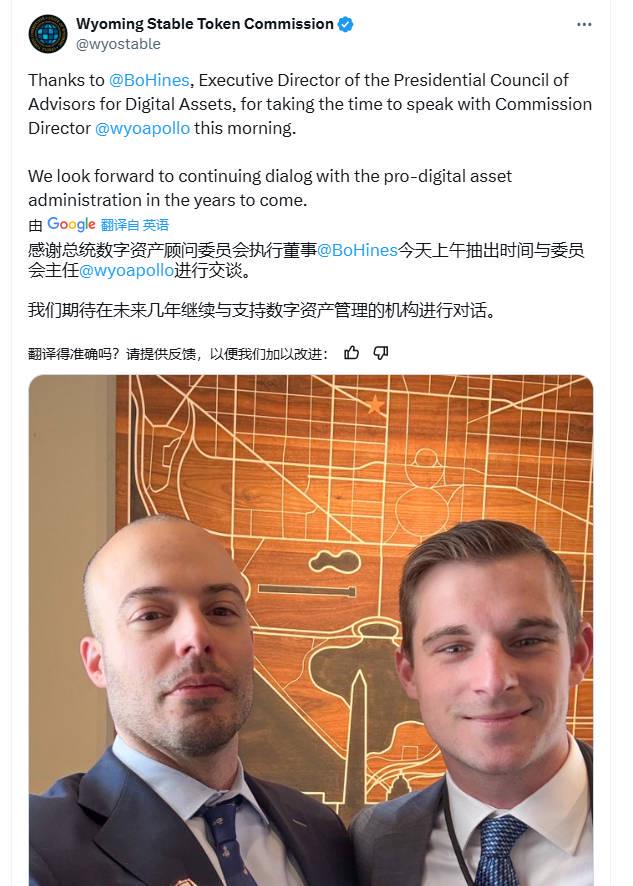
On March 27, the Wyoming Stable Token Commission’s X account shared a photo of Executive Director Anthony Apollo with Bo Hines, Executive Director of the Presidential Working Group on Digital Assets, captioned: “We look forward to continuing dialogue with governments supportive of digital asset management in the years ahead.”
Stablecoin or CBDC? Commission Faces Backlash from Republican Peers
Although the commission stresses that WYST is not issued by a central bank and is fundamentally different from a central bank digital currency (CBDC), the project has received cautious treatment within Republican circles.
On March 27, shortly after the latest update on the WYST plan, House Majority Whip and Republican Tom Emmer unusually criticized a fellow party member’s initiative.
“I respect the people of Wyoming and their vote, but I personally strongly oppose any government tokenizing its currency,” Tom Emmer told the media. “At the federal level, this would be considered a central bank digital currency.”
A central bank digital currency (CBDC)—a digital version of a nation’s fiat money—has become one of the most feared “monsters” among Republican politicians in recent years. Republican governors and former President Trump have both committed to banning CBDC development in the U.S., citing threats to user privacy. Unlike decentralized crypto assets, CBDCs are issued and managed by central authorities, enabling capabilities such as freezing and tracking funds. Critics argue they lack censorship resistance and could be used by governments to interfere in personal finances.
In response, Apollo firmly rejected equating WYST with a CBDC. He stated he also opposes the concept of a nationally backed CBDC, but emphasized that WYST is a fundamentally different product. “Wyoming values privacy greatly,” Apollo said. “We will establish rules defining exactly what data we can and cannot collect, how we handle it, and how we act upon it.”
“Wyoming is not a central bank,” Apollo added. “We are not issuing any cash.”
Still, Apollo acknowledged that the question “Is WYST equivalent to a CBDC?” is frequently raised by the public and legislators alike. Within Wyoming itself, the issue remains sensitive. Just weeks earlier, Governor Gordon had signed a bill banning CBDC development within the state, clearly expressing the state government’s opposition to “controlled digital currencies.”
A Pioneer in Crypto Legislation: Proactively Embracing Bitcoin, Four Key Bills Introduced This Year
Wyoming is no stranger to attention for blockchain legislation. Over the past decade, it has consistently advanced pro-digital asset laws. Since 2019, the state legislature has passed more than 30 related bills. This year, pro-crypto lawmakers have introduced four key proposals:
HB 201: State Investment in Bitcoin
Introduced by Republican Representative Jacob Wasserburger, this bill would allow up to 3% of state treasury funds to be invested in Bitcoin, aiming to position Wyoming ahead of potential federal adoption. Although the bill ultimately did not pass, Wasserburger said he intends to continue pushing for related education and legislation.
HB 256: Establish Blockchain Special Committee (Not Passed)
HB 264: Ban CBDC
Proposed by Representative Daniel Singh, this bill aims to prohibit state agencies from accepting CBDC payments or using taxpayer funds to build CBDC infrastructure, clearly expressing Wyoming’s resistance to CBDCs.
HB 308: Crypto Frontier Act
The final major crypto-related bill is another proposal by Singh. HB 308 would authorize the state Attorney General to “investigate specific instances of federal overreach involving blockchain or cryptocurrency.” Aligned with the goals of Singh and Wasserburger, the bill seeks to strengthen the state’s ability to operate digital currencies without federal interference. However, the bill has not yet been considered for introduction in the House.
For now, despite controversy surrounding WYST’s test deployment, the initiative holds significant experimental value at the state level and poses a challenge to the federal government’s path forward on CBDC and stablecoin regulation.
On one hand, Wyoming is demonstrating through action that stablecoins need not be controlled solely by private institutions—state governments can also build compliant, publicly accountable digital currency products. On the other hand, the project forces a critical question: Where exactly lies the boundary between public stablecoins and CBDCs?
In the coming months, WYST will continue running on testnets and gradually open to external audits and public evaluation. Can it become the first successful example of a state-level “on-chain dollar” in the U.S.? The answer will impact not only Wyoming, but potentially the entire trajectory of digital currency development in America.
Join TechFlow official community to stay tuned
Telegram:https://t.me/TechFlowDaily
X (Twitter):https://x.com/TechFlowPost
X (Twitter) EN:https://x.com/BlockFlow_News
 PANews