Bitcoin Standard 3: Escaping the "Inflation Trap," Returning to "Time as the Standard"
TechFlow Selected TechFlow Selected
Bitcoin Standard 3: Escaping the "Inflation Trap," Returning to "Time as the Standard"
True scarcity has never been metals, paper money, or gold reserves, but rather our time that can be freely disposed of.
 Navigating Web3 tides with focused insights
Author: Daii
Following weaker-than-expected February PCE data, Bitcoin's price dropped below its 200-day exponential moving average—a key support level. The loss of this critical threshold has once again cast the market mood into the shadow of a "bear market," as shown in the chart below.
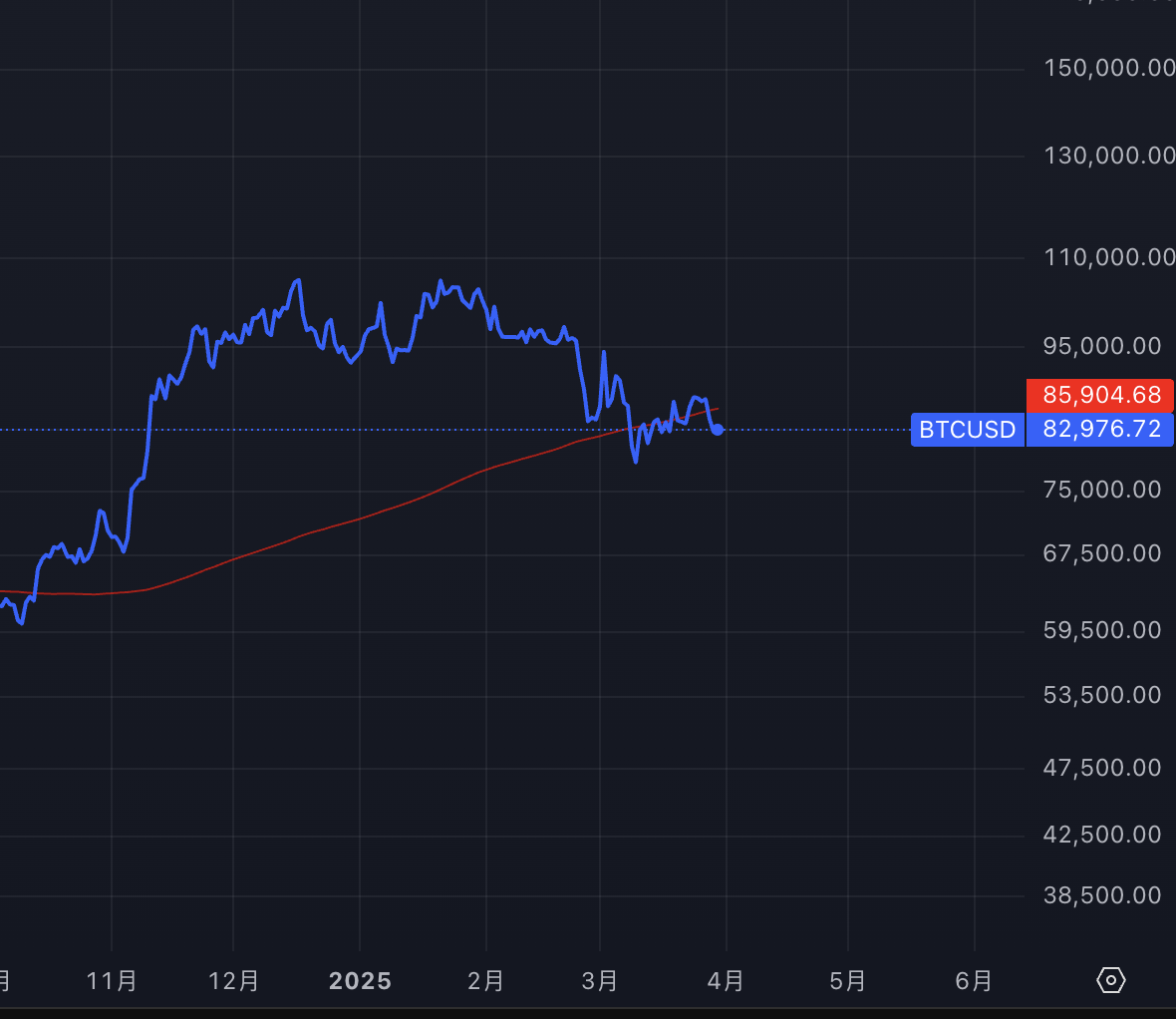
Facing price corrections, fluctuating rate hike expectations, and heightened short-term volatility, many are now asking: “Have we reached the end of another cycle?”
But if you're willing to lift your gaze from price charts and adopt a longer-term, more macroscopic view of Bitcoin today, you might realize:
Market turbulence does not mean faith is shaken; price pullbacks do not imply logic has failed.
In fact, we’ve simply grown accustomed to an order that seems “normal”: money printed by nations, managed by banks, and fine-tuned by experts—where inflation is treated as a “lubricant” for economic growth.
Rarely do we pause to ask a fundamental question: When we measure time, store effort, and plan our futures using currency that is constantly being diluted, what exactly are we trusting?
From the immovable stone wheels deep in the Pacific Ocean, to the glass bead traps of colonial Africa; from the collapse of silver empires, to gold’s growing vulnerabilities amid space mining and nanotechnology; to the U.S. dollar’s century-long “global legalized inflation experiment”…
This article will take you across dimensions of civilization, technology, finance, and geopolitics, revealing a recurring trap:
The real danger isn’t deflation or inflation—it’s mistaking “currency” for the foundation of order itself.
And as money collapses repeatedly before power, could there be a new anchor? A value system that doesn’t rely on violence or trust, but operates solely through time and mathematics?
That answer may very well point toward Bitcoin.
1. Echoes of History: The Fall of Monetary Empires
From stone money to silver, from Africa to the East, from tribal societies to imperial rule—nearly every rise and fall of a monetary system hides a collapse of trust. And each collapse correlates closely with one metric: the Stock-to-Flow Ratio (S/F). Therefore, it’s essential to first understand what the Stock-to-Flow ratio is—an indicator that will be referenced repeatedly throughout this piece.
1.1 What Is Stock-to-Flow Ratio?
In simple terms, the Stock-to-Flow ratio measures the existing total stock (stock) of an asset versus its annual new production (flow). You can think of it as: “How many years would it take to double the current supply?”
For example:
-
If a currency has a stock of 100,000 tons and annual production of 1,000 tons, its S/F ratio is 100:1;
-
If a currency has a stock of 50,000 tons but adds 10,000 tons annually, its ratio drops to just 5:1.
The higher this number, the “rarer” the asset; the lower, the easier it is to replicate quickly—and thus, the more prone it is to devaluation.
You can remember its essence like this:
The Stock-to-Flow ratio measures how much a currency “respects the future.”
This metric isn’t just the bedrock of hard money—it’s the measuring stick for understanding every historical monetary collapse discussed here.
Next, we’ll use this “measuring stick” to re-examine three classic cases of monetary collapse: from Yap Island stone money, African glass beads, to the silver tragedies in modern China and India.
1.2 Yap Island Stone Money: When Dynamite Shattered a Thousand-Year Faith
In the remote Pacific lies Yap Island, where residents used massive limestone discs—Rai stones—as currency. These stone wheels (shown below), up to four meters tall and weighing several tons, didn’t need to be physically moved. Ownership was transferred simply by communal recognition.

This bankless, paperless “ledger-based monetary system” functioned stably for millennia, thanks to one golden trait: scarcity. Since these stones had to be quarried from distant islands and transported back via canoe—a costly, labor-intensive process—their annual issuance was extremely low, giving them an S/F ratio as high as 100:1. As stated in *The Bitcoin Standard*, this is the crucial metric upon which sound money depends.
That changed in 1903 when an American trader named O'Keefe arrived with dynamite and steamships. Using industrial methods, he increased stone production 300-fold in a single year, collapsing the S/F ratio to 3:1. In one explosion, a thousand-year-old trust system vanished. Rai stones transformed from a “public ledger” into worthless rocks.
This episode teaches us: a currency’s credibility doesn’t come from appearances, but from the difficulty of its creation. When anyone can easily “print” money, even the most sacred form becomes valueless.
The next monetary crisis won’t require explosives—just a machine, a mold, or a factory.
1.3 African Glass Beads: An Industrial Civilization Crushes a Monetary Experiment
A similar fate struck West Africa. Locals once used “slave beads”—hand-blown glass beads crafted by Venetian artisans (see image below)—as currency. Due to their beauty and scarcity, they held strong purchasing and store-of-value functions, with an S/F ratio reaching 50:1.

But with the Industrial Revolution, Europe began mass-producing beads on mechanized assembly lines, increasing annual output ten millionfold. Colonizers brought these cheap beads to Africa, exchanging them for vast lands, minerals, and even human freedom. It’s estimated that 40 tons of glass beads bought 200,000 square kilometers of Congo. This wasn’t trade—it was colonization; not equal exchange, but monetary slaughter.
When technology shatters the illusion of scarcity, money becomes a tool of plunder.
The next victim was silver.
1.4 The Silver Trap: Monetary Slaughter in the Age of Globalization
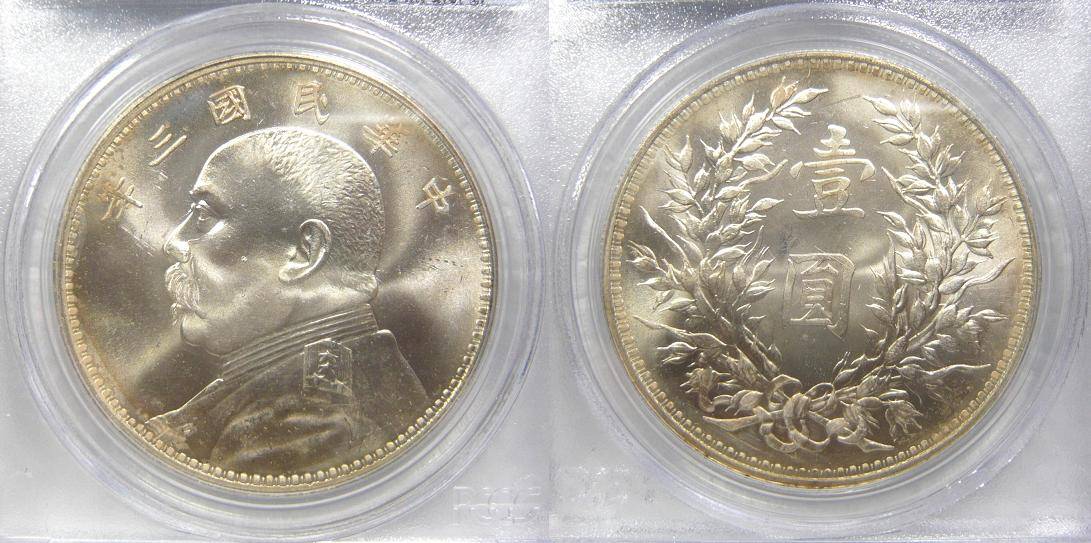
In the late 19th century, an invisible silver storm swept the globe. Between 1870 and 1900, global annual silver production surged from 1,500 to 6,000 tons, pushing the previously stable silver standard into collapse.
In this monetary disaster, China and India suffered most deeply:
China’s silver purchasing power plummeted 78% over 30 years. Merchants and farmers went bankrupt; private wealth evaporated. By 1935, China was forced to abandon the silver standard and launch fiat currency reform.
India’s rupee depreciated 56% against the British pound—effectively a “blood transfusion” from colony to colonizer, plunging Indians into poverty and debt.
*The Bitcoin Standard* emphasizes: the root cause of monetary collapse isn’t price volatility, but the loss of monetary “hardness.” Silver’s softening didn’t just destroy savings—it handed two ancient civilizations over to the iron boot of financial colonialism.
You might wonder: Could gold, whose price is soaring today, be next? Later, you’ll get a clear answer: yes.
1.5 Summary
From stone wheels to beads, from silver to paper money, we see a startling pattern: any currency with uncontrolled issuance will eventually collapse—it’s only a matter of time.
What’s truly consumed isn’t the currency itself, but people’s labor, time, and hope.
Currency is more than a medium of exchange—it’s the bridge between people and their future. If that bridge collapses overnight, long-term planning, saving behavior, and social order disintegrate with it.
Inflation is civilization’s invisible butcher; scarcity is the lifeline of hard money.
So, what is truly scarce in this world?
2. Scarcity Isn’t Resources—Is It Time?
Why does money “devalue”? Why do all “high-inflation countries” eventually face social unrest? To solve these puzzles, we must step beyond balance sheets and interest rate curves and examine a deeper variable: scarcity.
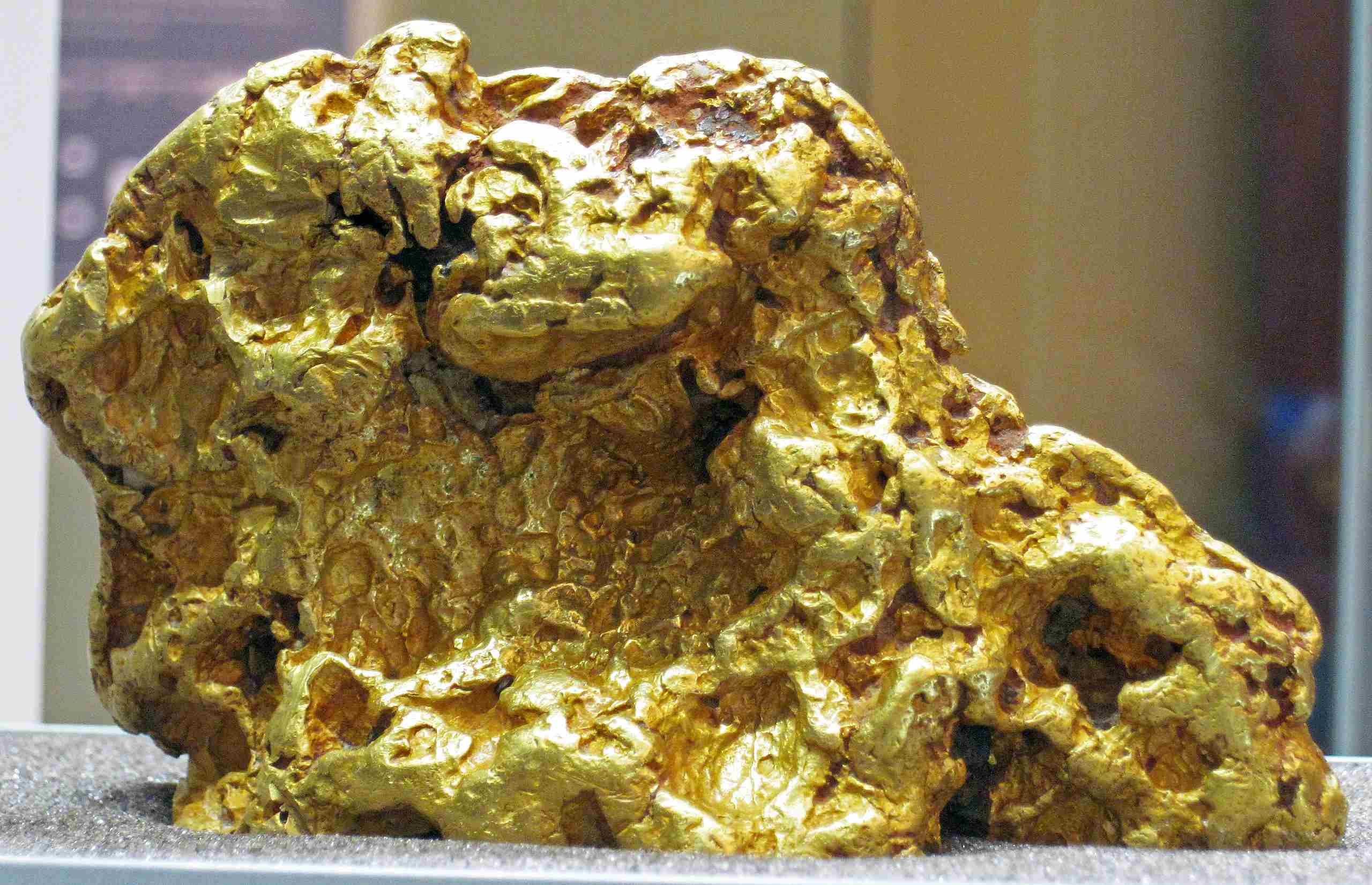
Take gold. Many believe “gold is valuable” because it’s “too scarce.” But did you know? Earth’s crust contains roughly 60 trillion tons of gold—enough for 8,000 tons per person.
What actually limits gold’s supply isn’t geological scarcity, but the amount of human time required to extract it. On average, producing one ounce of gold involves processing 30 tons of ore, consuming 100 cubic meters of water, and deploying heavy machinery and skilled labor.
As Julian Simon put it: the only true scarcity is time invested in production.
In other words, gold isn’t “naturally scarce”—it’s “artificially scarce.” When you store value in gold, you’re really relying on the trust that others will spend time mining it. Once technological progress lowers that barrier, gold’s value foundation becomes precarious.
And this “technology → inflation” curse isn’t hypothetical—it’s history’s destiny.
Looking back, nearly every once-dominant currency—stone tools, copper coins, silver, even fiat money—follows the same logic chain:
Technological advancement → lower extraction cost → supply surge → inflation → loss of trust
Take copper: between 1845 and 1873, copper prices crashed 80%. Not due to lack of demand—but because steam-powered mining equipment became widespread, causing annual output to flood like a dam burst.
In the 21st century, deep-sea drilling allows humans to extract copper from 4,000 meters underwater, increasing theoretical reserves a thousandfold. Copper’s historical role as money is now gone forever.
Thus, any currency relying on “physical scarcity” enters a death spiral once technology breaks through.
Now that we’ve discussed gold, let’s apply this theory to predict its future.
3. Gold’s Dilemma: Crisis in the Space Mining Era
For two thousand years, humanity has used gold as the ultimate “hard currency,” largely because it’s “hard to mine.” Unlike shells, paper, or glass beads, gold requires mines, labor, and equipment to slowly extract.
But have you considered whether this logic still holds in the space age?
3.1 Asteroid Mining: The Sword of Damocles Approaching
NASA estimates that a small asteroid called “Psyche” (shown below) may contain up to $70 quadrillion worth of metal resources—much of it gold and platinum.

$70 quadrillion? That’s fifty times the current global GDP—enough to buy every country, company, and property on Earth.
More importantly, SpaceX’s Starship program has reduced rocket launch costs to under $2 million—one-tenth the price of earlier systems. That means, once space mining matures, vast quantities of metal could be shipped back to Earth as routinely as vegetables.
If gold becomes as accessible as iron, can it retain its “store of value” status? Of course not.
Gold’s current S/F ratio is about 56:1. That means above-ground stocks are ~200,000 tons, with annual production around 3,500 tons—what we call “controlled scarcity.”
But if by 2070, humans begin returning 100,000 tons of gold annually from space, that ratio could crash from 56:1 to 2:1—or lower.
Now you understand why Bitcoiners claim it’s “harder than gold.” Gold’s scarcity could be technologically erased within your lifetime.
If gold can no longer rely on “difficulty to mine” for value, could “demand” stabilize its price?
3.2 Nanotechnology: Turning Gold Into a “Consumable”?
A gold investor might say: So what? Even if supply increases, demand will grow too.
This argument hasn’t always held in the past, but in the future—especially with nanotech and industrial catalysis—it could become reality.
As shown in the image of gold nanoparticles below, their stability and catalytic activity stem from electric double-layer structures and surface potential distribution. Such breakthroughs are driving industrial demand for gold. Gold is transitioning from a “store of value symbol” to an “industrial consumable.”
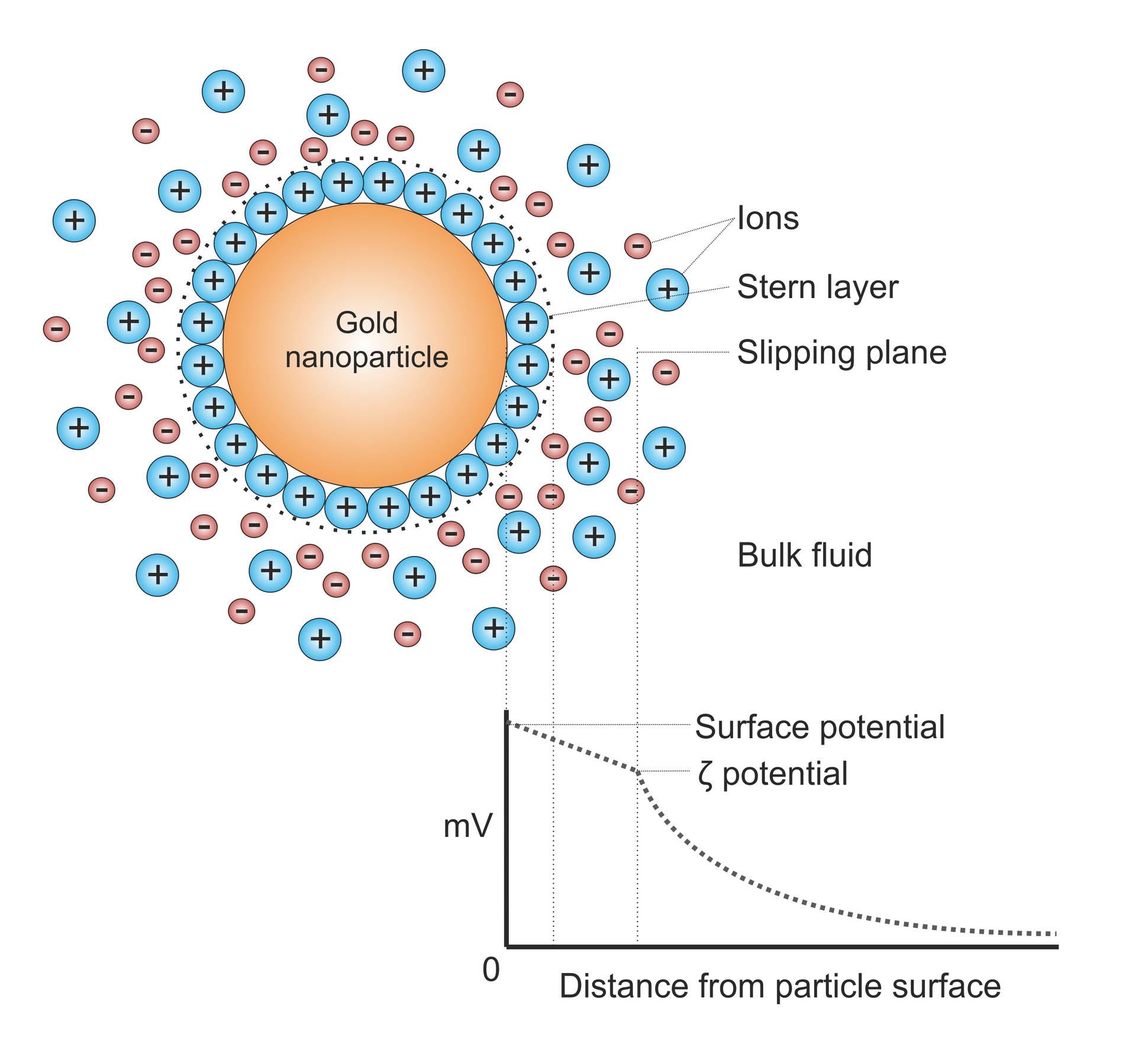
Today, one gram of gold can produce 500 square meters of nano-catalytic film, widely used in clean energy, medicine, and electronics. If this technology scales, global industrial demand for gold could jump from 4,500 to 12,000 tons annually—nearly triple.
And once gold is actively “used” instead of sitting idle in vaults or jewelry, it truly becomes a “consumable”—which sounds bullish, right?
Not so fast. There’s another factor:
Industrial gold recycling efficiency is skyrocketing.
For instance:
-
Gold used in electrocatalytic films;
-
Gold nanoparticles for drug delivery;
-
Thin gold layers in chips, sensors, and electrodes;
These are often fragmented, mixed, and embedded deep in products. Previously, recovery was prohibitively expensive and inefficient—often equivalent to “disappearance.”

But recently, with advances in micro-separation devices, novel low-temperature solvents, and even microbial gold extraction, industrial gold recovery rates are rapidly rising:
Recovery from high-precision electronics has improved from under 30% to over 90%;
Extracting gold from old phone circuit boards now costs 50% less, turning e-waste into a major “urban mining” source;
Modular recycling stations may soon enable local, rapid gold recovery from industrial waste.
What does this mean?
Industrial gold thought to be “consumed” never truly disappears. It’s merely hard to recover—for now. Once tech matures, it will flow back into the market in large volumes.
So when you see soaring industrial gold demand, don’t rush to conclude “gold will become scarcer.”
In the long run, much of this industrial gold is “borrowed,” not “burned”—and likely to return as future supply.
By now you should see: while industrial demand may grow, technology both accelerates mining and recycling—a double blow.
Thus, the decline in gold’s Stock-to-Flow ratio is inevitable—just gradual. And yes, gold will still outperform fiat currencies in value retention. That’s why its price appears to keep rising.
3.3 Geopolitics: Your Gold Reserves Aren’t Really Yours
Unfortunately, another blade hangs over gold holders: geopolitical risk.
Do you know where the world’s central banks store most of their gold? New York, USA. According to BIS data, about 60% of official gold reserves (~21,000 tons) are stored in the vaults of the Federal Reserve Bank of New York (see image below).
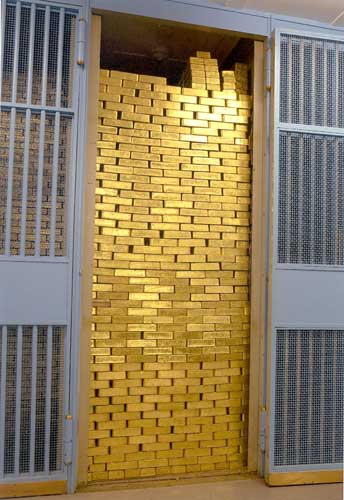
Yes, including portions of Germany’s, the Netherlands’, Japan’s, and even China’s early gold reserves—all “deposited” with the Fed.
What does this mean? In times of geopolitical conflict, the U.S. government could theoretically invoke the Emergency Banking Act (as in 1933) to freeze foreign gold reserves.
This isn’t speculative—it’s precedent. In 1971, Nixon closed the gold window, ending Bretton Woods. Don’t forget that.
Gold may remain strong for a while, but with advancing technology, it can no longer serve as a “forever-trusted” safe haven.
Next, we uncover the largest, most hidden inflation trap today: the U.S. dollar.
4. The Dollar Trap: A Crumbling Hegemony
The true force dragging the world into an inflation quagmire isn’t stone money, silver, or gold—but the name printed beneath “IN GOD WE TRUST”: the U.S. dollar. Note: the dollar is symbolic; others may be worse.
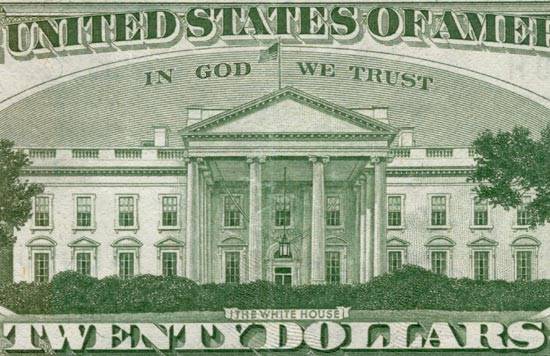
4.1 How Was Dollar Hegemony Forged?
In 1944, a conference dubbed the “Monetary Yalta” took place in Bretton Woods, New Hampshire. Representatives from 44 nations signed an agreement, handing control of the global monetary system to the United States.
The structure was simple yet brilliant:
All currencies pegged to the U.S. dollar;
The dollar pegged to gold at $35 per ounce.
In effect, the dollar wasn’t ordinary fiat—it was “equivalent to gold,” a global super-currency. America became the “Pope of Money,” wielding divine authority over global value.
Why did they dare? Because then, the U.S. alone held 75% of the world’s gold reserves (~22,000 tons, see arrow in image below), while Europe fought wars, Japan lay in ruins, and China faced turmoil.
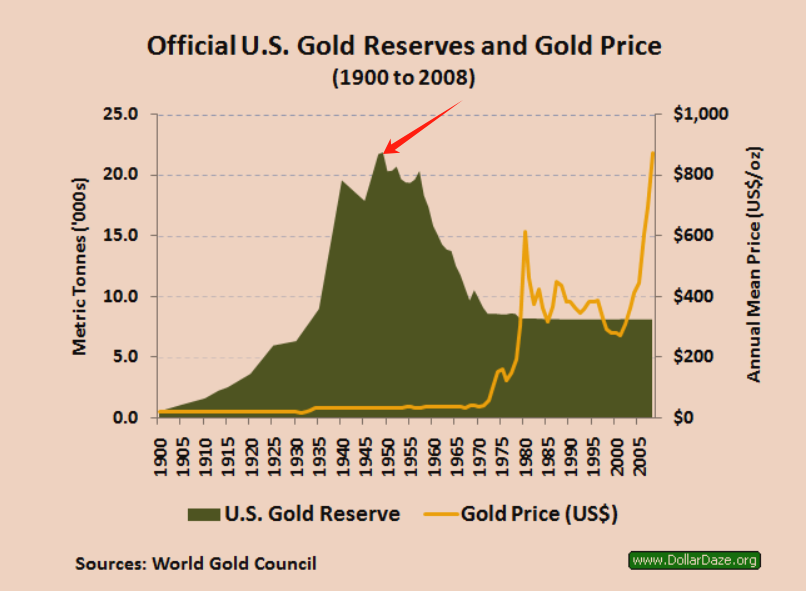
But how long could this “dollar equals gold” myth last?
Less than 30 years.
By 1971, rising overseas military spending and welfare costs drained U.S. gold—60% lost in two decades.
Finally, Nixon issued a decree: “Close the gold window.” The dollar detached from gold. The world entered the “fiat era”—your paper money now backed by nothing but one word: “trust.”
From that moment, the floodgates of inflation opened.
In 1971, global base money totaled $480 billion;
By 2025, it reached $200 trillion—an increase of 416x.
Did you think dollars were backed by “reserves”?
No. They’re backed by printing presses, national debt, and an increasingly devalued “future.”
4.2 The Four Pillars of Dollar Hegemony
Many assume the dollar’s strength stems from America’s economy. True—but superficial. The real pillars supporting dollar dominance are four financial structures.
The first pillar: Petrodollar System.
In 1974, the U.S. and Saudi Arabia struck a secret deal: oil must be priced in dollars. Thus, to buy oil, the world must first acquire dollars.
This turned energy into “dollar necessity.” As long as Earth burns oil, dollars will be demanded. In 2025, global energy trade hit $7.5 trillion—almost entirely fueling the “dollar liquidity pool.”
The second pillar: SWIFT payment system.
SWIFT connects 200 countries and 11,000 financial institutions—the world’s largest cross-border payment network. Its core servers sit in Belgium—but controlled by Washington.
In other words, the U.S. government can “ban” any nation from SWIFT. Not speculation—reality. Iran, Russia, and Afghanistan have all been cut off during crises, freezing their global funds.
The third pillar: Treasury bond markets.
Global central banks once held $7.5 trillion in U.S. Treasuries—59% of global forex reserves. It’s like every central bank collectively bought a “dollar insurance policy.”
Worse: the more who buy Treasuries, the more the U.S. can borrow, the more dollars flood the world—and the harder it becomes for anyone to exit.
The fourth pillar: over 1,000 U.S. military bases worldwide.
In 2023, U.S. defense spending hit $916 billion—more than the next 11 countries combined. Think it’s about security? No—it’s the “military collateral for the dollar.”
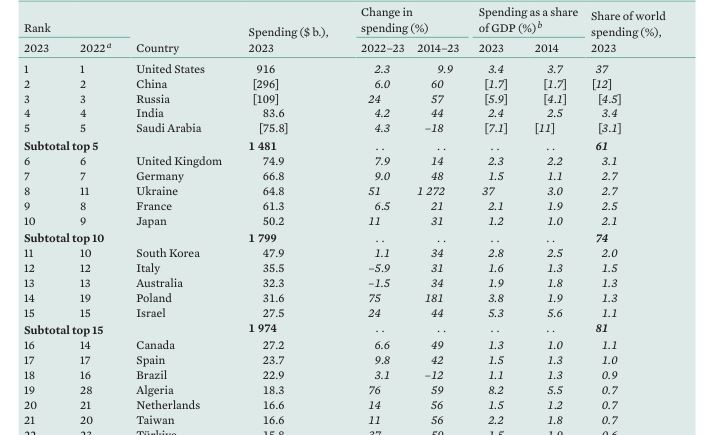
With these four pillars, dollar hegemony forms a maze locking the global economy—you see the way out, but cannot escape.
Yet now, cracks are forming.
4.3 Two Cracks: Tearing the Dollar’s Sacred Robe
Once, the dollar wore four armors—oil, SWIFT, Treasuries, and military—and seemed invincible. Now, this golden robe is splitting from two directions.
First crack: Debt addiction rotting from within.
By early 2025, U.S. federal debt surpassed $36 trillion—127% of GDP. Interest payments alone exceeded $952 billion, nearly matching military spending and approaching combined education and healthcare budgets.
The debt clock ticks upward by $40,000 every second. The Congressional Budget Office projects that by 2052, for every $3 in tax revenue, $1 will go to interest.
This isn’t debt management—it’s drinking poison to quench thirst, a national Ponzi scheme. When interest devours budgets and deficits become normal, how much credit remains?
Second crack: De-dollarization storm rising externally.
Once, central banks revered the dollar as the “final anchor.” In 2000, 70% of global reserves were dollars. By Q3 2024, that fell below 58%—and keeps dropping.
In 2023 alone, China sold $100.4 billion in Treasuries. Saudi Arabia, Brazil, India, and others are pushing local currency settlements, bypassing dollar channels.
Meanwhile, cryptocurrencies are emerging as “financial neutral zones.” By early 2025, global crypto market cap exceeded $2.8 trillion. More nations, firms, and individuals now use it to evade dollar-dominated sanctions and clearing systems.
This de-dollarization wave is no longer just geopolitical—it’s a triple convergence of tech revolution, financial decoupling, and sovereignty awakening.
When dollar usage is “forced,” not “chosen,” its hegemony begins to crumble.
4.4 Summary: The Dollar’s Self-Contradiction
Since detaching from gold in 1971, the dollar has walked a paradoxical path:
To serve as global currency, it must “flood” the world; but the more it floods, the more its credit dilutes, undermining its own dominance.
This is the core of the “Triffin Dilemma”: to maintain reserve status, the dollar must be exported; but the more it’s exported, the faster it collapses.
Everyone sees the game’s end—but no one dares exit first, because the dollar isn’t better—it’s the only option.
Until now, we finally begin to ask:
Is there a currency that needs no army, no state backing—running only on code and math?
Is there a currency that can finally break inflation’s endless cycle?
5. Bitcoin Breakthrough: A New Monetary Paradigm Under Mathematical Rule
We’ve exposed gold’s “future dilemma” and revealed the systemic cracks in dollar hegemony. Now you may ask: Bitcoin, without military protection or state endorsement—how can it break through using only code and computing power?
Let’s analyze step by step.
5.1 Code-Sealed Absolute Scarcity
There will only ever be 21 million Bitcoins. Not a “theoretical cap,” but a physical reality hardcoded into the protocol.
It uses SHA-256 encryption: a block is mined every 10 minutes, with Bitcoin rewards halving every four years until approaching zero.
What does this mean?
Even if Earth had 1,000 Federal Reserves and 100 million miners, no one can create the 21,000,001st Bitcoin. For the first time in history, a currency’s “issuance rate” is untied from human greed—linked only to time itself. Thus, Bitcoin is humanity’s first time-anchored currency.
5.2 Quantum-Resistant Security Walls
Many worry: Will quantum computers make Bitcoin obsolete? Can they crack private keys and seize control of the chain?
The tech community has debated this for over a decade. The answer is clear: First, Bitcoin’s security isn’t based on individual keys, but on the network’s “collective verification.” Even if a quantum computer cracks a private key, as long as the coin hasn’t moved, the network will automatically reject the transaction.
Second, the Bitcoin community already has “quantum-ready” upgrade plans, including Lamport signatures, multi-sig protections, and key rotation mechanisms.
Crucially: to successfully execute a “51% attack,” an adversary must simultaneously control over half the world’s mining hash rate.
As of February 2025, Bitcoin’s global hash rate reached 954.16 EH/s—95.4 quintillion cryptographic operations per second (see chart below).
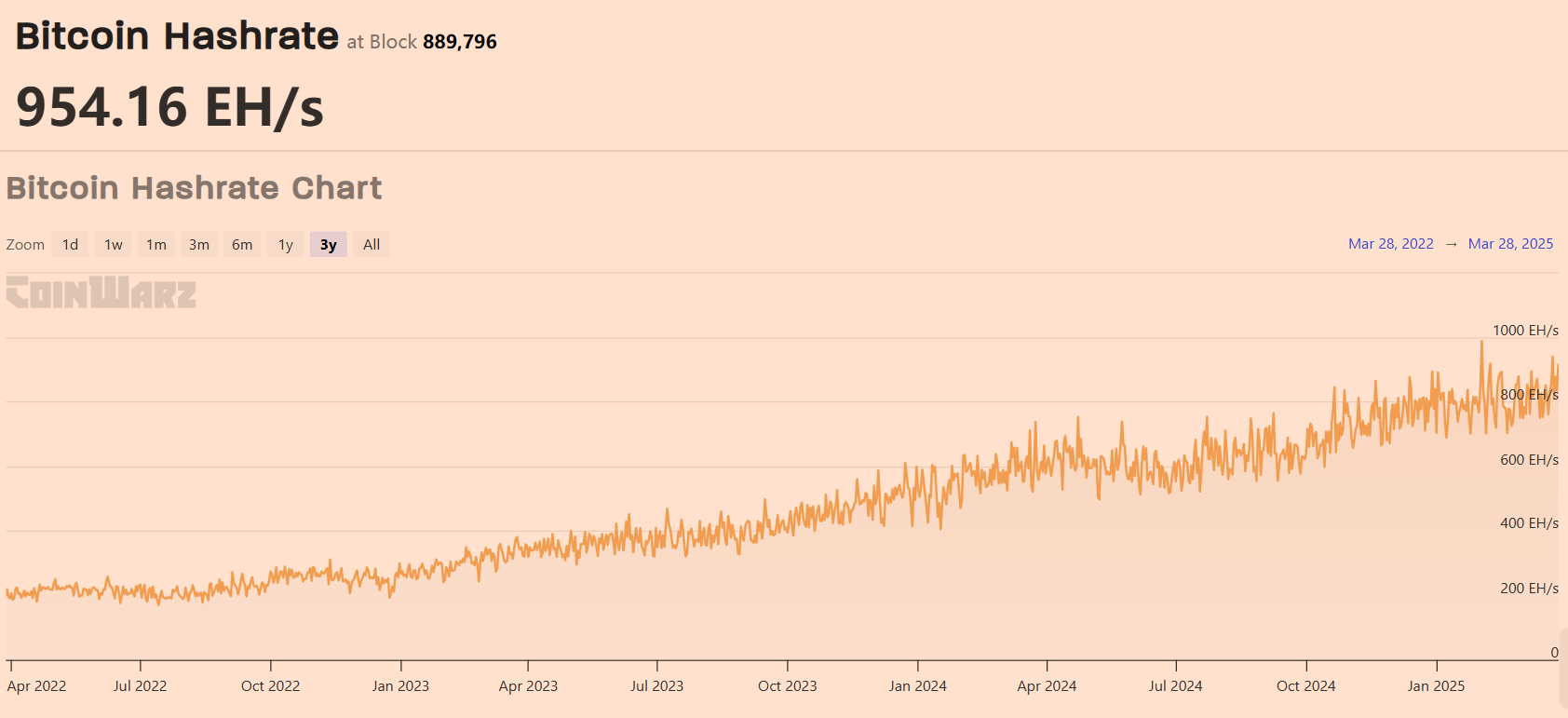
To launch such an attack, the attacker would need over 477 EH/s of dedicated computing power.
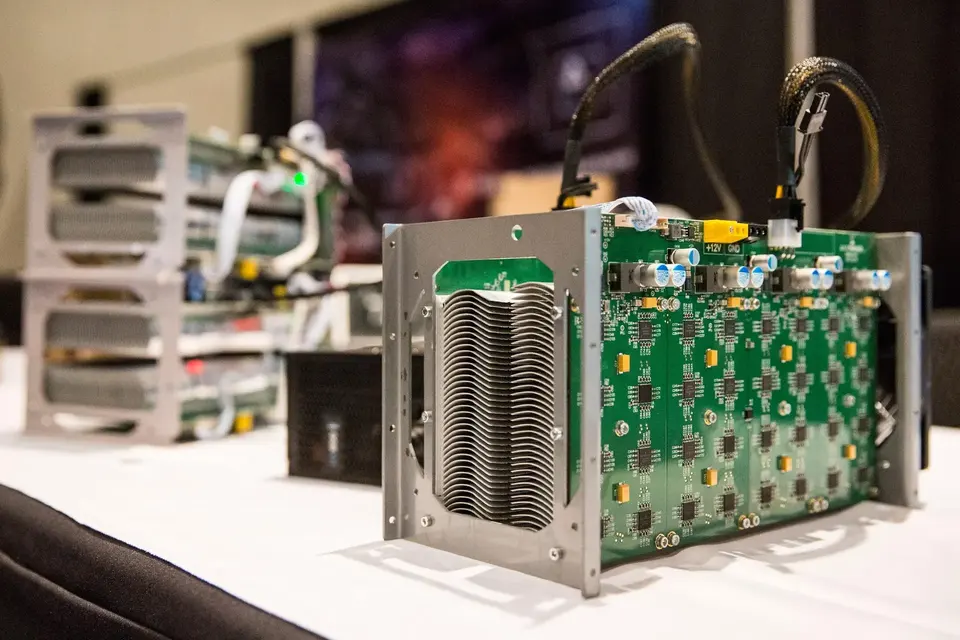
How big is that? Even combining all the world’s supercomputers couldn’t handle a fraction of this specialized hashing work. Bitcoin relies on thousands of ASIC miners, each performing trillions of SHA-256 operations per second.
Bitcoin isn’t invincible—but it’s strong enough that you don’t even need to trust it for it to work.
5.3 The Immortal Gene of a Distributed Network
Recall how Russia’s banking system nearly collapsed when expelled from SWIFT. Recall how Afghan bank accounts froze overnight after regime change, leaving the treasury empty.
Bitcoin was designed precisely to withstand such “centralized failures.” It’s decentralized—no headquarters, no kill switch, no single authority. Over 21,600 nodes span more than 100 countries; the mainnet code is open-source, verifiable, copyable, and shareable by anyone.
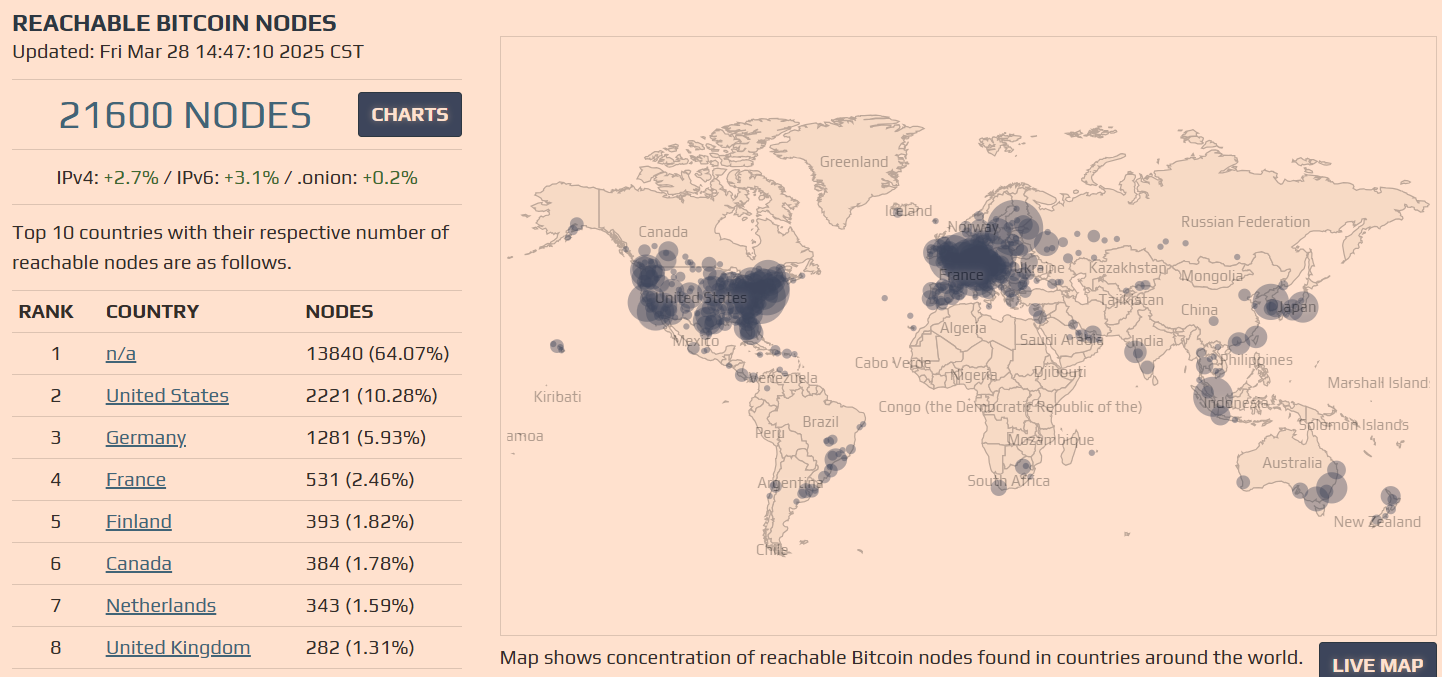
You say it’s not money? Perhaps it’s more like a living organism—a free entity existing across the internet and time.
It needs no military convoy, no bank custody. Just a private key, and you hold your entire wealth, anytime, anywhere.
5.4 A Time Machine That Revives Saving Behavior
High inflation breeds short-term thinking: today’s money loses value tomorrow—why not spend it now?
Bitcoin does the opposite. Because it’s deflationary, scarce, and leaderless, it fosters a rare mindset: willingness to wait. Bitcoin holders often choose to “hold long-term,” like planting a seed and waiting for it to grow. Data shows over 65% of Bitcoin hasn’t moved in over a year—many addresses untouched for “a decade.”
This is Bitcoin’s greatest achievement: it’s not just an investment, but a value vault, a reverser of time preference.
5.5 Summary: Bitcoin Isn’t the Answer—It’s the Starting Point
Bitcoin isn’t perfect. It suffers price volatility, ongoing technical evolution, and immature institutional frameworks. But it represents the closest approximation to an “ideal money” humanity has ever seen:
-
Its supply is unchangeable, immune to political will;
-
It has no issuer, no confiscator;
-
It cannot be inflated, nor vanish with war or regime change;
-
It’s portable, globally transferable, permissionless and trustless;
-
It rests not on “state credibility,” but on “math and consensus.”
From Yap stone wheels, African glass beads, silver storms to dollar hegemony—we’ve repeatedly placed hope in power and trust, only to watch them collapse.
Bitcoin is the first time we’ve grounded money in code, time, and transparent rules.
Conclusion
True scarcity has never been metal, paper, or gold reserves—but our freely disposable time.
Bitcoin isn’t perfect, but it offers a possibility:
No reliance on governments, no reliance on trust—only rules and transparent time consensus.
In an era where inflation is glorified, debt indulged, and wealth silently stolen, we need not just the courage to resist monetary traps, but a monetary philosophy aligned with time.
This is the core thesis of *The Bitcoin Standard*:
Return to time-based value. Escape the inflation trap.
This revolution in economic order may have only just begun.
And we—are witnesses, perhaps also choosers.
Join TechFlow official community to stay tuned
Telegram:https://t.me/TechFlowDaily
X (Twitter):https://x.com/TechFlowPost
X (Twitter) EN:https://x.com/BlockFlow_News
 @yzdxs8